






41. Lecture I
MS 122: September-October 1866
Ladies and Gentlemen
I address you upon an exceedingly dry subject which I cannot hope to make entertaining; but the great importance of which to everyone who is to use his mind at all ought to render it interesting. I shall be obliged to call upon you for an exertion of intellect which is unnecessary in a popular lecture upon any subject which presents less unity or depends less upon long trains of thought; but I think that for the sake of the object to be gained you will be willing to make the effort, and I refuse to believe that a people as subtile as any under the sun and who promise to eclipse every nation since the Greeks in their genius for abstract studies should be generally unable to follow the necessarily complicated arguments of the Logician.
Logic is a much abused science. Like Medicine, Law, and in short any branch of knowledge which has important practical bearings, it is brought by its applications to an ordeal which is sure to make its shortcomings manifest. It is no more perfect than any other product of humanity and we have the same right to be dissatisfied with its present state that we have with everything else that we are in a condition to improve. But many persons not resting here, go so far as to say that it is utterly useless,—and since they do so while unacquainted with the present state of the science—they ought consistently to maintain that it never can be improved so as to be of any use.
This is one of those slashing judgments, so common with men who have not had the benefit of logical discipline. What is Logic? It is the science by which we are enabled to test reasons. Now to test anything there is a particular sort of facts which it is necessary to know. You can see for yourselves that this is so. There is a particular kind of knowledge which the man who examines flour to brand it with its value, and the man who examines a piece of paper money to tell whether it is
good, and the man who makes a chemical analysis of an unknown substance, all require. What kind of knowledge is this? There are many curious and important facts about flour which are of no consequence at all to the inspector of flour. What proportions of the chemical elements enter into the composition of the best flour, whether Nitrogen or Phosphorus ought to be present in large quantities, is of no practical moment to him. To the physician, these facts are of vast practical consequence, but of none at all to the inspector of flour. Because it is his business simply to discriminate and say what sort of flour it is that he has offered for his examination. It is the same with the bank-teller and the analytical chemist. The methods of making a good engraving and the precautions which have to be taken in printing from it are of little account to the former, nor do theories of the constitution of chemical bodies trouble the head of the latter. What each wishes to know with reference to that general class of objects which it is his business to test is, what are the different kinds of these things and what are the characteristic properties of each kind. The bank-note detector contains the science by which we test bank-notes and that consists in a classification of all bank-notes with an accurate description of each species. So with analytical chemistry; it is nothing but a system of classification of bodies; and the whole subject of chemical physics—the reason why in chemistry—is totally out of the analyst's line. And so you will find that it is a universal rule that to have a testing art we need no other knowledge than a classifying science. And accordingly, if we wish to be able to test arguments, what we have to do, is to take all the arguments we can find, scrutinize them and put those which are alike in a class by themselves and then examine all these different kinds and learn their properties. Now the classificatory science of reasons so produced is the science of Logic. And it is so obvious, that the research I have described, however difficult presents nothing transcending human power altogether; and that the possession of the resulting knowledge—so long as men are constantly erring in reasoning and so long as the scientific world is divided upon a question which it must call in logic to solve—would be very useful, that those who sneer not merely at this or that antiquated yet once valuable logic but at all logical studies whatever display an ignorance not only of what logicians have already accomplished but also of the very nature of the science itself.
But, indeed, few persons who have not had some special interest in the subject are at all aware of the immense progress which has been
made in the science during the present century. School-books are usually antiquated; and those who know nothing later than Whately, might as well judge Chemistry by the Shaw's Boërhaave or Lemery's chemistry which they find in their grandfathers' libraries as judge modern logic by that. And even the more recent works in our language, generally reflect the system of a learned but insular logician, who seems to have been impressed with no one later than the immediate disciples of Kant and who certainly ignored the now well-nigh universal views as well as those which these have displaced.
Logic is a very ancient science; it is 2300 years of age. It has been more constantly studied than any except Law, Medicine, and Divinity. It has always been pursued by men of learning principally. And it found its Newton, almost at its birth. In consequence of this the logic of one generation has been religiously handed down to the next, in almost every age, but since at the same time each age has taken its peculiar view of the subject, involving some necessary distinctions of its own, these being preserved after the conception of the whole subject which was their life has disappeared, and so the subject has gradually become encumbered with a great mass of useless subtileties; and those who have undertaken to dispense with them have not always been judicious in the selection of those they were to retain. This has been one cause of the contempt into which logic had fallen when the Kantian revival at the end of the last century took place.
Another thing which brought logic into disrepute was the fierce dispute of the nominalists and realists. No definite notion of the nature of the disagreement can be afforded by a brief statement. Suffice it to say that the Realists believed that there is really humanity in man, animality in animals, and so forth; while the Nominalists held that humanity, animality, and such terms, are merely words indicating the applicability to men, animals, et cetera, of their class appellations. The controversy seems to go back to the earliest times; in the middle ages it was begun in the 11th century and soon began to excite universal attention. At this time the dispute was a fourteen-sided battle; that being the number of different opinions enumerated by Prantl the historian of Logic, as having been held by different philosophers of that century. Afterwards, nominalism seems to have died out for a while, long enough to allow the hatching of a quarrel almost as bitter between the realists among the Dominican and Franciscan orders of monks. But in the fourteenth century, William of Ockham, the greatest of the Nominalists appeared
and the old controversy was excited again and raged with tenfold fury. The discussions of the learned doctors sometimes ended with black eyes and bloody noses; and even monarchs patronized one party or the other and protected it by the power of the state. All this has long ago passed away. It cannot be denied that differences still exist among logicians, and that the ingenious may trace in them a resemblance to those which divided the Doctors of the middle ages; but it is a most unwarrantable inference that these differences will never be reconciled, or that logic has not advanced even in reference to the points which these differences concern. No one can deny that great advances were made from century to century in the understanding of these points even during the middle ages; and at the present time a full understanding appears to be approaching us apace.
We have, at present, Formal logicians and Anthropological logicians. Anthropological logicians think that Logic must be founded upon a knowledge of human nature and requires a constant reference to the facts of human nature. Formal logicians believe that logic can be learned merely by the comparison of the products of thinking. For my part, while admitting that the greater array of talent is upon the side of anthropologists, I agree myself with the formal logicians.
We have seen that logic is a classificatory science by which we are enabled to test reasoning; and we have seen that all information as to the forces which produce things of any kind is quite irrelevant to the business of classifying those things. The inspector of flour does not care to know by what agencies wheat grows; nor does the analytical chemist need to find by what processes the substances which he examines are manufactured. No more, then, does it concern the logician by what mental process arguments are produced. This is the simple but decisive argument which my reason approves and which all that bears upon the subject in my experience as a student of logic confirms.
Let us suppose, for example, that the opinion of James Mill be adopted that all inference arises merely from the association of ideas. Here is one of those psychological facts which Stuart Mill thinks has a great bearing upon logic. But would such a fact make any argument good which we had hitherto supposed to be bad? Not at all. Does it make any argument bad which we had hitherto supposed to be good? Not at all. Does it alter the degree or character of the belief we ought to repose in any inference, when certain premisses have been admitted? Not at all. Does it afford any new characteristic by which we can distinguish
good reasoning from bad or what we should believe in one mode from what we should believe in another? It does not. Then I say that however true and important the discovery may be, it has nothing to do with logic whatsoever.
I shall add but two remarks upon this subject. 1st That I admit some anthropological facts have a great bearing upon logic; but unfortunately they are facts which are supported only by the science of logic itself and cannot therefore constitute its foundation, and 2nd that it seems to me the anthropological theory has gained support principally from a belief that formal logic cannot give an account of the most important reasonings of any; those, I mean, by which we advance in science. I hope to show you in subsequent lectures that this is quite a mistake. That kind of inference, namely Induction and Hypothesis, or judging of the whole by a part, and of the cause from its effect, will be the special subject of this course.
We must begin, however, with the simplest kind of argumentation—that which is called Deductive reasoning—or as we may call it reasoning from preconceived ideas—that which traces out what is implicitly involved in what we already admitted. Few errors are made by any but the most careless reasoners in this kind of argument; and it may seem, therefore, not worth studying but the more difficult kinds of inference cannot possibly be understood without a thorough knowledge of Deduction.
Here is the simplest sort of argument there is:—
All men are free agents
All rational creatures are men
∴ All rational creatures are free agents.
Let us study this argument a little. Remember, it is this argument only which we have to consider. We do not estimate the arguments by which the premisses are established. Let those be good or bad; we consider only the inference from these premisses when admitted of this conclusion. Of course this argument is good. It consists of two propositions besides the conclusion. The first proposition All men are free agents is a general rule. The second All rational beings are men, puts a case under that rule; in logical language, it is the subsumption of a case under a rule. I shall use this term subsumption often; it means the statement considered as stating that something belongs to a certain
class. But you must learn the exact shade of meaning by practice. When we said that all men are free we actually stated that men belong to the class of free beings but it was not necessary to consider that rule in that way; we might regard it as attributing a certain quality to men. When, however, we say that all rational beings are men, it is necessary -in order to draw the inference-to observe that rational beings are said to be denoted by that word-or what is the same thing, put under that class-which forms the subject of the general rule. The first proposition, then, is a rule, the second the subsumption of a case; the conclusion is the assertion of the action of that rule in that case, in other words of the result of that rule.
I now propose to study the conditions of the validity of this argument by comparing it with others which differ from it in a single respect and yet are bad reasonings. In the first place, suppose that instead of saying that All rational creatures are men we say that they are women; so that the argument reads
All men are free agents
and All rational beings are women
Here we have no argument at all, nothing follows from those premisses.
It is essential therefore that the subject of the rule should be the predicate of the case. These must be identical not merely in external aspect but in their meaning; otherwise we shall fall into the greatest absurdities. We could prove a miser to be poor by saying
Whoever has not enough is poor
A miser has not enough
∴ A miser is poor.
But here he who has not enough has two different meanings in the two premisses; in the first it means he who has not enough to satisfy his needs, in the second he who has not enough to satisfy his wishes. So the subject of the rule and the predicate of the case must really be the same.
Let us replace men instead of women, then, in the subsumption of the case and suppose that we say Some men are free agents; All rational creatures are men; here again nothing follows. If we do not assert the rule of all it is not a rule. Some need not deny all; it means some at
least; but still if the rule is not asserted of all, no conclusion follows. A servant who was carrying up a roasted stork to his master for dinner, was prevailed upon to take off the leg and give it to his sweetheart. The master unfortunately noticed the deficiency and asked him what had become of the other leg. O, said he, storks have but one leg. The master was so astonished at the impudence of this, that he said nothing at the time but took the servant out to walk the next day to find a stork. Presently they saw one, standing on one leg as storks always do with the other drawn up. There, said the servant, I told you they only had one leg. Hereupon the master flung a stone at the stork who immediately put down the other leg and flew away. Yes, said the servant, but master you didn't fling a stone at that stork Yesterday. The servant thought the master's argument a bad one. He understood him to reason thus:-[Slow]
Storks who have stones thrown at them have two legs by nature
The bird at dinner yesterday was a stork
∴ The bird at dinner yesterday had two legs by nature.
Now, he says, storks who have a stone thrown at them are not all storks but only some storks:-and it does not follow because
Some storks are two-legged
and That bird was a stork
That that bird was two-legged.
The man did not apprehend the full nature of the master's argument; his objection was unsound but ingenious and based on a truth of logic. The rule then must assert of all not of some. In logical language it must be universal, not particular. Universal means predicating of all; particular, predicating of some.
We can say:-
All men are free agents
Some rational beings are men
From these premisses it will not follow, that All rational beings are free agents but it will follow that Some rational beings are free agents. The case, or subsumption of the case, then, may be particular as well as universal, only if it is particular the result will be particular. As we express
it, the result agrees in quantity with the case; that is, agrees with it in being universal or particular.
On the other hand, suppose we leave the case universal, but make it negative; thus
All men are free agents
No rational creatures are men
Here nothing follows. The case, then, must be affirmative, not negative. It is different with the rule; we may say
No men are free agents
All rational creatures are men
and this will be a good argument; only the result will be negative when the rule is negative. As we say, the result agrees in quality with the rule; that is agrees with it in being affirmative or negative.
The rule then is universal; the case, affirmative; the result agrees in quality with the rule and in quantity with the case. We can formulate that in this manner.
Let A stand for a Universal Affirmative proposition as All X is Y. I for a Particular Affirmative, E for a Universal Negative, O for a Particular Negative. These abbreviations have been used, thus, for 800 years; and their usefulness is incontestable. They are supposed by some to be derived from the vowels of πᾶς τὶς οὐδέν and οὐ πᾶς words used by the Greek logicians to denote the four kinds of propositions. Others think they are the first two vowels of affirma and nego. I shall ask you to remember the meaning of the four vowels, whatever may be the origin of it.
Now then; as the rule is universal it is either A or E. As the case is affirmative it is either A or I; and as the result agrees with rule in quality and the case in quantity it is A E I O as the lines indicate. So that the three propositions are either A A A, A I I, E A E, or E I O. These have been made the vowels of four words.
Barbara, Celarent, Darii, Ferio.
These words are constructed by merely throwing consonants in with the three significant vowels so as to make a euphonious combination. Just as we could treat the notorious sophism of the French minister
Lavilette in his recent circular, thus. The argument is All Europe is at peace, A; Some time must elapse without war, I; hence No expense should be spared to raise an army, E. And filling it up we have LAVILETTE. So that we might call an argument of that peculiar form a Lavilette.
I shall now take up another syllogism, quite different from those we have considered:—
All men are free agents
Some rational creatures are not free agents
∴ Some rational creatures are not men.
This is, plainly, a good argument. It begins as the first did with asserting a rule. But, then, instead of going on to subsume a case under that rule, it denies the operation of a rule in a particular case; the consequence is that it must be denied-as it is in the conclusion here-that that case comes under the rule.
This is called the second figure of syllogism. Here as in the first figure the rule is universal, the case affirmative, and the result agrees with the rule in quality and with the case in quantity. Only as we proceed from the
Assertion of Rule
and Denial of Result
to Denial of Case
the first proposition is universal. As for the third, since a case is affirmative, the denial of a case is negative, therefore this conclusion must be negative, as it is in the example on the board. And as the result agrees with the rule in quality, the denial of the result must disagree with the rule in quality; that is the 2nd proposition must be negative if the first is affirmative and vice versa. And as the result agrees with the case in quantity, the denial of the result must agree with the denial of the case in quantity; that is the second proposition must be universal if the conclusion is universal. These principles will be plainer, if we take each mood of the first figure separately. First, then, we have  . Corresponding to this is a mood of the second figure. The rule asserted is the first
proposition in both first and second figures; the first A therefore will be repeated as the first proposition in the second figure. The second proposition in the first figure is the assertion of the case; while in the second figure the denial of the case is the third proposition. And the result which is the third proposition of the first figure, being denied becomes the second proposition of the second figure. So that to get the second figure from the first we transpose the second and third propositions and deny them both. I call that contraposing those propositions  . Now if we deny A—if we deny All X is Y—we say Some X is not Y—which is O. The denial of A then is O. So we have
  . In the same way from
  we have
  the denial of I—or Some X is Y—is No X is Y—that is E. So we get
  . From
  ,
,  and from
  , . Those therefore are the moods of the second figure.
Now we will take up another figure.
Some rational beings are not free agents
All rational beings are men
∴ Some men are not free agents.
This is the third and last figure. Here we begin by denying the result of the rule in the case in hand; but we assert that the case comes under the rule. It follows that the rule is not true. That is we reason from the
Denial of result
and Assertion of case
to Denial of rule
So that we have contraposed the conclusion with the other premiss-not contraposed in the second figure. In this figure as before the rule is universal, and therefore the denial of the rule is particular. The case is
affirmative. And the denial of the result agrees with the denial of the rule in quality and disagrees with the case in quantity. So we get
Now we may make a table of all the moods. At the top we will enter the proposition asserting or denying the rule. At the side the proposition asserting or denying the case. We will put the 2nd Figure in in red and the 3rd in blue chalk. We get
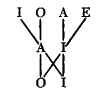
Now we may make a table of all the moods. At the top we will enter the proposition asserting or denying the rule. At the side the proposition asserting or denying the case. We will put the 2nd Figure in in red and the 3rd in blue chalk. We get
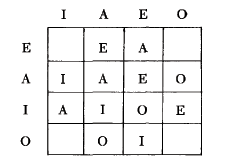
In this case the A's E's I's and O's will run in lines, symmetrically.
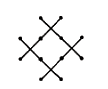
Those who know something of logic may perhaps think they catch me tripping in enumerating only 12 moods of the three figures instead of fourteen which is the number given in the books. I give four moods of this figure  derived by contraposition from the four
moods of the first figure. Logicians, generally, add  and
and  which would correspond to and in the second figure. I will give an example in words:—A A I is like this
All whales are mammals
All whales live in the sea
∴ Some mammals live in the sea.
This corresponds to the following syllogism in the first figure
No mammals live in the Sea
All whales are mammals
∴ Some whales do not live in the sea.
There can be no question that these syllogisms correspond. Nevertheless, although logicians reckon the additional two in the third figure they do not recognize the additional two in the first figure. This inconsistency has already been exposed by De Morgan. Both must be admitted or both rejected. Now it is plain that in saying All X is Y we actually say that Some X is Y. Hence the syllogism
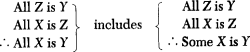
and upon the same priniciple, since the mood  differs from by one of the premisses of the latter expressing more, it is plain that this more which it expresses, does not help the argument, and therefore is irrelevant. And as plainly expresses since A expresses I, the former mood is not distinct from the latter but is a case under it. And it is the same
with . These are the reasons which lead me to apparently omit these two moods, which I maintain that other logicians count twice over.
Logicians like dictionary-makers copy one another's blunders. Knowing how easy it is to avoid an error they believe their predecessors have escaped errors; thus they fall into the technical fallacy of an ambiguous middle.
I now come to a question, the precise force of which it is difficult to convey. We have seen that it is the business of logic to classify arguments. It must, then, be important to ascertain how much difference there is between arguments. Now the question arises, are syllogisms in the three figures arguments of different kinds—is the manner of inference different and following different Leading Principles—or is there one principle applied to different premisses? No one will hesitate to admit that the differences between the four moods of each figure, differences resulting from affirmative and negative rules and universal and particular cases, are differences which affect the matter to which the principle of inference is applied and not that principle itself. It is true we usually speak of the moods as different forms of syllogism; but this is but a figure of speech, for I believe we intend to maintain only that the forms of their parts are different, not that the essential form of inference is different.
But when we ask the same question respecting the figures there is a difference of opinion among logicians; the greater body considering them as essentially different, while many of the best modern authors consider them the same.
In order to answer this question, I must call your attention to the orders of the terms subjects and predicates in the three figures. We have seen that the subject of the rule is the predicate of the case; that the subject of the result is the subject of the case; and that the predicate of the result is the predicate of the case. Accordingly if we just write the subject and predicate of each proposition without the is, is not, all, or some, we have in the first figure  This may represent any mood.
| All M is P | No M is P | |
| All S is M | or | Some S is M |
| ∴ All S is P | ∴ Some S is not P |
In the second figure the case and result are contraposed and we have  . In the third figure the rule and result are contraposed and we have
  Now you perceive that in the first figure the term which is contained in the two first propositions is the subject of the first and the predicate of the second, and of the other two terms one is subject twice and the other predicate twice. It is different with the second and third figures; in the second the term which is in the two first propositions is predicate of both; in the third figure the term which is in the two first propositions is subject of both. Now I shall show you that there are three ways in which the terms of the second figure and three ways in which the terms of the third figure can be transposed so as to give them the same arrangement which is found among the terms of the first figure.
Firstly, if the second and third propositions of the second figure are transposed we get the arrangement of the 1st figure and in the same way if the first and third propositions of the third figure are transposed we get the arrangement of the first figure. Now we know that these transpositions can be made if we deny both propositions, without destroying the logical sequence of the conclusion from the premisses.
Secondly, if the terms of the first proposition of the second figure are transposed we get where the subject of the first proposition is the predicate of the second and the other two terms are twice subject and twice predicate. The same result will be got in the third figure by transposing the terms of the second proposition from SM to MS. Now if we have any proposition MP we can always find another PM which means the same thing. And therefore syllogisms of the 2nd and 3rd figures can always be reduced to the first in this second way also.
Thirdly, if in the second figure, we transpose the terms of both the 2nd and third propositions so as to make them PS and MS and at the same time transpose the first and second propositions we have  which has the form of arrangement peculiar to the first figure. And in the same way, if we transpose the terms of the first and third propositions
of the third figure and at the same time transpose the two first propositions we have  which again is in the first figure. These transpositions also can always be performed.
I must apologize for taxing your attention so heavily but this subject is of greater importance than it seems. You perceive that there are three syllogisms in the first figure which are tantamount to any syllogism in either of the other figures. Now in order not to enter any further into technical details, which however curious are difficult to follow, I will state to you that in every case the equivalence of a syllogism in the second figure with a syllogism in the first figure depends upon the equivalence of
No X is Y and No Y is X
and the equivalence of any syllogism of the third figure with one in the first depends upon the equivalence of
Some X is Y is Some Y is X.
What sort of an inference then is it, from No X is Y to No Y is X? This can be thrown into a syllogistic form by means of the premiss All Y is Y; thus
No X is Y
All Y is Y
∴ No Y is X
This is the only way of putting this into syllogistic form and this is an inference in the second figure. Thus it appears that if every syllogism in the second figure is tantamount to one in the first, it is so only by virtue of an inference in the second figure. So that the syllogism in the second figure is not strictly equivalent to a syllogism in the first figure, but only to a syllogism in the first combined with one in the second figure. And in the same way the inference from Some X is Y to Some Y is X can be thrown into a syllogism only thus:
All X is X
Some X is Y
∴ Some Y is X
which is a syllogism in the third figure. So that a syllogism in the first figure cannot by itself replace a syllogism in either second or third figures, but can do so only when combined with another syllogism in the same figure as that of the syllogism which is replaced. This tends strongly to show that the three figures are essentially different forms of inference, although they certainly have this in common, that they all depend upon the possibility of inferring a result of a rule, from the rule itself, and the subsumption of a case under it.
The sort of syllogism which we have thus far studied may be called Aristotelean. We now come to a different kind which I shall denominate Theophrastean syllogism. An instance is this:—
No body heated by fire retains a constant temperature without consumption of fuel
but Some things which retain a constant temperature without
consumption of fuel are red hot
Hence, Some red hot
things are not heated by fire
It is very difficult to class such syllogisms. Theophrastus made them moods of the first figure; Galen is believed to have made them constitute a fourth figure. I should treat them as follows.
☞ Suppose we have 1st a Rule, 2nd a case under that rule which is itself a rule, and 3rd a case under that second rule. From the first rule and case under it one result will follow, while from the second rule and case a second result will follow: thus
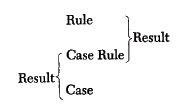
Or writing subject and predicate
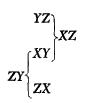
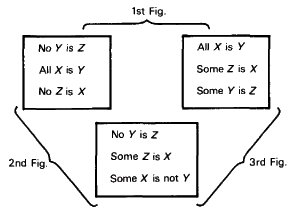
You perceive that the first result contains the same terms X and Z as the second case; and the second result the same terms Y and Z as the first rule. Suppose now that the first result and second case are incompatible, as well as the second result and first rule. It is plain then that of the three original propositions all cannot be true. Consequently if either two are asserted the third must be denied. Now the proposition which is both a Rule and a Case must be Universal Affirmative; Universal because a Rule, Affirmative because a Case. The 1st Rule is universal negative; universal because a rule, negative because a result from it which agrees with it in quality is inconsistent with a case. The 2nd Case must be Particular Affirmative; affirmative because a case, particular because a result from it which agrees with it in quantity is incompatible with a rule. Hence the three propositions are
No Y is Z
All X is Y
Some Z is X
Now if any two of these propositions are maintained, the third must be controverted. Suppose first that a rule and its case are maintained. Then the syllogism will belong to the first figure. This rule and case will be either the first and second or second and third propositions. So we have the two moods, as shown in the diagram on the next page.
If a rule is asserted and its case denied, there is a syllogism of the second figure. These two moods, one of which is identical with one of those of the 1st figure are these. If a rule is denied and its case asserted, the syllogism is of the third figure. Here again we have two moods, one of which is identical with one of those of the first and the other with one of those of the second figure. The reason why Theophrastean syllogisms of different figures can be identical is that they all involve those inferences from No X is Y to No Y is X and from Some X is Y to Some Y is X which make the essential difference between figures.
So much for the categorical syllogism. I have been forced to condense a vast field of study into this lecture and have therefore been as dry as any  digest
  must be; I trust the succeeding lectures will be less difficult to follow.
————
Two Examples.
Some statues are life-like
Some statues are uncolored
∴ Some uncoloured things are lifelike.
————
He who is most hungry eats most
He who eats least is most hungry
∴ He who eats least eats most.