












ON THE PHYLLOTAXIS.1
By Chauncey Wright,
ASSISTANT IN THE OFFICE OF THE AMERICAN EPIIHMERIS AND NAUTICAL ALMANAC.
§ 1. General Properties of the Phyllotactic Surds.
The fractions 1/2, 1/3, 2/5, 3/5, &c., each of which has a numerator equal to the sum of the two preceding numerators, and a denominator equal to the sum of the two preceding denominators, have been shown to be the successive approximations of the continued fraction
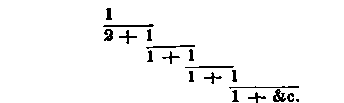
The value of this fraction is obtained from the expression
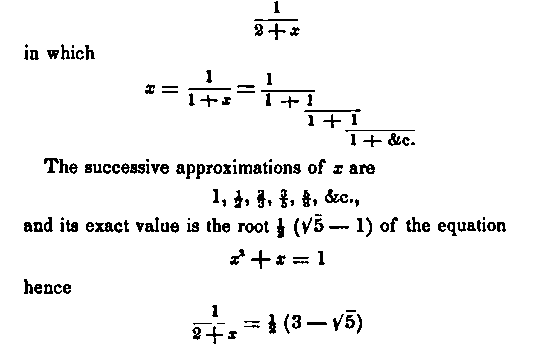
The sum of these two surds is unity, and the latter is equal to the square of the former; hence they divide unity in extreme and mean ratio.
The equation
x2 x = 1
becomes by transposition
x2 = 1 - x
which, in the form of a proportion, is
1 : x = x : 1- x
that is, x and 1 - x divide unity in extreme and mean ratio.
Again, by geometry, if the base of a right-angled triangle = 1, and its altitude = 1/2, the hypothenuse is 1/2 √5. Subtracting the altitude from the hypothenuse, we have remaining 1/2 (√5 - 1), and this subtracted from the base leaves 1/2 (3 - √5 ).
This process is the method in geometry of dividing a line in extreme and mean ratio.
If two quantities are in extreme and mean ratio, their sum is to the greater as the greater is to the smaller, or as the smaller is to their difference; hence the surds
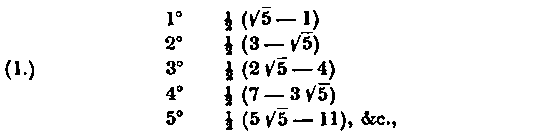
each equal to the difference of the two preceding, are in geometrical progression with the ratio of the extreme and mean proportion. The first term 1/2 (√5 - 1) is equal to the common ratio, which we will indicate by k; hence these surds are the successive powers of the first; that is

The reciprocal of each of these surds is obtained by changing the sign - to +, since the difference of the squares of the two terms within the parenthesis of each surd is equal to 4; moreover each surd may be represented by a continued fraction of the form

in which a is the rational term of the surd, and the signs are + for the odd surds, and - for the even surds; thus,
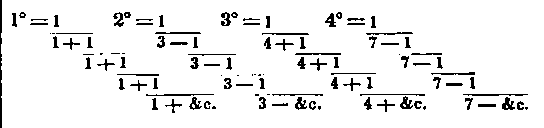
The odd surds 1°, 3°, 5°, &c., may also be expressed by continued fractions of the form
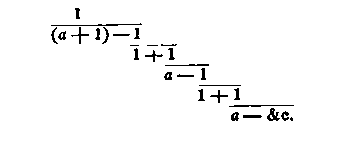
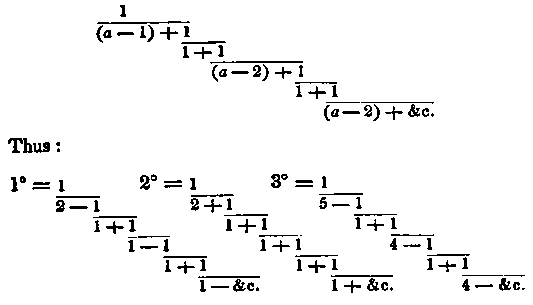
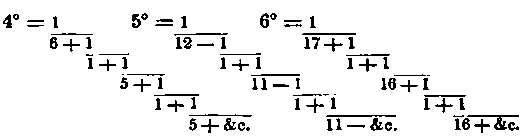
§2. Geometrical Properties of the Phyllotactic Surds.
1. If leaves be supposed to follow each other in succession around their axis, with the constant interval k between them, we have the typical arrangement from which other arrangements may be produced by variations following a very simple law. Let the radii of the following figures represent the directions of the leaves in their typical arrangement. The numbers at the ends of the radii indicate the order of the leaves.
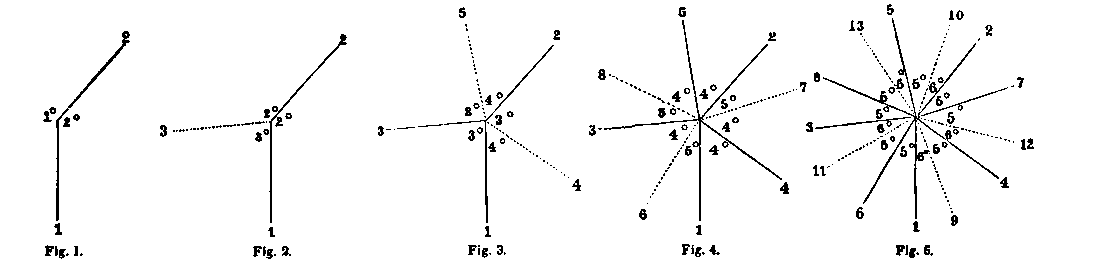
The leaves 1 and 2 of Fig. 1 divide the circumference into the spaces 1° and 2°, or into the fractions k and k2, and therefore in extreme and mean ratio. The leaf 3 of Fig. 2 divides the space 1° into the spaces 2° and 3°; the leaves 4 and 5 of Fig. 3 divide each of the spaces 2° into the spaces 3° and 4°; the leaves 6, 7, and 8, of Fig. 4, divide each of the spaces 3° into the spaces 4° and 5°; and the leaves 9, 10, 11, 12, and 13, of Fig. 5, divide each of the spaces 4° into the spaces 5° and 6°; — all in the same ratio, namely, that expressed by k. In general any leaf whatever, falling between two older leaves, divides the included space in extreme and mean ratio. This arrangement effects the most rapid and thorough distribution of the leaves around their axis.
If we consider each leaf as produced by that older leaf which stands nearest to it, we find that 1 produces 2, then 3, and then 4, while 2 produces 5; then 1 produces 6, 2 7, 3 8; then 1 9, 2 10, 3 11, 4 12, 5 13; then 1 14, 2 15, &c. Leaf 1 in producing 2, 3, 4, 6, 9, 14, &c., introduces successively, and alternately on its left and right, the intervals 1°, 2°, 3°, 4°, 5°, 6°, &c., which are the successive powers k, k2, k3, k4, k5, k6, &c. of the first and largest interval.
The suppression of any interval kn brings the leaf which introduces this interval over leaf 1, and produces one of the systems of arrangement expressed by the fractions
1/2, 1/3, 2/5, &c.
The interval 3° of Fig. 2 may be suppressed by moving back 2 one half, and 3 two halves of the interval 3°. This will give the alternate system expressed by the fraction

The suppression of interval 4° by moving forward the leaves 2, 3, and 4 respectively 1/3, 2/3, and 3/3 of the interval 4°, gives the system expressed by the fraction

In the same manner, the suppression of the intervals 5°, 6°, &c. gives the systems

If we subtract each member of these equations from unity, we obtain the following:

Certain anomalous forms of arrangement occur in nature, which cannot be expressed by any of the approximations of k. It has been shown, however, that all forms may be expressed by approximations of the fraction

in which m is an integer.
The distribution produced by this more general typical arrangement is, in effect, the same as that which we have
discussed; that is, the intervals 1°, 2°, 3°, &c. of this arrangement are in geometrical progression with the ratio of the extreme and mean proportion for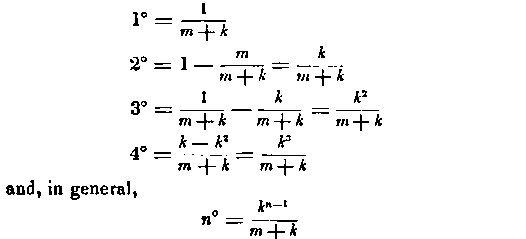
2. If the ratio of the mean motions of two planets be indicated by r, and if x represent the fraction of the circumference between two successive heliocentric conjunctions, then
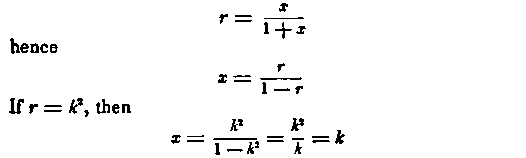
and if r be any one of the approximations of k2, 1/2, 1/3, 2/5, &c., then x is equal to the corresponding approximation of k; 1, 1/2, 2/5, &c.- Thus, if r = 2/5, x = 2/5 ÷ 3/5 = 2/3.
Since, as Professor Peirce has shown, the mean motions of the planets form a progression in which the ratios are nearly expressed by a series of phyllotactic fractions, it follows that the intervals between the successive conjunctions of neighboring planets are also expressed by these fractions, and that their points of conjunction are thus distributed around the sun as leaves are around their axes, in the several systems. If the ratio of the mean motions of two planets were exactly k\ their points of conjunction would be distributed in the most rapid and thorough manner.
The idea of thorough distribution (in the leaves of plants with reference to the formation of wood, and in the conjunctions of planets with reference to their mutual perturbations) seems to be a central thought or typical principle of these natural arrangements. Variations from the typical arrangement produce in plants specific forms of symmetry, while in the planets they fulfil conditions as yet imperfectly understood.
The progression of the mean motions ought not to be geometrical, lest through the common ratio there occur constant repetitions of the same configurations in the whole system of planets, which would cause their action through one another to be always of the same character.
The ratios of this progression, therefore, while each approaches the typical ratio k2, ought to differ as much as possible among themselves, and most for the larger planets; as in fact they do.
§3. The Phyllotactic Function.
Required the form of the function which by the substitution for the variable of the common series of numbers
1, 2, 3, 4, 5, 6, &c.
gives the phyllotactic series of numbers
1, 1, 2, 3, 5, 8, &c.
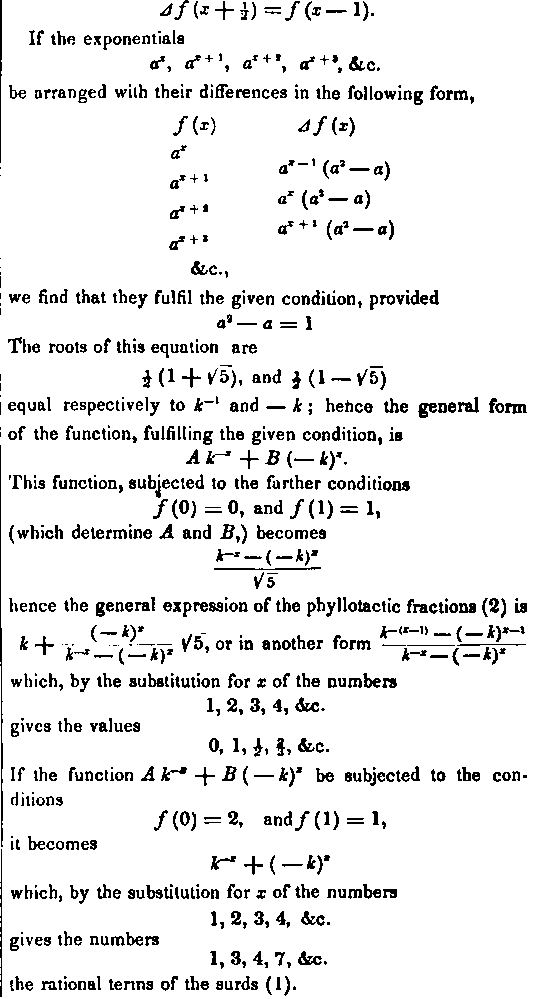
Each of the phyllotactic numbers is equal to the sum of the two preceding; hence the required function is subject to the condition