










The Letters of Horace Walpole [1771-1774]
1771
January
1336. To Sir Horace Mann.
Arlington Street, Jan. 15, 1771.
There seems to be a pestilence amongst our politicians. They go off by wholesale. The Duke of Bedford died last night; happily for himself, poor man! for he had lost his sight, and almost his speech and limbs. Sir Edward Hawke is only dead politically, having resigned from age and infirmities. The new Secretary of State, Lord Sandwich, succeeds him†1, and no man in England is fitter for the office. I do not know who will have the Seals. Lord Suffolk is most talked of, but, though young, he is all over gout. The Great Seal remains at nurse, and the changes in the law are still in suspense, like the Peace, which somehow or other has been strangely bungled. We might, I am persuaded, have had it two months ago. The opposition is in the last state of a consumption; Mr. Grenville's friends point due west to St. James's; Lord Chatham and Lord Temple have quarrelled, and the latter is retired. Lord Shelburne has lost his wife (our friend Lady Granville's daughter†2), acts the disconsolate husband, and is going
abroad; Wilkes and Parson Horne write against each other; Alderman Sawbridge is dying; and, in short, Lord Chatham, like Widdrington in Chevy Chace, is left almost alone to fight it out upon his stumps. So we must have a new world, start new subjects, or sink into a dead calm; for I think still that we shall not go to war.In France the scene seems thoroughly foolish. The Duke of Choiseul has lost his power ridiculously by braving a fille de joie, to humour two women†3 who seem to think 'qu'on ne doit pas être impunément putain, sans être grande dame.' He comforts himself, as everybody does in France that is in fashion, with being applauded, and with reading a million of epigrams against his enemies; not considering that he will be as much forgotten in a month as if he was the pattern of last year's coat. The cabal that drove him out are said to be divided; at least they had no arrangement ready. They have been dragging old lieutenant-generals out of garrisons to fill up state places, and cannot get enough even thence, or from hospitals; but are trying to furbish up ancient ministers and ambassadors to set forwards for ostensible minister. They have talked of Monsieur d'Ossun from Madrid, a Monsieur de Vergennes†4 who was at Constantinople, and even of the silly Cardinal de Bernis. The Chancellor, who is abhorred, seems to have most credit. The Duc d'Aiguillon, they say, is a little disappointed, but will have the affaires étrangères as soon as the Peace is made; but at present the Prince of Condé has much power with the King. In the meantime the thunders of Versailles have blunted themselves, and a composition is on foot with the Parliament, who are permitted not to register the last tempest. I do not think these new giants
will grow more tractable when Pelion and Ossa are lifted off their necks.So much for England and France. Yes, yes, it is a new world. The ancient dramatis personae are dead, or have quitted the stage. I shall continue for your sake to send you great outlines, but I cannot interest myself about a new race, when I have done with the theatre myself. What can occupy one less than a play-bill, when one scarce knows half the actors by sight? Not that I have that symptom of age, esteeming only the veterans one remembers. God knows, how few I admired of the old troop! neither Betterton nor Penkethman, Lord Hardwicke nor the Duke of Newcastle. I can easily expect their successors to play their parts better.
Princess Amelia, who is not of this age neither, was very near dying two days ago of a bilious fever.
Well, as we have closed a long period, pray send me my letters to the end of last year. I believe I have mentioned it once or twice. I should like to have them all together, for they are a kind of history--only think of eight-and-twenty years!
I will tell you what I must get you to send me, too, by the first opportunity, the Lettere Pittoriche; I am not quite sure of the title, but they are three, four, or five small volumes, in quarto, of the letters of the great painters. I saw the two first volumes some time ago at Paris, but could not get them; and as I have now finished the last volume of my Anecdotes of Painting, and intend, after it is published, to make a new general edition, I know there are passages in those Letters that I should like to insert in my work. My own letters you will take care to reserve for a safe opportunity, but the books I wish for immediately by sea. Adieu!
1337. To Sir Horace Mann.
Arlington Street, Jan. 20, 1771.
You will wonder to hear from me again so very soon. Yet I am not going to proclaim war, or announce peace; though I believe we shall, thank God, have the latter. We have not a new Secretary of State, nor any new death; but, in short, I am impatient to thank you for a present that I have received, and that you never mentioned having sent me. Sure it is not so insignificant! It is the volume of Masaccio's designs, brought by Mr. Coxe. I am transported with them! They are nature itself, and evidently the precursors of Raphael. He plainly availed himself of their dignity, but scarce reached the infinite truth of their expression. The action of the mouth in every head almost surpasses any other master, and seems to have been caught only by this. I did not remember these works. Oh! if there are more, make your Patch†1 give us all. I cannot be content under all. They are admirably touched and executed: he must engrave the rest; and there is one more work he must perform, too. I remember at Florence a very few pictures of Fra Bartolomeo, another parent of Raphael, and whose ideas I thought, if possible, greater: as there is such a scarcity of his works, and as they have never that I know been engraved, at least not so well I am persuaded as these by Patch, make him add them to another set of Masaccio's heads. It will immortalize you both to preserve such works. I am much pleased, too, with the caricaturas, that is, with those that are scarce caricaturas; for, you must know, I love truth; and those that are not extravagant are highly natural. Tell me more of this Patch; and, if you
have a mind to please me quite, send me a drawing by him of yourself, of your whole person, exactly as you are. Astley's head of you, though finely coloured, never satisfied me for likeness. Let me have your figure precisely, and as natural as the Crelia in Funzione. I am expecting Sir Joshua Reynolds, our best painter, whom I have sent for, to see some wonderful miniatures I have bought, and these heads of Masaccio. I think they may give him such lights as may raise him prodigiously. I must repeat it, the mouths, and often the eyes, are life itself. There is but one head I do not like; it is No. 22; and yet I believe it a portrait, but ill chosen. My dear Sir, do push on this work: let us have more of Masaccio, and all the few of Bartolomeo. The Great Duke will not refuse you a permission for Patch to copy them.22nd.
Obligations beget importunities. I must beg you to send me two more of Patch's volumes of Masaccio; but, as they are for other people, I must pay for them; so don't haggle, but tell me their price, and I will give your brother the money.
The Parliament is in the act of meeting; but, I should think, except a Mansfield-baiting, there will be little stirring till the Peace is made, and can be found fault with. Made, I hope, and think, it will be. For the vacancies, they are still at market. It is odd that just at the same moment, in France the Chancellor cannot make a minister, and in England the minister cannot make a Chancellor.
As this is a letter of supererogation, I make no excuses for its brevity. Adieu.
Tuesday, 22nd, in the evening.
I had sealed my letter, as you will perceive; and break it open again in a great hurry, to tell you the Peace†2 was
signed last night, and declared in the House of Commons to-day. You will ask the conditions: I don't know them yet, nor much trouble my head about them, but I could not help sending you this good news.My codicil must contradict half my letter. Lord Halifax is Secretary of State, and Lord Suffolk Privy Seal. Mr. Bathurst, Lord Keeper, en attendant his father's death to be Chancellor; De Grey, Chief Justice of the Common Pleas; Thurlow and Wedderburne†3 Attorney and Solicitor-Generals. There, I think I shall have no occasion to write again soon. Good night!
†1338. To Lady Mary Coke.
Arlington Street, Jan. 27, 1771.
I am extremely flattered, dear Lady Mary, by your sisters telling me that you complain of my silence--alas! I thought, surrounded by emperors and empresses, you could not think of or care for the letters of such little mortals as I. I imagined that I must write to you with all the formality of the Aulic Chamber. I had begun an epistle and put myself into one of M. de Seilern's most exalted altitudes, but my words came so slow, that I should not have finished before I hope you will return. By your kind reproof I trust you will allow me to descend from my Austrian buskins, and write in my usual style. I am [not], nor ever can be, altered towards your Ladyship; but, truth is, I feared your having become at least an Archduchess, and did not know, which would be a thousand pities, but your fair nose might
have risen half an inch, and your lips, which could never mend, have dropped and pouted with prodigious dignity at being addressed with a familiarity unknown to the house of Hapsburg. I am transported with finding you still the same, and could now almost trust you with the baneful influence of the Czarina. However, pray never think of making her a visit too. You have travelled enough, and ought to have the Magi come to see you, instead of wandering yourself after every star. I do not pretend, Madam, to tell you news, for Lady Strafford and Lady Greenwich leave none untold. One article rejoices me greatly, the Peace with Spain. I do not wish to conquer the world every ten years! Events happen here so daily, that we do not want battles and sieges for conversation; and yet I think politics are likely to grow a little drowsy. The deaths of Mr. Grenville and the Duke of Bedford have left Lord North in full security. Lord Temple takes no more part, and they say is even quarrelled with Lord Chatham. Wilkes and Parson Horne have a civil war between themselves, and nobody insists upon one's lighting up candles for either. Loo begins to yield to quinze--oh! I had forgotten: there are desperate wars†1 between the Opera in the Haymarket and that at Mrs. Cornelys's. There was a negotiation yesterday for a union, but I do not know what answer the definitive courier has brought. All I know is that Guadagni is much more haughty than the King of Castille, Arragon, Leon, Granada, &c. In the meantime King Hobart†2 is starving, and if the junction takes place his children must starve, for he must pay the expenses of both theatres. The Ladies' Club--oh! but you are one of the profane and must not be acquainted with our mysteries, yet you must respect them, for Monsr. de Belgioioso†3 is one of our members. He is a sensible good sort of man, and has not half the pasteboard about him that Seilern had. You will like Monsr. de Guines too, who is very civil and modest, and has none of the agreeable peevishness of his predecessor†4, nor the charming indifference of his predecessoress. What do you say at Vienna to Monsr. de Choiseul's fall? And when will your neighbour Mustapha 3rd be sent in chains to Petersburg? Is the Dauphiness†5 breeding, or are you very angry she is not? Plays, at least scenes, thrive exceedingly. There is a farce at Covent Garden called Mother Shipton that has a million of pretty landscapes, and temples of ruby and emerald. Garrick has revived Dryden's King Arthur with some good scenery: unluckily, for a heathen temple, he has produced a Gothic cathedral, in which the devil happens to be the principal performer, and then Purcell's venerable music is squalled in imitation of modern singing, till one's ear don't know it by sight. He has got a tragedy too, translated from Voltaire's Tancrède by Madame Celesia†6, Mallett's daughter, which takes, though very middling; and a sentimental comedy called The West Indian, by Mr. Cumberland, that is quite ravishing; at least so they say, but I have not had time yet to go and be ravished. I do not know that we have a single new book, except one or two political pamphlets, that nobody reads but the Common Council, who cannot read. Lord Huntingdon is going abroad, not, like your Ladyship, to see kings and queens, but because he has fewer opportunities of seeing them than he had. Lord Shelburne is going too, on the loss of his wife, and Lord Grantham to Spain†7. I have not heard who is to succeed the last as Vice-Chamberlain. The worst and the best news I can tell you is, that you and I, Madam, have been very near losing our Princess, and that she is perfectly well again. I am to play there to-morrow, but our loo is reduced to half-crowns. You have heard, I suppose, that on account of her deafness she goes no more to court, and is to have no more Drawing-rooms. This sketch of everything will, I hope, atone a little for my past omissions, and yet why should I expect it? You are a wanderer, Lady Mary, like Cain, and seem not to care for your own country. You would have liked it better, I believe, during the Heptarchy, when we had more kings and queens than there are in a pack of cards. If you should ever write your travels, and like Baron Polnitz give a full account of all the gracious sovereigns upon earth, I flatter myself you will honour the Strawberry Press with them. I promise you they shall be printed on the best Imperial paper. It is employed at present on the last volume of my Anecdotes of Painting, which do not deserve better than quires of foolscap. May I trouble your Ladyship with my compliments to Lord Stormont†8. I am just going to Lady Ailesbury, and as I conclude I shall meet Lady Strafford there, I must finish my letter that I may trouble her to send it--but the length indeed is all I ought to make excuses for.I am, Madam,
Your Ladyship's
Abandoned but ever
Faithful and devoted knight,
HORACE WALPOLE.
†1339. To the Duchesse De Choiseul.
Pendant que la France entière vous marquoit ses regrets, Madame, je n'osois pas vous importuner des miens. Mais le triomphe de la vertu doit-il se borner à un seul pays? La reconnoissance et la plus parfaite estime ne trouveront-elles pas un moment à se faire entendre? Oui, chère grandmaman, je perds le respect qui vous est dû à tant d'égards, pour épancher mon cœur avec plus de liberté et de tendresse. Je me réjouis avec vous, car de quoi vous plaindre? Avez-vous été ambitieuse, avare, insolente? Sont-ce des créatures qui vous regrettent, ou des malheureux? Monsieur le Duc de Choiseul est-il condamné de sa patrie et de vous, ou approuvé et comblé de louanges? Est-il plus doux de deviner ce que la postérité dira de nous, ou de l'entendre de la bouche de sa patrie et de toute l'Europe? Oh! vraiment je bénis le ciel de m'avoir donné un père et un grand-père dont la gloire ne fait qu'accroître tous les jours, et à qui il ne manquoit que la disgrâce pour fixer l'immortalité. Oui, oui, belle maman, il faut vous conter ce qu'on dit de papa Choiseul; et cela ne vient pas d'une voix suspecte. My Lord Chatham a dit en plein Parlement, que depuis feu M. le Cardinal de Richelieu la France n'avoit point possédé un aussi grand ministre que M. le Duc de Choiseul, et qu'il avoit emporté les regrets de tous les ordres de l'état. Voilà comme parlent les véritables grands hommes, qui s'y entendent. Notre peuple, qui ne connoît
M. de Choiseul que par la peur qu'il leur avoit faite, a une manière de louer toute différente, et se félicite de sa chute. Ce n'est pas un éloge à mépriser.Votre fermeté et la noblesse de votre âme, Madame, m'assurent que parmi tant de sujets de gloire, vous n'oublierez pas entièrement un homme que vous avez comblé de bontés, et qui vous est attaché par la reconnoissance et par l'admiration de toutes vos belles qualités. Permettez-moi de conserver le doux titre de votre petit-fils, et laissez-moi m'enorgueillir, comme si j'étois grand prince, sans mérite des vertus de mes ancêtres. Ma foi, je ne les troquerois pas contre un Cardinal de Richelieu, trop flatté si j'ose me signer,
Madame,
Votre très affectionné et très fidèle serviteur,
HORACE WALPOLE de Choiseul.
February
1340. To Sir Horace Mann.
Arlington Street, Feb. 22, 1771.
Two days ago there began to be an alarm at the delay of the Spanish courier, and people were persuaded that the King of Spain had refused to ratify his Ambassador's declaration; who, on the warrant of the French King, had ventured to sign it, though expecting every hour to be recalled, as he actually was two days afterwards. However, the night before last, to the great comfort of Prince Masserano and our ministers, the ratification arrived; and, after so many delays and untoward accidents, Fortune has interposed (for there has been great luck, too, in the affair), and peace is again established. With you, I am not at all clear that Choiseul was in earnest to make it. If he was, it was entirely owing to his own ticklish situation. Other people think this very situation had made him
desperate; and that he was on the point of striking a hardy stroke indeed; and meditated sending a strong army into Holland, to oblige the Dutch to lend twelve men-of-war to invade us. Count Welderen†1, who is totally an anti-Gaul, assured me he did not believe this project. Still I am very glad such a boute-feu is removed.This treaty is an epoch; and puts a total end to all our preceding histories. Long quiet is never probable, nor shall I guess who will disturb it; but whatever happens must be thoroughly new matter, though some of the actors perhaps may not be so. Both Lord Chatham and Wilkes are at the end of their reckoning, and the opposition can do nothing without fresh fuel.
The scene that is closed here seems to be but opening in France. The Parliament of Paris banished; a new one arbitrarily appointed; the Princes of the blood refractory and disobedient; the other Parliaments as mutinous; and distress everywhere: if the army catches the infection, what may not happen, when the King is despised, his agents detested, and no ministry settled? Some say the mistress and her faction keep him hourly diverted or drunk; others, that he has got a new passion: how creditable at sixty! Still I think it is the crisis of their constitution. If the monarch prevails, he becomes absolute as a Czar; if he is forced to bend, will the Parliament stop there?
In the meantime our most serious war is between two operas. Mr. Hobart, Lord Buckingham's brother, is manager of the Haymarket. Last year he affronted Guadagni, by preferring the Zamperina, his own mistress, to the singing hero's sister. The Duchess of Northumberland, Lady Harrington, and some other great ladies, espoused the
brother, and without a licence erected an Opera for him at Madame Cornelys's. This is a singular dame, and you must be acquainted with her. She sung here formerly, by the name of the Pompeiati. Of late years she has been the Heidegger of the age, and presided over our diversions. Her taste and invention in pleasures and decorations are singular. She took Carlisle House in Soho Square, enlarged it, and established assemblies and balls by subscription. At first they scandalized, but soon drew in both righteous and ungodly. She went on building, and made her house a fairy palace, for balls, concerts, and masquerades. Her Opera, which she called Harmonic Meetings, was splendid and charming. Mr. Hobart began to starve, and the managers of the theatres were alarmed. To avoid the Act, she pretended to take no money, and had the assurance to advertise that the subscription was to provide coals for the poor, for she has vehemently courted the mob, and succeeded in gaining their princely favour. She then declared her masquerades were for the benefit of commerce. I concluded she would open a bawdy house next for the interests of the Foundling Hospital, and I was not quite mistaken, for they say one of her maids, gained by Mr. Hobart, affirms that she could not undergo the fatigue of making the beds so often. At last Mr. Hobart informed against her, and the bench of justices, less soothable by music than Orpheus's beasts, have pronounced against her. Her Opera is quashed, and Guadagni, who governed so haughtily at Vienna, that, to pique some man of quality there, he named a minister to Venice, is not only fined, but was threatened to be sent to Bridewell, which chilled the blood of all the Cæsars and Alexanders he had ever represented; nor could any promises of his lady-patronesses rehabilitate his courage--so for once an Act of Parliament goes for something.You have got three new companions†2; General Montagu†3, a West Indian Mr. Paine†4, and Mr. Lynch, your brother at Turin.
There is the devil to pay in Denmark†5. The Queen has got the ascendant, has turned out favourites and ministers, and literally wears the breeches, actual buckskin. There is a physician†6, who is said to rule both their Majesties, and I suppose is sold to France, for that is the predominant interest now at Copenhagen. The Czarina has whispered her disapprobation, and if she has a talon left, when she has done with the Ottomans, may chance to scratch the little King.
For eight months to come I should think we shall have little to talk of, you and I, but distant wars and distant majesties. For my part, I reckon the volume quite shut in which I took any interest. The succeeding world is young, new, and half unknown to me. Tranquillity comprehends every wish I have left, and I think I should not even ask what news there is, but for fear of seeming wedded to old stories--the rock of old men; and yet I should prefer that failing to the solicitude about a world one belongs to no more! Adieu!
1341. To Grosvenor Bedford.
Arlington Street, Feb. 27, 1771.
Dear Sir,
Inquiring of your son to-day why my new clerk Mr. Harris was not more instructed, he said there were circumstances
which some persons of the Treasury would not like to have communicated; which much surprising me, your son said, Mr. Rowe†1 had had some cloth, which he chose to have entered as some other article. This notice did and could not but greatly astonish me, who have always told you, in the most positive manner, that I never would connive at the smallest collusion, nor upon any account receive the least profit that was not strictly and justly my due. You know I have repeatedly declared to you, that I would not suffer the benefits of my office to be raised by any indirect practices on my part; and you must remember how strongly I rejected old Palmer's pretensions, and was firm that I would lose the perquisites due on what he was entitled to take at the office, rather than enter into any bargain with him.When I talked to you last at Brixton Causeway, you desired me not to let anybody into the secrets of my office. I replied with dissatisfaction, that I would have no secrets in my office, nor would receive a shilling from it that I was not willing all the world should know; and I appeal to yourself if this has not been my constant rule.
I am sensible that you have done nothing but from zeal for me, and regard to my interest; but my honour is infinitely more dear to me, and I most peremptorily charge you not to give into the least collusion with anybody at the Treasury in order to serve me, either by increasing my profits, or by gaining them to my interest. I will go shares with no man living in any dirt. I am aware that this may make those people my enemies, and may turn them to prejudice me by postponing my accounts, by delaying my payments, or, as your son said, by preventing their taking many articles from the office, on which I should have a just profit; but I scorn such traffic, and had rather lose the
office itself, than blush to hold it by such means; in short, I prefer being wronged to doing wrong.In the present case Mr. Rowe is welcome to the cloth, but then I will pay for it myself, and do absolutely forbid you to charge it in any shape to the Government. Should he ever make such another application to you, you must say that you dare not yield to it, and that I have positively forbidden it.
Mr. Harris must be instructed thoroughly in all the duties of his place, but I do not desire he should know this transaction, for fear he should ever be tempted to imitate it. I am fully persuaded of your good intentions to me in it, and that your prudence and fear of making me an enemy induced you to comply. But I entreat you to remember, that as I have no worldly wisdom myself, I cannot let any man living use any for me contrary to right, justice, and the duty I owe to the public as a servant of the Government. I have held the place now above thirty years, through many storms, and sometimes under much oppression; but my conduct in it has been untainted; and as I have disdained to secure it by voting with ministers against my conscience, you may depend upon it, I will not traffic for the favour of clerks by winking at their corruption.
I am, dear Sir, yours most sincerely,
HOR. WALPOLE.
March
1342. To Sir Horace Mann.
Arlington Street, March 22, 1771.
I was in too great a hurry when I announced peaceable times, and half took leave of you as a correspondent. The horizon is overcast again already; the wind is got to the north-east and by Wilkes; and without a figure, the House of Commons and the City of London are at open war. It is
more surprising that Wilkes is not the aggressor--at least folly put new crackers into his hand. Two cousins, both George Onslow by name, the son and nephew of the old Speaker, took offence at seeing the debates and speeches of the House printed, and the more as they had both been much abused. They complain, and the House issues warrants for seizing the printers, and addresses the King to issue a proclamation for apprehending them. Out comes a proclamation, and no Great Seal to it. The City declares no man shall be apprehended contrary to law, within their jurisdiction. The printers are seized; Wilkes, as sitting alderman, releases one: the Lord Mayor†1, Wilkes, and another alderman deliver another, and commit the messenger of the House of Commons to prison. The House summons the Lord Mayor to appear before them and answer for his conduct, but as he is laid up with the gout, allow him to come on Monday last, or to-day, Friday. He gets out of bed and goes on Monday. Thousands of hand-bills are dispersed to invite the mob to escort him, but not an hundred attend. He pleads his oath of office, is too ill to stay, demands that the City should be heard by counsel, and is allowed to retire. Wilkes is summoned too: writes a refusal to the Speaker, unless he is admitted to his seat. The Speaker will not receive his letter, nor the House hear it, though read, and again order him to attend. On Wednesday they allow counsel, but not against their own privileges, and expect the Lord Mayor again to-day, but the papers of this morning say he is not yet able to appear.This is the argomento, as your opera books call the sketch of the subject, but I do not tell you the dénouement any more than Metastasio does--I wish it may not be necessary to call it the catastrophe, for methinks here are plenty of
combustibles: but as this is only the first act, and I have not time to finish my letter to-day, I may be able to unfold a little more of the drama by Tuesday's post; but I have long left off guessing, for in all public events I have observed that the turn things take depends upon persons and accidents that start up in the midst of the story, and have nothing to do with the reasoning on which one builds conjectures; so for the present I leave this chapter in the dark, which is conformable to the suspense that artful tragic writers use to increase the interest and curiosity of their readers. I believe you will think I have been employing the same mechanism before, having announced to you three months ago the progress of the prosecution of Lord Mansfield; but it seems that Lord Camden, Lord Chatham, and the public, who seldom relinquish a promised bear-baiting, have equally forgotten the pomp with which that spectacle was announced. I have not heard it mentioned since Christmas --and now we are not likely to want trials and sufferers!-- nay, martyrs!I doubt--yes, I doubt, whether King Carlos does not intend to find us still more serious employment, if this should not prove so. There has been an ugly question asked, I don't know by whom, or to whom, 'But, pray when does England intend to restore Falkland's Island?'--'Restore it! Why, Lord bless us! you have not given it back to England yet: how can she restore it to you?' The stocks have got wind of this secret, and their heart is fallen into their breeches, where the heart of the stocks is apt to lie. Then there is a famine and pestilence arrived from Bengal. Some say three millions of people are swept away, and others three thousand; and a ship lost†2 with Vansittart, Scrafton, and the supervisors
who were going to set all to rights; for it seems we are playing the devil, and plundering and tyrannizing-- as if we had not gone thither for those two Christian purposes.Saturday, 23rd.
My Lord Mayor is still confined, and sent a card yesterday to the Speaker to excuse waiting on him. The House in the meantime intend to divert themselves with Alderman Oliver on Monday, for their dignity grows very much inflamed for its own honour. So does the City's too, and Temple Bar will have enough to do to keep the peace between them.
France, luckily, has little leisure to join with King Carlos or King Brass Crosby--their confusions and King Louis's weakness seem to increase every day. You shall hear the history of the Comte de Maillebois. He accused Marshal D'Etrées in the last war for losing the battle of Hastenbecke, which, by the way, we never found. D'Etrées recriminated, and called Maillebois before the Marshals of France, by whom he was flétri, imprisoned for a year, and deprived of all his employments but one lieutenance héréditaire.
Of late he had revived, and caballed against Choiseul, on whose fall he grew big; and, by the interest of the Prince of Condé and M. de Montegnard, was appointed one of a new commission of three Directeurs des Places fortifiées, with forty thousand livres a year each. The Comte de Broglie, who adheres to the D'Aiguillon's faction, spirits up his brother, and the Marshals of France present a strong memorial against so improper a nomination. Montegnard prevails, and obtains from the King a reprimand to the Marshals, and calls it téméraire to dispute his royal choice. This was signed at ten in the morning. Triumphant Maillebois posts with it to Paris. At past twelve that very night he receives a dismission, and Montegnard a
command to wait on each separate Marshal of France the next morning, and beg their pardons for having made so unworthy a recommendation. There! there are two men tolerably disgraced! And what do you think of such weathercock majesty that signs two such contradictions in one day? As the latter was Madame du Barri's act, it is plain what is the shape of the helm of Government. Monsieur de Montegnard and the Abbé du Terray are said to have resigned, and to be again in place, but I am not sure of the truth of this last paragraph.Strawberry Hill, Sunday night.
I came hither to-day in a tempest of snow; it is the fourth winter we have had since Christmas. I was not quite so much at ease when I went to town last Monday, having received a courier from Mr. Conway to tell me that my house in Arlington Street had been broken open in the night, and all my cabinets and trunks forced and plundered. I was a good quarter of an hour before I recollected that it was very becoming to have philosophy enough not to care about what one does care, for if you don't care there is no philosophy in bearing it. I dispatched my upper servant, breakfasted with Mr. Chute, who was come down with me, fed the bantams as usual, and made no more hurry to town than Cincinnatus would have done, if he had lost a basket of turnips. I had left in my drawers 270l. in bank-bills, and three hundred guineas; not to mention all my gold and silver coins, some inestimable miniatures, a little plate, and a good deal of furniture, under no guard but that of two maidens, whom lions you know will not touch, but are very ravishable by house-breakers, a much more hungry kind of wild beast. When I arrived, my surprise was by no means diminished. I found in three different chambers, three cabinets, a large chest, and a glass
case of china wide open, the locks not picked, but forced, and the doors of them broken to pieces. You will wonder that this should surprise me when I had been prepared for it.--Oh! the miracle was, that I did not find, nor to this hour have found, the least thing missing. In the cabinet of modern medals there were, and so there are still, a series of English coins, with downright John Trot guineas, half-guineas, shillings, sixpences, and every kind of current money. Not a single piece was removed. Just so in the Roman and Greek cabinet; though in the latter were some drawers of papers, which they had tumbled and scattered about the floor. A great Exchequer chest, that belonged to my father, was in the same room. Not being able to force the lock, the philosophers (for thieves that steal nothing deserve the title much more than Cincinnatus or I) had wrenched a great flapper of brass with such violence as to break it into seven pieces. The trunk contained a new set of chairs of French tapestry, two screens, rolls of prints, and a suit of silver stuff that I made for the King's wedding. All was turned topsy-turvy, and nothing stolen. The glass case and cabinet of shells had been handled as roughly by these impotent gallants. Another little table with drawers, in which, by the way, the key was left, had been opened too, and a metal standish, that they ought to have taken for silver, and a silver hand-candlestick that stood upon it, were untouched. Some plate in the pantry, and all my linen just come from the wash, had no more charms for them than gold or silver. In short, I could not help laughing, especially as the only two movables neglected, were another little table with drawers and the money, and a writing-box with the bank-notes, both in the same chamber where they made the first havoc. In short, they had broken out a panel in the door of the area, and unbarred and unbolted it and gone out at the street door, which they left wide open at five o'clock in the morning. A passenger had found it so, and alarmed the maids, one of which ran naked into the street, and by her cries waked my Lord Romney†3, who lives opposite. The poor creature was in fits for two days, but at first, finding my coachmaker's apprentice in the street, had sent him to Mr. Conway, who immediately dispatched him to me before he knew how little damage I had received, the whole of which consists in repairing the doors and locks of my cabinets and coffer.All London is reasoning on this marvellous adventure, and not an argument presents itself that some other does not contradict. I insist that I have a talisman. You must know that last winter, being asked by Lord Vere to assist in settling Lady Betty Germaine's auction, I found in an old catalogue of her collection this article, The Black Stone into which Dr. Dee used to call his spirits. Dr. Dee, you must know, was a great conjurer in the days of Queen Elizabeth, and has written a folio of the dialogues he held with his imps. I asked eagerly for this stone; Lord Vere said he knew of no such thing, but if found, it should certainly be at my service. Alas, the stone was gone! This winter I was again employed by Lord Frederic Campbell, for I am an absolute auctioneer, to do him the same service about his father's†4 collection. Among other odd things, he produced a round piece of shining black marble in a leathern case, as big as the crown of a hat, and asked me what that could possibly be? I screamed out, 'Oh Lord, I am the only man in England that can tell you! it is Dr. Dee's black stone!' it certainly is; Lady Betty had formerly given away or sold, time out of mind, for she was a thousand years old, that part of the Peterborough collection that contained Natural Philosophy. So, or since, the black stone had wandered into an auction, for the lotted paper is
still on it. The Duke of Argyle, who bought everything, bought it: Lord Frederic gave it to me; and if it was not this magical stone, which is only of high polished coal, that preserved my chattels, in truth I cannot guess what did.We have got the Roman Prince and Princess Giustiniani: she is daughter of some Derwentwater†5, and has many relations here among the spurious royal family. He, you know, inhabits that sumptuous of all palaces at Rome with door-cases of giallo antico. He is not quite so magnificently lodged here, his portal being garnished with beef-steaks. He would allow but seven sequins a month for his lodging, and nobody would house him at that rate but a butcher in Piccadilly. The Duke of Gloucester went to thank him for his civilities to the Duke of York--and was let in! Think of two such demigods visiting at a shamble. I will reserve the rest of my paper for the event of to-morrow. If the war with the City goes on, Prince Giustiniani may happen to be as much surprised as we are at his lodging in a butcher's shop.
Stay, I must say a few words more. What felicity that Patch had saved Masaccio's designs before the fire, and what pity St. Andrea's†6 body was not burnt instead of them! The body might have been supplied by the first malefactor's that was hanged, and might have passed for a miracle. I shall be very thankful to you for any two views of Florence, not as sopra-portas, for my houses are not furnished at all in the French style, but as pictures, and smaller than that size; and I give you other thanks for what you have sent me. I will try to serve Patch in his subscription, but the best way will
be to have his brother†7 advertise. However, I will send for the brother and talk to him.Tuesday, March 26.
The die is cast. The army of the House of Commons has marched into the City, and made a prisoner; but as yet no blood is spilt; though I own I expected to hear there was this morning when I waked. Last night, when I went to bed at half an hour after twelve, I had just been told that all the avenues to the House were blockaded, and [the mob] had beaten back the peace-officers, who had been summoned, for it was toute autre chose yesterday, when the Lord Mayor went to the House, from what it had been the first day. He was now escorted by a prodigious multitude, who hissed and insulted the members of both Houses, particularly Lord March and Sullivan, who escaped with difficulty, and the latter of whom they had mistaken for the elder Onslow. However, many retired with the Lord Mayor, who went away ill at ten at night, and the rest were dispersed by the extreme severity of the weather, and by the lateness of the debate, which lasted till past four in the morning, when they sent Alderman Oliver†8 to the Tower, who would make no submission, though the ministers wished to be quit of him on easy terms. The Lord Mayor is to be judged to-morrow.
Many unpleasant passages there were for the court. Sir George Savile left the House, protesting against their proceedings, and was followed by some of his friends. Colonel Barré went farther, said in his place that the conduct of the House was infamous, that no honest man could sit amongst them, and walked away--and the House was forced to swallow so ungrateful a bolus. Nor was this all. Alderman
Townshend charged all their arbitrary proceedings on the baneful influence of the Princess Dowager of Wales--yes, in those very words.Well! what think you now? When so many men have ambition to be martyrs, will the storm easily subside? Oh, Sir Robert, my father, would this have happened in your days? I can remember, when on the Convention†9, Sir William Windham, no fool for that time, laboured to be sent to the Tower, and my father told him in plain terms he knew his meaning, and would not indulge him. This generation is wiser, for I am sure Alderman Oliver is not, and yet he has carried his point. But I grow old, and gossip. One always prefers the wisdom of one's own age. My father's maxim, Quieta non movere, was very well in those ignorant days. The science of government is better understood now--so, to be sure, whatever is, is right. Adieu!
1343. To Sir Horace Mann.
Arlington Street, March 30, 1771.
This is not a letter, but a codicil to the last. I think we are going into great violences. A prodigious mob came from the City with the Lord Mayor on Wednesday, and a greater was at his service, but he would not encourage it. The two Foxes were assaulted and dragged out of their chariot, and escaped with difficulty. Lord North was attacked with still more inveteracy; his chariot was torn to pieces, and several spectators say there was a moment in which they thought he must be destroyed. Sir William Meredith, though in opposition, and a Mr. La Roche†1, saved him from the fury of the people. He went into the House and spoke with great firmness,
and as much coolness. Others were insulted, but not so outrageously. At twelve at night, the ministers proposed to commit the Lord Mayor only to the Serjeant-at-Arms, on account they said of his ill-health, but, in truth, to avoid extremities; he protested that he was perfectly well, and chose to accompany his brother alderman to prison; on which he was sent to the Tower. The Deputy Serjeant, who attended him, he had great difficulty to save from the fury of the populace, who insisted on hanging him on a sign-post.The ministers are more moderate than their party, who demand extremities. Young Charles Fox, the meteor of these days, and barely twenty-two, is at the head of these strong measures, and equally offends the temperate of his own party and the warm ones of the opposition. Sir George Savile left the House, protesting against the persecution of the citizens; and Colonel Barré in plainer terms told the House on Wednesday night, that their conduct was infamous, that no honest man could sit amongst them, and walked away.
The King was excessively hissed yesterday as he went to the House. Charles Fox again narrowly escaped with his life, a large stone being thrown at him, which passed through both the windows of his chariot. Two committees are appointed; one to enforce the powers of the House; the other to inquire into the riots. I wish both do not inflame the riots! The riots will certainly encourage war from abroad, and war will return them the compliment. But it were talking to the winds to urge this!
The House is adjourned to Monday se'nnight, but the committees are to continue sitting. Neither side probably will allow itself holidays; and, when the City of London gives the toast, will neither Ireland nor America pledge it, who are both enough disposed to drink out of the same goblet?
Well! still I say, to be sure I grow very old, when I cannot discover the wisdom of these proceedings. They cannot mean quiet and peace, for we had but just obtained both strangely. We seem to be governed by the predominant fashion, gaming. A gamester loses, regains what he had lost, and continues to play on.Pray whom is your neighbour, the Empress-Queen, going to bet with, for I see she is putting all her troops in motion†2? The poor people are everywhere but fish and counters. To what end do modern philosophers write against all this? Kings and queens never read essays of morality. They only read books of devotion, which are too civil to meddle with crimes of state. Parsons are like the law, and seem to think a king can do no wrong. How their Majesties will stare in the next world, when they come to plead that their ministers are answerable for all they did in this, and find their plea overruled! Adieu!
April
1344. To Sir Horace Mann.
Arlington Street, April 26, 1771.
You may wonder I have been so silent, when I had announced a war between the House of Commons and the City--nay, when hostilities were actually commenced; but many a campaign languishes that has set out very flippantly. My letters depend on events, and I am like the man in the weather-house who only comes forth on a storm. The wards in the City have complimented the prisoners†1, and some towns; but the train has not spread much. Wilkes is your only gunpowder that makes an explosion. He and his associates are more incensed at each other than against
the ministry, and have saved the latter much trouble. The select committees†2 have been silent and were forgotten, but there is a talk now of their making some report before the session closes.The serious war is at last absolutely blown over. Spain has sent us word she is disarming. So are we. Who would have expected that a street-walker at Paris would have prevented a general conflagration? Madame du Barri has compensated for Madame Helen, and is optima pacis causa. I will not swear that the torch she snatched from the hands of Spain may not light up a civil war in France. The Princes of the blood are forbidden the court†3. Twelve dukes and peers, of the most complaisant, are banished, or going to be banished; and even the captains of the guard. In short, the King, his mistress, and the Chancellor, have almost left themselves alone at Versailles. But as the most serious events in France have always a ray of ridicule mixed with them, some are to be exiled to Paris, and some to St. Germain. How we should laugh at anybody being banished to Soho Square and Hammersmith! The Chancellor desired to see the Prince of Conti; the latter replied, 'Qu'il lui donnoit rendez-vous à la Grève.'
If we laugh at the French, they stare at us. Our enormous luxury and expense astonishes them. I carried their Ambassador, and a Comte de Levi, the other morning to see the new winter Ranelagh†4 in Oxford Road, which is almost finished. It amazed me myself. Imagine Balbec in all its glory! The pillars are of artificial giallo antico. The ceilings, even of the passages, are of the most beautiful stuccos in the best taste of grotesque. The ceilings of the ball-rooms and the panels painted like Raphael's loggias
in the Vatican. A dome like the Pantheon, glazed. It is to cost fifty thousand pounds. Monsieur de Guisnes said to me, 'Ce n'est qu'à Londres qu'on peut faire tout cela.' It is not quite a proof of the same taste, that two views of Verona, by Canaletti, have been sold by auction for five hundred and fifty guineas; and, what is worse, it is come out that they are copies by Marlow†5, a disciple of Scott. Both master and scholar are indeed better painters than the Venetian; but the purchasers did not mean to be so well cheated.The papers will have told you that the wheel of fortune has again brought up Lord Holdernesse†6, who is made governor to the Prince of Wales. The Duchess of Queensberry, a much older veteran, is still figuring in the world, not only by giving frequent balls, but really by her beauty. Reflect, that she was a goddess in Prior's days! I could not help adding these lines on her--you know his end:
Kitty, at heart's desire,
Obtained the chariot for a day,
And set the world on fire.
This was some fifty-six years ago, or more. I gave her this stanza:
To many a Kitty, Love his car
Will for a day engage,
But Prior's Kitty, ever fair,
Obtained it for an age!
And she is old enough to be pleased with the compliment.
My brother†7 has lost his son; and it is no misfortune, though he was but three-and-thirty, and had very good parts; but he was sunk into such a habit of drinking and gaming, that the first ruined his constitution, and the latter would have ruined his father.
Shall I send away this short scroll, or reserve it to the end of the session? No, it is already somewhat obsolete: it shall go, and another short letter shall be the other half of it--so, good night!
May
1345. To Sir Horace Mann.
Arlington Street, May 8, 1771.
I wish, my dear Sir, I could be as useful to you in solid, as I am in trifling, commissions. I bought your fans the very next day, the best, the most fashionable, and the prettiest I could get, and carried them directly to Mr. Davenport myself. Unluckily, he had sent away your liveries, but promised me the fans should set sail with the first vessel he could find. I have sent you six; two of two guineas, two of a guinea and a half, and two of one guinea. I went to the utmost because you will be little in my debt, Lord Beauchamp owing me six guineas for the wine you sent him; and I think after all the expenses I have put you to, your conscience need not be much embarrassed about the remaining four guineas.
I wish with all my soul you may obtain an increase of pay, but as it is not to be got from a fan-shop, I doubt nobody could serve you less in that article than I, who never deal at the great warehouses. I am still more awkwardly situated about the offer of your house†1. You may probably have heard enough to make you think I was just the proper person to make the tender; but for that very reason I am the most unfit. I firmly believe the solidity of the connection I hint at†2, but not knowing it authoritatively, I have most sedulously avoided even the
appearance of supposing there is any such connection at all. It would not become my character to wink at any such thing, and I never will know it, but in a light proper to be known. It is not enough for me to be persuaded that it is strictly honourable; I will run no risk of having a démenti. In the meantime, not to neglect your concerns, I have desired Lord Hertford to make the offer, as if coming through him from you. I dare to say it will be guessed that it passed through me to him. It will be taken equally well from you, and will mark at once my fierté, and how incapable I am of taking liberties upon so equivocal a footing. In truth, I believe there is no prospect of the journey. The person, who is extremely good and amiable, is in danger of taking a much longer journey. The disorder in his family has settled on his lungs, and produced a confirmed asthma. He falls away every day, and was very near death within this month. I grieve for the fate of the survivor, nor guess what it will be, but it was not in my power to prevent her risking so much!The Parliament rose suddenly this morning--sudden it was, though advanced but a day--but as the Lord Mayor and Alderman Oliver are at liberty the instant of the prorogation, the King was advised to go to the House to-day before the mob was apprised of it. It was not very dignified counsel; but, in truth, that whole business has been wofully conducted, and has heaped nothing but disgrace on the House of Commons; who, instead of vindicating their authority, have betrayed the utmost pusillanimity. It was begun unadvisedly, and has ended piteously. We are threatened with violent rejoicings and illuminations tomorrow, and, therefore, as we expect much riot, I suppose there will be little, for nothing ever happens that is premeditated; mobs, especially, are the creatures of a moment, not of thought. Wilkes, though he has his rebels like other
monarchs, triumphs over the Government and the House of Commons. The latter did not dare to let him appear before them.The Duke of Choiseul is still more popular against the court. His head is on every snuff-box, and the women are so violent, that their wives every day make some of the new Parliament†3 resign their functions. I should not have expected so much sense from him, but the Prince of Conti has made an admirable answer to the Dauphin. The latter said, 'Papa-Roi†4 est bien le maître pourtant?' 'Oui, Monseigneur,' replied the Prince, 'et si fort le maître, qu'il peut donner sa couronne à Monsieur le Comte d'Artois†5.' That is just what majesty gets when it arrives at its utmost wishes! It overturns the constitution, and then nothing is left to overturn but the succession. The Prætorian, or Preobazinski guards, must achieve the first, and soon learn that il ne tient qu'à eux to dispose of the second. I think it very probable that the Chancellor†6 may not be suffered to wait so long, but may be dispatched by the people. Quieta non movere was my father's motto, and he never found it was a silly one. However, I am very glad Monsieur de Maupeou and Madame du Barri thought they knew better; they have saved us a war.
Thursday, 9th.
I have had a note from Mr. Davenport to say he would send the fans by the first ship, and that he would write you word he had a parcel for you. I have told him how much haste you are in for them, and begged him to forward them with the utmost expedition.
Lord Hertford has made your offer, but the Great Duke's
will be accepted, who has promised to act like a private friend; so you have all the merit, and avoid the trouble and expense. I wish he may be able to undertake the journey.Lord Halifax has been at the point of death†7; but, though out of immediate danger, is said to be incapable of business, and Lord Suffolk, I hear, is to replace him immediately. I do not know that this is true.
The summer, I think, will be so quiet that our correspondence will not be very lively. In July I propose a little journey to Paris for about six weeks. We have had five winters since Christmas, and not an appearance of spring till within these three days. Your snow will soon be compensated by glorious suns; but in England we every year give ourselves airs of being disappointed, though it is so very seldom we have any fine weather. I believe, if we did not read Virgil at school, we should never have invented names for distinctions of seasons. Somebody said lately that the winter was come over to pass the spring in England, but though well said, it was an air too. We live in the Northern Ocean, and our nabobs that plunder the Indies cannot contrive to import an ounce of Eastern climate. Adieu!
Friday morning.
Wednesday night did not pass quietly; besides the rejoicings in the City, the mob demolished all the windows of Sir Fletcher Norton, the Speaker, and a much greater assaulted Lord North's, with threats of pulling it down. The Guards were sent for in time; and all is quiet.
1346. To the Rev. William Cole.
Arlington Street, May 29, 1771.
Dear Sir,
I have but time to write you a line, that I may not detain Mr. Essex, who is so good as to take charge of this note, and of a box, that I am sure will give you pleasure, and I beg may give you a little trouble. It contains the very valuable seven letters of Edward the Sixth to Barnaby Fitzpatrick†1. Lord Ossory, to whom they belong, has lent them to me to print, but to facilitate that, and to prevent their being rubbed or hurt by the printer, I must entreat your exactness to copy them, and return them with the copies. I need not desire your particular care, for you value these things as much as I do, and will be able to make them out better than I can do, from being so much versed in old writing. Forgive my taking this liberty with you, which I flatter myself will not be disagreeable. Mr. Essex and Mr. Tyson dined with me at Strawberry Hill, but could not stay so long as I wished. The party would have been still more agreeable if you had made a fourth. Adieu! dear Sir.
Yours ever,
H. WALPOLE.
P.S. I am rejoiced you are delivered from the dread of inundations.
June
1347. To Sir Horace Mann.
Strawberry Hill, June 8, 1771.
I have received the parcel of letters very safe from Major Dixon; they reach to the end of last year.
I do not believe that Orestes and Pylades were half so punctual for thirty years together. But do not let us be content and stop here; thirty years more will finish the century; I have no objection to living so long: I hope you have none.
You say I do not cite the dates of your letters, but I did better, I executed your commission the instant I received it, and it is no fault of mine if Madame Santini is not at this moment fanning herself with one of the fans. I should be inexcusable if I neglected the few commissions you give me, when you are so kindly punctual about mine.
Mr. Chute, who dined here to-day, told me he had just heard that Lord Halifax is dead. It was hourly expected when I came from town on Thursday. Lord Suffolk was most talked of for his successor; and then the Privy Seal will be contested†1 by two ex-ministers, the Duke of Grafton and Lord Weymouth.
In the letters I have been reading over, I find you have been a great advocate for Le Fèvre's medicine for the gout. He is already quite exploded here; and, about Liège, where he lives, they abhor him. He performs none of his promises, but in producing an immediate fit, which can be done without a medicine. Mr. Chute and I are strong bootikinists. He, indeed, is a marvellous proof of their efficacy. He (so many years devoured by gout) has not had a fit in his feet these four years; and, when it comes in his hands, though it lasts very long, he never has three days of sharp pain.
I do not know whether the Russian fleet will pass the Dardanelles, but their army must not pass the Danube. It is certain that Prince Lobkowitz was sent to Petersburgh to make this declaration in the names of the Empress-Queen and Emperor; and there is such a dearth of roubles in the other Empress's treasury, that she must stoop to the prohibition.
The Peace itself would be made, but as there is provision of money and troops made at Constantinople, the Sultan dares not but try another campaign, for fear of an insurrection. I like to see these haughty sovereigns obliged to draw in their talons, or put them forth, whether they will or not.Some of their representatives are to dine here to-morrow. Indeed you ought to come too: there will be a little corps diplomatique--the French, Spanish, and Austrian ministers. I am sorry this card cannot sail till Tuesday, when it will be too late. Seriously, how happy it would make me to see you here, salvâ your dignitate. Strawberry is in the most perfect beauty, the verdure exquisite, and the shades venerably extended. I have made a Gothic gateway to the garden, the piers of which are of artificial stone, and very respectable. The round tower is finished, and magnificent; and the state bedchamber proceeds fast; for you must know the little villa is grown into a superb castle. We have dropped all humility in our style: yet, fond as I am of this place, I am going to leave it for some weeks: in short, on another journey to Paris. Nothing, I think, but my dear old woman†2 could draw me so far; and nothing but her shall I see. The time of year disculpates me from the scandalous surmise of going to divert myself. If the disturbances there should happen to amuse me, why that is excusable in an ancient politician; and no philosopher has forbidden our being entertained with public confusion. I shall, in truth, only look on with the same indifference with which I see our own squabbles. The latter are drawn to the dregs. I shall set out on the 7th of July, and be here again by the end of August. If you write to me in the interval, direct to London; for you know we always have found more difficulty in sending our letters by the
straight road than by that roundabout. I shall probably write again before I go, though this is not a time of year when I can have much to tell you, and at present less than ever. If Count Orloff takes Constantinople, the bombs will be heard at Paris before they can be reverberated from Florence. Lord Bute is arrived in good health, but they say much emaciated, and looking much older. He is going to marry his fourth daughter to Lord Finlater†3, the son of our old acquaintance Lord Deskford. The Queen is brought to bed, I think, of a son†4, but an eighth prince or princess is nobody's business but the compiler's of the court-calender. I am told that at Paris I am to go distracted about the Dauphiness, and to recover my wits by seeing the Comtesse de Provence†5. Good night! I reserve some paper in case I should learn any European secrets from my guests tomorrow.Sunday night.
My party has succeeded to admiration, and Gothic architecture has received great applause. I will not swear that it has been really admired. I found by Monsieur de Guisnes that, though he had heard much of the house, it was in no favourable light. He had been told it was only built of lath and plaster, and that there were not two rooms together on a level. When I once asked Madame du Deffand what her countrymen said of it, she owned they were not struck with it, but looked upon it as natural enough in a country which had not yet arrived at true taste. In short, I believe they think all the houses they see are Gothic, because they are not like that single pattern that reigns in every hotel in
Paris; and which made me say there, that I never knew whether I was in the house that I was in, or in the house I came out of. Two or three rooms in a row, a naked salle à manger, a white and gold cabinet, with four looking-glasses, a lustre, a scrap of hanging over against the windows, and two rows of chairs, with no variety in the apartments, but from bigger to less, and more or less gilt, and a bed-chamber with a blue or red damask bed: this is that effort of taste to which they think we have not attained--we who have as pure architecture and as classic taste as there was in Adrian's or Pliny's villas. Monsieur de Guisnes is very civil, and affects to like even our gardens, though I can but doubt whether they do not use more of Nature's beauties than a Frenchman can be brought to feel.Lord Halifax died yesterday. The Bishop of Osnaburg†6 is to have that riband to which the Earl had never been installed. As there is going to be an installation at the expense of the crown, the Bishop's will be lumped with it, and save such another cost. Lord Hyde†7, they say, is to be Chancellor of the Duchy, in the room of Lord Strange†8, who died suddenly last week. I don't know how the greater places are to go. If I hear to-morrow, when I shall pass through London in my way to Lord Ossory's, I will tell you.
Monday night.
It rains great places and preferments. The Bishop of Durham†9 died last night; but what is that to you or me? You no more desire to be a right-reverend father in God than I to be Secretary of State. Yet how many are hankering after these things, without reflecting that they are more likely to follow in death than in succession! It is excusable
in children to cry for rattles; for they don't know how soon they are to part with them. I don't mean by this to give myself any preference in wisdom....†10
†1348. To Lady Mary Coke.
Strawberry Hill, June 9, 1771.
You cannot imagine, dear Madam, how much I am flattered with receiving your orders to pass a whole day with you, though I have not, that I know of, a drop of Austrian blood†1 in my veins. It is true Charlemagne was my grandfather by a Courtenay that married somebody from whom I am descended, but I hope you had not that match in your eye, but graciously invited me without considering that I am but a thousand years off from being a sort of prince. I shall obey your commands with more submission and satisfaction than if your Ladyship's name was Teresa as well as Mary. You are goddess enough for me, and I shall never pilgrimize to Vienna to see a greater lady. I wish you was as much content with your own dignity. A wise lady should make such a progress but once; no more than the wise men. I doubt whether even they would have retained that character, if they had danced after the same star year after year. It is the Emperor's turn to come after your Ladyship. Can we expect him, if you carry to him what is most worth seeing in England? or will he come if you are to return to Vienna? Nay, he does not deserve your visit, when he had a vacant throne to offer you, and yet let you slip out of his hands. There is not an instance in romance of such a neglect. Do you think any consideration upon earth would have determined Berenice to return to Rome, after Titus had been so weak
and ill-bred, as to suffer her to depart? Shall the Duke of Argyll's daughter run up and down Europe like the Wandering Jew? Choose your kingdom and reign there, and though I shall certainly die of it, I wish to see you settled and crowned once for all. Your glory is still dearer to me than loo at Notting Hill†2, and even than all my rash hopes. For your sake I could sacrifice my darling view of tending a few sheep with you on our two hills, but I cannot bear to see you return so often without a diadem. 'Or Cæsar or nothing,' said Borgia: 'Be Cæsar's wife or mine,' say I. Cæsar has not done his part. My heart is still at your service, but I am off, if you offer it to Cæsar once more. Nay, I will not be pacified, though you should pretend the visit is only to his mother†3. Nobody but I goes to see an old woman more than once. If you think of Vienna again, I marry Madame du Deffand, and will no longer beYour Ladyship's
Constant and
Eternal adorer,
HOR. WALPOLE.
1349. To the Rev. William Cole.
Arlington Street, June 11, 1771.
You are very kind, dear Sir, and I ought to be, nay, what is more, I am, ashamed of giving you so much trouble; but I am in no hurry for the letters. I shall not set out till the 7th of next month, and it will be sufficient if I receive them a week before I set out.
Mr. C. C. C. C.†1 is very welcome to attack me about a Duchess of Norfolk. He is ever welcome to be in the right; to the edification I hope of all the matrons at the
Antiquarian Society, who I trust will insert his criticism in the next volume of their Archæologia or Old Women's Logic; but, indeed, I cannot bestow my time on any more of them, nor employ myself in detecting witches for vomiting pins. When they turn extortioners†2 like Mr. Masters, the law should punish them, not only for roguery, but for exceeding their province, which our ancestors limited to killing their neighbour's cow, or crucifying dolls of wax. For my own part, I am so far from being out of charity with him, that I would give him a nag or new broom whenever he has a mind to ride to the Antiquarian sabbat, and preach against me. Though you have more cause to be angry, laugh at him as I do. One has not life enough to throw away on all the fools and knaves that come 'cross one. I have often been attacked, and never replied but to Mr. Hume and Dr. Milles--to the first, because he had a name; to the second, because he had a mind to have one:--and yet I was in the wrong, for it was the only way he could attain one. In truth, it is being too self-interested, to expose only one's private antagonists, when one lets worse men pass unmolested. Does a booby hurt me by an attack on me, more than by any other foolish thing he does? Does not he teaze me more by anything he says to me without attacking me, than by anything he says against me behind my back? I shall, therefore, most certainly never inquire after or read Mr. C. C. C. C.'s criticism, but leave him to oblivion with her Grace of Norfolk and our wise Society. As I doubt my own writings will soon be forgotten, I need not fear that those of my answerers will be remembered.I am, dear Sir,
Yours most sincerely,
HOR. WALPOLE.
†1350. To the Hon. Henry Seymour Conway.
Strawberry Hill, June 17, 1771.
I was very sure you would grant my request if you could, and I am perfectly satisfied with your reasons†1; but I do not believe the parties concerned will be so too, especially the heads of the family, who are not so ready to serve their relations at their own expense as gratis. When I see you, I will tell you more, and what I thought I had told you.
You tax me with four days in Bedfordshire†2: I was but three at most, and of those the evening I went and the morning I came away made the third day. I will try to see you before I go. The Edgcumbes†3 I should like, and Lady Lyttelton, but Garrick does not tempt me at all. I have no taste for his perpetual buffoonery, and am sick of his endless expectation of flattery; but you who charge me with making a long visit to Lord and Lady Ossory,--you do not see the mote in your own eye; at least, I am sure Lady Ailesbury does not see that in hers. I could not obtain a single day from her all last year, and with difficulty got her to give me a few hours this. There is always an indispensable pheasantry that must be visited, or something from which she cannot spare four-and-twenty hours. Strawberry sets this down in its pocket-book, and resents the neglect.
At two miles from Houghton Park is the mausoleum†4 of the Bruces, where I saw the most ridiculous monument of one of Lady Ailesbury's predecessors that ever was imagined; I beg she will never keep such company. In the midst of an octagon chapel is the tomb of Diana, Countess of Oxford and Elgin†5. From a huge unwieldy base of white marble rises a black marble cistern; literally a cistern that would serve for an eating-room. In the midst of this, to the knees, stands her Ladyship in a white domino or shroud, with her left hand erect as giving her blessing. It put me in mind of Mrs. Cavendish when she got drunk in the bathing-tub. At another church†6 is a kind of catacomb for the Earls of Kent: there are ten sumptuous monuments. Wrest and Hawnes†7 are both ugly places; the house at the former is ridiculously old and bad. The state bedchamber (not ten feet high) and its drawing-room are laced with Ionic columns of spotted velvet and friezes of patchwork. There are bushels of deplorable earls and countesses. The garden was execrable, too, but is something mended by Brown. Houghton Park and Ampthill stand finely: the last is a very good house, and has a beautiful park. The other has three beautiful old fronts, in the style of Holland House, with turrets and loggias, but not so large. Within it is the worst contrived dwelling I ever saw. Upon the whole, I was much diverted with my journey. On my return I stayed but a single hour in London, saw no soul, and came hither to meet the deluge. It has rained all night and all day; but it is midsummer, consequently midwinter, and one can expect no better. Adieu!
Yours ever,
H. W.
1351. To Sir Horace Mann.
Strawberry Hill, June 19, 1771.
I answer your letter, as you desire, the moment I receive it, that is, acknowledge the receipt of it; but I am sorry Mr. Davenport's punctuality is not as well ascertained as mine. I have sent him your letter, and wish it may correct him for the future. But do not you deserve to be scolded, too, when you talk of my getting paid? How many score commissions am I in your debt? Or is this a reprimand, and a prohibition ever to employ you again?
I know no news but newspaper news, which is seldom new but by being false. The Duke of Grafton has certainly got the Privy Seal: it is not being proud†1. In France, the Duc d'Aiguillon is at last minister: it is not being timorous. I expect to find a doleful scene in that country: tyranny and poverty are trying which shall have the honour of conferring total ruin on it. It is fortunate for us that Louis the Well-beloved has preferred ministers who will undo his own country, to one†2 who had an ambition of undoing his neighbours; and it is unlucky for Corsica that so amiable a monarch did not make his option sooner. It looks as if he himself was fond of both sorts.
Wilkes seems destined to confound all his adversaries. He carries the palm triumphantly from Horne†3, who has proved a very dull fool--not that I have read half their correspondence; but at least Wilkes maintains his empire over the mob without the benefit of his clergy. The court profits by their civil war, and we are as quiet as ever I remember the season. Wilkes's canvass for sheriff just stands in place of a considerable horse-race.
I am writing to you in the bow-window of my delicious
round tower, with your Bianca Capello over against me, and the setting sun behind me, throwing its golden rays all around. Are you never to see this castle? It is not a hovel like Lady Mary Wortley's château, of which she used to brag to the Florentines. My trees flourish so exuberantly, that I am every day clearing away; and every bough that is lopped lets in new verdure, gaiety, and prospect. From such a scene one looks down with contempt or pity on Messieurs Maupeou and D'Aiguillon; with greater on Monsieur de Choiseul, if he is sorry to be at Chanteloup. If he was here at this moment, I would say, 'Look at yon sinking beams; his gaudy reign is over; but the silver moon above that elm succeeds to a tranquil horizon, and seems to enjoy the serenity of the evening, with more passionate though with fewer admirers! If she gilds no objects, remember she scorches none.'--Oh, a charming idea, no doubt, Monsieur de Choiseul would conceive of the pleasure of sitting in a silent window alone, admiring the changes of an evening landscape, and writing to a distant friend! 'Tis below the dignity of ambition to taste a satisfaction that any common individual may enjoy! Crowds must be witnesses to the luxury of our situation, or it loses its quintessence; and yet I, who was born in the cradle of that greatness M. de Choiseul doats on, thank Heaven for having given me no inclination to sacrifice my repose to a chimera! As an acquaintance, the world amuses me; it is horrible to be its master or its slave. Adieu! my dear Sir: it will not be long, I hope, before I write to you again from this very spot!Thursday, June 20.
I have this morning received the six volumes of letters of painters and two of Masaccio. If you will cast up our accounts and tell me what I owe you, I will send you the bill for the fans.
I have been dining at Lord Buckingham's at Marble Hill†4. He has three fine children by his first wife†5; and has got a pretty, agreeable young wife†6; but it was a melancholy day to me, who have passed so many agreeable hours in that house and garden with poor Lady Suffolk.
1352. To the Earl of Strafford.
Strawberry Hill, June 20, 1771.
I have waited impatiently, my dear Lord, for something worth putting into a letter; but trees do not speak in Parliament, nor flowers write in the newspapers; and they are almost the only beings I have seen. I dined on Tuesday at Notting Hill†1 with the Countesses of Powis and Holdernesse, Lord and Lady Pelham†2, and Lord Frederick Cavendish--and Pam; and shall go to town on Friday to meet the same company at Lady Holdernesse's; and this short journal comprises almost my whole history and knowledge.
I must now ask your Lordship's and Lady Strafford's commands for Paris. I shall set out on the 7th of next month. You will think, though you will not tell me so, that these are very juvenile jaunts at my age. Indeed, I should be ashamed if I went for any other pleasure but that of once more seeing my dear blind friend†3, whose much greater age forbids my depending on seeing her often. It will, indeed, be amusing to change the scene of politics; for though I have done with our own, one cannot help hearing them--
nay, reading them; for, like flies, they come to breakfast with one's bread and butter. I wish there was any other vehicle for them but a newspaper; a place into which, considering how they are exhausted, I am sure they have no pretensions. The Duc d'Aiguillon, I hear, is minister. Their politics, some way or other, must end seriously, either in despotism, a civil war, or assassination. Methinks, it is playing deep for the power of tyranny. Charles Fox is more moderate: he only games for an hundred thousand pounds that he has not.Have you read the Life of Benvenuto Cellini, my Lord? I am angry with him for being more distracted and wrong-headed than my Lord Herbert. Till the revival of these two, I thought the present age had borne the palm of absurdity from all its predecessors. But I find our cotemporaries are quiet good folks, that only game till they hang themselves, and do not kill everybody they meet in the street. Who would have thought we were so reasonable?
Ranelagh, they tell me, is full of foreign dukes. There is a Duc de la Trémouille, a Duc d'Aremberg, and other grandees. I know the former, and am not sorry to be out of his way.
It is not pleasant to leave groves and lawns and rivers for a dirty town with a dirtier ditch, calling itself the Seine; but I dare not encounter the sea and bad inns in cold weather. This consideration will bring me back by the end of August. I should be happy to execute any commission for your Lordship. You know how earnestly I wish always to show myself your Lordship's most faithful humble servant,
HOR. WALPOLE.
1353. To the Rev. William Cole.
Arlington Street, June 22, 1771.
I just write you a line, dear Sir, to acknowledge the receipt of the box of papers, which is come very safe, and to give you a thousand thanks for the trouble you have taken. As you promise me another letter I will wait to answer it.
At present I will only beg another favour, and with less shame, as it is of a kind you will like to grant. I have lately been at Lord Ossory's at Ampthill. You know Katherine of Arragon lived some time there†1. Nothing remains of the castle, nor any marks of residence but a very small bit of her garden. I proposed to Lord Ossory to erect a cross to her memory on the spot; and he will. I wish, therefore, you could, from your collections or books, or memory, pick out an authentic form of a cross, of a better appearance than the common run. It must be raised on two or three steps; and if they were octagon would it not be handsomer? Her arms must be hung, like an order, upon it. Here is something of my idea†2. The shield appendant to a collar. We will have some inscription to mark the cause of erection. Adieu!
Your most obliged
HOR. WALPOLE.
1354. To the Earl of Upper Ossory.
Strawberry Hill, Sunday night, June 23, 1771.
My Lord,
I have got your letters†1 again, and the copies, and beg to know which is the safest way of conveying the originals
to you. My reverend friend†2 who copied them tells me that one of them, and part of another, are printed in Fuller's Church History, but that need not prevent the printing altogether. I must ask your Lordship in what manner you would have me print them; I mean, whether for publication, or a smaller number only to give away. I submit to you whether the latter is not the preferable way, for as there are so very few they will barely make a sixpenny pamphlet, and not being all new, people might not think them quite important enough for sale. On the contrary, a smaller number will keep them a curiosity, and yet be sufficient to preserve them. If you like this method, I will print you what number you please, and will send you two or three hundred, and will ask your leave to keep a hundred for myself, as I did for Lord Powis. He had one hundred copies†3, and I the same; and in two years one copy was sold at an auction for four guineas--you see I have learnt the mysteries of my trade. I doubt I shall not have time to set about the Preface before I leave England, as I have not yet got Fuller, and a book or two more that I shall want. The long evenings in autumn are my best working hours; and as I flatter myself you will now and then be here at your villa, I can receive your directions.I have searched in every volume I could think of where I was likely to make discoveries, but can find out nothing that perfectly satisfies me about the foundation†4 and devices of Houghton. The construction is in the style of a view of Scadbury†5, Sir Francis Walsingham's house, in a picture I have of him, consequently might be built by Sir Philip
Sidney, who married his daughter. The boar was certainly Sir Philip's crest, and the pheon his arms--nay, there is one of the ciphers in which are several letters of his names; but I can touch upon no scent of his having lived there, or having an estate there. Still, I am clear that none of the emblems relate to the Bruces. Though, as a critic, I have taken liberties with Sir Philip, as an antiquary I venerate him, there being a clear distinction between the ideas we have from our sense, and those we have from our nonsense. As I have no partiality for the Bruces, from either the one or the other, I beg Sir Philip may be worshipped as founder of Houghton. I now step two hundred years later to tell my Lady Ossory a match that I have just heard at Lady Blandford's, which is droll enough. Miss Legge†6, smitten with Colonel Keene's black eyes, has consented to give him her hand. They must, indeed, keep a few sheep at setting out, but I suppose the shepherd expects that Lord North†7 will enable them to enlarge their flock. Lord Villiers†8 is a new object of contention. Mrs. Anne Pitt has made a ball for him--don't be in a hurry-- it is not to put her brother's large nose out of joint by her own; no, this is a pure act of friendship. She destines him to Lady Caroline Stuart†9, Lord Bute's fifth daughter. They are a very homely pair of turtles, and do not much add to the decoration of the great pigeon-house at Ranelagh, where she produces them every night. My Lady Harrington disputes the prize with her; and at least to secure part of it gets him to loo with herself, old Boothby, and Lady Schaub. I pity poor Lady Harriet†10, who is too charming to be set up to sale.I hope to have more dignified news to tell you at my return from Paris, where the Duc d'Aiguillon is at last minister. I expect to find many a Junius there, at least in ballads; but if ever the French rebel farther than in couplets, the time must be at hand. It is foolish to be presenting remonstrances after the King has struck the blow†11. When they have harangued him into despotism, no philippic will talk him out of it. That lamb and legislatress the Czarina would suffer no Patriot orations. By the way, I hear Voltaire has already half-stifled Monsieur d'Aiguillon with incense. It is just two years since I was witness to a thousand fulsome epistles that the Duchess of Choiseul received from him in praise of her husband.
If parts allure thee, think how Bacon shined,
The wisest, brightest, meanest of mankind†12!
I know another person†13, unworthy to be named in such immortal company, who has written a very fulsome letter too to the Dowager d'Aiguillon, not in truth for his own interest, but in hopes of serving a dear old blind friend, who I fear wants protection.
If you recollect any other commission before I set out this day fortnight, be so good to let me know. You allow me, I trust, to end without any formal conclusion.
1355. To the Rev. William Cole.
Strawberry Hill, June 24, 1771.
When I wrote to you t'other day, I had not opened the box of letters, and consequently had not found yours, for
which, and the prints, I give you a thousand thanks; though Count Bryan†1 I have, and will return to you. Old Walker†2 is very like, and is valuable for being mentioned in the Dunciad; and a curiosity, from being mentioned there without abuse.Your notes are very judicious, and your information most useful to me in drawing up some little preface to the Letters; which, however, I shall not have time now to do before my journey, as I shall set out on Sunday se'nnight. I like your motto much. The Lady Cecilia's letters are, as you say, more curious for the writer than the matter. We know very little of those daughters of Edward IV. Yet she and her sister Devonshire†3 lived to be old, especially Cicely, who was married to Lord Wells†4, and I have found why: he was first cousin to Henry VII, who, I suppose, thought it the safest match for her. I wish I knew all she and her sisters knew of their brothers, and their uncle Richard III. Much good may it do my Lord of Canterbury with his parboiled stag†5! Sure there must be many more curiosities in Bennet Library!
Though your letter is so entertaining and useful to me, the passage I like best is a promise you make me of a visit in the autumn with Mr. Essex. Pray put him in mind of it, as I shall you. It would add much to the obligation if you would bring two or three of your MS. volumes of Collections with you.
Adieu, dear Sir!
Yours with the utmost gratitude,
H. WALPOLE.
1356. To Grosvenor Bedford.
Arlington Street, June 27, 1771.
Dear Sir,
I am very happy to be able to set your mind quite at ease about your place, which was wanted for O'Brien†1, of which I think you will hear no more. I would not enter into the method by which I got rid of the application, were it not to prove to you how sincerely I am your friend. In two words then, when I found I could not beat them from the pursuit by any other means, I declared to Lord and Lady H.†2 that I would not request you to do a thing to which you had so great a repugnance; but if that would satisfy them, I would part with my own two little places in the Exchequer, at what they should be reckoned worth fairly. They did not choose to pay the price for them, but the offer entirely put a stop to their insisting on your place, which they could not in decency require, when they had the option of mine, and thus, in form, Lady H. told me she gave up the whole.
1357. To the Countess of Upper Ossory.
Arlington Street, June 27, 1771.
I enclose the ticket your Ladyship ordered, and as Mr. Fitzpatrick†1 may wish to carry his children and some companion with him, I have made the order for five instead of four, and would have added another, but having lately had some disputes about sometimes giving a larger and sometimes a more contracted order, I am forced to confine the rule to four, or as near it as I can; my neighbours wanting to bring all their acquaintance, and taking it ill if they are refused and
others indulged; and when your Ladyship comes amongst us, you will find we are a gossiping set of folks.I expect to be prodigiously well received at the Resurrection by numberless old folks, whose portraits I have rescued from oblivion in various visits I have made at country-houses. When I have the pleasure of being at Ampthill, I will write the names and histories on the back of the Gowrans and Robinsons†2, and on the Fitz-Arbuthnot and parrot. You will find, Madam, an account of Michael Wright in the third volume of my Anecdotes. Before I received your Ladyship's, I had written to Lord Ossory about King Edward's letters, and expect his commands. Your Ladyship's and his for Paris shall be carefully executed.
I came to town yesterday, and as usual, found that one hears much more news in the country than in London. I have not picked up a pencil since I wrote to my Lord. I may, if I please, go to another ball to-morrow, at Mrs. A. P.'s†3, but I think I shall choose to return to Strawberry. Her nephew, Tom Pitt, is going to marry a Miss Wilkinson†4, a great fortune, sister to Jack Smith's wife. I don't believe your Ladyship cares much about these Jacks and Toms.
There is a great hubbub, I believe, at the other end of the town, where Wilkes is triumphing†5 over all the aldermen, and Hornes and Olivers; but in this quarter the grass would grow if it were not for a few coaches from Ranelagh.
I have sent an injunction to my antiquarian friend†6, who copied over the letters, to find me out a pattern of a genuine cross, to be erected at Ampthill, and I am sure he will if
there is such a thing above ground, for he is as true a Roman Catholic as it is possible for a Protestant clergyman to be-- and there is but a very nice distinction between them, especially when they are antiquaries.'Tis a mortification, Madam, to be able to send you nothing more amusing, but when one knows no news, a short letter is better than a composed one, and anything to dull excuses. I am grown too old for invention, and, like other old servants, have no merit but that of attachment. No ancient domestic can boast of that quality more than
Yours, &c.
July
1358. To Sir Horace Mann.
Arlington Street, Saturday noon, July 6, 1771.
I am not gone; I do go to-morrow, and this letter will not set out till after me, as there is no foreign post till Tuesday. I only write to tell you that my nephew†1, Lord Cholmondeley, is gone to Spa, and thinks of frisking through Italy before the Parliament meets. If he comes to Florence, I know how kind you will be to him. He is a good young man, and I hope will not make a bad old one; but of that I know nothing--nor ever shall.
We are told the Jesuits are restored in France. That I shall know in two or three days. Pray take notice that two years ago I foretold this. Nor do I brag of it now, but to show that once in my life at least I guessed right. I said, semen regum seges ecclesiae. Think of old Richelieu and Madame du Barry begetting the resurrection of St. Ignatius. It is all she could help him to resurrect.
Wilkes is another Phœnix revived from his own ashes. He was sunk--it was over with him; but the ministers too
precipitately hurrying to bury him alive, blew up the embers, and he is again as formidable as ever; and what will seem worse, he must go into the very closet†2 whenever the City sends him thither on a message. You and I, and all very wise men, laugh at luck and fatality, and such essences as we know do not exist; but pray let us confess honestly that we cannot wonder if the unilluminated populace are staggered on some occasions. Does not there seem to be a fatality attending the court whenever they meddle with that man? Does not he always rise higher for their attempting to overwhelm him? What instance is there of such a demagogue subsisting and maintaining a war against a king, ministries, courts of law, a whole legislature, and all Scotland, for nine years together? Masaniello did not, I think, last five days. Wilkes, in prison, is chosen member of Parliament, and then alderman of London. His colleagues betray him, desert him, expose him, and he becomes sheriff of London. I believe, if he was to be hanged, he would be made King of England--I don't think King of Great Britain†3. Well, in the meantime I will go and see the reverse; a whole nation and every Parliament in it in opposition to the crown, and the courts of law suppressed by the Chancellor. Adieu!
1359. To John Chute.
Amiens, Tuesday evening, July 9, 1771.
I am got no farther yet, as I travel leisurely, and do not venture to fatigue myself. My voyage was but of four hours. I was sick only by choice and precaution, and find myself in perfect health. The enemy, I hope, has not returned to pinch you again, and that you defy the foul fiend. The weather is but lukewarm, and I should choose to have all
the windows shut, if my smelling was not much more summerly than my feeling; but the frowsiness of obsolete tapestry and needlework is insupportable. Here are old fleas and bugs talking of Louis Quatorze like tattered refugees in the Park, and they make poor Rosette attend to them, whether she will or not. This is a woful account of an evening in July, and which Monsieur de St. Lambert†1 has omitted in his Seasons, though more natural than anything he has placed there. If the Grecian religion had gone into the folly of self-mortification, I suppose the devotees of Flora would have shut themselves up in a nasty inn, and have punished their noses for the sensuality of having smelt to a rose or a honeysuckle.This is all I have yet to say; for I have had no adventure, no accident, nor seen a soul but my cousin Richard Walpole, whom I met on the road and spoke to in his chaise. Tomorrow I shall lie at Chantilly, and be at Paris early on Thursday. The Churchills are there already. Good night-- and a sweet one to you!
Paris, Wednesday night, July 10.
I was so suffocated with my inn last night, that I mustered all my resolution, rose with the alouette, and was in my chaise by five o'clock this morning. I got hither by eight this evening, tired, but rejoiced; have had a comfortable dish of tea, and am going to bed in clean sheets. I sink myself even to my dear old woman and my sister; for it is impossible to sit down and be made charming at this time of night after fifteen posts, and after having been here twenty times before.
At Chantilly I crossed on the Countess of W., who lies there to-night on her way to England. But I concluded she had no curiosity about me--and I could not brag of
more about her--and so we had no intercourse. I am woebegone to find my Lord F----†2 in the same hotel. He is as starched as an old-fashioned plaited neckcloth, and come to suck wisdom from this curious school of philosophy. He reveres me because I was acquainted with his father; and that does not at all increase my partiality to the son.Luckily, the post departs early to-morrow morning. I thought you would like to hear I was arrived well. I should be happy to hear you are so; but do not torment yourself too soon, nor will I torment you. I have fixed the 26th of August for setting out on my return. These jaunts are too juvenile. I am ashamed to look back and remember in what year of Methuselah I was here first. Rosette sends her blessing to her daughter. Adieu! Yours ever.
†1360. To Edward Louisa Mann.
Paris, July 22, 1771.
I have received no letter from my brother, and consequently have no answer to make to him. I shall only say that after entering into a solemn engagement with me, that we should dispose of the places†1 alternately, I can scarce think him serious, when he tells you he has made an entirely new arrangement for all the places, expects I should concur in it; and after that, is so good as to promise he will dispose of no more without consulting me. If he is so absolutely master of all, my concurrence is not necessary, and I will give none. If he chooses to dispose of no more places without me, that matter, with others more important, must
be regulated in another manner,--and it is time they should, when no agreement is kept with me, and I find objections made which upon the fullest discussion, and after allowance of the force of my arguments and right, had been given up twenty years ago.With regard to your letter, Sir, some parts of it are, I protest, totally unintelligible to me. Others, which I think I do understand, require a much fuller answer than I have time to give now, as the post goes out to-morrow morning. That answer will contain matter not at all fit for the post, and which I am sure you would not wish should be handled there; for which reason I shall defer it, till I give my answer at length into your own hands. It will, I believe, surprise you and my brother, and show how unkindly I have been treated after doing everything to accommodate both. As to the conditions which you say, Sir, you intend to exact from my brother, you will undoubtedly state them to himself; and cannot expect I should meddle with them, or be party to them. Neither you nor he can imagine that I am quite so tame an idiot as to enter into bonds for a person of his recommendation. If the office is his, he must be answerable for it, and for all the persons he employs in it. I protest against everything that is not my own act--a consequence he perhaps did not foresee, when he chose, contrary to his agreement with me, to engross the whole disposition. I have always known clearly what is my own right, and on what founded; and have acted strictly according to my right, and am ready to justify every step of my conduct.
I have sufficiently shown my disposition to peace, and appeal to you yourself, Sir, and to my brother, whether either can charge me with the least encroachment beyond my right; and whether I have not acquiesced in every single step that either has desired of me. Your letter, Sir, and that you quote of my brother, have shown how necessary
it is for me to take the measure I am determined to take. I would have done anything to oblige either you or my brother, but I am not to be threatened out of my right in any shape. I know when it is proper to yield and when to make my stand. I refused to accept the place for my own life when it was offered to me: when I declined that, it is not probable that I should hold the place to the wrong of anybody else; it will and must be seen who claims any part or prerogatives of the place unjustly; my honour demands to have this ascertained, and I will add, that when I scorned a favour, I am not likely to be intimidated by a menace. I say all this coolly and deliberately, and my actions will be conformable.I do not forget my obligations to you, dear Sir, or to your dead brother†2, whose memory will ever be most dear to me. Unkind expressions shall not alter the affection I have for you or your family, nor am I so unreasonable, so unjust, or so absurd, as not to approve your doing everything you think right for your own interest and security, and for those of your family. What I have to say hereafter will prove that these not only are, but ever have been my sentiments. I shall then appeal to your own truth, whether it is just in you to have used some expressions in your letter; but as I mean to act with the greatest circumspection, and without a grain of resentment to anybody, I shall say no more till I have had full time to weigh every word I shall use, and every step I mean to take. In the meantime I am,
Dear Sir,
Your obliged humble servant,
HOR. WALPOLE.
P.S. My refusal of the patent for my life has shown what value I set upon it; but I will have justice, especially for
my character, which no consideration upon earth shall prevent my seeking. It must and shall be known whether I enjoy the place to the wrong of any man living. You have my free consent, Sir, to show this letter to whom you please; I have nothing to conceal, and am ready to submit my conduct to the whole world.
1361. To the Hon. Henry Seymour Conway.
Paris, July 30, 1771.
I do not know where you are, nor where this will find you, nor when it will set out to seek you, as I am not certain by whom I shall send it. It is of little consequence, as I have nothing material to tell you, but what you probably may have heard.
The distress here is incredible, especially at court. The King's tradesmen are ruined, his servants starving, and even angels and archangels cannot get their pensions and salaries, but sing 'Woe! woe! woe!' instead of Hosannahs. Compiègne is abandoned; Villiers-Coterets and Chantilly†1 crowded, and Chanteloup†2 still more in fashion, whither everybody goes that pleases; though, when they ask leave, the answer is, 'Je ne le défends ni le permets.' This is the first time that ever the will of a King of France was interpreted against his inclination. Yet, after annihilating his Parliament, and ruining public credit, he tamely submits to be affronted by his own servants. Madame de Beauveau, and two or three high-spirited dames, defy this Czar of Gaul. Yet they and their cabal are as inconsistent on the other hand. They make epigrams, sing vaudevilles against the
mistress†3, hand about libels against the Chancellor†4, and have no more effect than a sky-rocket; but in three months will die to go to court, and to be invited to sup with Madame du Barri. The only real struggle is between the Chancellor and the Duc d'Aiguillon. The first is false, bold, determined, and not subject to little qualms. The other is less known, communicates himself to nobody, is suspected of deep policy and deep designs, but seems to intend to set out under a mask of very smooth varnish; for he has just obtained the payment of all his bitter enemy La Chalotais' pensions and arrears. He has the advantage, too, of being but moderately detested in comparison of his rival, and, what he values more, the interest of the mistress. The Comptroller-General†5 serves both, by acting mischief more sensibly felt; for he ruins everybody but those who purchase a respite from his mistress. He dispenses bankruptcy by retail, and will fall, because he cannot even by these means be useful enough. They are striking off nine millions from la caisse militaire, five from the marine, and one from the affaires étrangères: yet all this will not extricate them. You never saw a great nation in so disgraceful a position. Their next prospect is not better: it rests on an imbécile†6, both in mind and body.July 31.
Mr. Churchill and my sister set out to-night after supper, and I shall send this letter by them. There are no new books, no new plays, no new novels; nay, no new fashions. They have dragged old Mademoiselle Le Maure out of a retreat of thirty years, to sing at the Colisée, which is a most gaudy Ranelagh, gilt, painted, and becupided like an Opera, but not calculated to last as long as Mother Coliseum, being composed of chalk and pasteboard. Round
it are courts of treillage, that serve for nothing, and behind it a canal, very like a horse-pond, on which there are fireworks and jousts. Altogether it is very pretty; but as there are few nabobs and nabobesses in this country, and as the middling and common people are not much richer than Job when he had lost everything but his patience, the proprietors are on the point of being ruined, unless the project takes place that is talked of. It is, to oblige Corneille, Racine, and Molière to hold their tongues twice a week, that their audiences may go to the Colisée. This is like our Parliament's adjourning when senators want to go to Newmarket. There is a Monsieur Gaillard†7 writing a history of the Rivalité de la France et de l'Angleterre. I hope he will not omit this parallel.The instance of their poverty that strikes me most, who make political observations by the thermometer of baubles, is, that there is nothing new in their shops. I know the faces of every snuffbox and every teacup as well as those of Madame du Lac and Monsieur Poirier. I have chosen some cups and saucers for my Lady Ailesbury, as she ordered me; but I cannot say they are at all extraordinary. I have bespoken two cabriolets for her, instead of six, because I think them very dear, and that she may have four more if she likes them. I shall bring, too, a sample of a baguette that suits them. For myself, between economy and the want of novelty, I have not laid out five guineas-- a very memorable anecdote in the history of my life. Indeed, the Czarina and I have a little dispute: she has offered to purchase the whole Crozat collection of pictures, at which I had intended to ruin myself. The Turks thank her for it!--Apropos, they are sending from hence fourscore officers to Poland, each of whom I suppose, like Almanzor, can stamp with his foot and raise an army.
As my sister travels like a Tartar princess with her whole horde, she will arrive too late almost for me to hear from you in return to this letter, which in truth requires no answer, vu que I shall set out myself on the 26th of August. You will not imagine that I am glad to save myself the pleasure of hearing from you; but I would not give you the trouble of writing unnecessarily. If you are at home, and not in Scotland, you will judge by these dates where to find me. Adieu!
Yours ever,
HOR. WALPOLE.
P.S. Instead of restoring the Jesuits, they are proceeding to annihilate the Celestines, Augustines, and some other orders.
August
1362. To John Chute.
Paris, Aug. 5, 1771.
It is a great satisfaction to me to find by your letter of the 30th that you have had no return of your gout. I have been assured here that the best remedy is to cut one's nails in hot water. It is, I fear, as certain as any other remedy! It would at least be so here, if their bodies were of a piece with their understandings; or if both were as curable as they are the contrary. Your prophecy, I doubt, is not better founded than the prescription. I may be lame; but I shall never be a duck, nor deal in the garbage of the Alley.
I envy your Strawberry tide, and need not say how much I wish I was there to receive you. Methinks, I should be as glad of a little grass, as a seaman after a long voyage. Yet English gardening gains ground here prodigiously--not much at a time, indeed--I have literally seen one that is exactly like a tailor's paper of patterns. There is a Monsieur
Boutin†1, who has tacked a piece of what he calls an English garden to a set of stone terraces, with steps of turf. There are three or four very high hills, almost as high as, and exactly in the shape of, a tansy pudding. You squeeze between these and a river, that is conducted at obtuse angles in a stone channel, and supplied by a pump; and when walnuts come in, I suppose it will be navigable. In a corner enclosed by a chalk wall are the samples I mentioned; there is a stripe of grass, another of corn, and a third en friche, exactly in the order of beds in a nursery. They have translated Mr. Whately's†2 book, and the Lord knows what barbarism is going to be laid at our door. This new Anglomanie will literally be mad English.New arrêts, new retrenchments, new misery, stalk forth every day. The Parliament of Besançon is dissolved; so are the Grenadiers de France. The King's tradesmen are all bankrupt; no pensions are paid, and everybody is reforming their suppers and equipages. Despotism makes converts faster than ever Christianity did. Louis Quinze is the true rex Christianissimus, and has ten times more success than his dragooning great-grandfather. Adieu, my dear Sir!
Yours most faithfully,
HOR. WALPOLE.
Friday, 9th.
This was to have gone by a private hand, but cannot depart till Monday; so I may be continuing my letter till I bring it myself. I have been again at the Chartreuse; and, though it was the sixth time, I am more enchanted with those paintings†3 than ever. If it is not the first work
in the world, and must yield to the Vatican, yet in simplicity and harmony it beats Raphael himself. There is a vapour over all the pictures, that makes them more natural than any representation of objects--I cannot conceive how it is effected. You see them through the shine of a south-east wind. These poor folks do not know the inestimable treasure they possess--but they are perishing these pictures, and one gazes at them as at a setting sun. There is the purity of Racine in them, but they give me more pleasure-- and I should much sooner be tired of the poet than of the painter.It is very singular that I have not half the satisfaction in going into churches and convents that I used to have. The consciousness that the vision is dispelled, the want of fervour so obvious in the religious, the solitude that one knows proceeds from contempt, not from contemplation, make those places appear like abandoned theatres destined to destruction. The monks trot about as if they had not long to stay there; and what used to be holy gloom is now but dirt and darkness. There is no more deception than in a tragedy acted by candle-snuffers. One is sorry to think that an empire of common sense would not be very picturesque; for, as there is nothing but taste that can compensate for the imagination of madness, I doubt there will never be twenty men of taste for twenty thousand madmen. The world will no more see Athens, Rome, and the Medici again, than a succession of five good emperors, like Nerva, Trajan, Adrian, and the two Antonines.
Aug. 13.
Mr. Edmonson†4 has called on me; and, as he sets out to-morrow, I can safely trust my letter to him. I have, I own, been much shocked at reading Gray's death†5 in the
papers. 'Tis an hour that makes one forget any subject of complaint, especially towards one with whom I lived in friendship from thirteen years old. As self lies so rooted in self, no doubt the nearness of our ages†6 made the stroke recoil to my own breast; and having so little expected his death, it is plain how little I expect my own. Yet to you, who of all men living are the most forgiving, I need not excuse the concern I feel. I fear most men ought to apologize for their want of feeling, instead of palliating that sensation when they have it. I thought that what I had seen of the world had hardened my heart; but I find that it had formed my language, not extinguished my tenderness. In short, I am really shocked--nay, I am hurt at my own weakness, as I perceive that when I love anybody, it is for my life; and I have had too much reason not to wish that such a disposition may very seldom be put to the trial. You, at least, are the only person to whom I would venture to make such a confession.Adieu! my dear Sir! Let me know when I arrive, which will be about the last day of the month, when I am likely to see you. I have much to say to you. Of being here I am most heartily tired, and nothing but this dear old woman should keep me here an hour--I am weary of them to death --but that is not new!
Yours ever,
HOR. WALPOLE.
1363. To the Countess of Upper Ossory.
Paris, Aug. 11, 1771.
I fear, Madam, I shall return from hence, like many an English Ambassador, without having done anything that signifies. I have indeed at last received some canvas and
silk from M. Francès, to the value of forty-six livres two sous, which, when the materials shall be manufactured by your Ladyship, will, I trust, increase a million-fold. As to snuffboxes and toothpick cases, the vintage has entirely failed this year. I have not been able to find a new one of either sort. The shops complain of a total stagnation of trade, and this some impute to a cross man whom they call Mons. le Chancelier†1, who has pulled all the Parliament out by the noses, and occasioned a decrease of 40,000 of those organs of smelling in Paris; and others say, that a certain Comptroller-General†2 having left nobody anything to eat, there is but little demand for toothpick cases. As I am totally ignorant of commerce, it is impossible for me to judge what truth there is in these hypotheses--all I know is, that I am as well acquainted with the faces of every snuffbox in every shop, as every administration is with Mr. Ellis's. Lord Ossory's commission will be a little better executed--that is, it may be. I have seen three fine clocks, two dearer than the sum he limited, and one under it; but as I could not venture to lay out more or less money than his Lordship allowed, I have made all three sit for their pictures, and shall bring him the designs, that he may throw his handkerchief himself.Paris is quite empty, even of English. In truth, I live in a hotel full of English, but I know the faces of but one, and of him, scarce the voice; it is my Lord Finlater, who I suppose is dying for love of his future bride, for he is an absolute statue: we have visited thrice, met once, and shall speak to one another next time. Lady Barrymore†3 went yesterday to Compiègne; Marshal Richelieu had orders to
take care she had a box at the Opera here; but don't tell Junius so.It is with great satisfaction I have to inform your Ladyship that the taste for English gardening makes great progress here, not owing, alas! to mine, but to Mr. Whately's
TABLE OF REFERENCES.
1. Slip of corn. 2. Do. of grass. 3. Do. of weeds, very rural. 4. Do. of oats. 5. Irregular grove. 6. A well and pump that furnishes the river. 7, 7, 7. A serpentine river in a stone channel, four feet wide. 8. A canal. 9, 9. Two mountains, twelve feet high, in the shape of a tansy-pudding, but not so green as the river. 10. Mount Olympus, with a temple on it. 11. An irregular piece of turf. 12. A fairy, with an Italian front. 13. Slips of grass. 14, 14, 14. The wall 15. Terrace commanding a superb view over the hot-houses and dunghill. 16. Kitchen-garden with melon frames. 17. French garden.
book, which has been translated. I have been to see a garden almost out of Paris, which has been laid out in our taste at a vast expense; and as it improves upon us, I have here sent your Ladyship the plan as well as I could bring it
away by memory, at the same time begging you to excuse the badness of the drawing, which does not do justice to the original.If Lord Ossory should wish to lay out Ampthill in this manner, I will take care to have a more correct plan made; but, indeed, without being upon the spot there is no judging of the effect. There is something so sociable in being able to shake hands across the river from the tops of the two mountains, 9 9, that nothing but so amiable a nation could have imagined it. Nay, it is a great idea; one thinks one sees the mountain-gods of Parnassus and Ida pulling their fauteuils across a continent, and drinking a glass of helicon to the health of their bergères!
The rest of my travels I shall reserve till I have the honour of seeing your Ladyship at Twickenham. I intend to set out on my return to-morrow se'nnight; and am, Madam,
Yours, &c.
1364. To the Hon. Henry Seymour Conway.
Paris, August 11, 1771.
You will have seen, I hope, before now, that I have not neglected writing to you. I sent you a letter by my sister, but doubt she has been a great while upon the road, as they travel with a large family. I was not sure where you were, and would not write at random by the post.
I was just going out when I received yours and the newspapers. I was struck in a most sensible manner, when, after reading your letter, I saw in the newspapers that Gray is dead! So very ancient an intimacy, and, I suppose, the natural reflection to self on losing a person but a year older, made me absolutely start in my chair. It seemed more a corporal than a mental blow; and yet
I am exceedingly concerned for him, and everybody must be so for the loss of such a genius. He called on me but two or three days before I came hither; he complained of being ill, and talked of the gout in his stomach--but I expected his death no more than my own--and yet the same death will probably be mine. I am full of all these reflections--but shall not attrist you with them: only do not wonder that my letter will be short, when my mind is full of what I do not give vent to. It was but last night that I was thinking how few persons last, if one lives to be old, to whom one can talk without reserve. It is impossible to be intimate with the young, because they and the old cannot converse on the same common topics; and of the old that survive, there are few one can commence a friendship with, because one has probably all one's life despised their heart or their understandings. These are the steps through which one passes to the unenviable lees of life!I am very sorry for the state of poor Lady Beauchamp†1. It presages ill. She had a prospect of long happiness. Opium is a very false friend.
I will get you Bougainville's†2 book. I think it is on the Falkland Isles, for it cannot be on those just discovered; but as I set out to-morrow se'nnight, and probably may have no opportunity sooner of sending it, I will bring it myself. Adieu!
Yours ever,
HOR. WALPOLE.
1365. To the Rev. William Cole.
Paris, Aug. 12, 1771.
Dear Sir,
I am excessively shocked at reading in the papers that Mr. Gray is dead! I wish to God you may be able to tell me it is not true! Yet in this painful uncertainty I must rest some days! None of my acquaintance are in London-- I do not know to whom to apply but to you--alas! I fear in vain! too many circumstances speak it true!--the detail is exact: a second paper arrived by the same post, and does not contradict it--and, what is worse, I saw him but four or five days before I came hither; he had been to Kensington for the air, complained of the gout flying about him, of sensations of it in his stomach, and indeed, thought him changed, and that he looked ill--still I had not the least idea of his being in danger--I started up from my chair when I read the paragraph--a cannon-ball would not have surprised me more! The shock but ceased, to give way to my concern, and my hopes are too ill-founded to mitigate it! If nobody has the charity to write to me, my anxiety must continue till the end of the month, for I shall set out on my return on the 26th, and unless you receive this time enough for your answer to leave London on the 20th, in the evening, I cannot meet it till I find it in Arlington Street, whither I beg you to direct it.
If the event is but too true, pray add to this melancholy service that of telling me any circumstance you know of his death. Our long, very long friendship, and his genius, must endear to me everything that relates to him. What writings has he left? Who are his executors†1? I should earnestly wish, if he has destined anything to the public, to
print it at my press. It would do me honour, and would give me an opportunity of expressing what I feel for him. Methinks, as we grow old, our only business here is to adorn the graves of our friends, or to dig our own! Adieu, dear Sir!Yours ever,
HOR. WALPOLE.
P.S. I heard this unhappy news but last night, and have just been told that Lord Edward Bentinck†2 goes in haste to-morrow to England: so that you will receive this much sooner than I expected. Still I must desire you to direct to Arlington Street, as by far the surest conveyance to me.
†1366. To Lady Mary Coke.
I never trouble your Ladyship with common news. The little events of the world are below the regard of one who steps from throne to throne, and converses only with demigods and demigoddesses. Parliaments are broken here every day about our ears, but their splinters are not of consequence enough to send you. I waited for something worthy of being entered in your imperial archives--little thinking that I should be happy enough to be the first to inform you, at least to ascertain you, of the most extraordinary discovery that ever was made, and far more important than the forty dozen of islands, which Dr. Solander†1 has picked up the Lord knows where, as he went to catch new sorts of fleas and crickets; and which said islands, if well husbanded, may produce forty more wars. The discovery I mean
will occasion great desolation too: it will produce a violent change in the empire of Parnassus, it will be very prejudicial to the eyes, and considerably reduce the value of what Cibber called the paraphonalia of a woman of quality. It is difficult not to moralize on so trist an event! Can we wonder at that fleeting condition of human life, when the brightest and most durable of essences is proved to be but a vapour! No, Madam, I do not mean angels. They have indeed been in some danger; but have been saved, at least for some time, by Madame du Barry, and the late edicts that wink at the return of the Jesuits. The radiances in question have undergone a more fiery trial, and their nothingness is condemned without reprieve. Yes, Madam, diamonds are a bubble, and adamant itself has lost its obduracy! I am sorry to say that it would be a greater compliment now to tell a beauty that she had ruby eyes, than to compare them to a diamond, and if your Ladyship's heart were no harder than adamant, I should be sure of finding it no longer irresistible. As this memorable process took its rise at Vienna, your Ladyship may perhaps have heard something of it†2. Public experiences have now been made here; and the day before yesterday the ordeal trial was executed. A diamond was put into a crucible over a moderate fire, and in an hour was absolutely annihilated. No ashes were left, not enough to enclose in a fancy-ring. An emerald mounted the scaffold next--its verdure suffered, but not its essence. The third was a ruby, who triumphed over the flames, and came forth from the furnace as unhurt as Shadrac, Meshac, and Abednego--to the immortal disgrace of the diamond: a crystal behaved with as much heroism as the ruby, and not a hair of its head was singed. Nobody can tell how far this revolution will go. For my part, as I foresee that no woman of quality will deign to wear any more diamonds, and that next to rubies, crystal will be the principal ornament in a lady's dress, I am buying up all the old lustres I can meet with. I have already got a piece of two thousand weight, and that I hope to sell for fifty thousand pounds to the first nabob's daughter that is married, for a pair of earrings; and I have another still larger, that I am taking to pieces and intend to have set in a stomacher large enough for the most prominent slope of the present age. Madame du Barry they say has already given Pitt's diamond to her chambermaid; and if Lord Pigott†3 is wise, he will change his at Betts's glass shop for a dozen strong beer glasses. As to Lord Clive and the Lady of Loretto, I do not feel much pity for them; they are rich enough to stand this loss. The reflections one might make on this disaster are infinite, but I will take up no more of your Ladyship's time--nor do I condole with you, Madam; your philosophy is incapable of being shaken by so sublunary a consideration, as a decrease in the value of your large ring. It has a secret and inestimable merit, which is out of the power of a crucible to assail; and you and it will remain or become stars, when the fashion of this world passeth away.I am, Madam,
Your Ladyship's
Most faithful
Humble servant,
HOR. WALPOLE.
Paris, Aug. 22, 1771.
1367. To the Earl of Strafford.
Paris, Aug. 25, 1771.
I have passed my biennial six weeks here, my dear Lord, and am preparing to return as soon as the weather will
allow me. It is some comfort to the patriot virtue, envy, to find this climate worse than our own. There were four very hot days at the end of last month, which, you know, with us northern people compose a summer: it has rained half this, and for these three days there has been a deluge, a storm, and extreme cold. Yet these folks shiver in silk, and sit with their windows open till supper-time. Indeed, firing is very dear, and nabobs very scarce. Economy and retrenchment are the words in fashion, and are founded in a little more than caprice. I have heard no instance of luxury but in Mademoiselle Guimard, a favourite dancer, who is building a palace: round the salle à manger there are windows that open upon hot-houses, that are to produce flowers all winter. That is worthy of ----. There is a finer dancer, whom Mr. Hobart is to transplant to London; a Mademoiselle Heinel or Ingle, a Fleming. She is tall, perfectly made, very handsome, and has a set of attitudes copied from the classics. She moves as gracefully slow as Pygmalion's statue when it was coming to life, and moves her leg round as imperceptibly as if she was dancing in the Zodiac. But she is not Virgo.They make no more of breaking Parliaments here than an English mob does of breaking windows. It is pity people are so ill-sorted. If this King and ours should cross over and figure in, Louis XV would dissolve our Parliament if Polly Jones did but say a word to him. They have got into such a habit of it here, that you would think a Parliament was a polypus: they cut it in two, and by next morning half of it becomes a whole assembly. This has literally been the case at Besançon. Lord and Lady Barrymore, who are in the highest favour at Compiègne, will be able to carry over the receipt.
Everybody feels in their own way. My grief is to see the ruinous condition of the palaces and pictures. I was yesterday
at the Louvre. Le Brun's noble gallery, where the battles of Alexander are, and of which he designed the ceiling, and even the shutters, bolts, and locks, is in a worse condition than the old gallery at Somerset House. It rains in upon the pictures, though there are stores of much more valuable pieces than those of Le Brun. Heaps of glorious works by Raphael and all the great masters are piled up and equally neglected at Versailles. Their care is not less destructive in private houses. The Duke of Orleans' pictures and the Prince of Monaco's have been cleaned, and varnished so thick that you may see your face in them; and some of them have been transported from board to cloth, bit by bit, and the seams filled up with colour; so that in ten years they will not be worth sixpence. It makes me as peevish as if I was posterity! I hope your Lordship's works will last longer than these of Louis XIV. The glories of his siècle hasten fast to their end, and little will remain but those of his authors.I am, my dear Lord,
Your most faithful humble servant,
HOR. WALPOLE.
September
†1368. To Mrs. Abington†1.
Paris, Sept. 1, 1771.
If I had known, Madam, of your being at Paris, before I heard it from Colonel Blaquière†2, I should certainly have prevented your flattering invitation, and have offered you any services that could depend on my acquaintance here. It is plain I am old, and live with very old folks, when
I did not hear of your arrival. However, Madam, I have not that fault at least of a veteran, the thinking nothing equal to what they admired in their youth. I do impartial justice to your merit, and fairly allow it not only equal to that of any actress I have seen, but believe the present age will not be in the wrong, if they hereafter prefer it to those they may live to see.Your allowing me to wait on you in London, Madam, will make me some amends for the loss I have had here; and I shall take an early opportunity of assuring you how much
I am, Madam,
Your most obliged humble servant,
HOR. WALPOLE.
1369. To the Hon. Henry Seymour Conway.
Arlington Street, Sept. 7, 1771.
I arrived yesterday, within an hour or two after you was gone, which mortified me exceedingly: Lord knows when I shall see you. You are so active and so busy, and cast bullets†1 and build bridges, are Pontifex Maximus, and, like Sir John Thorold†2 or Cimon,
----triumph over land and wave,
that one can never get a word with you. Yet I am very well worth a general's or a politician's ear. I have been deep in all the secrets of France, and confidant of some of the principals of both parties. I know what is, and is to be, though I am neither priest nor conjurer--and have heard a vast deal about breaking Carabiniers and Grenadiers; though, as usual, I dare to say I shall give a woful account
of both. The worst part is, that by the most horrid oppression and injustice their finances will very soon be in good order--unless some bankrupt turns Ravaillac, which will not surprise me. The horror the nation has conceived of the King and Chancellor†3 makes it probable that the latter, at least, will be sacrificed. He seems not to be without apprehension, and has removed from the King's library a MS. trial of a Chancellor who was condemned to be hanged under Charles VII. For the King, qui a fait ses épreuves, and not to his honour, you will not wonder that he lives in terrors.I have executed all Lady Ailesbury's commissions; but mind, I do not commission you to tell her, for you would certainly forget it. As you will, no doubt, come to town to report who burnt Portsmouth†4, I will meet you here, if I am apprised of the day. Your niece's marriage†5 pleases me extremely. Though I never saw him till last night, I know a great deal of her future husband, and like his character. His person is much better than I expected, and far preferable to many of the fine young moderns. He is better than Sir Watkin Williams Wynne†6, at least as well as the Duke of Devonshire, and Adonis compared to the charming Mr. Fitzpatrick. Adieu!
1370. To George Augustus Selwyn.
Strawberry Hill, Sept. 9, 1771.
Who would ever have thought that Raton and Rosette†1 would be talked of one for another? But neither innocence nor age are secure. People say that there never is a smoke without some fire: here is a striking proof to the contrary.
Only think of the poor dear souls having a comic opera made upon their loves†2. Rosette is so shocked that she insists upon Raton's posting to Paris and breaking the poet's bones, sauf à les ronger après. If he is a preux chevalier, he will vindicate her character d'une manière éclatante. Do not tell me that you are lying-in and cannot spare him; I am sure you are so fond of your little girl†3, that you will not miss him.Have you heard the last adventure of the fiancée du Roi de Garbe†4? She was seven years and a half at sea; the captain of the packet-boat is tall, comely enough, and a very shark on such an occasion. He snapped her up at once as voraciously as she did John Harding. They passed a week together at Calais, and he then consigned her over to a marching regiment at Ardres. Alfieri told this story himself to Monsieur Francès, from whom I had it fresh. Alfieri's sentiments, that had resisted so many trials, could not digest this last chapter; he has given her up. I wish, when she has run the gauntlet through all the troops on the road to Paris, she may replace Madame du Barry, and prove la fiancée du Roi de France.
Yours ever,
H. WALPOLE.
1371. To Sir Horace Mann.
Strawberry Hill, Sept. 9, 1771.
I could not have laid out my holidays more conveniently (if I may be wicked enough to call a suspension of our correspondence so) than by fixing on the time I did for going to France. Nothing has happened here that would have furnished a letter, and there I heard and saw enough for a volume: I must try to abridge my materials.
For the misery of his people, and for the danger of his successors (if he escapes himself), the King, I think, will triumph over his country: a victory most kings prefer, not only to peace, but to foreign laurels. The Princes of the blood are firm, without spirit or sense: the nobility have as little of either; the vigour of Parliamentary remonstrances are hushed by the English remedy--bribery; and the people curse the King, the Chancellor, the mistress; and starve. Besançon, Douay, Toulouse, Grenoble, and by this time Bordeaux, have lost their Parliaments, or accepted new ones. In some are erected superior councils--this variety proves how wrong the system is, or how incomplete. The only good attained is the diminution of law-suits; many preferring to compound their quarrels, rather than apply to the new judicature.
In the meantime the Chancellor does as much hurt against all law, as any of his profession ever did by law. He is very able, very enterprising, and after being the most servile flatterer, proves the most inhuman tyrant. Everybody is pillaged, and numbers ruined. The army is much reduced, and if corruption does not prevent it, their finances will soon be in good order. The besotted old Bien-aimé†1 neither desires this increase of power, nor feels for the
sufferings it occasions; but shudders for his own life, and yet lets Abigail, who has still less sense than himself, plunge him into all these difficulties and shame. This street-walker has just received the homage of Europe. The holy Nuncio, and every Ambassador but he of Spain, have waited on her, and brought gold, frankincense, and myrrh. Fuentes†2 alone would neither bend the knee to her or to the Chancellor. The Dauphiness, who is governed by her husband's aunts, paid no regard to her good mother's†3 instructions, and would not speak to the mistress at her presentation. The Duc d'Aiguillon is not so refractory: he not only visits her publicly, but very privately--yet he gains little ground with the King. The Chancellor seems to think devotion a bawd better suited to the monarch's age, and meets him often at Sœur Louise's†4 cell at St. Denis. This Princess is undoubtedly a Papal engine. The reform of convents does not proceed: and Sœur Louise is supposed to have effected a considerable disgrace. The Bishop of Orléans, a bon vivant and bon couchant, and friend of Choiseul, had the feuille de bénéfices. Madame Victoire drew him into some conversation on the times. He was cautious; yet, as she is a Frondeuse, he opened his mind a little to her. She betrayed the conversation to her father, and the prelate is banished to an abbey, and not permitted to go to his mother, who is past fourscore. Madame Victoire's treachery and folly, both to her party and to the bishop, is laid to the saint her sister.The Duc de Choiseul acts joy, spirits, happiness: receives all the world, treats all the world, and thinks himself not only the greatest minister, but the most beloved that ever was; not reflecting how foolishly he threw away his power;
and insensible to the ruin he is drawing on his friends and on himself too. It has been the fashion to ask leave to visit him. Very few have been refused, but the answer is, Je ne le défends, ni le permets. This has passed for permission; but the King has said he would remember those who should go,--and he will not want remembrancers. In short, the proscription has already commenced. The Prince of Beauvau is removed from the government of Languedoc, worth 103,000 livres a year, under pretence that having opposed the fate of the Parliament of Paris, he could not be proper to dissolve that of Toulouse. The Duc de Duras is to lose the government of Bretagne, and I know from very good authority that not one person placed by Choiseul but will be removed within a year. His own Swiss Guards†5 are to be taken away, bon gré, mal gré.This prospect is by no means unfavourable to us. France and Spain on cool terms; the army no longer the favourite object,--perhaps disgusted--certainly dispirited, and liable to be soured by the crowds of discontented,--the Vive le Roi certainly extinguished for the present; a Dauphin more unpromising; an old King, like Hercules betwixt virtue and vice, torn different ways by a bigot-daughter and an idiot bunter; a government dissolved and not resettled; and, to crown all, a divided and rival ministry. I do not think the Duc d'Aiguillon of abilities to reconcile this chaos. He is very gracious, but very dark, and by some circumstances, I believe so great a politician, that he is a very little one; that is, he will spring a mine to blow up an ant-hill.
This is a slight sketch of my observations. Paris suffers grievously; the ruin of so many fortunes has introduced the severest economy. The retirement of the Parliament, and the numbers that depended on them, has carried away, they say, forty thousand persons. Even fashion and whim
are out of fashion. I heard of but one instance of remaining luxury: Mademoiselle Guimare, a favourite dancer, now belonging to the Prince de Soubize, and lately to the Bishop of Orléans, who kept her in lodgings within the precincts of a convent, is building a magnificent house. The salle à manger is to have des serres chaudes round it, with windows opening into the room, that she may have orange-flowers and odours all the winter.As your own country is never behind the rest of the world in extravagance and folly, I must tell you of a set of young men of fashion, who, dining lately at the St. Alban's Tavern†6, thought the noise of the coaches troublesome. They ordered the street to be littered with straw, as is done for women that lie-in. The bill from the Haymarket amounted to fifty shillings apiece: methinks I am glad the Carabiniers and the Grenadiers of France are cashiered,--the sight of them before a tavern would make our young men miscarry.
I arrived but last Friday, and am delighted with a wedding that is going to be in my family. Lord Villiers, only son of Lady Grandison, a very rich Irish peeress, is going to marry Lady Gertrude Conway, Lord Hertford's eldest unmarried daughter. She is very pretty, though not so beautiful as her two next sisters. The bridegroom is well enough in his person, sensible enough, and very good natured. I know you interest yourself in whatever pleases me, and therefore I tell it you, though you know neither of the turtles.
Pray what is become of Constantinople? Are the Russians to be taking it and taking it as long as the Greeks Troy-town? This is the third summer that the Russians have been sauntering towards the Turkish capital.
I beg against the proper season you will send me a parcel
of roots of iris. They are for my dear old friend at Paris to put into sweet bags. Adieu!
1372. To the Rev. William Mason.
Strawberry Hill, Sept. 9, 1771.
Dear Sir,
I judge of your shock and concern at Mr. Gray's death by my own. I saw him the day before I left England. He complained of the gout flying about him, and said he had been a month at Kensington for the air. I saw him changed and very low, yet I had not the least idea of any sudden misfortune. Three weeks after I read in the Chronicle at Paris, that he was dead! I would not believe it--not alas! from reason; but I could not bear to believe it. I wrote to Mr. Cole to inquire--he has confirmed it, and I find it at my return but too true. I feel for you, Sir, and as I most heartily regret him, I would do anything to show my regard to his memory. If he has left anything for the press, I flatter myself mine will be allowed to contribute to that office. I shall be very happy to bear all the expense. You, I am sure, Sir, will let his genius want no due honour; and it is not to interfere with anything that you design to say of him, and which you will say better than anybody, that I send you the following lines. They are not worthy of him, nor do I repeat them to you but as a proof of my sorrow and a tribute to your friend, which is the only light in which they can please you: you will see that the lines suppose him buried among his real predecessors.
Great shades of Shakespeare, Milton, Dryden, hear,
A genuine Bard from Genius claims a tear.
He, who in numbers, worthy of the Lyre,
Enshrin'd your names, now joins the mighty choir.
Amidst your radiant Urns his Urn enclose,
A spot more hallow'd than where Kings repose;
Aloft let Pomp her Edwards, Henrys, keep;
Near Homer's dust should Pindar's ashes sleep.
If I could have greater contempt for the age than I have, it would be on observing that one single paragraph is all that has been said on our friend; but when there are columns in every paper on Sir Francis Delaval†1, ought we not to be glad? Who would be the hero of these times?
Is there any chance, Sir, of your coming southwards? I long to pass a melancholy hour with you. Who has possession of the plate from my picture of Mr. Gray? I have many scraps and letters of his that show how very early his genius was ripe, and which will please you exceedingly. To collect the reliques of our friends is perhaps the sweetest employment of those moments which remain when we have lost them! It is a decent preparation too for our own fate.
I am, &c.
1373. To the Rev. William Cole.
Strawberry Hill, Sept. 10, 1771.
However melancholy the occasion is, I can but give you a thousand thanks, dear Sir, for the kind trouble you have taken, and the information you have given me about poor Mr. Gray. I received your first letter at Paris; the last I found at my house in town, where I arrived only on Friday last. The circumstance of the Professor†1 refusing to rise in the night and visit him adds to the shock. Who is that true professor of physic? Jesus! is their absence to murder as well as their presence?
I have not heard from Mr. Mason, but I have written to
him. Be so good as to tell the Master of Pembroke†2, though I have not the honour of knowing him, how sensible I am of his proposed attention to me, and how much I feel for him in losing a friend of so excellent a genius. Nothing will allay my own concern like seeing any of his compositions that I have not yet seen. It is buying even them too dear--but when the author is irreparably lost, the produce of his mind is the next best possession. I have offered my press to Mr. Mason, and hope it will be accepted.Many thanks for the cross†3, dear Sir; it is precisely what I wished. I hope you and Mr. Essex preserve your resolution of passing a few days here between this and Christmas. Just at present, I am not my own master, having stepped into the middle of a sudden match in my own family. Lord Hertford is going to marry his third daughter to Lord Villiers, son of Lady Grandison, the present wife of Sir Charles Montagu†4. We are all felicity, and in a round of dinners--I am this minute returned from Beaumont Lodge at Old Windsor, where Sir Charles Grandison lives. I will let you know, if the papers do not, when our festivities are subsided.
I shall receive with gratitude from Mr. Tyson either drawing or etching of our departed friend, but wish not to have it inscribed to me, as it is an honour more justly due to Mr. Stonehewer.
If the Master of Pembroke will accept a copy of a small picture I have of Mr. Gray, painted soon after the publication of the Ode on Eton, it shall be at his service--and after his death I beg it may be bequeathed to his college. Adieu! dear Sir.
Yours most sincerely,
HOR. WALPOLE.
1374. To the Rev. William Mason.
Strawberry Hill, Sept. 25, 1771.
I have received both your letters, Sir, by Mr. Stonhewer and by the post from York. I direct this to Aston rather than to York, for fear of any miscarriage, and will remember to insert near Sheffield.
I not only agree with your sentiments, but am flattered that they countenance my own practice. In some cases I have sold my works, and sometimes have made the impressions at my own press pay themselves, as I am not rich enough to treat the public with all I print there; nor do I know why I should. Some editions have been given to charities, to the poor of Twickenham, &c. Mr. Spence's Life of Magliabecchi was bestowed on the reading tailor. I am neither ashamed of being an author, nor a bookseller. My mother's father was a timber-merchant, I have many reasons for thinking myself a worse man, and none for thinking myself better: consequently I shall never blush at doing anything he did. I print much better than I write, and love my trade, and hope I am not one of those most undeserving of all objects, printers and booksellers, whom I confess you lash with justice. In short, Sir, I have no notion of poor Mr. Gray's delicacy. I would not sell my talents as orators and senators do, but I would keep a shop, and sell any of my own works that would gain me a livelihood, whether books or shoes, rather than be tempted to sell myself. 'Tis an honest vocation to be a scavenger, but I would not be Solicitor-General†1. Whatever method you fix upon for the publication of Mr. Gray's works, I dare answer I shall approve, and will, therefore, say no more on
it till we meet. I will beg you, Sir, when you come to town to bring me what papers or letters he had preserved of mine: for the answer to Dr. Milles, it is not worth asking you to accept or to take the trouble of bringing me, and, therefore, you may fling it aside where you please.The epitaph is very unworthy of the subject. I had rather anybody should correct my works than take the pains myself. I thank you very sincerely for criticizing it, but indeed I believe you would with much less trouble write a new one than mend that. I abandon it cheerfully to the fire, for surely bad verses on a great poet are the worst of panegyrics. The sensation of the moment dictated the epitaph, but though I was concerned, I was not inspired. Your corrections of my play I remember with the greatest gratitude, because I confess I liked it enough to wish it corrected, and for that friendly act, Sir, I am obliged to you. For writing, I am quitting all thoughts of it; and for several reasons--the best is because it is time to remember that I must quit the world. Mr. Gray was but a year older, and he had much more the appearance of a man to whom several years were promised. A contemporary's death is the Ucalegon of all sermons. In the next place his death has taught me another truth. Authors are said to labour for posterity; for my part I find I did not write even for the rising generation. Experience tells me it was all for those of my own, or near my own, time. The friends I have lost were, I find, more than half the public to me. It is as difficult to write for young people, as to talk to them; I never, I perceive, meant anything about them in what I have written, and cannot commence an acquaintance with them in print.
Mr. Gray was far from an agreeable confidant to self-love, yet I had always more satisfaction in communicating anything to him, though sure to be mortified, than in being
flattered by people whose judgement I do not respect. We had besides known each other's ideas from almost infancy, and I was certain he would understand precisely whatever I said, whether it was well- or ill-expressed. This is a kind of feeling that every hour of age increases. Mr. Gray's death, I am persuaded, Sir, has already given you this sensation, and I make no excuse for talking seemingly so much of myself, but though I am the instance of these reflections, they are only part of the conversation, which that sad event occasions, and which I trust we shall renew. I shall sincerely be a little consoled if our common regret draws us nearer together; you will find all possible esteem on my side: as there has been much similarity in some of our pursuits, it may make some amends for other defects. I have done with the business, the politics, the pleasures of the world; without turning hermit or morose. My object is to pass the remainder of my life tranquilly and agreeably, with all the amusements that will gild the evening, and are not subject to disappointment; with cheerfulness, for I have very good spirits, and with as much of the company, as I can obtain, of the few persons I value and like. If you have charity enough or inclination to contribute to such a system you will add much to the happiness of it, and if you have not, you will still allow me to say I shall be ever, with great regard, Sir,Your obedient humble servant,
HOR. WALPOLE.
1375. To Sir Horace Mann.
Strawberry Hill, Sept. 26, 1771.
I am sorry that so watchful a cat should have let its mouse†1 slip at last, without knowing into what hole it is
run. To the Dissidents†2 in Poland! think you?--why, they have not a cheese-paring left. I should rather think to Spain, and to be wafted to Ireland. King Carlos is absurd, mortified, angry, disappointed, and obstinate: intends, soon or late, to attack us, and may have pitched on the Pretender for his pioneer. If it should be so, it will be diverting to hear the loyal ejaculations of the Scotch, nay, of even more than one in each family: I question if my Lord Dunbar†3 himself is a Jacobite now--except in principle. Should I guess right, you must positively come home: you prevented his receiving the crown of England at Rome, and must now keep him from reaching it at Dublin. I know nothing in his favour but the rule of contraries--as his father missed the crown when Queen Anne was on his side: and he himself when all Scotland and half England were Jacobites, when he had conquered his way to Derby, and almost everything but his own fears; he may be more fortunate when even the University of Oxford scarce drinks his health. But no, this is an age in which all kings light upon their legs: the Czarina lives yet; the King of Portugal has survived the expulsion of the Jesuits; the King of Prussia escaped from twenty battles, and the well-beloved Louis from the rage of a dozen demolished Parliaments. I had forgot,--not all kings in this age,--poor Peter III did not escape from his wife.Apropos, I hear that the Parliament of Bordeaux has made as much stand as they could, and enough to frighten the victorious Richelieu†4 out of the remains of his old senses. They said they knew not what he meant by lettres
de cachet, they acknowledge no such power. He retreated to his seat at Fronsac†5, and has dispatched a courier to Versailles for a squadron of powers. I suppose it will end in his plundering the city, and building a new Pavillon in his garden: do you know they call that which he erected with the spoils of the Electorate Le pavillon d'Hanovre? I have seen it; there is a chamber surrounded with looking-glasses, and hung with white lute-string painted with roses: I wish you could see the antiquated Rinaldo that has built himself this romantic bower! Looking-glass never yet reflected so many wrinkles: you would think Rinaldo had lived till now.I am very sorry to confirm poor Mr. Gray's death. He died of the gout in his stomach, I fear, partly by quacking himself, and partly by the horrible neglect of the Professor of Physic at Cambridge, who would not rise out of his bed to assist him. He has left nothing finished; in truth, he finished everything so highly, and laboured all his works so long, that I am the less surprised.
We have nothing in the shape of news, for I do not reckon the factions in the City of London, which is divided and subdivided amongst a parcel of people, whose names are almost all unknown but to themselves. The papers are filled with their squabbles, but I never read such annals! They would tire the voluminous patience of Holinshed and Stow.
We do not believe your Russian naval victory; it is a tedious war, and dull enough to afford the invention of another game of chess. Your brother the Emperor is still more unintelligible: what is he doing with his armies, and marches and counter-marches without an enemy?
You have received, I hope, the letter I wrote to you immediately on my return from Paris. Monsieur de Boisgelin was just returned thither, being recalled in anger, for
meddling impertinently in some court squabbles at Parma: I heard the detail, but have forgotten it--one cannot be looking through a microscope at the politics of such a diminutive government. Our correspondence is revived, but I am always glad when it wants forage.
October
1376. To the Rev. William Cole.
Strawberry Hill, Oct. 12, 1771.
Dear Sir,
As our wedding†1 will not be so soon as I expected, and as I should be unwilling to have you take a journey in bad weather, I wish it may be convenient to you and Mr. Essex to come hither on the 25th of this present month. If one can depend on any season, it is on the chill suns of October, which, like an elderly beauty, are less capricious than spring or summer. Our old-fashioned October, you know, reached eleven days into modern November, and I still depend upon that reckoning, when I have a mind to protract the year.
Lord Ossory is charmed with Mr. Essex's cross, and wishes much to consult him on the proportions. Lord Ossory has taken a small house very near mine, is now, and will be here again after Newmarket. He is determined to erect it at Ampthill, and I have written the following lines to record the reason:
In days of old here Ampthill's towers were seen,
The mournful refuge of an injur'd queen.
Here flow'd her pure, but unavailing tears;
Here blinded zeal sustain'd her sinking years.
Yet Freedom hence her radiant banners wav'd,
And love aveng'd a realm by priests enslav'd.
From Catherine's wrongs a nation's bliss was spread,
And Luther's light from Henry's lawless bed.
I hope the satire on Henry VIII will make you excuse the compliment to Luther, which, like most poetic compliments, does not come from my heart--I only like him better than Henry, Calvin, and the Church of Rome, who were bloody persecutors. Calvin was an execrable villain, and the worst of all; for he copied those whom he pretended to correct. Luther was as jovial as Wilkes, and served the cause of liberty without canting.
Yours most sincerely,
HOR. WALPOLE.
1377. To Sir Horace Mann.
Strawberry Hill, Oct. 22, 1771.
The clouds that concealed the Pretender's elopement seem to disperse. It is affirmed that he is in the Highlands of Poland, with the Catholics and Dissidents. I hear from Paris that his cousin, the Marquis de Fitz-James, is going to him with a commission from Louis the well-behated. When I was there, I know they were sending to Poland†1 between twenty and thirty officers, headed by a Monsieur de Vieumenil†2, reckoned one of their best military heads. I do not comprehend it, and pity the poor true blue Sobieskists, who are to be betrayed and drawn into their destruction by this handful, like the Jacobites in Scotland. One wants, indeed, many other lights: if the Emperor and King of Prussia approve this plan, what can thirty Frenchmen add to it? If they do not, what can that diminutive troop effect in opposition? France is wofully fallen indeed, if, after arming the Ottoman Sultan against the Czarina†3, they are reduced to play off this puppet against her. 'Tis
the lapdog that yelps when mastiffs are worrying one another. I am curious, however, to see farther into the scuffle. If what I have told you proves true, I shall no longer believe Spain concerned in the project. Fuentes and Caraccioli†4 persist in refusing their homage to Madame du Barri. The Duc d'Aiguillon thinks he has made her amends by insisting on his mother visiting her. I pity the old Duchess, who had held out nobly. It is a worthy act of duty in a son! The Abbé Terray has recovered his ground, but at the expense of sacrificing his mistress, a Madame de la Garde, who scandalized a court where the Du Barri triumphs--but it was by selling her favour, not her favours....†5 This creature, and a Madame Sabatin, mistress of the Duc de la Vrillière, kept open shops for the disposal of preferments. The three Sultanas were called Les Trois Dis-Grâces.Mr.†6 and Mrs. Hamilton from Naples passed one day last week here, and I left them this morning at Park Place. She looks better, but the climate affects her strangely. Vesuvius has burnt him to a cinder.
I have no news to tell you. You know as much of Wilkes and Townshend as I do, from their memorials in the newspapers. The famous Junius seems at last to issue from the shop of the former, though the composition is certainly above Wilkes himself. The styles are often blended, and very distinguishable, but nobody knows who it is that deigns to fight in disguise under Wilkes's banner. So far this unknown knight will not resemble his predecessors in romance, that he probably will not disclose himself and demand the Princess†7 in marriage.
This letter, short as it is, must depart; I have nothing
to add to it. I live chiefly here, and alone; and though I can amuse myself, it is not so easy to amuse others with the history of solitary hours. My house is comfortable and charming, and except the great bedchamber, on which I am at work, quite finished. I go but little abroad, for as I told Mrs. Hamilton, and she agreed to it, our climate is delightful when framed and glazed, that is, beautiful through a window. Thus my time steals away peaceably and agreeably, but is not a theme for a letter; and therefore, when I am reduced to talk of myself, and have nothing to say of myself, it is time to bid you adieu!October 24th.
I was just going to send this letter to London for the post to-morrow, when I received yours of the 24th of last month, with the enclosed deputation†8.
I will take care to execute your commission punctually, though a little difficult to me. Your nephew never takes the least notice of me, but that I can excuse; I am not of an age to be agreeable to so young a man. I am sorry to add that his conversation on my father is not so decent as it ought to be. However, I can transact your business through your brother. Indeed I am as ill-circumstanced with your brother, which I have not mentioned to you before, because I hate to give you a moment's uneasiness-- but I remember he is your and Gal's brother, and bear as much as I can. He has not only treated me with his usual peevishness, but with a good deal of insolence--I have not seen him since my return from Paris, and the subject is not proper for the post. I believe he is laid up with the gout at Richmond, which has prevented my answering a most provoking letter that I received from him while I was in France. All this shall go for nothing, for I can overlook
his ill-humour and wretched temper, when it is to serve you. I will write to him, and if your nephew does not accept the office, as probably he will not, I will transact the whole with Lord Rochford, and inform myself of all that is necessary. Take no notice to your brother of what I have said, and do not let him quarrel with you, for your own sake. I know how to deal with him, and do not mind his ill-humour. I have kept my temper, and shall not lose it: it is too late in my life to suffer the follies of others to disturb my tranquillity--and with two such considerations as you and Gal's memory, I am not likely to come to any open rupture with your family. As to an installation, I have no notion that there will be one before the spring-- I never heard of one in winter and during short days-- especially as I suppose there will be a banquet, one of the King's sons being to be installed, and consequently the length of the ceremony would make it necessary to illuminate the Hall; not to mention the cold and damp of such a spot--but you shall hear more soon. I am glad the fans are arrived at last, though so late. It was no fault of mine.
1378. To the Rev. William Cole.
Strawberry Hill, Oct. 23, 1771.
I am sorry, dear Sir, that I cannot say your answer is as agreeable and entertaining as you flatter me my letter was; but consider, you are prevented coming to me, and have flying pains of rheumatism--either were sufficient to spoil your letter.
I am sure of being here till to-morrow se'nnight, the last of this month: consequently I may hope to see Mr. Essex here on Monday, Tuesday, or Wednesday next. After that, I cannot answer for myself, on account of our wedding, which depends on the return of a courier from Ireland. If
I can command any days certain in November, I will give you notice; and yet I shall have a scruple of dragging you so far from home at such a season. I will leave it to your option; only begging you to be assured that I shall always be most happy to see you.I am making a very curious purchase at Paris, the complete armour of Francis the First. It is gilt in relief, and is very rich and beautiful. It comes out of the Crozat collection. I am building a small chapel, too, in my garden, to receive two valuable pieces of antiquity, and which have been presents singularly lucky for me. They are the window from Bexhill with the portraits of Henry III and his Queen, procured for me by Lord Ashburnham. The other, great part of the tomb of Capoccio†1, mentioned in my Anecdotes of Painting on the subject of the Confessor's shrine, and sent to me from Rome by Mr. Hamilton, our minister at Naples. It is very extraordinary that I should happen to be master of these curiosities. After next summer, by which time my castle and collection will be complete (for if I buy more I must build another castle for another collection), I propose to form the catalogue and description, and shall take the liberty to call on you for your assistance. In the meantime there is enough new to divert you at present.
I am, dear Sir,
Yours most sincerely,
HOR. WALPOLE.
†1379. To Lady Mary Coke.
Your Ladyship's illustrious exploits are the constant theme of my meditations. Your expeditions are so rapid, and to such distant regions, that I cannot help thinking you are possessed of the giant's boots that stepped seven leagues at a stride, as we are assured by that accurate historian Mother Goose. You are, I know, Madam, an excellent walker, yet methinks seven leagues at once are a prodigious straddle for a fair lady. But whatever is your manner of travelling, few heroines ancient or modern can be compared to you for length of journeys. Thalestris, Queen of the Amazons, and M. M. or N. N. Queen of Sheba, went each of them the Lord knows how far to meet Alexander the Great and Solomon the Wise; the one to beg the favour of having a daughter (I suppose) and heiress by him; and the other, says scandal, to grant a like favour to the Hebrew monarch. Your Ladyship, who has more real Amazonian principles, never makes visits but to empresses, queens, and princesses; and your country is enriched with the maxims of wisdom and virtue which you collect in your travels. For such great ends did Herodotus, Pythagoras, and other sages, make voyages to Egypt, and every distant kingdom; and it is amazing how much their own countries were benefited by what those philosophers learned in their peregrinations. Were it not that your Ladyship is actuated by such public spirit, I could put you in mind, Madam, of an old story that might save you a great deal of fatigue and danger--and now I think of it, as I have nothing better to fill my letter with, I will relate it to you.
Pyrrhus, the martial and magnanimous King of Epirus (as my Lord Lyttelton would call him), being, as I have heard or seen Goodman Plutarch say, intent on his preparations for invading Italy, Cineas, one of the grooms of his bedchamber, took the liberty of asking his Majesty what benefit he expected to reap if he should be successful in conquering the Romans?--'Jesus!' said the King, peevishly; 'why the question answers itself. When we have overcome the Romans, no province, no town, whether Greek or barbarian, will be able to resist us: we shall at once be masters of all Italy.' Cineas after a short pause replied, 'And having subdued Italy, what shall we do next?'--'Do next?' answered Pyrrhus; 'why, seize Sicily.' 'Very likely,' quoth Cineas; 'but will that put an end to the war?'--'The gods forbid!' cried his Majesty: 'when Sicily is reduced, Libya and Carthage will be within our reach.' And then, without giving Cineas time to put in a word, the heroic Prince ran over Africa, Greece, Asia, Persia, and every other country he had ever heard of upon the face of God's earth; not one of which he intended should escape his victorious sword. At last, when he was at the end of his geography, and a little out of breath, Cineas watched his opportunity, and said quietly, 'Well, Sire, and when we have conquered all the world, what are we to do then?'-- 'Why, then,' said his Majesty, extremely satisfied with his own prowess, 'we will live at our ease; we will spend whole days in banqueting and carousing, and will think of nothing but our pleasures.'
Now, Madam, for the application. Had I had the honour a few years ago of being your confidential abigail, when you meditated a visit to Princess Esterhazy, I would have ventured to ask your Ladyship of what advantage her acquaintance would be to you? Probably you would have told me, that she would introduce you to several Electresses
and Margravines, whose courts you would visit. That having conquered all their hearts, as I am persuaded you would, your next jaunt should be to Hesse; from whence it would be but a trip to Aix, where Madame de Rochouart lives. Soaring from thence you would repair to the Imperial court at Vienna, where resides the most august, most virtuous, and most plump of empresses and queens-- no, I mistake--I should only have said of empresses; for her Majesty of Denmark, God bless her! is reported to be full as virtuous, and three stone heavier. Shall not you call at Copenhagen, Madam? If you do, you are next door to the Czarina, who is the quintessence of friendship, as the Princess Daskioff says, whom, next to the late Czar, her Muscovite Majesty loves above all the world. Asia, I suppose, would not enter into your Ladyship's system of conquest; for, though it contains a sight of queens and sultanas, the poor ladies are locked up in abominable places, into which I am sure your Ladyship's amity would never carry you--I think they call them seraglios. Africa has nothing but empresses stark-naked; and of complexions directly the reverse of your alabaster. They do not reign in their own right; and what is worse, the emperors of those barbarous regions wear no more robes than the sovereigns of their hearts.--And what are princes and princesses without velvet and ermine? As I am not a jot a better geographer than King Pyrrhus, I can at present recollect but one lady more who reigns alone, and that is her Majesty of Otaheite, lately discovered by Mr. Banks†1 and Dr. Solander; and for whom your Ladyship's compassionate breast must feel the tenderest emotions, she having been cruelly deprived of her faithful minister and lover Tobiu, since dead at Batavia.Well, Madam, after you should have given me the plan of your intended expeditions, and not left a queen regent on the face of the globe unvisited, I would ask what we were to do next?--'Why then, dear Abigail,' you would have said, 'we will retire to Notting Hill†2, we will plant shrubs all the morning, read Anderson's†3 Royal Genealogies all the evening; and once or twice a week I will go to Gunnersbury and drink a bottle with Princess Amelia.'-- Alas, dear lady! and cannot you do all that without scuttling from one end of the world to the other?--This was the upshot of all Cineas's inquisitiveness: and this is the pith of this tedious letter from, Madam,
Your Ladyship's most faithful Aulic Counsellor
And humble admirer,
HOR. WALPOLE.
November
1380. To Sir Horace Mann.
Arlington Street, Nov. 7, 1771.
I scarce know where to begin, and I know not what to say on all the melancholy and strange events that I heard yesterday. My Deputy†1 died suddenly on Monday, and it brought me to town. On my way I called at Holland House; Lord Holland's servant came in and said the Duke of Gloucester was dead†2. When I arrived here, I found your two letters, in which you give me so particular and sensible an account of his illness, and of the very attentive and proper part you have acted. The instant I had dined I went to Lord Hertford, who told me no confirmation was
come of the Duke's death; but he, as well as I, from your letters, conclude it over!--But, unfortunate as this event is, what will be your astonishment, when at the same time I tell you that the very same moment brought to light, at least to the public, an event that made that loss almost overlooked? In short, the Duke of Cumberland, as rash and absurd as the Duke of Gloucester was decent, prudent, and amiable, went off, last Friday the first, to Calais, and wrote to the King, that he was married to Mrs. Horton†3, and that she was enceinte, and gone with him. You know of no Mrs. Horton but the Duke of Grafton's Mrs. Horton†4, the Duke of Dorset's Mrs. Horton, everybody's Mrs. Horton--faith, I do not know whether it would have been so improper a Mrs. Horton as her he has married--and yet this is a woman of virtue! But think what a bitter pill to the royal family, when you hear it is the sister of the very Colonel Luttrel whom the court crammed into the House of Commons in the room of Wilkes--so fatal is that man to the crown, and such triumphs start up for him, even whenever he is at the lowest ebb. Think how he will exult at the court's being lashed with the instrument they prepared for him!--no mortification can equal it! But what will you say to this mad boy, when you know that, if the world says true, his mother†5 was thought at the point of death at the very instant he chose to make his declaration. All last week it was affirmed that she has a cancer in her mouth, and that it was got into her throat. She, however, went to the King at Richmond on Sunday. What a dreadful catastrophe; if she is dying, to learn the death of so respectable a son, and such a completion of folly in another son, who had already furnished such matter for abuse†6! as Shakespeare says,
The funeral baked meats
Will coldly furnish forth the marriage supper.
The new Princess of the blood is a young widow of twenty-four, extremely pretty, not handsome, very well made, with the most amorous eyes in the world, and eyelashes a yard long. Coquette beyond measure, artful as Cleopatra, and completely mistress of all her passions and projects. Indeed, eyelashes three quarters of a yard shorter would have served to conquer such a head as she has turned. I need not hint to you how unfortunate an event this is at the present moment, and how terribly it clashes with the situation of another person†7! a person whom I most heartily pity, and whom I did all I could to prevent from falling into so cruel a position. I know not what she will, or is to do! You, it is possible, by this time may know more than I do--at least I surmise so by the command laid on the physicians to notify the worst.
Well! altogether here is a strange scene opened! The circumstances make it different from anything history can furnish; and I wish history may not have more to do with the consequences! Had the Pretender met the younger brother at Genoa the other day, instead of the elder, and laughed, I should not have wondered. How singular too that the Duke of York should land and die at Monaco, and the Duke of Gloucester at Leghorn! But reflections rise on reflections, and what has happened almost makes one superstitious, and what may happen makes one almost prophesy. We expect the fatal courier every hour, and as this letter cannot depart until to-morrow, I will say no more to-day on this extraordinary crisis.
You will certainly have no occasion to think of your installation now for some time. Your brother sent me a mighty sugared answer to my letter, and has written to your nephew to be your proxy. I hope heartily that he will accept it. The person recommended to you is by no means a proper representative for you: he is an apothecary's son, and was forced into the place he enjoys by the late Duke of York, whose intimacies were the prototype of Mrs. Horton's consort. I doubt your nephew must be knighted, which I imagine was a great object with your candidate: but as your nephew must have your title, he can surely not hesitate to make a step towards it. We shall have full time to discuss all these matters. Thank you for the roots of iris.
Alderman Townshend has refused to pay the land-tax, on pretence that Luttrel's election deprives the county of Middlesex of being represented. His goods are seized, and the cause would have always made noise enough--what will it not make now, when the royal wedding is coupled with it? I begin to question whether this will be the age of abortions, as I have always called it, and hitherto always found it. Methinks it will rather be the age of seeds that are to produce strange crops hereafter.
Friday, 8th.
The courier that arrived yesterday has made everybody happy with the fortunate news that the Duke of Gloucester was out of danger on the 25th. The King is so overjoyed, that he seems to forget the other misfortune, and all the world does justice to the merit of the recovering Prince. I would fain flatter myself it will last....†8 I am impatient for another letter from you to confirm the good news. Adieu!
1381. To Sir Horace Mann.
Strawberry Hill, Nov. 18, 1771.
It is but just to acknowledge the good news you send us. I rejoice very disinterestedly at the Duke of Gloucester's recovery. I put no trust in princes: I doubt, I may add, for there is no health in them. Nor shall I be surprised if all the flattering symptoms vanish, and, in a few posts, contradict the prognostics of the surgeons. The Princess is said to be much relieved by taking hemlock. For the third object of the present curiosity, deep silence is observed at court on that point. The public is not so reserved: a thousand tales are coined, which I spare you, for I have neither seen nor heard anything that had wit enough to deserve being sent so far. Indeed, as I pass my time here chiefly and alone, you will not wonder that I do not even know where the new court†1 resides: the last place named was Arras.
You please me with the kind things you say of my nephew, Lord Cholmondeley. He is amiable and seems good. I do not pretend to judge of such young men, who do not easily take to us ancestors; but it would be a satisfaction to me not to have all my nepotism as worthless as if I were a Pope. If Lord Cholmondeley goes to Rome, pray tell him I wish he would bring me a head of himself, by Pompeio Battoni.
We are again bickering, I think, with Spain; but a spark here, and a cinder there, do not make a bonfire. King Carlos hates us ever since Naples; but we have a navy that, while it adds to the provocation, does not tempt him to display his anger too openly. Your old friend, Lord Sandwich, is activity, industry, and knowledge, in person; and the most proper man in the world to be at the head of the marine.
I have heard nothing from your brother, or of your nephew. I fear the latter is negligent; for I cannot conceive his having any aversion to the commission. It is, hitherto, of no consequence, but in preventing me from giving an answer to Lord Rochford.
Mr. Hamilton's Correggio is arrived. I have seen it: it is divine--and so is the price; for nothing but a demi-god, or a demi-devil, that is, a nabob, can purchase it. What do you think of three thousand pounds? It has all Correggio's grace, and none of his grimace, which, like Shakespeare, he is too apt to blend and confound. I myself expect a treasure to-morrow, a complete suit of armour of Francis the First, which I have bought out of the Crozat collection. It will make a great figure here at Otranto. Mr. Chute is come to welcome the monarch at his landing. It is cruel to me never to see you here: what an addition would it be to the tranquillity I have had the sense to give myself! It would be delicious, if Time did not disperse or carry off one friends and cotemporaries. As to young acquaintance, there is no uniting the conversation of different ages. One is checked every moment: one cannot make an allusion to what one has seen, without being reduced to explanations that become, or seem to them, old stories. The times immediately preceding their own are what all men are least acquainted with. A young man knows Romulus better than George the Second. On the other hand, the young have new words, new language, new amusements; and one can no more talk their talk, than dance their dances. You and I could at least talk of a rigadoon, or of Booth and Mrs. Oldfield; and, were you your own master, methinks you would prefer it to name-days and christenings of baby future sovereigns. It amazes me when I see men, by choice, push on towards a succession of courts. Ambition should be a passion of youth; not, as it generally is, of the end of life. What joy can it be to
govern the grandchildren of our cotemporaries? It is but being a more magnificent kind of schoolmaster. I was told that I should regret quitting my seat in Parliament; but I knew myself better than those prophets did. Four years are past; and I have done nothing but applaud my resolution. When I compare my situation with my former agitated and turbulent life, I wonder how I had spirits to go through the former, or how I can be charmed with the latter without having lost those spirits.Arlington Street, 21st.
The town furnishes no more than the country, and is almost as empty. The wandering court is again at Calais; where the Prince has given a ball to the garrison. 'Tis piteous--ay, and too silly to talk of. Adieu!
1382. To the Countess of Upper Ossory.
Arlington Street, Nov. 30, 1771.
The Duchess of Bedford alarmed me extremely, Madam, the night before last, by telling me both your Ladyship and Lord Ossory have been very ill. Happily, she added that the worst was over with both. I am, however, very anxious to hear more, especially as last night she knew nothing further. She said you had caught colds by going into your house before it was thoroughly aired; but at least I fear, Madam, you carried yours from Twickenham. I will not trouble your Ladyship with more at present; but must beg that at least you would be so good as to order some one of your servants to send me a line with an exact account, both of yourself and Lord Ossory.
December
1383. To the Earl of Upper Ossory.
Arlington Street, Dec. 4, 1771.
My Dear Lord,
As it is not agreeable to the principles of distributive justice (which ought to be a rule to great authors as well as
to magistrates) that Lady Ossory should monopolize all my nonsense, I take the liberty of addressing the following manuscript to your Lordship, drawn up for the use of your daughter†1; and though I must confess a faint imitation, calculated, like Fénelon's Telemachus, to assist in the plan of her education, I had, indeed, another view in sending it to your Lordship:--There is rather more abstruse learning in it than might be agreeable to a lady's taste, especially in the allusions to the ancient wisdom of the Egyptians and the mystic doctrines of Zoroaster, without a little taste of which a modern young lady cannot be thoroughly accomplished. If Lady Anne should draw the least benefit from my instructions, under your Lordship's inspection, I should not despair of her being one day or other thought a proper bride for the Grand Duke of Russia, whose education under so wise a mother as the Czarina, assisted by all the philosophers of France, is reckoned the most complete that ever was bestowed on the heir of a crown. I am, your Lordship's most faithful humble servant,HORACE TRISMEGISTUS.
P.S. I need not say that I think--that I trust, my dear Lord, you will not let this foolery go out of your own hands.
THE PEACH IN BRANDY,
A MILESIAN TALE,
FOR THE USE OF THE RIGHT HON. THE LADY ANNE FITZPATRICK.
Fitz-Scanlan Mac Giollal'hadnug, King of Kilkenny, the thousand and fifty-seventh descendant in a right line from Milesius, King of Spain, had an only daughter, called Great A, and by corruption, Grata, who being arrived at years of discretion, and perfectly initiated by her royal parents in the arts of government, the fond monarch determined to
resign his crown to her. Having accordingly assembled the senate, he declared his resolution to them; and having delivered his sceptre into the Princess's hands, he obliged her to ascend the throne; and, to set the example, was the first to kiss her hand and vow eternal obedience to her. The senators were ready to stifle the new Queen with panegyrics and addresses; the people, though they adored the old King, were transported with having a new sovereign; and the University, according to custom immemorial, presented her Majesty, three months after everybody had forgotten the event, with testimonials of the excessive sorrow and excessive joy they felt in losing one monarch and getting another.
Her Majesty was now in the fifth year of her age, and a prodigy of sense and goodness. In her first speech to the senate, which she lisped with inimitable grace, she assured them that her heart was entirely Irish, and that she did not intend any longer to go in leading-strings; as a proof of which she immediately declared her nurse Prime Minister. The senate applauded this sage choice with even greater encomiums than the last, and voted a free gift to the Queen of a million of sugar-plums, and to the favourite of twenty thousand bottles of usquebaugh. Her Majesty then jumping from her throne, declared it was her royal pleasure to play at blindman's buff--but such a hubbub arose from the senators pushing and squeezing and punching one another, to endeavour to be the first blinded, that in the scuffle her Majesty was thrown down, and got a bump upon her forehead as big as a pigeon's egg, which set her a squalling, that you might have heard her to Tipperary. The old King flew into a rage, and snatching up the mace, knocked out the Chancellor's brains, who at that time happened not to have any [vide the Minutes], and the Queen-mother, who sat in a tribune above to see the ceremony, fell into a fit and miscarried of twins, who were killed by her Majesty's fright; but the Earl of Bull-a-boo, great butler of the crown, happening to stand next to the Queen, snatched up one of the dead children, and perceiving it was a male, ran down to the King and wished him joy of the birth of a son and heir. The King, who had now recovered his sweet temper, called him fool and blunderer: upon which Mr. Phelim O'Torture, a zealous courtier, started up with great presence
of mind and accused the Earl of Bull-a-boo of high treason, for having asserted that his late Majesty had had any other heir than their present most lawful and most religious sovereign Queen Grata. An impeachment was voted by a large majority, though not without warm opposition, particularly from a celebrated Kilkennian orator, whose name is unfortunately not come down to us, it being erased out of the journals afterwards, as the Irish author whom I copy says, when he became First Lord of the Treasury, as he was during the whole reign of Queen Grata's succession. The argument of this Mr. Killmorachill, says my author, whose name is lost, was, that her Majesty, the Queen-mother, having conceived a son before the King's resignation, that son was indubitably heir to the crown, and consequently the resignation void, it not signifying an iota whether the child was born dead or alive. It was alive, said he, when it was conceived--here he was called to order by Dr. O'Flaharty, the Queen-mother's man-midwife, and member for the borough of Corbelly, who entered into a learned dissertation on embryos; but he was interrupted by the young Queen's crying for her supper, the previous question for which was carried without a negative--and then the House being resumed, the debate was cut short by the impatience of the majority to go and drink her Majesty's health. This seeming violence gave occasion to a long protest, drawn up by Sir Archee Mac Sarcasm, in which he contrived to state the claim of the departed fœtus so artfully, that it produced a civil war, and gave rise to those bloody ravages and massacres which so long laid waste the ancient kingdom of Kilkenny; and which were at last terminated by a lucky accident, well known, says my author, to everybody, but which he thinks it his duty to relate for the sake of those who never may have heard of it. These are his words:--
'It happened that the Archbishop of Tuum (anciently called Meum by the Catholic clergy), the great wit of those days, was in the Queen-mother's closet, who had the young Queen in her lap. His Grace was suddenly seized with a violent fit of the colic, which made him make such wry faces, that the Queen-mother thought he was going to die, and ran out of the room to send for a physician, for she was a pattern of goodness and void of pride. Whilst she was
stepping into the servants' hall to call somebody, according to the simplicity of those times, the Archbishop's pains increased, when, perceiving something on the mantelpiece, which he took for a peach in brandy, he gulped it all down at once without saying grace, God forgive him! and found great comfort from it. He had not done licking his lips before the Queen-mother returned, when Queen Grata cried out, "Mamma, Mamma, the gentleman has eat my little brother!" This fortunate event put an end to the contest, the male line entirely failing in the person of the devoured Prince. The Archbishop, however, who became Pope by the name of Innocent III, having afterwards a son by his own sister, named the child Fitzpatrick, as having some of the royal blood in its veins; and from him are descended all the younger branches of the Fitzpatricks of our time. Now the rest of the acts of Queen Grata, and all that she did, are they not written in the book of the chronicles of the Kings of Kilkenny?'
1384. To the Countess of Upper Ossory.
Strawberry Hill, Dec. 4, 1771.
Though the account your Ladyship gives me of yourself is so bad, I cannot but feel my obligations to you for taking so much trouble. There are few, I believe, Madam, more interested than I am in your recovery; and were sacrifices or masses in fashion, Venus, or the Virgin Mary, would have a great deal of my custom. You must not indeed stay in the country, but come to town, where your house is dry and warm. Our climate requires to be roasted and boiled as much as our meat. Why do you think we have more coal-mines than all the rest of the world, but because we have more fogs, damps, and rains? You must not tell me that you keep good fires at Ampthill. You cannot make an atmosphere of smoke there; and for air, its great excellence is being changed. You will conclude, Madam, that half what I say is for my own sake; so it certainly is:
it is my interest that you should be well, and I am persuaded London will restore you sooner than the country. I speak very little for myself in any other respect, for I am chiefly here, and shall be so till after Christmas. I am glad you have the comfort of seeing Lord Ossory recovered: it must have been very melancholy to want each other's company and assistance. I wish I could send you or tell you anything that would divert you; but whether it is the world's fault, or mine, I know nothing. The newspapers have already told you, Madam, that the Duke and Duchess of Cumberland are come to Windsor. That he is privately forbidden the court is certain, for of she there is no question; and that Lord Hertford is ordered to tell everybody, as a secret, which they are desired to tell everybody, that there is no road from Windsor or Cumberland House to St. James's. There is a good-natured exception for the Duke's own servants, who having been placed by the King, and having had no hand in the wedding, are allowed to go backwards and forwards. Princess Amelie, where I played the night before last, and whom by the by I do not intend to marry, we having, as the Duke of Norfolk said to the Duchess when she proposed her niece for his nephew, married one another enough, told us that Lady Holdernesse had begged her Royal Highness to contradict the report of an intended match between the Lady Amelie†1 and the Prince of Mecklenburg. I don't know whether your Ladyship will understand all this, and whether I have not made such a confusion of Lady Amelies and Princess Amelies, and nephews and nieces, and matches and princes, that my letter will be as difficult to unravel as one of Lord Chatham's long motions in the House of Lords.I have the satisfaction of announcing to you the arrival of two great personages from France; one is, Mademoiselle
Heinel, the famous dancer; the other, King Francis the First. In short, the armour of the latter is actually here, and in its niche, which I have had made for it on the staircase; and a very little stretch of the imagination will give it all the visionary dignity of the gigantic hand in armour that I dreamt of seeing on the balustrade of the staircase at Otranto. If this is not realizing one's dreams, I don't know what is. The two play-houses have been doing the reverse; they have converted the real Installation†2 into a vision, especially at Covent Garden, where nymphs and satyrs appear in St. George's Chapel, and behave like good Christians as they are.The weather is so fine, that forgetting it was December, and that I am not in the spring of my age, I went a birds'-nesting this morning: I cannot say I had any sport; Rosette put up one robin-redbreast; but we did not kill. The first rat or mouse, or such small deer that she runs down, I will take the liberty of sending your Ladyship some venison.
†1385. To Lady Mary Coke.
Arlington Street, Dec. 11, 1771.
Lady Strafford tells me I ought to write to your Ladyship. I obey, though I am not quite clear that she is in the right. Can you care for hearing from anybody in England, Madam, when you are indifferent whether you see them or not? I could say a great deal upon this subject, but I will not, only do not be surprised that I have got a new passion. Ancient paladins, I know, were bound to maintain constancy, though they travelled all over
the world; but no act of the Parliament of Love was ever passed enjoining fidelity to knights, when it was their ladies that took to travelling. Indeed, if your Ladyship had made a vow to wander till you had obliged every fair dame in Europe to confess how much handsomer I am than their lovers, something might be said; but as you have sent no conquered Amazon to kiss my hand, and to acknowledge my claim, I am not bound to believe that you are travelling to assert my glory; and therefore, regarding you as a truant, I have thrown my handkerchief to another lady, and declare by these presents that I renounce your Ladyship's allegiance. It will be in vain to mount your milk-white palfrey and amble home directly; the die is cast--and Heaven knows whether matrimony itself may not ensue. I shall always retain a sincere friendship for you, but really there was no end of having one's heart jolted about from one country to another, and of having it lugged once a year to Vienna. A heart torn to pieces, like flags torn in battle, is very becoming; but a heart black and blue is horrible, and I can tell you, your Ladyship does not look the better for it, though you have endeavoured to conceal its bruises by embroidering it all over with spread eagles†1. But here I drop the subject: you are now your own mistress, Madam, and may seek what adventures you please, undisturbed by me. I shall be sorry to see you return even with two black eyes, but shall bear it with all the philosophy of friendship; and as friends always do, shall content myself with telling you that it was your own fault, and with recommending the best eye-water I know. Can a friend go farther, except in whispering to everybody, that if you would have taken my advice, you would have stayed at home?The best news I can send you, Madam, is that I never
saw Lady Strafford look in better health. The town is a desert: grass grows in the pit at the Opera. The Princess of Brunswick is coming: the Princess Dowager is going. There is the devil to pay I don't know where†2; and the Duke of Chandos is dead to the great joy of that noble family. All the fine ladies are in love with Prince Poniatowski†3, and some of them win his money at loo-- that they may have something to keep for his sake. England is in profound peace. Ireland in a hubbub. December, which is indeed no news to you, is warmer than June, and which is still less newsI am
Your Ladyship's
Most devoted
(though inconstant)
Humble Servant,
HOR. WALPOLE.
1386. To the Countess of Upper Ossory.
Strawberry Hill, Dec. 14, 1771.
I am not a little impatient, Madam, to hear of your perfect recovery, of which I am anxiously in doubt, for I think you know too well what pleasure it would give me, not to have confirmed it to me, if you were quite well again. Had you been worse, I think I should have heard it from others, as I have been in town all this week, and returned but to-day. I shall go thither again on Monday to see that greatest of curiosities, a fine dancer at the Opera. Mademoiselle Heinel is to appear on Tuesday, and all the fine gentlemen pay her a compliment they used only to pay to the Speaker, of leaving their hunting to see her. I hope
this will re-establish our Albemarle Street Club and Almack's, which have both been in a very languishing way; the first from the absence of Miss Loyd and Mrs. Fitzroy, who has got another daughter to comfort her for the loss of her mother; and the second, because it is not so easy to borrow a Jew, now so many are hanged†1 or run away.The Princess of Brunswick was expected to-day; but they say will find her mother much better. The restitution of Falkland's Island came the beginning of the week. If all these prosperities do not cure you, Madam, you must be a very disloyal politician. I do not think any other news I can tell you will do you much good. There is a new tragedy at Covent Garden called Zobeide, which I am told is very indifferent, though written by a country gentleman†2; and there is a new Timon of Athens, altered from Shakespeare by Mr. Cumberland, and marvellously well done, for he has caught the manners and diction of the original so exactly, that I think it is full as bad a play as it was before he corrected it. Lord Lyttelton has published the rest of his Henry the Second, but I doubt has executed it a little carelessly, for he has not been above ten years about it. I began it, but, I don't know how, I was tired. It is so crowded with clouds of words, and they are so uninteresting, that I think one may dispute, as metaphysicians do, whether all the space is a plenum or a vacuum. Lady Sackville†3 told me t'other day of a new discovery, which, I suppose, is metaphysical too--that there is no such colour as grey, but that what we call so is green or blue. I am rejoiced at it, and have some thoughts of going without powder, and insisting that my hair is green.
Lady Holdernesse swears on her Bible that there is no truth in the supposed match of her daughter and the Prince of Mecklenburg--and there ends my Gazette. In the Strawberry Courant there is not a syllable of news. If Lord Ossory has a mind to enrich Ampthill, Mr. Hamilton has brought over a charming Correggio, and a collection of Tuscan vases, idols, amulets, javelins and casques of bronze, necklaces and ear-rings of gold from Herculaneum, Pompeii, and Sicily, sacrificing instruments, dice of amber, ivory, agate, &c.; in short, enough antiquity to fill your whole gallery at least. Your Lord must make haste, or those learned patrons of taste, the Czarina, Lord Clive, or some nabob, will give 50,000l. for the collection, though the picture may as yet be had for 3,000l., and the antiquities for 8,000l. They are a little dear, but the first is delightful, and the latter most entertaining. Adieu! my Lord and Lady, tell me you are both well, and I will not plague you again soon.
THE SEQUEL TO GULLIVER'S TRAVELS.
The two nations of the giants and the fairies had long been mortal enemies, and most cruel wars had happened between them. At last, in the year 2,000,096, Oberon the Four hundred and Thirteenth had an only daughter, who was called Illipip, which signified the Corking-pin, from her prodigious stature, she being full eighteen inches high, which the fairies said was an inch taller than Eve, the first fairy. Gob, the Emperor of the giants, had an only son, who was as great a miracle for his diminutiveness; for, at fifteen, he was but seven-and-thirty feet high, and though he was fed with the milk of sixteen elephants every day, and took three hogshead of jelly of lions between every meal, he was the most puny child that ever was seen, and nobody expected that he would ever be reared to man's estate. However, as it was indispensably necessary to marry him, that the imperial family might not be extinct, and
as an opportunity offered of terminating the long wars between the two nations by an union of the hostile houses; ambassadors were sent to demand the Princess of the fairies for the Prince of the giants, who, I forgot to say, was called the Delicate Mountain. The Queen of the fairies, who was a woman of violent passions, was extremely offended at the proposal, and vowed that so hopeful a girl as Corking-pin should not be thrown away upon a dwarf; however, as Oberon was a very sage monarch, and loved his people, he overruled his wife's impetuosity, and granted his daughter. Still the Queen had been so indiscreet as to drop hints of her dissatisfaction before the Princess, and Corking-pin set out with a sovereign contempt for her husband, whom she said she supposed she should be forced to keep in her toothpick-case for fear of losing him. The witticism was so applauded by all the court of fairy, that it reached the ears of Emperor Gob, and had like to have broken off the match.
On the frontiers of the two kingdoms the Princess was met by the Emperor's carriages. A litter of crimson velvet, embroidered with seed pearls as big as ostriches' eggs, and a little larger than a cathedral, was destined for the Princess, and was drawn by twelve dromedaries. At the first stage she found the bridegroom, who, for fear of catching cold, had come in a close sedan, which was but six-and-forty feet high. He had six under-waistcoats of bear-skin, and a white handkerchief about his neck twenty yards long. He had the misfortune of having weak eyes, and when the Princess descended from her litter to meet him, he could not distinguish her. She was wonderfully shocked at his not saluting her, but when his governor whispered him which was she, he spit upon his finger and stretched out his hand to bring her nearer to his eye, but unluckily fixed upon the great mistress of the Queen's household, and lifted her up in the air in a very unseemly attitude, to the great diversion of all the young fairy lords. The lady squalled dreadfully, thinking the Prince was going to devour her. As misfortunes would have it, notwithstanding all the Empress's precaution, the Prince had taken cold, and happening at that very instant to sneeze, he blew the old lady ten leagues off, into a mill-pond, where it was forty to one
but she had been drowned. The whole cavalcade of the fairies was put into great disorder likewise by this untoward accident, and the cabinet councillors deliberated whether they should not carry back the Princess immediately to her father, but Corking-pin, it seems, had not found the Prince so disagreeable as she expected, and declared that she would not submit to the disgrace of returning without a husband. Nay, she said, to prevent any more mistakes, she would have the marriage solemnized that night. The nuptial ceremony was accordingly performed by the Archbishop of St. Promentory, but the governor declared that he had the Empress's express injunctions not to let them live together for two years, in consideration of the Prince's youth and tender constitution. The Princess was in such a rage that she swore and stamped like a mad woman, and spit in the Archbishop's face. Nothing could equal the confusion occasioned by this outrage. By the laws of Giantland, it was death to spit in a priest's face. The Princess was immediately made close prisoner, and couriers were dispatched to the two courts, to inform them of what had happened. By good fortune, the chief of the law, who did not love the Archbishop, recollected an old law, which said that no woman could be put to death for any crime committed on her wedding-day. This discovery split the whole nation of giants into two parties, and occasioned a civil war, which lasted till the whole nation of giants was exterminated; and as the fairies, from a factious spirit, took part with the one side or other, they were all trampled to death, and not a giant or fairy remained to carry on either race.
1387. To Sir Horace Mann.
Strawberry Hill, Dec. 15, 1771.
I am vexed that you have not had perfect contentment about your Pisan Palace; yet I am persuaded that no incivility was meant, for the Prince†1 is naturally obliging: but I will say no more on this subject. The other brother†2
is returned with his wife; has been privately forbidden the court; and it has been intimated, as a general secret which everybody is expected to know, that the same persons must not go to St. James's and to the new-married couple. The Princess Dowager is said to be much better.A public brother of yours is going to be your brother in another sense: the Duke of Chandos's red riband is to be given to Mr. Hamilton, from Naples, and Sir Francis Delaval's to Sir Charles Hotham†3: yet I don't believe the Installation will be advanced. Your real brother says not a word of your nephew; I don't know whether he is more communicative to you.
The ministers are in great joy: news of the restoration of Falkland's Island to us is arrived. It ought to be general joy, for it secures peace. There have been endeavours to persuade both us and Spain that we were out of humour with one another, but neither country would take the hint. Thus all our storms are blown over, except in Ireland, and that does not seem to threaten much, for the money bills are passed, and, consequently, the opposition are at the King's mercy, as he might now prorogue their Parliament without inconvenience to himself. What ten years of vexation might have been avoided if folks would have adhered to my father's maxim of Quieta non movere!
What do you say to the rape and almost murder of the King of Poland†4? I should think it must alarm King Louis's old wound, which is very apt to quiver. I hear he says that he would not for a great deal play so deep a game as his Chancellor does. The other assassinated monarch's†5 Prime Minister has been in danger too--Oeyras.
There is no harm if such tyrants as Oeyras and Maupeou are frightened a little.Dec. 17.
I was in hopes of thanking you for the receipt of the pictures and iris roots, for the ships are arrived, but I have not got the things from the Custom House. However, there is no being too premature with gratitude, and I do thank you very much d'avance.
By a more authentic account that Princess Amelia gave me last night, there seems to be small chance of another Princess's†6 recovery.
We are so much accustomed to politics, that people do not know how to behave under the present cessation. We can go into the City without being mobbed, and through Brentford without 'No. 45' on one's coach-door. Wilkes is almost as dead as Sacheverell, though sheriff. You will not be sorry that I have no more to tell you, and consequently will excuse the shortness of this, but one cannot make letters without political straw.
1388. To Sir Horace Mann.
Arlington Street, Dec. 28, 1771.
I this minute receive yours of the 9th, from Pisa, and am much concerned at the account you give of the Duke's†1 alarming situation. Though I have not the honour of knowing him, it is impossible not to feel for his danger, as it is impossible not to respect his character. I thought, as the physical folks here did too, that the great discharge would relieve both his breast and the humour that occasioned his illness, but I now doubt it very much. He certainly apprehends his own danger, and has, I suppose, other
reasons to add to his low spirits; but I cannot believe, as you think, that he is ignorant of what has happened†2: that history, for many reasons, is more likely to have added to his unhappiness. You, my dear Sir, I fear, for I seem to perceive, though you do not express it, are not without difficulties.Pray assure Lord Cholmondeley how very kindly I take his messages, and how pleased I shall always be with any marks of his affection. The great difference of our ages prevents my flattering myself that his should be great, and it is to avoid being importunate that I do not trouble him much with marks of mine; but he may be sure of it, whenever he thinks it worth his while to seek it. I wish you would read this paragraph to him without telling him I desired you to do so. It is for his sake, between you and me, that I wish him to cultivate me a little more than he does. At the same time, I own to you that I do not esteem him the less for his not paying court to me; and should he become more attentive on your hints, I should still make allowance for that, as I have seen that his nature is not interested. I have lived too long to expect more than natural good disposition. It is not flattery I want, but so much intimacy with him as might give me opportunities of knowing him better; for though he is the relation on whom it would suit me best to fix my views, I cannot place them on an almost stranger, nor would think of it without another point that I wish could be brought about too. You will oblige me, therefore, my dear Sir, extremely, if, after reading to him the passage above, you were to hint to him, that it would be prudent in him to make me his friend.
This must absolutely be from yourself, for I would not for the world enter into any engagements to him which
I might afterwards disappoint, though from his own fault. Be so kind to us both as to sound him on his thoughts of marriage, and whether rank, beauty, or fortune, is his object. I have a person in my eye who has both the former, and who has had the best education, and has the most charming character, with uncommon sense and prudence. Fortune he will not want when the General†3 dies: but his consent must be fully granted, and therefore before I attempt any overture, I wish to know my nephew's mind, and then I would sound the General. You will see the extreme delicacy of all this, and I leave it totally to your discretion.With regard to your own affair, I like your idea about the want of knighthood in the person who has applied to be your proxy; but for that very reason, I would be silent on it till the time is fixed, that he may not acquire it in the interim; and therefore I will not deliver your message to the Earl†4 till then. For Sir William Boothby, I should not think he would accept it; but he would be very proper. I would advise you to write to Mr. Crofts to know what answer your nephew has given, or whether any.
I have received Mr. Patch's pictures, and like them very well, but I think they are a little hard. I speak plainly, that he may correct. Thank you much for them; I should like to pay for them, if I thought you would allow me. The engravings from Fra Bartolomeo disappoint me: I see none of the great ideas I thought I remembered in him: at least he is far below the amazing Masaccio. They are well engraved, except wanting a little more strength. The iris roots are still performing quarantine; but there is no haste.
News we have none, except from Ireland, where the opposition gain frequent victories by the absurdity of Lord Townshend†5.
The Princess Dowager is much better, and it is thought in no immediate danger.
The Swiss†6 are at last taken from the Duc de Choiseul, who resigned them handsomely, without haggling. It has softened his fall extremely. They give him three hundred thousand livres down, sixty more for life, and thirty to Madame de Choiseul, if she survives him. It is the exit of an English minister, rather than of a French one.
Little Sorbe, the Genoese minister at Paris, where he was born when his father was in the same character, is dead suddenly. It was a dirty, intriguing, sensible creature. I mention him because he was the vermin that instigated Choiseul to invade Corsica; and therefore his death, if sudden, was, at least, not early enough. Europe, Asia, and America do not furnish me with another paragraph, though we have such magnificent fields for our correspondence. Good night, therefore, from one end of the world to the other! Yours ubique.
1772
January
1389. To the Countess of Upper Ossory.
Arlington Street, Jan. 5, 1772.
Nothing but disasters, Madam, since my last. Poor Mr. Fitzherbert†1 hanged himself on Wednesday. He went to see the convicts executed that morning; and from thence, in his boots, to his son, having sent his groom out of the way. At three, his son said, 'Sir, you are to dine at Mr. Buller's; it is time for you to go home and dress.' He went to his own stable and hanged himself with a bridle.
They say his circumstances were in great disorder. There have been deep doings at Almack's, but nobody has retired into a stable. This paragraph, possibly, may be as old when you receive it, as if it was in the magazine, for my letter will not set out till Thursday, as I cannot yet tell you the whole of a tragedy that happened to myself this very morning--don't be frightened, Madam, I am not wind-bound on the banks of Styx, and waiting to send back my letter by Charon.I was waked very early this morning, by half an hour after nine (I mean this for flattery, for Mr. Crauford says your Ladyship does not rise till one); by the way I was in the middle of a charming dream. I thought I was in the King's Library in Paris, and in a gallery full of books of prints, containing nothing but fêtes and decorations of scenery. I took down a long roll, on which was painted, on vellum, all the ceremonies of the present reign; there was the young King walking to his coronation; the Regent before, who I thought was alive. I said to him, 'Your Royal Highness has a great air'; he seemed extremely flattered, when the house shook as if the devil were come for him. I had scarce recovered my vexation at being so disturbed, when the door of my room shook so violently that I thought somebody was breaking it open, though I knew it was not locked. It was broad daylight, but I did not know that housebreaking might not be still improving. I cried out, 'Who is there?' Nobody answered. In less than another minute, the door rattled and shook still more robberaceously. I called again--no reply. I rung: the housemaid ran in as pale as white ashes, if you ever saw such, and cried, 'Lud! Sir, I am frightened out of my wits: there has been an earthquake!' Oh, I believed her immediately. Philip†2 came in, and, being a Swiss
philosopher, insisted it was only the wind. I sent him down to collect opinions in the street. He returned, and owned everybody in this and the neighbouring streets were persuaded their houses had been breaking open; or had ran out of them, thinking there was an earthquake. Alas! it was much worse; for you know, Madam, our earthquakes are as harmless as a new-born child. At one, came in a courier from Margaret to tell me that five powder-mills had been blown up at Hounslow, at half an hour after nine this morning, had almost shook Mrs. Clive, and had broken parts or all of eight of my painted windows, besides other damage. This is a cruel misfortune: I don't know how I shall repair it! I shall go down to-morrow, and on Thursday will finish my report.Wednesday, 8th.
Well! Madam, I am returned from my poor shattered castle, and never did it look so Gothic in its born days. You would swear it had been besieged by the Presbyterians in the Civil Wars, and that, finding it impregnable, they had vented their holy malice on the painted glass. As this gunpowder-army passed on, it demolished Mr. Hindley's†3 fine bow-window of ancient Scripture histories; and only because your Ladyship is my ally, broke the large window over your door, and wrenched off a lock in your kitchen. Margaret sits by the waters of Babylon, and weeps over Jerusalem. I shall pity those she shows the house to next summer, for her story is as long and deplorable as a chapter of casualties in Baker's Chronicle; yet she was not taken quite unprepared, for one of the bantam hens crowed on Sunday morning, and the chandler's wife told her three weeks ago, when the barn was blown down, that ill-luck
never comes single. She is, however, very thankful that the china room has escaped, and says God has always been the best creature in the world to her. I dare not tell her how many churches I propose to rob, to repair my losses.As my calamity has brought the Gunpowder plot into my head, I will transcribe some lines on that occasion, made at Oxford several years ago, which I think will divert Lord Ossory from their great simplicity, and the natural tumble in the last verse:
Guy Vulpes ardere domum vult Parliamenti:
Lanterna caeca conditus ignis erat.
Lord Mounteagle venit, et narrat Salsburiensi;
Salsburiens Regi narrat, et ille aliis.
Many thanks, Lord and Lady, for your last letters; yet I wish our correspondence at an end, and that you would come to town. Have you heard, my Lord, of Colonel Luttrell's repentance†4? He intends to do penance in the House of Commons, and acknowledge his sin in representing Middlesex at the instigation of the devil and Lord Bute-- and then vacate his seat. I dare say there will be more joy over him in Middlesex than over ninety and nine just persons that have been duly elected--if so many there be.
George Selwyn has just been here, and told me twenty more dismal stories. Poor Lady Di Beauclerc is given over at Blenheim from a black vomit. Little Cashiobury was attacked the night before last while he and Lord March were at the great house. The thieves were disappointed, and then invaded a lawyer's house in the neighbourhood, but the master fired a blunderbuss and dispersed them. Some of their brethren were more successful last night in town. Lord Ilchester had sent up all his plate by the waggon. It arrived, and there were two of his servants
in the house, but this morning not so much as a silver spoon was left! Robbed if one lives in London! blown up in the country! One must really go to the Indies to enjoy one's fortune in safety and quiet. Adieu! Madam; I fear this journal is too long.P.S. I have just reflected antiquarianly that pale as ashes must be one of our most ancient proverbs, and in use before coals were invented; as the ashes of the latter only are black, of wood, grey or pale.
THE SPECTATOR,
NO. NONE.
WRITTEN BY NOBODY.
SUNDAY, JANUARY 19, 1772.
Vera bona, atque illis multum diversa.--JUV.
One of the greatest advantages of human reason is that it can assimilate everything to its own nature. To use words less philosophic, man can give an appearance of reason to everything he says. He can lend falsehood the semblance of truth; he can establish false principles, draw false conclusions, form false hypotheses, and yet continue to seem a rational being. One cause of these deceptions is the mysterious and fugitive nature of truth; we have so little real knowledge, and so much is left to guess, that it is no wonder men deceive both themselves and others. Plausible systems were the first great effort of the human understanding. Their seeming possibility established their credit, it being requisite that a greater portion of sense, or a course of long experience, should concur to their destruction. But the slow progress of experience not keeping pace with the alacrity of wit and invention, new systems, equally false, displaced the old, and succeeded to the character of reason, till time and accident demolished the new fabric, as they had done the former. Yet all this
while did reason seem to govern,--a circumstance that may suggest some apprehension whether reason itself be not an ignis fatuus. It is allowed that there is much the same portion of sense in every age; we have had a longer series of experience than the ancients, but it is certain that our parts, capacities, understandings, are not superior to theirs. Now, if whole ages rolled away in dreaming, why should we suppose that we possess more reason than they did? To believe that our own age is wiser than the preceding, is exactly such an arbitrary assumption, as that of adhering to any religion because it is the religion of our own country,--a compliment paid to self, and no proof either of our faith or our wisdom.
From this deduction I think it clearly follows that any system, or the reverse of any system, is equally true. Now, as the present age is singularly philosophic, but not endowed with much invention, almost all the new philosophy being little more than a revival of ancient exploded systems, dressed up in phrases borrowed from experimental process, I would recommend to any man who is ambitious of founding a new sect, to take any obsolete system, to build a new one by reversing it totally; it will supply his want of imagination, and probably hang together better than any theory he could spin out of his own conception or memory.
But as all primitive inventions are naturally simple, it may be difficult, if recourse is had to very ancient systems, to find sufficient matter for contradiction. The opposition, too, may be too obvious. In such case I would recommend the compounding of two ancient theories, which may be contradicted, or so melted together as to contradict one another, with various other combinations, at the discretion of the author. As an instance is the best method of illustration, let us try what may be done. One of the most ancient doctrines handed down to us is the transmigration of souls into other bodies. Another, but far more recent, is the immortality of the soul, which, according to Bishop Warburton, was never known to the man who preached it; or which is the same thing, was never preached by the man who knew it, except by his never mentioning it--a pretended new method of induction, but though set forth in five ample volumes, by that learned prelate, solely and singly built on
that great aphorism, Silence gives consent; a kind of demonstration by which anything may be proved to be in a book from its not being there. Nor, by the way, ought we to give the total honour of this application of the aphorism to the Reverend Bishop. It was practised, not two centuries ago I think, on the works of Jansenius by the Church of Rome, who found the famous five propositions which she condemned in his book, though nobody could ever discover them there, either in words or in sense. But to return to my new method of system-making. Pythagoras, or whoever he learned it from, held that souls, after the decease of the bodies to which they had been annexed, wandered into and successively informed other bodies; a very simple doctrine, but the very reverse of which would be equally sensible. I would therefore (after adopting the converse of the other proposition I mentioned above, viz. immortality of the soul, which I would affirm is mortal) assert, that several souls pass successively into the same body; and that when one soul dies, another immediately takes its place,--a system that, give me leave to say, would account for the various contradictions we observe in mankind much more satisfactorily than the received notice of marriage between one soul and one body, indissoluble but by the death of the latter. It is a far more simple system, and consequently more agreeable to the operations of Nature, who always prefers the easiest and least complex march. My system annihilates that involved system of the passions, which are supposed to occasion the various caprices, follies, crimes that enter into the human composition, which, if they existed together and at once, would form madmen instead of rational beings, by drawing the man different ways at the same time, and not leaving him tranquil enough to make an option. On the contrary, if we suppose the soul dies, as it probably does, and that a new one immediately succeeds to its place, a total alteration may naturally ensue; and the man may become as different from his former self, as a new body is that is informed by an old soul which had passed through other bodies. For example, there have been instances of young men handsome, strong, well-made and vigorous, who have passed through the dangerous age of temptation with as much modesty, as much continence, as the most blushing
virgin of a northern climate. The same men arrived at years of decrepitude have hurried headlong into the lowest excesses of debauchery, and flung themselves into the arms of common prostitutes, practising all the tricks of enfeebled desire, and purchasing infamy without acquiring pleasure. As on one side such conduct cannot be the effect of passion, so is it impossible to suppose on the other that it could be the result of the union of the same soul and the same body. But as we are sure the body is the body of the same man, we are reduced to believe that that body is inhabited by another soul. The former is dead, and some lewd old soul has entered into the body, and transported it to actions totally inconsistent with its former behaviour.
Instances, more familiar to us in this country, happen every day. A young man is inflamed with the love of his country; Cato, Leonidas, Epaminondas, fire his imagination, and inspire imitation. Liberty charms him; he is jealous of her; he would risk his life for her safety. He speaks, writes, moves, and drinks for her. He searches records, draws remonstrances, fears prerogative, hopes for public misfortunes, that she may escape in the confusion. A Secretary of the Treasury waits on him in the evening; he appears next morning at a minister's levee; he goes to court, is captivated by the King's affability, moves an address, drops a censure on the liberty of the press, kisses hands for a place, bespeaks a Birthday coat, votes against Magna Charta, builds a house in town, lays his farms into pleasure-grounds under the inspection of Mr. Brown, pays nobody, games, is undone, asks a reversion for three lives, is refused, finds the constitution in danger, and becomes a Patriot once more.
Now can any one believe that the soul, that pure ethereal incorruptible essence, that immortal portion of divinity, given to us for the direction of our lives, that one sole noble, as we are told, of all our actions, can be capable of such and so many other inconsistencies? Undoubtedly not. A soul must be a mortal temporary spirit, which informs our bodies for more or less time, and is far more liable to destruction than the body. It is obnoxious to various accidents; and perhaps may be affected by many outward impressions. It may be like the sensitive-plant; the approach of another person's hand, or that person's
breath, may be fatal to it. For instance, the hand of a Secretary of the Treasury, or that person's breath, may kill a soul, though it does good to the annexed body. His breath may be poison to it. Other souls may be of a stronger texture, and, though liable to be soiled, may survive the noxious touch or effluvia. I am persuaded that when a man, hitherto virtuous, becomes vicious, his first soul is departed, and has made room for another of stronger element, which can resist everything but disgust and disappointment.
I will not multiply examples, but any man's meditation will suggest to him how extensive this theory may prove. It will tell him how many systems may be composed only by inverting every proposition. Mr. Asgill acquired a name by denying the necessity of dying. I do not expect less renown for establishing a plurality or succession of souls, in one and the same body. The uncertainty of everything makes everything possible.
The fallibility of sense has persuaded several modern philosophers that nonsense may be capable of demonstrating truth. Hence have they given power to a nonentity, and design, and contrivance, and execution to what is only acted upon; how else came chance and matter to be erected into the dictators of creation? A word is enough to the wise, says a silly old dictum. Let it give place to this improvement, words satisfy fools; and with more truth, for what word ever satisfied a wise man? What did a wise man ever learn that did not excite a thirst in him of knowing more? He finds all his knowledge bounded; and can he then be satisfied, when the impediments themselves prove there is something still beyond? As he cannot advance, were it not the best way to go backwards? Nonsense is unlimited; and the capital defect of all philosophers, past and present, is, that they have not pursued their researches far enough. Truth, like the pedigree of a noble family, is carried on only in the right line. Falsehood takes in collaterals, and the genealogy is endless. Its branches people the earth; and the descendants of the cursed Cain found and possess empires, while the race of the beloved David is poor, despised, and unknown.
1390. To the Hon. Henry Seymour Conway.
Late Strawberry Hill, Jan. 7, 1772.
You have read of my calamity without knowing it, and will pity me when you do. I have been blown up; my castle is blown up; Guy Fawkes has been about my house; and the 5th of November has fallen on the 6th of January! In short, nine thousand powder-mills broke loose yesterday morning on Hounslow Heath; a whole squadron of them came hither, and have broken eight of my painted-glass windows; and the north side of the castle looks as if it had stood a siege. The two saints in the hall have suffered martyrdom! they have had their bodies cut off, and nothing remains but their heads. The two next great sufferers are indeed two of the least valuable, being the passage windows to the library and great parlour--a fine pane is demolished in the round room; and the window by the gallery is damaged. Those in the cabinet, and Holbein room, and gallery, and blue room, and green closet, &c., have escaped. As the storm came from the north-west, the china closet was not touched, nor a cup fell down. The bow-window of brave old coloured glass, at Mr. Hindley's, is massacred; and all the north sides of Twickenham and Brentford are shattered. At London it was proclaimed an earthquake, and half the inhabitants ran into the street.
As Lieutenant-General of the Ordnance, I must beseech you to give strict orders that no more powder-mills may blow up. My aunt, Mrs. Kerwood, reading one day in the papers that a distiller's had been burnt by the head of the still flying off, said she wondered they did not make an Act of Parliament against the heads of stills flying off. Now, I hold it much easier for you to do a body this service, and would recommend to your consideration, whether it would not be prudent to have all magazines of powder kept under
water till they are wanted for service. In the meantime, I expect a pension to make me amends for what I have suffered under the Government. Adieu!Yours, all that remains of me,
HOR. WALPOLE.
1391. To Sir Horace Mann.
Arlington Street, Jan. 14, 1772.
I see with great uneasiness, my dear Sir, the disagreeable position you are in from the absurdity of your inmates†1. When your patience drops a hint, I know how bad it must be. The principal is to be pitied, who has such wretched followers--I attribute to his low state that with regard to you he does not remedy neglects--but if fools could be cured, they would not be fools. You will, I doubt, be delivered ere long by a melancholy conclusion. The fate of the mother is now very near--and very extraordinary--she can swallow no liquids, only solids. Do not think I misplace the two words: the case has been known. She is forced to go out in her coach every day to shake the numbness of her legs, but can speak only at moments and with great difficulty. It is a dreadful conclusion, and much to be compassionated.
I shall write to your brother to-day to press your nephew's decision, and if he declines, to desire your brother will find a proper person, for surely the one recommended is little so.
Sir Charles Hotham and Mr. Hamilton are to receive their ribands to-morrow, but certainly no Installation will follow soon.
Do not be concerned at your nephew's want of attention
to me: I am too old and too indifferent to everything that does not disturb my tranquillity, which has long ceased to depend on the actions of others. One's mind suffers only when one is young, and while one is ignorant of the world. When one has lived some time, one learns that the young think too little, and the old too much, and one grows careless about both. I at least have contracted an ease in my temper, which diverts itself with most things, and takes few to heart. I think of my own nephew and yours with the same composure, as you saw by a letter I wrote to you lately. The friend†2 the former has got is far from a proper one; I know a horrible story of him in his own family; but as I do not believe much in the duration of friendships, theirs will probably die away like others. For the fashionable discourse of young people, it is the nonsense of the moment. What is called bon ton is generally the tone of people that have not yet got into good company, because an affected tone is never used by really good company. Young men of sense lose it soon; young men that have not sense keep it even after it has ceased to be anybody's tone. Indeed, what is fashion? Is not it a persuasion that nothing was ever right till the present moment, and that the present moment will immediately be as wrong as all its predecessors? And can such a system be but absurd? And what notice does absurdity deserve more than being laughed at for an instant?The current of time hurries everything along with it, and if we have the patience to sit still and see it pass, it is sure of washing away our vexations as well as our pleasures; and both being dreams are not worth remembrance. I have attained so much habitual philosophy (for I believe in no other) that events which would formerly have distressed me exceedingly, do not now put me out of temper; as
I experienced last week. A dozen powder-mills within two miles of Twickenham blew up last week, and almost levelled my castle as low as Troy. This is far from true; but the explosion really demolished four of my windows of painted glass, and broke as many more. I neither stomached it like a Stoic, nor damned the undertaker of the mills like a Christian. I shall set about mending them with the patience of Penelope, though with the prospect of having them ruined again, for, as Mr. Bentley said, in this country abuses are freeholds, and I do not believe the neighbourhood will get the mills removed. The Duke of Northumberland†3, to raise his rent a trifle, obtained an Act of Parliament for this nuisance; indeed, he got the consent of the gentlemen within the circuit, by promising they should be corn-mills; but the Act was no sooner passed, than lo, they became powder-mills! and have torn the whole county to pieces!The Parliament meets next week. There will, I think, be little to do, unless an attempt to set aside the subscription of the clergy to the Thirty-nine Articles†4 should stir up a storm. Religious disputes are serious; and yet, can one care about shades of nonsense? Adieu!
1392. To Sir Horace Mann.
Arlington Street, Jan. 21, 1772.
I must set you right, my dear Sir, in an error into which I innocently led you; and am glad to be able to do it, as I am happy to find that a son of your dear brother is not always in the wrong. In general, I agree with you that it is melancholy to be interested for either children or
nephews, they are so often disappointing: in short, your brother Edward had never yet mentioned the proxyhood to Horace: but tells me he had disliked his nephew being knighted yet--that is, would have had him wait till it came to him regularly. This totally disculpates Horace, who on your brother's writing to him, as he has now done, has in a very civil letter to me handsomely and cheerfully accepted the office. I shall write him as obliging an answer as I can. As I love to do justice, especially to folks I am a little out of humour with, I must tell you that your brother has, as handsomely, taken upon himself the refusal to Mr. A., who applied to him; telling A. that you having left the nomination of a proxy to him, he chose it should be one of your own family. Thus I think all difficulties are obviated. I will see your nephew when he comes to town, and manage the whole, or as much as I can, myself. This is the best I have to say on the chapter of nephews.I doubt Lord Chatham has given you no reason to make a panegyric on him. The ghost of old Horace†1 would chuckle at the little regard I meet with from my nephews and nieces. Yet, will that not put us on a foot? The endeavours of my life have been to make them happy, rich and great, to save them from ruin and distress; not to cheat them of heiresses, and defraud them of estates entailed on them.
I am more wounded at the neglect shown to you; nor can I account for it. It is out of character, and cruel. If I can guess at all at the person on whom your suspicion lights, it is a titular at Leghorn; but why not fathom it? One should be as much afraid of suspecting a friend wrongfully, as of finding him in the wrong. I know nothing of the man, but the zeal he showed about your riband: nor can I conceive how he should have influence enough to hurt you. It is a mystery I cannot unravel.
I wish you were not exposed to these désagrémens! It has been my wonder how you could support the pertness and folly of all the youths that debark at Florence, and of all that govern them. Your fortune, I know, and am grieved, my dear Sir, to know, is very moderate; but sure, as you are not young, tranquillity is the best riches. What are rank and fortune, if they do not secure content?
I was born at the top of the world; I have long been nobody, and am charmed to be so. I see the insolence of superiors; but how does it hurt me? They can neither frighten me, nor deprive me of any enjoyment. I laugh at their dignity, which I generally see built or leaning on meanness and slavery; and which is best founded, their contempt or mine? To be determined to be content with little, is to be determined that one's happiness shall depend on no one but oneself; but, if consideration is one's point, I do not see why one should be satisfied without being emperor of the world. One superior would mortify me more than a thousand inferiors homaging me would contribute to my satisfaction; but when one is emperor of one's self all is harmony and sunshine. And depend upon it, a moderate fortune is more capable of bestowing and ensuring that reign, than any position of grandeur. Were I rich, my nephews and nieces would be attentive and sincere enough; I like better to know their hearts.
We have no news; but to-day is the birthday of news: the Parliament meets; indeed, with a quiet aspect. Old Northington†2 is dead, as he lived, cursing and swearing. He had taken an aversion to his son†3, and ordered the trees in the park to be cut down. The gardener, trusting to the proximity of his death, demurred. He perceived it, and turned him away: repeated his orders, but found that
a dying lawyer could not quicken other people, more than other people can quicken a living lawyer. His servants went so slowly to work that only five oaks attended his funeral.Some of the English at Pisa, Florence, or Leghorn, have sent home Lord L.'s†4 story, and it has appeared in the newspapers. Methinks the public have nothing to do with every boy's amours--but it seems the public thinks otherwise. I must go write to your nephew, so good-morrow!
1393. To the Rev. William Cole.
Arlington Street, Jan. 28, 1772.
It is long indeed, dear Sir, since we corresponded. I should not have been silent if I had anything worth telling you in your way--but I grow such an antiquity myself, that I think I am less fond of what remains of our predecessors.
I thank you for Bannerman's proposal I mean, for taking the trouble to send it, for I am not at all disposed to subscribe. I thank you more for the notes on King Edward; I mean, too, for your friendship in thinking of me. Of Dean Milles I cannot trouble myself to think any more. His piece is at Strawberry; perhaps I may look at it for the sake of your note. The bad weather keeps me in town, and a good deal at home, which I find very comfortable, literally practising what so many persons pretend they intend, being quiet and enjoying my fireside in my elderly days.
Mr. Mason has shown me the relics of poor Mr. Gray. I am sadly disappointed at finding them so very inconsiderable. He always persisted, when I inquired about his
writings, that he had nothing by him. I own I doubted. I am grieved he was so very near exact--I speak of my own satisfaction; as to his genius, what he published during his life will establish his fame as long as our language lasts, and there is a man of genius left. There is a silly fellow, I do not know who, that has published a volume of Letters on the English Nation, with characters of our modern authors. He has talked such nonsense on Mr. Gray, that I have no patience with the compliments he has paid me. He must have an excellent taste! and gives me a woful opinion of my own trifles, when he likes them, and cannot see the beauties of a poet that ought to be ranked in the first line.I am more humbled by any applause in the present age, than by hosts of such critics as Dean Milles. Is not Garrick reckoned a tolerable, though he has proved how little sense is necessary to form a great, actor? His Cymon, his prologues and epilogues, and forty such pieces of trash, are below mediocrity, and yet delight the mob in the boxes as well as in the footman's gallery. I do not mention the things written in his praise, because he writes most of them himself. But you know any one popular merit can confer all merit. Two women talking of Wilkes, one said he squinted--t'other replied, 'Squints!--well, if he does, it is not more than a man should squint.' For my part, I can see how extremely well Garrick acts, without thinking him six feet high. It is said Shakespeare was a bad actor; why do not his divine plays make our wise judges conclude that he was a good one? They have not a proof of the contrary, as they have in Garrick's works--but what is it to you or me what he is? We may see him act with pleasure, and nothing obliges us to read his writings. Adieu, dear Sir.
Yours most sincerely,
HOR. WALPOLE.
†1394. To Lady Mary Coke.
Arlington Street, Jan. 29, 1772.
Your reproofs, my dear Madam, are so kindly tempered, that, though undeserved, I cannot be quite sorry to have received them. I thank you much for giving me an opportunity of defending myself: and you must allow me to distinguish between the two accusations, as they affect me very differently; what you think you have observed yourself would hurt me very seriously, if well founded; what has passed through another, Madam, you ought only to have smiled at, if you will allow me to say so. Your Ladyship says that you have observed an alteration in my behaviour to you. I should be very culpable indeed if there was any. It would be most ungrateful after all your goodness to me; and it would be a capital contradiction to all I feel. I am not of an age to plead giddiness and thoughtlessness; and yet most assuredly inattention can be all my crime, because there is certainly no change in my regard and esteem. I respect your virtues, Madam, and the thousand good qualities I know of you; and as you have lost none of them I must have lost my senses if I did not honour them as much as ever, which I swear to you I do.
I beg your pardon if any negligence can be imputed to me; and I refer you to my future behaviour for my sincerity. For what your Ladyship calls a message in ridicule, and which was nothing but a very inoffensive joke, if no more was delivered than I uttered, and even in which you should consider how much the alteration but of an accent may affect the substance, all I can remember is, that meeting Lady G.†1 at Lady Blandford's, I said
something, I protest I do not know what, of supposing your Ladyship's next jaunt would be to China. I should have said it to yourself without fear of displeasing you-- and to say the truth, if this was aggravated into a serious message, I must conclude it was done with a good intention, as your friends cannot but grieve at your frequent and long eclipses; and may like to cover what they wish to say to you under another person's name. Nobody can be absurd enough to suppose your Ladyship has any interested view in visiting the Empress Queen, or in courting any other person. Can the Duke of Argyle's daughter desire to be higher than she is, and would not paying court be lowering her? Would it not infer that she does not think herself great enough? Great birth is your own; favour must be conferred and can only come from a superior, and they who confer favours always think so highly of themselves that they seem to undervalue those whom they fancy they honour. In short, Madam, not to be too serious, nor to enter into the Empress's merits, which shall be as great as you please, let me beg you to return to your own empire; come and reign over those hearts you dispose of, and do not leave them because somebody or other has offended you. Contempt and indifference are our best weapons or shield. Life is not long enough to attend to resentments. It is easy to be happy, if one does not care much about the world, but takes it as it comes. I have practised what I preach, and am sure of my nostrum's success. If one does not love often, one cannot hate often: now both love and hatred are troublesome inmates. I will give your Ladyship more lectures upon my philosophy when you return; but I shall not set them down in writing, for the profane are not to be initiated. You shall hear me with patience--nay, and if you do not, I will not mind it, but preach on. I had rather make you angry with reason, than be again accused of neglect. I will make use of all the impertinent privileges of a friend, which I confess are shocking, rather than let you suspect me of lukewarmness --but never a verbal message more! I condole with you, Madam, on the death of the Princess of Hesse†2. Princess Amelia, though expecting it, was much shocked. I tell you no news, for I know Lady Strafford sends you bushels, wet and dry. If she does not tell you that the Pantheon is more beautiful than the Temple of the Sun, read no more of her letters. I acknowledge with the utmost gratitude, dear Lady Mary, the repetition of your friendship, and am firmly persuaded that mine will never alter on the condition you mark for its duration: and if [it] does, the fault must then be inYour Ladyship's
Most faithful
Humble Servant,
HOR. WALPOLE.
Jan. 30th. We learnt last night the revolution†3 in Denmark, and the disgrace of the Queen, &c.
February
1395. To Sir Horace Mann.
Arlington Street, Feb. 3, 1772.
Your representative Majesty will be shocked to find how frequently your family†1 furnishes Europe with very unpleasant conversation. We are all gazing on what has happened in Denmark, where the Queen and her medical
Prime Minister†2 has been seized; the former imprisoned, and the latter loaded with irons. It is certain that fame has been busy with their amours for these two years--it is as certain that nothing is weaker than the little King; yet, as I look on revolutions as I do on private quarrels, in which both sides are generally in the wrong, I do not doubt but that it will come out that her Majesty's gallantry has been amply balanced by ambition and treachery†3. The Queen Dowager†4 and her son†5, who have been brought forward, are both said not to excel the King in capacity; and if so, are only phantoms to decorate the conspiracy: but little is known yet, nor could I tell you much more than you will see in the public papers.This tempest has clouded the halcyon calm that accompanies the opening of the session, where the voice of opposition is no longer heard. In truth, the calamities of the royal family are much to be pitied, and the conclusion of the Princess's†6 life is very melancholy. I have heard nothing of her this morning, but yesterday she was thought near her end. We every day expect like news from Naples†7. The news of Princess Mary's†8 death came a week ago. She had long been ill, and never happy, though a most gentle and amiable being. There remains only Princess Amelia now of all the late King's children.
Mr. Chute desires I will recommend to you a Mr. Musgrave, a young lawyer, whom you will see some time hence at Florence. I know him a little too, and can add my
testimonial to his character. There will come with him a Mr. Graves, whom I do not know, but of whom I have heard much good; and if he is like Mr. Musgrave, neither of them will want your congenial good nature to be warmed in their favour. You will therefore be kind to the Mus-graves.Friday, 7th.
I was ashamed to send away such a scrap, and therefore stayed till to-day's post to recruit it. The last accounts from Naples speak of the Duke of Gloucester as better; but for the Princess of Wales, I do not know at this moment whether she is not dead†9. She was last night at the extremity, and this morning the King forbade his levee. Her end has been expected these ten days; yet her courage was so great that she went out to take the air on Monday or Tuesday.
No more news yet from Denmark, which is extraordinary; but one should think, therefore, that nothing tragic has happened, or Mr. Keith†10 would have dispatched messengers faster. You may imagine the impatience of everybody to hear more of this strange revolution.
Yesterday there was a long debate, for this session, in the House of Commons. A petition was offered from two hundred and fifty divines, for abolition of the Thirty-nine Articles, that summary of impertinent folly. It was rejected at eleven at night by a large majority; so much more difficult is it to expel nonsense than sense--for sense makes few martyrs. Will not the Jesuits think it hard upon them, that we are more absurd than France, or even than Spain? I begin to think that folly is matter, and cannot be annihilated. Destroy its form, it takes another. The reformation was only a re-formation. It is happy
when attempts to serve or enlighten mankind do not produce more prejudice to them. What are the consequences of the writings of the philosophers, and of the struggles of the Parliaments in France? Despotism! Lawyers have been found to support it, and priests will not be wanting. Methinks it would be a good text for the gallows, 'Upon this hang all the law and the prophets.'The Czarina has sent Lord Chesterfield a box of her own turning, ornée, says she vulgarly, de son portrait. It is in return for some compliments he paid her to her Ambassador. What miserable thirst of pedantic vainglory! How sorry one should be to be obliged to answer civilly! What pains people take to have everything but common sense!
1396. To Sir Horace Mann.
Arlington Street, Wednesday, Feb. 12, 1772.
I cannot express my surprise at the jumble your brother has made, by writing to your nephew to be your proxy, and at the same time advising you to apply to Sir W. Boothby. Mr. Croft brought me your letter to Sir William, but I begged him not to deliver it, but to go to your brother at Richmond first, and settle it with him. As your nephew has accepted the proposal so handsomely, and is by so much the most proper person, I should, and I think you would, be sorry to have that arrangement altered, especially as it is an unanswerable excuse to Lord Rochford. I question much too whether Sir William would accept it--should he decline it, your nephew might refuse, after being dismissed --and then how should we avoid Mr. A.? I will do all I can to settle it for Horace, as most proper, and as what I am sure you would like best. This will go on Friday; but as Mr. Croft cannot go to Richmond till Saturday or Sunday, you must have patience for the definitive answer till Tuesday's post.
I am much obliged to you for the plan you have undertaken about my nephew, though as it must be conveyed by letter, I should rather not have it executed, as I doubt he will see too clearly into my project--but as I conclude your letter is gone, there is no remedy.
The Princess Dowager died on Saturday morning. Nothing ever equalled her resolution. She took the air till within four or five days of her death, and never indicated having the least idea of her danger, even to the Princess of Brunswick, though she had sent for her. Although she had convulsions the day before she expired, she rose and dressed to receive the King and Queen, and kept them four hours in indifferent conversation, though almost inarticulate herself; said nothing on her situation, took no leave of them, and expired at six in the morning without a groan. She could not be unapprised of her approaching fate, for she had existed upon cordials alone for ten days, from the time she had received the fatal news from Denmark; and died before she could hear again of her daughter.
The courier arrived in the evening; the new governing powers, whoever they are, whether the conspirators under the name of the Queen Dowager, or whether that woman herself, have determined to manage the young Queen's honour as much as possible, but to press home the charge on Struensee for intending to drug the King's understanding in order to draw from him a cession of the Regency to that physician-minister--a plan that, affecting decency, establishes the outrage--a plan, too, very difficult to believe; unless both the Queen and physician had taken drugs to intoxicate themselves first. Count Ostein†1, your late neighbour at Naples, is said to be deep in the revolution, as
Sir William Hamilton told me he was sure it would appear; nay, on his first coming over, he mentioned this man to me as the genius of intrigue.Our halcyon days are already clouded: the tempest has again risen in Ireland. Yesterday's letters from thence say their Parliament is outrageous on a new Board erected there: they talk of sending a deputation of twenty-one members of the Commons to remonstrate to the King against it. Lord Townshend has occasioned all these troubles by the most extravagant behaviour. He lives with a carpenter and two more low fellows, and has written a satiric ballad on the chief men there, a mark of contempt that even money will not wipe out. The East Indies are going to be another spot of contention. Such a scene of tyranny and plunder has been opened as makes one shudder! The heaven-born hero†2, Lord Clive, seems to be Plutus, the dæmon who does not give, but engrosses riches†3. There is a letter from one of his associates to their Great Mogul, in which our Christian expresses himself with singular tenderness for the interests of the Mahometan religion! We are Spaniards in our lust for gold, and Dutch in our delicacy of obtaining it.
A terrible blow, which I have long foreseen, has fallen on Lord Hertford's family. His daughter-in-law†4, a most amiable and good young woman, is dead, and her husband half distracted for his loss. You will pity Lord Hertford's situation: his daughter, Lady Gertrude, was married to Lord Villiers on Monday morning, Lady Beauchamp died on Tuesday, and the Princess is to be buried on Saturday, for which, as Lord Chamberlain, he must give all the orders.
I cannot certainly refuse, when you ask it, to let Mr. Patch inscribe the designs†5 to me, and my repugnance is lessened, as dedications are quite out of fashion. The way now is only to write the person's names and titles--luckily I have none of the latter, and therefore the page will be so naked, that I think he had better pick out some young Lord Mæcenas, who will be fond of the compliment. If he insists on me, who had rather pass eldest, something in the manner of the enclosed card is all that is not only necessary, but all that I can admit.
I am not proud of being a favourer of the arts, but it is better than Illustrissimos and Eccellenzas. It is horrible to owe one's lustre only to an adjective; and I like nobile Inglese, because one may be a gentleman without being a lord, as many are lords without being gentlemen; so my humility, you see, is errant pride--yes, yes, we are pitiful creatures, and all impostors; always studying what the world will think of us, though hourly experience shows us how little it does think of us. Who will throw away a moment's reflection on a dedication to me? A mighty comfort truly to have the letters of one's name exist in a page that is turned over unread, in a hundred copies of a set of prints! Yet this is a farthing's-worth of fame that many men covet! Is there a clown who scratches his initials on the leads of a church, who does not say to himself, Exegi monumentum aere perennius? I laugh at the world, I laugh at myself, and you will laugh at me too for this long monologue: pray do. There is little intrinsic in me but my invariable attachment to you. It has lasted above thirty years, and I do not find that it breaks with age.
P.S. On reading over your letter again, I perceive that
you cannot have written to my nephew, and therefore it is better to omit it.I must add a codicil, I find.
Codicil, Feb. 14, 1772.
Mr. Croft could not rest, but went to Richmond yesterday very good-naturedly, and has settled all with your brother. Horace is to remain your proxy, and to be another Sir Horace, the only way I could bear his being so. Mr. Croft will tell you all himself on Tuesday.
Wish me joy: I have changed all my Roman medals of great brass, some of which were very fine, particularly a medaliuncino of Alexander Severus, which is unique, for the uniquest thing in the world, a silver bell for an inkstand, made by Benvenuto Cellini. It makes one believe all the extravagant encomiums he bestows on himself: indeed so does his Perseus†6. Well, my bell is in the finest taste, and is swarmed by caterpillars, lizards, grasshoppers, flies, and masques, that you would take it for one of the plagues of Egypt. They are all in altissimo, nay, in out-issimo relievo, and yet almost invisible but with a glass. Such foliage, such fruitage! In short, it is fit to keep company with my eagle and your Caligula--can one say more?
March
1397. To Sir Horace Mann.
Arlington Street, March 5, 1772.
I do not wonder you are impatient for Danish news, or that you mistake in what you say of their King. Absurd he has been enough; but in the late revolution he was as much a sacrifice as his Queen; and is in effect not less a prisoner. There is not only a dead silence observed here, but foreign courts are kept as much in the dark. All
I can collect is, that a knot of offended nobility have operated the change, headed by Rantzau†1, and two others, whose names I forget, and who never quit sight of the King; Rantzau even lying in his room. He signs, is forced to sign, every paper they offer to him, and I suppose is as roundly lectured as Charles II was by the Kirk in Scotland before the battle of Worcester. The Queen Dowager, besides that she and her son are both fools, is said to be very ambitious; but whether they have real influence or not, I do not know. The poor little Prince Royal†2, of whose legitimacy there can be no doubt, whatever there is of his sister's†3, is never mentioned, and I suppose will be set aside as well as his father, when the junto have found, or pretended to find, sufficient grounds for deposition: such are the blessed effects of despotism, even to the despots! When no resource but despair is left, the oppressors make much quicker work than can be done by the help of laws. Fifty Grand Signors have lost their heads for one Charles I, and he might have kept his, if he had not sultanized.The Queen of Denmark, I am told, is to be dispatched to Norway†4. I pity her! Her youth and inexperience could not suppose that she might not do anything, when she was told that she might do everything. How many dismal hours will she have for fruitless reflections! How she will curse those who misled her, far more guilty than those who confine her! They are wise princes who sacrifice their ministers, that seldom deserve better. Mr. Keith's spirit in behalf of the Queen has been rewarded. The red riband has been sent to him, though there was no vacancy,
with orders to put it on directly himself, as there is no sovereign in Denmark to invest him with it.We have another scene coming to light, of a black dye indeed. The groans of India have mounted to heaven, where the heaven-born General Lord Clive will certainly be disavowed. Oh, my dear Sir, we have outdone the Spaniards in Peru! They were at least butchers on a religious principle, however diabolical their zeal. We have murdered, deposed, plundered, usurped--nay, what think you of the famine in Bengal, in which three millions perished, being caused by a monopoly of the provisions, by the servants of the East India Company†5? All this is come out, is coming out--unless the gold that inspired these horrors can quash them. Voltaire says, learning, arts, and philosophy have softened the manners of mankind: when tigers can read they may possibly grow tame--but man!
What shall I tell you to clear up your brow and make you smile again? Shall it be that Lord Chatham hunts and makes verses? He has written a copy to Garrick, in which he disclaims ambition. Recollect what I have said to you, that this world is a comedy to those who think, a tragedy to those who feel! This is the quintessence of all I have learnt in fifty years! Adieu!
1398. To Sir Horace Mann.
Arlington Street, March 27, 1772.
The Royal Marriage Bill†1 is at last finished, after taking up near an hundred hours in the House of Commons.
It was near being wrecked at last, being carried but by a majority of eighteen, while ten more, who would have been against it, were accidentally shut out, not expecting a division so soon. This is a mighty tumble from the first day of the session, when the opposition had given up the game.Never was a bill that gave more deep offence, and from mere speculation: the people did not interfere; nor was it a matter of popularity to oppose it. Lord Mansfield bears all the odium, and very deservedly, for no man else had a hand in drawing it, as ministers and lawyers declare. Lord North, though disliking the bill, supported it like a man; the rest treacherously condemning it, voting for it, and wishing it might miscarry.
Lord North is likely to have the Duke of Saxe-Gotha's†2 vacant Garter, the only one except my father's that has shone in the House of Commons since Queen Elizabeth's day.
If you want any more news, you must have it from Ireland, where there is a pretty substantial insurrection of four thousand men, calling themselves Hearts of Steel. Whatever their hearts are, their heads are of gunpowder. Poor souls! they have had thorough provocation; reduced to starve, to be shot, or to be hanged. They are tenants of Lord Donegal, driven off their lands because they could not pay hard fines for renewing their leases. Sixteen hundred horse and infantry are marched against them. We had better have wasted an hundred hours in redressing these misfortunes, than in framing acts against marriages!
It is confidently said that the Danish Hearts of Steel have assured us that the Queen's life shall not be touched,-- and this they reckon a favour. Struensee and Brandt†3 are probably by this time no more.
We had last Sunday a most violent storm of thunder and lightning. The latter entered by the wire of the bell into Lady Mary Fox's†4 dressing-room in Cavendish Square, where she was with her husband, Lord Robert Spencer†5, and young Harry Conway. It melted the wire, fired the cornice, burned a chair, and damaged the floor. I cannot but think it was raised in a hot-house, by order of the Maccaronis, who will have everything before the season.
The House of Commons is going to tap the affairs of India, an endless labyrinth! We shall lose the East before we know half its history. It was easier to conquer it, than to know what to do with it. If you or the Pope can tell, pray give us your opinion.
April
1399. To Sir Horace Mann.
Arlington Street, April 9, 1772.
It is uncommon for me to send you news of the Pretender. He has been married in Paris by proxy, to a Princess of Stolberg†1. All I can learn of her is, that she is a niece to a Princess of Salm, whom I knew there, without knowing any more of her. The new Pretendress is said to be but sixteen, and a Lutheran: I doubt the latter; if the former
is true, I suppose they mean to carry on the breed in the way it began, by a spurious child. A Fitz-Pretender is an excellent continuation of the patriarchal line. Mr. Chute says, when the royal family are prevented from marrying, it is a right time for the Stuarts to marry. This event seems to explain the Pretender's disappearance last autumn; and though they sent him back from Paris, they may not dislike the propagation of thorns in our side.I hear the credit of the French Chancellor declines. He had strongly taken up the clergy; and Sœur Louise, the King's Carmelite daughter, was the knot of the intrigue. The new Parliament has dared to remonstrate against a declaration obtained by the Chancellor for setting aside an arrêt of 1762, occasioned by the excommunication of Parma. The Spanish and Neapolitan ministers interposed, and pronounced the declaration an infringement of the family compact: the arrêt of 1762 has been confirmed to satisfy them, and the Pope's authority, and everything that comes from Rome, except what regards the Penitential (I do not know what that means), restrained. This is supported by D'Aiguillon and all the other ministers, who are labouring the reconciliation of the Princes of the blood, that the Chancellor may not have the honour of reconciling them. Perhaps the Princess of Stolberg sprung out of Sister Louise's cell. The King has demanded twelve millions of the clergy: they consent to give ten. We shall see whether Madame Louise, on her knees, or Madame du Barry, on her back, will fight the better fight. I should think the King's knees were more of an age for praying, than for fighting.
The House of Commons is embarked on the ocean of Indian affairs, and will probably make a long session. I went thither the other day to hear Charles Fox, contrary to a resolution I had made of never setting my foot there
again. It is strange how disuse makes one awkward; I felt a palpitation, as if I were going to speak there myself. The object answered: Fox's abilities are amazing at so very early a period, especially under the circumstances of such a dissolute life. He was just arrived from Newmarket, had sat up drinking all night, and had not been in bed. How such talents make one laugh at Tully's rules for an orator, and his indefatigable application. His laboured orations are puerile in comparison with this boy's manly reason. We beat Rome in eloquence and extravagance, and Spain in avarice and cruelty; and, like both, we shall only serve to terrify schoolboys, and for lessons of morality! 'Here stood St. Stephen's Chapel; here young Catiline spoke; here was Lord Clive's diamond-house; this is Leadenhall Street, and this broken column was part of the palace of a company of merchants who were sovereigns of Bengal! They starved millions in India by monopolies and plunder, and almost raised a famine at home by the luxury occasioned by their opulence, and by that opulence raising the prices of everything, till the poor could not purchase bread!' Conquest, usurpation, wealth, luxury, famine--one knows how little farther the genealogy has to go! If you like it better in Scripture phrase, here it is: Lord Chatham begot the East India Company; the East India Company begot Lord Clive; Lord Clive begot the Maccaronis, and they begot poverty; all the race are still living; just as Clodius was born before the death of Julius Cæsar. There is nothing more like than two ages that are very like; which is all that Rousseau means by saying, 'give him an account of any great metropolis, and he will foretell its fate.' Adieu!
1400. To Sir Horace Mann.
Arlington Street, April 21, 1772.
...†1 We have little news. Everybody is gone out of town, or to Newmarket, for the Easter holidays. The Parliament will sit late on Indian affairs. There is a select committee appointed to examine into those grievances: but I expect nothing from it. People will be very eager and very important at first. The criminals will puzzle and weary them; the idle will grow tired with the discussion; and the persevering will probably be bribed to drop or perplex the pursuit. Should you wonder if the most guilty, who are the most rich, should obtain a verdict of applause!
We have a strong fleet preparing†2, that has a formidable appearance. The world destines it against Copenhagen. I hope it will not sail. I believe a Prussian army would soon sail by land to Hanover, without waiting for a wind. We conclude Struensee and Brandt executed, and things seem to look but ill for the young Queen herself. There have been flying reports that she is dead, and to-day the papers say she is recovered of two fits of the colic--the colic sounds like a very political illness. It is certain that Baron Dieden, the Danish minister, behaved with great insolence to the King the other day at the levee, laughing indecently at the Prussian minister on the King's not speaking to him. His wife is just arrived, but has not been at court, nor is visited by the great ladies. All this looks serious.
The Pretender is certainly married to the Princess of Stolberg, whose youngest sister is the wife of the Marquis de la Jamaïque, son of the Duke of Berwick; but I do not believe she is a Protestant, though I have heard from one who should know, General Redmond, an Irish officer in the French service, that the Pretender himself abjured the Roman Catholic religion at Liège a few years ago; and that, on that account, the Irish Catholics no longer make him remittances. This would be some, and the only apology, but fear, for the Pope's refusing him the title of King. What say you to this Protestantism? At Paris they call his income twenty-five thousand pounds sterling a year. His bride has nothing, but many quarters. The Cardinal of York's answer last year to the question of whither his brother was gone? is now explained: you told me, he replied, 'Whither he should have gone a year sooner.'
I am just going to the Opera to hear Milico, who sings to-night for the first time. I do not believe he will draw such audiences as Mademoiselle Heinel has done. The town has an idle notion that she made so much impression on a very high heart, that it is thought prudent to keep it out of her way. She is the most graceful figure in the world, with charming eyes, bewitching mouth, and lovely countenance; yet I do not think we shall see a Dame du Barri on this side the Channel. Adieu!
P.S. I know Mr. Nicholls†3, and have a great regard for him. Pray tell him so, and show him so.
I have no reason to think my nephew†4 married.
May
1401. To the Rev. William Mason.
Strawberry Hill, May 9, 1772.
I have given up to Mr. Stonhewer, as you desired, dear Sir, Mr. Gray's volume of MSS.†1, but shall be glad hereafter, if you do not dislike it, to print some of the most curious. He himself was to lend me the speech and letters of Sir Thomas Wyat. At a leisure hour, would not it be amusing to you to draw up a little account of that poet?
Dr. Brown has sent me a very civil letter of thanks for Gray's portrait. He speaks too of the book I intended for their college, and that he was to receive from you. I forget whether I troubled you with it or not.
I have selected for your use†2 such of Gray's letters as will be intelligible without many notes; but though all his early letters have both wit and humour, they are so local, or so confined to private persons and stories, that it would be difficult, even by the help of a comment, to make them interesting to the public. Some of the incidents alluded to have slipped out of my own memory; still there are about twenty of his juvenile letters that I think will please. I will bring them with me when I make you a visit in August. I have a great many more, to the very end of his life; but they are grave, and chiefly relative to questions in antiquity on which I consulted him, or begged him to consult the libraries at Cambridge; there are some criticisms on modern books and authors, either his own opinions or in answer to mine. These are certainly not proper for present publication: but I shall leave these and the rest behind me, and none of them will disgrace him; which ought to be our care, since it was so very much his own.
Mr. Palgrave†3 is in town, and has promised to pass a day with me here, where I am continuing my immortal labours with those durable materials, painted glass, and carved wood and stone. The foundations of the chapel in the garden are to be dug on Monday. The state bedchamber advances rapidly, and will, I hope, be finished before my journey to Yorkshire. In short, this old, old, very old castle, as his prints called old Parr, is so near being perfect, that it will certainly be ready by the time I die to be improved with Indian paper; or to have the windows cut down to the ground by some travelled lady.
The newspapers tell me that Mr. Chambers, the architect, who has Sir-Williamized himself, by the desire as he says of the Knights of the Polar Star†4, his brethren, who were angry at his not assuming his proper title, is going to publish a treatise on Ornamental Gardening; that is, I suppose, considering a garden as a subject to be built upon. In that light it will not interfere with your verses†5 or my prose†6; and we may both use the happiest expression in the world and
coldly declare him free.
In truth our climate is so bad, that instead of filling our gardens with buildings, we ought rather to fill our buildings with gardens, as the only way of enjoying the latter.
The dreaded East is all the wind that blows;
and yet I am afraid to rail at it, lest the rain should take advantage of my plaints, and come and drown us till the end of July. I was lamenting the weather to M. de Guines:
the French Ambassador. He said, 'In England you talk of nothing but the bad weather; I wonder you are not used to it.' Yet one must have seen such a thing as spring, or one could not have invented the idea. I can swear to have formerly heard nightingales as I have been sitting in this very bow-window. If I was thirty years younger, I might fancy they are gone because Phœbe is gone; but I have certainly heard them long since my ballad-making days. I hope your garden, which is not exposed to wayward seasons, butwill always flourish in immortal youth,
advances a great pace; consider, you are to record what it was when fashion and great lords shall have brought back square enclosures, walls, terraces, and labyrinths, and shall be told by the Le Nautre†7 of the day, that their Lordships have invented a new taste; and will never know to the contrary; for though beautiful poems preserve themselves, it is not by being read and known. Works of genius are like the Hermetic philosophers; none but adepts are acquainted with their existence, yet certainly nothing is ever lost--as you may find in Mr. Wharton's†8 new Life of Sir Thomas Pope, which has resuscitated more nothings, and more nobodies, than Birch's Life of Tillotson or Louth's†9 William of Wykeham.
There has been a masquerade at the Pantheon, which was so glorious a vision that I thought I was in the old Pantheon, or in the Temples of Delphi or Ephesus, amidst a crowd of various nations, and that formerly
Panthoides Euphorbus eram,
and did but recollect what I had seen. All the friezes and
niches were edged with alternate lamps of green and purple glass, that shed a most heathen light, and the dome was illuminated by a heaven of oiled paper well painted with gods and goddesses. Mr. Wyat†10, the architect, has so much taste, that I think he must be descended from Sir Thomas. Even Henry VIII had so much taste, that were he alive he would visit the Pantheon. Adieu! dear Sir.Yours most sincerely,
HOR. WALPOLE.
1402. To Sir Horace Mann.
Arlington Street, May 13, 1772.
You will receive, I hope, by yesterday's post a letter from your nephew Horace. He promised me to write, and I knew it would give you pleasure. So it will to hear of my negotiation with him, and the content I have had in him. One of the heralds, whom I had charged to give me the earliest notice of an Installation, brought me word last week that it was fixed for June, and that as the King was to defray the expense on account of his son, it would be very magnificent. I immediately wrote to your brother, desiring he would take on himself to make your excuses to Lord Rochford, and I offered to wait on your brother and settle all with him; for though I have not seen him since what passed in the autumn, and though we are, as it were, reconciled, I did not stick at punctilios when your service was concerned. He sent in great haste for your nephew, and sent him as fast to me, to prevent my visit, as he has the gout; I was rejoiced at the exchange, especially as I found Horace a most amiable young man: civil, sensible, rational, and good-natured. He does not at all taste the present knighthood, but yields with the best grace in the world to accommodate you.
As your brother is incapable of writing, he desired me to draw the letter to Lord Rochford, which I did; and took occasion (speaking in your brother's name) to call Horace the hopes of the family. I had vast inclination to call him the heir of the family, but I would not venture displeasing your brother, nor risk his refusing to adopt the expression. However, I talked to Horace on the subject, who does not conceive there is any doubt of the entail, which I am glad to tell you. The hopes passed very well with your brother. The letter was written out for him by his daughter; he signed it, and Lord Rochford received it with great politeness, and said he was perfectly satisfied before with your excuse. Still, as your brother disliked the person proposed so much, I thought it was right Lord Rochford should know the objection came from him, not from you.
This has turned out very agreeably to me. You are served in the best manner. I have been civil to your brother; I am again acquainted with dear Gal's son; find him infinitely better than he had been represented to me; see him rightly disposed towards you--and shall take care not to lose sight of him again. He has promised to bring Lady Lucy to dine with me at Strawberry Hill. She is now ready to lie in. They have only one girl; have lost two boys--I hope will have a third Horace.
I have little to say to you on my own Horace†1, who has left his name a single time at my door. My projects there, as well as in all my Horaces, are disappointed--and you may be quite satisfied that you are not the cause of any coldness from me--but one cannot petition anybody to be one's heir. I hinted at the marriage I mentioned to you to his uncle of his own name. It was received with so much indifference, not to say distaste, that I shall meddle with them no farther. The uncle is very fond of him, and can
do so much more than I can, that I shall not interfere, but let them please themselves.We have nothing new, but what is no longer so, the Danish tragedy. It was on the point of being a very deep one. Had our fleet sailed, the North had been in arms. Luckily it did its business without stirring out of port. The Queen goes to Zell. Struensee is gone to David Rizzio!
May 14th.
I hear to-day that the destination is changed, and that the Danish Queen does not go to Zell, but to the Goerde, a hunting-seat near Hanover†2. The yatch to convey her is to hoist the Danish flag as soon as she goes on board. I have heard from good authority too, that her husband has twice endeavoured to get to her. I do not wonder we maintain her royalty, for by what code can a divorce pass on a legal marriage without the consent of either party? Even your match-making and match-dissolving operator at Rome would not allow of such a sentence. Adieu†3!
1403. To Viscount Nuneham.
Thursday, May 14th, 1772.
My Dear Lord,
I waited on you this morning, to learn your motions. There is an evil report of your thinking of the country-- but sure you remember that I have a mortgage on you, and that you must pay it off before you can stir. I beg to know your plan, that I may obtain a day from you at Strawberry Hill before you go: and I cannot have the conscience, even for your sake and Strawberry's, to ask it before the east wind is rained away. As there is no wind-bow to ensure us
that the world is not to be blown away, as there is to defend us against being drowned, it is impossible to tell when the weather-cock will change its mind; but, wet or dry, I must insist on your promise, and flatter myself that Lord and Lady Jersey†1 will do me the same honour.
1404. To Viscount Nuneham.
[Endorsed '1772.']
I am in such confusion, my dear Lord, that I do not know what to say, but the truth. I had read Tuesday on your Lordship's card instead of Monday, and never knew my mistake until this instant. My servant asked me what I would have for dinner! I replied, 'I dine at Lord Nuneham's.' He said, 'I beg your pardon, Lord Nuneham's card was for yesterday; I thought your Honour had disengaged yourself.' I dined alone at home yesterday, and am shocked to think that I probably made your Lordship, Lady Nuneham†1, and your company wait. You will possibly forgive me, but I can never see my own face again--nor will ever read a card again without spectacles. Consider what pleasure I have lost, and pity
Your mortified humble servant,
HOR. WALPOLE.
†1405. To Sir Edward Walpole.
Arlington Street, May 20, 1772.
Dear Brother,
I am much obliged to you for the mark you have given me of your friendship in acquainting me with Lady Waldegrave's
marriage†1; and I give you many thanks for the justice you do me in believing that I interest myself extremely in the welfare of all your children.Though entirely out of the secret of the match, I never doubted it, from the long conviction I have had of Lady Waldegrave's strict virtue and many excellent qualities; since it is accomplished, I hope in God it will prove as great felicity to her as it is an honour to her and her family. When I have said this with the utmost truth, it would be below me to affect much zeal and joy for the attainment of an object which, at the beginning, I said all I could to dissuade her from pursuing, on the sincere belief that it was not likely to tend to her happiness. When I found I had no chance of prevailing, I desisted; and, having no right to question her, I forbore all mention of the subject. For her sake I did not approve the connection; for my own I could take no part in it, without being sure of the marriage. As both friendship for her and regard for my own honour dictated this conduct, I can neither repent it nor deny it. Your daughter, I think, has too nice a sense of honour herself to blame me; and the Duke of Gloucester, I hope, will not be sorry that his wife's relations (for it is justice to you to say that you have always been more anxious about her character than her fortune) were infinitely more afraid of any disgrace that might happen to her, than they were ambitious of an honour so much above their pretensions. It is not to make my court that I say this. I have no vanity to gratify; I have no wishes that were not satisfied before. I receive the honour done to the family with great respect for the royal person who confers it, but with no pride for myself, having never aspired above
the privacy of my situation. To you and to your daughter I sincerely hope the event will prove a source of great happiness, and shall always be, with proper deference for her, and with cordial good wishes for her and you,Dear brother,
Yours most affectionately,
HORACE WALPOLE.
†1406. To the Duchess of Gloucester.
Arlington Street, May 24, 1772.
My Dear Madam,
It is very true what your father has told you, that I never was so struck with admiration of anything as I was with your letter to him. It shows the goodness of your heart, of your understanding, and of your conduct; and a greatness of mind that makes you worthy of your fortune. You will not think this flattery, for you know I am incapable of flattering you--and it cannot be designed as a compliment to your rank, when I approve, as I do exceedingly, your waiving it. The Duke of Gloucester has thence a satisfaction that few princes taste--the conviction that you married him from inclination, not from ambition. I do not ask your pardon for having opposed that inclination, because I did it from fearing it would not tend to your happiness. Nor can I repent my conduct and silence since; you cannot disesteem me for it, and his Royal Highness cannot be sorry to have found that his wife's relations had too much honour to be proud even of his favour to you till they were satisfied of your marriage. The Duke, I hear, is to have a levee on Thursday; as I would not dare to take any liberty, and certainly would as little omit any mark of veneration and gratitude to his Royal Highness after the honour he has done to the family, I went to your
father to consult him on what would be most proper for me to do. Having never had the honour of being presented to his Royal Highness or of kissing his hand, it would be presumption in me to approach him without that testimony of duty; but at the same time, as the motives of my past absence are well known, my going through that ceremony just now would be a positive declaration of my being assured of your marriage. Sir Edward is clear that such a step at this time would be the most improper imaginable, and very repugnant to that amiable and wise moderation you have adopted, and he bid me tell you how wrong he thinks it would be for me to go to the Duke's levee. Let me beg you therefore, dear Madam, to acquaint his Royal Highness with the reasons why I am not one of the first to express my zeal and gratitude, together with my joy for his recovery and return. I have the utmost respect and attachment to his person, the more sincere as I have no views, no ambition, no pride to gratify. My wishes are completely satisfied in your having acted as became the names you bore. The accession of dignity without your excellent qualities would never have made me, so much as I am, either in affection or respectYour most obedient humble servant,
HORACE WALPOLE.
1407. To the Rev. William Mason.
Strawberry Hill, May 25, 1772.
Dear Sir,
I have told Lord Hertford of the injurious manner in which your thoughts of resigning the chaplainship have been represented in the newspapers, and of the obliging expressions you have used towards him in offering to give it up. He is extremely sensible of your civility, and desired I would thank you from him in the handsomest
manner, and, as you permit him, will fill up your place, when you are willing to resign it. For myself, I assure you, dear Sir, that next to the pleasure I should have, if it was in my power to do you service, the greatest satisfaction I can enjoy is to assist in delivering you from attendance on a court: a station below your sentiments and merit. I have read Chambers's book†1. It is more extravagant than the worst Chinese paper, and is written in wild revenge against Brown†2; the only surprising consequence is, that it is laughed at, and it is not likely to be adopted, as I expected; for nothing is so tempting to fools, as advice to deprave taste.Lord Carlisle has written and printed some copies of an Ode on Gray's death. There is a real spirit of poetry in it, but no invention; for it is only a description of Gray's descriptions. There are also two epitaphs on Lady Carlisle's dog, not bad, and a translation from Dante of the story of Count Ugolino, which I like the best of the four pieces. Mrs. Scott†3, sister of Mrs. Montagu, has written a life of Agrippa d'Aubigné,--no--she has not written it, she has extracted it from his own account, and no dentist at a fair could draw a tooth with less grace. It is only in a religious sense that she has made it a good book, for it seems she is very pious. There is a Mr. Jones†4 too, who has published imitations of Asiatic poets: but as Chambers's book was advertised by the title of Ornamental Gardening, instead of Oriental, I think Mr. Jones's is a blunder of Oriental for ornamental, for it is very flowery, and not at all Eastern.
Somebody, I fancy Dr. Percy, has produced a dismal dull ballad, called The Execution of Sir Charles Bawdin, and given it for one of the Bristol poems, called Rowley's†5-- but it is a still worse counterfeit than those that were first sent to me; it grows a hard case on our ancestors, who have every day bastards laid to them, five hundred or a thousand years after they are dead. Indeed, Mr. Macpherson, &c., are so fair as to beget the fathers as well as the children. Adieu! dear Sir.
June
1408. To the Rev. William Cole.
Arlington Street, June 9, 1772.
Dear Sir,
The preceding paper was given me by a gentleman, who has a better opinion of my bookhood than I deserve. I could give him no satisfaction, but told him I would get inquiry made at Cambridge for the pieces he wants†1. If you can give me any assistance in this chase, I am sure you will; as it will be trouble enough, I will not make my letter longer.
Yours ever,
H. W.
1409. To Sir Horace Mann.
Arlington Street, June 15, 1772.
Have not you felt very hot to-day: are not you a little fatigued? or have you no sympathy? While one Sir Horace Mann has been overwhelmed with ceremonies†1, was the other quite at his ease and insensible? In short, you have been installed to-day; and your representative is actually at this moment doing part of your honours to all
the remaining town, at a magnificent ball that you and the knights your companions are giving at the Opera House. New Sir Horace has been quite kind to me, and pressed me to accept as many tickets as I pleased: but I could not bring myself to go into such a formal crowd in this warm weather, for it is the first summer we have had for years, and so I only took two tickets for younger performers. Pray, one Sir Horace, write very cordially to the other Sir Horace, for he has really done everything with the best grace in the world.On Thursday there is to be a higher chapter, and Lord North is to receive the Garter.
Colonel Heywood†2 has sent me word of the box that is coming, so I conclude it will be taken care of.
The papers have told you what is indeed now very public, that the Duke of Gloucester, the very evening of his return, allowed my niece to acquaint her father that they have been married ever since September 1766. Lady Waldegrave, which I think very prudent, does not take the royal title, but her father has shown the letter†3 so much, that even copies of it have got about. For my own part, I have not at all changed my sentiments from the event, but still think her prudence to have been perfect....†4 It is, however, a great satisfaction that her character is invulnerable: and it gives me much more pleasure that she has preserved the honour she had, than that she has obtained this great honour, which does not dazzle me at all.
As the Parliament is risen, and everybody gone or going out of town, you cannot expect news. It is a kind of vacation that my letters are forced to observe. Your friend Lord Cowper has done a noble act: he has given a pension of two hundred pounds a year to an old friend of
his aunt, Lady Frances Elliot, who had left her but a bare thousand pounds: you cannot imagine how I admire him for it. Generosity is not the extravagance in fashion. Adieu! my dear Sir.
1410. To the Rev. William Cole.
Strawberry Hill, June 17, 1772.
Dear Sir,
You are a mine that answer beyond those of Peru. I have given the treasures you sent me to the gentleman from whom I had the queries. He is vastly obliged to you, and I am sure so am I, for the trouble you have given yourself--and therefore I am going to give you more. King Edward's Letters are printed; shall I keep them for you or send them, and how? I intend you four copies; shall you want more? Lord Ossory takes a hundred, and I have as many; but none will be sold.
I am out of materials for my press. I am thinking of printing some numbers of miscellaneous MSS. from my own and Mr. Gray's collections. If you have any among your stores that are historic, new, and curious, and like to have them printed, I shall be glad of them. Among Gray's are letters of Sir Thomas Wyat the elder. I am sure you must have a thousand hints about him. If you will send them to me, I will do you justice, as you will see I have in King Edward's Letters. Do you know anything of his son, the insurgent, in Queen Mary's reign?
I do not know whether it was not to Payne†1 the bookseller, but I am sure I gave somebody a very few notes to the British Typography. They are indeed of very little consequence.
I have got to-day, and am reading with entertainment, two vols. in octavo, the Lives of Leland, Hearne, and Antony
Wood. I do not know the author†2, but he is of Oxford. I think you should add that of your friend Browne Willis†3. There is a queer piece on Freemasonry in one of the volumes, said to be written, on very slender authority, by Henry VI, with notes by Mr. Locke--a very odd conjunction! It says that arts were brought from the East by Peter Gower. As I am sure you will not find an account of this singular person in all your collections, be it known to you, that Peter Gower was commonly called Pythagoras. I remember our newspapers insisting, that Thomas Kouli Khan†4 was an Irishman, and that his true name was Thomas Callaghan.On reading over my letter, I find I am no sceptic, having affirmed no less than four times that I am sure. Though this is extremely awkward, I am sure I will not write my letter over again: so pray excuse or burn my tautology.
Yours ever,
H. W.
P.S. I had like to have forgotten the most obliging, and to me the most interesting part of your letter, your kind offer of coming hither. I accept it most gladly; but, for reasons I will tell you, wish it may be deferred a little. I am going to Park Place, then to Ampthill, and then to Goodwood; and the beginning of August to Wentworth Castle, so that I shall not be at all settled here till the end of the latter month. But I have a stronger reason. By that time will be finished a delightful chapel I am building in my garden, to contain the shrine of Capoccio, and the window with Henry III and his Queen. My new bedchamber will be finished too, which is now all
in litter--and, besides, September is a quiet month; visits to make or receive are over, and the troublesome go to shoot partridges. If that time suits you, pray assure me I shall see you on the first of September.
1411. To the Hon. Henry Seymour Conway.
Strawberry Hill, Monday, June 22, 1772.
It is lucky that I have had no dealings with Mr. Fordyce†1; for, if he had ruined me, as he has half the world, I could not have run away. I tired myself with walking on Friday; the gout came on Saturday in my foot; yesterday I kept my bed till four o'clock, and my room all day--but, with wrapping myself all over with bootikins, I have scarce had any pain--my foot swelled immediately, and to-day I am descended into the blueth and greenth; and though you expect to find that I am paving the way to an excuse, I think I shall be able to be with you on Saturday. All I intend to excuse myself from is walking. I should certainly never have the gout, if I had lost the use of my feet. Cherubims that have no legs, and do nothing but stick their chins in a cloud and sing, are never out of order. Exercise is the worst thing in the world, and as bad an invention as gunpowder.
Apropos to Mr. Fordyce, here is a passage ridiculously applicable to him, that I met with yesterday in the Letters of Guy Patin†2: 'Il n'y a pas long-temps qu'un auditeur des comptes nommé Mons. Nivelle fit banqueroute; et tout fraîchement, c'est-à-dire depuis trois jours, un trésorier des parties casuelles, nommé Sanson, en a fait autant; et
pour vous montrer qu'il est vrai que res humanæ faciunt circulum, comme il a été autrefois dit par Plato et par Aristote, celui-là s'en retourne d'où il vient. Il est fils d'un paysan; il a été laquais de son premier métier, et aujourd'hui il n'est plus rien, sinon qu'il lui reste une assez belle femme†3.'--I do not think I can find in Patin or Plato, nay, nor in Aristotle, though he wrote about everything, a parallel case to Charles Fox: there are advertised to be sold more annuities of his and his society, to the amount of five hundred thousand pounds a year! I wonder what he will do next, when he has sold the estates of all his friends!I have been reading the most delightful book in the world, the Lives of Leland, Tom Hearne, and Antony Wood. The last's diary makes a thick volume in octavo. One entry is, 'This day old Joan began to make my bed.' In the story of Leland is an examination of a Freemason, written by the hand of King Henry VI, with notes by Mr. Locke. Freemasonry, Henry VI, and Locke, make a strange heterogeneous olio; but that is not all. The respondent, who defends the mystery of masonry, says it was brought into Europe by the Venetians--he means the Phœnicians.-- And who do you think propagated it? Why, one Peter Gore.--And who do you think that was?--One Pythagoras, Pythagore.--I do not know whether it is not still more extraordinary, that this and the rest of the nonsense in that account made Mr. Locke determine to be a Freemason: so would I too, if I could expect to hear of more Peter Gores.
Pray tell Lady Lyttelton that I say she will certainly kill herself if she lets Lady Ailesbury drag her twice a day to feed the pheasants, and you make her climb cliffs and
clamber over mountains. She has a tractability that alarms me for her; and if she does not pluck up a spirit and determine never to be put out of her own way, I do not know what may be the consequence. I will come and set her an example of immovability. Take notice, I do not say one civil syllable to Lady Ailesbury. She has not passed a whole day here these two years. She is always very gracious, says she will come when you will fix a time, as if you governed, and then puts it off whenever it is proposed, nor will spare one single day from Park Place-- as if other people were not as partial to their own Park Places. Adieu!Yours ever,
HOR. WALPOLE.
Tuesday noon.
I wrote my letter last night; this morning I received yours, and shall wait till Sunday, as you bid me, which will be more convenient for my gout, though not for other engagements; but I shall obey the superior, as nullum tempus occurrit regi et podagrae.
†1412. To the Rev. William Cole.
June 28, 1772.
Dear Sir,
As I am getting into my chaise I received your packet, for which I have only time to give you a thousand thanks. I have sent you six copies, and have left orders for Dr. Glynn†1 and his friends to see my house; but I fear it will be to great disadvantage; for my housekeeper is very ill, and there will only be a maid that can tell them nothing.
Yours ever,
H. W.
July
1413. To Sir Horace Mann.
Strawberry Hill, July 1, 1772.
It is true, you had forgot the list of maps, but I have received them in your postscript to-day, and as I shall be in London to-morrow, I will give my bookseller orders about them.
I am very sorry you are so little pleased with your nephew. He certainly did not like the knighthood, but was very desirous of pleasing you; and the less he tasted it, the more I think you are obliged to him. I have already told you how much I was charmed with his behaviour; and to say the truth, if he had not been your brother's nephew too, I believe we both should have had little cause to be dissatisfied with him. Your brother and I just got upon the foot I could have wished: he takes all methods to avoid seeing me; but is otherwise very civil--and so it shall remain for me.
Will you believe, in Italy, that one rascally and extravagant banker had brought Britannia, Queen of the Indies, to the precipice of bankruptcy! It is very true, and Fordyce is the name of the caitiff. He has broke half the bankers, and was very willing to have added our friend Mr. Croft to the list; but he begged to be excused lending him a farthing. He went on the same errand to an old Quaker; who said, 'Friend Fordyce, I have known several persons ruined by two dice; but I will not be ruined by Four dice.'
As the fellow is a Scotchman, and as the Scots have given provocation even to the Bank of England, by circulating vast quantities of their own bank's notes, all the clamour against that country is revived, and the war is carried very far, at least in the newspapers. This uproar
has given spirits, too, to the popular party in the City, who are recovering some of the ground they had lost, and will beat the court in the election of sheriffs, which I think was to be decided this morning: but, to say the truth, I know little either of this matter, or of the history of the bankers. Nay, I am not more au fait of Poland, where, they say, their Imperial Russian and Prussian Majesties are going to make the royalty hereditary in the present King's person and family, by dividing his dominions amongst themselves. It is very kind, for as his relations were never born to crowns, they might, no more than he, know how to wear a very heavy one. But what do you say to the affronts offered to France, where this partition treaty was not even notified? How that formidable monarchy is fallen, debased! It gives us brave time for playing the fool.And so all the Pope's subterfuges cannot save the Jesuits! Methinks I wish the King of Spain would insist on our dismissing our black militia too. The peace between the Russians and Turks seems to be made, but I have never thought of that war, since I found that Constantinople was not to be taken. You know I do not love piddling politics. Nothing but a vast revolution could revive my taste for them. Indeed, Denmark is pretty well: Poland pretty well,--but can one care whether some thousand acres of Tartary, more or less, belong to the Grand Signior or the Czarina? Good night.
3rd.
Four more bankers are broken; and two men ruined by these failures (which are computed to amount to four millions) shot themselves the day before yesterday! It is now thought that Fordyce only advanced the crash, and that it would have happened without his interference, for the Scotch bankers have been pursuing so deep a game by remitting bills and drawing cash from hence, that the
Bank of England has been alarmed, and was not sorry to seize this opportunity of putting an end to so pernicious a traffic. In short, it has given a great shock to credit, and it will require some time to re-establish it.
1414. To the Rev. William Mason.
Strawberry Hill, July 6, 1772.
It is with great pleasure, dear Sir, I see the time approach of making you my visit. The first of August I shall begin my progress, or very near that day: but, as I do not travel on maccaronic-wings, it is uncertain how long I shall be before I reach Aston; but you shall know before, that I may not keep you waiting. You must be so good as to tell me my road, and if there is anything in my way worth stopping to see--I mean literally to see--for I do not love guessing whether a bump in the ground is Danish, British, or Saxon. Give me leave to consult you too on the rest of my journey. From you I shall go to Lord Strafford, and thence wish to make excursions to York, Beverly, Castle Howard, and Mr. Aislabie's†1. Will you draw me a map, and mark the distances? Consider I am lazy, and not young; and do not weigh what can be done, but what I can do.
Mr. Stonhewer has not returned me the book, and unwilling to hurry him, I have forborne to send for it; if you write to him, will you mention it? I have printed King Edward's Letters, and will bring you a copy. I have since begun a kind of Desiderata Curiosa†2, and intend to publish it in numbers, as I get materials; it is to be an Hospital of Foundlings; and though I shall not take in all that offer,
there will be no inquiry into the nobility of the parents; nor shall I care how heterogeneous the brats are.Mr. Cole tells me Dr. Brown has given him a print of Mr. Gray, and that it is very like, which rejoices me, and makes me more impatient for one.
I have a visitor just come in; you will lose nothing by it, for I do not know a syllable worth telling you,
And am, dear Sir,
Yours most sincerely,
HOR. WALPOLE.
1415. To the Rev. William Cole.
Strawberry Hill, July 7, 1772.
Dear Sir,
I sent you last week by the Cambridge Fly, that puts up in Gray's Inn Lane, six copies of K. Edward's Letters, but fear I forgot to direct their being left at Mr. Bentham's, by which neglect perhaps you have not yet got them; so that I have been very blamable, while I thought I was very expeditious; and it was not till reading your letter again just now that I discovered my carelessness. I have not heard of Dr. Glynn and Co.: but the housekeeper has orders to receive them.
I thank you a thousand times for the Maltese notes, which I have given to the gentleman; and for the Wyattiana: I am going to work on the latter.
I have not yet seen Mr. Gray's print, but I am glad it is so like. I expected Mr. Mason would have sent me one early; but I suppose he keeps it for me, as I shall call on him in my way to Lord Strafford's.
Mr. West†1, one of our brother antiquaries, is dead. He had a very curious collection of old pictures, English coins,
English prints, and MSS., but he was so rich, that I take for granted nothing will be sold. I could wish for his family-pictures of Henry V and Henry VIII.Foote, in his new comedy of The Nabob, has lashed Master Doctor Milles and our Society†2 very deservedly for the nonsensical discussion they had this winter about Whittington and his cat--I am not sorry for it: few of them are fit for anything better than such researches.
Poor Mr. Granger has been very ill, but is almost recovered; I intend to invite him to meet you in September. It is a party I shall be very impatient for; you know how sincerely I am,
Dear Sir,
Your obliged and obedient
Humble servant,
HOR. WALPOLE.
P.S. Pray tell me who the Cardinal was, whose lectures, Ant. Wood says, Sir T. Wyat went to Oxford to hear. In my edition the column is 56; not 51, as in your letter. I have not Hearne's Langtoft: if there is any fact in Hearne's notes relating to Sir Thomas, be so good as to transcribe it.
1416. To the Rev. William Mason.
Strawberry Hill, July 21, 1772.
Dear Sir,
I answer your letter, as you bid me, the moment I receive it, though I can scarce write for laughing at Alma Mater and her nurslings. I thank you a thousand times for so inestimable a present: I do not know where Lord R.†1 could
get another bell that would purchase it. It makes me very impatient to see the new poem that is cast in the same mint.You have chalked me out a noble route, but I have not courage to undertake so mighty a compass at once. I must besides be at Lord Strafford's earlier than such a tour would allow. I shall, therefore, set out on the third, go directly to him, and wait on you afterwards, which will be soon after your return from York. A bad inn terrifies me more than any antiquity of art or nature can invite me, and I have no taste for crossing washes and rivers: one should look so silly to be drowned at my age, and to be asked by Charon, Qu'avois-tu à faire dans cette galère? I can pick up a few sights in a detached manner from Lord Strafford's, and the remainder I will consult with you at Aston.
Thank you for the account of the picture painted by Lambert†2. The print of Mr. Gray is the print of Mr. Mason, that is, either Mr. Cole named one for the other, or I misunderstood him; one of those you was so good as to give me is framed, and installed in the chamber where I am writing; it is the blue room, where hang Mad. du Deffand, Grammont, and Hamilton, company that will tell you the value I set on your portrait.
I shall bring you a copy of King Edward's Letters, and I hope my edition of Grammont†3, if I can get Hamilton's print from the engraver; by that time too I shall have the first number of my Miscellaneous Antiquities ready. The first essay is only a republication of some tilts and tournaments. I have been at work on Sir Thomas Wyat's life, to prefix to his speech and letters, but it is not yet finished,
so if you know anything more about him than is in Gray's papers, and in Leland, and our old biographers, I shall have ample room for it. Would it not be a pity to have so industrious a Caxton drowned? Mr. Cole has told me of somebody else, I forgot who it is, that is going to republish old historians à la Hearne. This taste of digging up antiquated relics flourishes abundantly, unless Foote's last new piece blows us up. He has introduced the Learned Society in Chancery Lane, sitting, as they really did, on Whittington and his cat; and as I do not love to be answerable for any fooleries but my own, I think I shall scratch my name out of their books. Oxford has lately contributed to the mass the Lives of Leland, Hearne, and Wood. In the latter's journal one of the most important entries is, 'This day old Joan began to make my bed.' What a figure will this our Augustan age make; Garrick's prologues, epilogues, and verses, Sir W. Chambers's Gardening, Dr. Nowel's†4 sermon, Whittington and his cat, Sir John Dalrymple's†5 History, and the life of Henry II†6! What a library of poetry, taste, good sense, veracity, and vivacity! ungrateful Shebbear! indolent Smollett! trifling Johnson! piddling Goldsmith! how little have they contributed to the glory of a period in which all arts, all sciences are encouraged and rewarded. Guthrie buried his mighty genius in a review, and Mallet died of the first effusions of his loyalty. The retrospect makes one melancholy, but Ossian has appeared, and were Paradise once more lost, we should not want an epic poem. Adieu! dear Sir.Yours ever,
H. W.
1417. To Sir Horace Mann.
Strawberry Hill, July 23, 1772.
I ought, I know, to have acknowledged sooner a letter of yours with very particular and kind advice, but I have waited to tell you that I have received the cassolette of Benvenuto Cellini, and in hopes of having something to fill a letter; but Benvenuto is still performing quarantine, and nothing has happened worth repeating; so, lest the delay should make you apprehend for the safety of your letter, I will no longer neglect to thank you for it, though I can no farther follow your advice than to be entirely a cipher in the affair. The part I have acted was dictated by the most scrupulous honour. I cannot repent it. I will not offer to atone for it. I may be hated, but I will not deserve to be despised. Honours I never sought; money I never valued; and if I did, I have what to my moderate wishes will always seem riches; and, what is more than all, I am fifty-five; is that an age to care for favour, or fear frowns?
I have executed your commission, but not at all in a way to satisfy me. The size of the maps you have fixed on is too small: there are none good that are not larger. I should be ashamed to send those I have got. For accounts of them, I do not know what to say more than maps say of themselves. Still I begged Mr. Conway, who is a great geographer, to assist me. He knows a General Loyd, still more an adept, and wrote to him for his assistance, but this person is out of town; so I will wait for farther directions. As to the price, unless the commission is
extended, the maps that answer the orders will come but to a parcel of shillings. Let me know farther, and you shall be punctually obeyed--but foreigners not understanding this country give strange commissions. Everything is to be had here for money; but Italians have little idea how dearly, and therefore I would not exceed without particular allowance. I shall give you, my dear Sir, some commissions in my turn. I want a print of the Pretender's new wife, if there is one, and of him, if a recent one. I much want Patch's caricatures that were added to his Masaccio, and a book of 150 views by one Mr. Stephens. I saw them at Lord Ossory's lately, who says the man is mad, and was much at your house. It is chiefly his head prefixed to them that I wish for, as I am indefatigable in collecting English portraits.On reading your letter over again, I must say one word more in answer to it. I did make a very proper excuse for my absence, and have rather reason to think it was not disapproved. It remains no longer with me--nor is it come to my turn, while another, who has a much stronger right, has received no attention. No, my dear Sir, you must allow me to sit with my arms folded and my mouth shut.
We have had the only perfect summer I ever remember; hot, fine, and still very warm, without a drop of rain. Our verdure suffers, and so do the poor cows, but I have fretted over so many deluges, that I cannot help enjoying these halcyon days. They are indeed, in all senses, halcyon. Not a cloud even in the political sky, except a caprice of Lord Hillsborough, who is to quit his American Seals, because he will not reconcile himself to a plan of settlement on the Ohio†1, which all the world approves; but I should
think this exit will terminate in a single alteration, and that Lord Weymouth will return to the Cabinet.I am going for a fortnight or three weeks into Yorkshire, and hope by my return to find your positive directions about the maps, and Benvenuto in Arlington Street.
1418. To the Rev. William Cole.
Strawberry Hill, July 28, 1772.
I am anew obliged to you, as I am perpetually, for the notice you give me of another intended publication against me in the Archæologia, or Old Women's Logic. By your account, the author will add much credit to their Society! For my part, I shall take no notice of any of his handicrafts. However, as there seems to be a willingness to carp at me, and as gnats may on a sudden provoke one to give a slap, I choose to be at liberty to say what I think of the learned Society, and therefore have taken leave of them, having so good an occasion presented as their council on Whittington and his cat, and the ridicule that Foote has thrown on them. They are welcome to say anything on my writings, but that they are the works of a Fellow of so foolish a Society.
I am at work on the Life of Sir Thomas Wyat, but it does not please me, nor will it be entertaining, though you have contributed so many materials towards it. You must take one trouble more: it is to inquire and search for a book that I want extremely to see. It is called The Pilgrim, was written by William Thomas†1, who was executed in Q. Mary's time, but the book was printed under, and dedicated to, Edward VI. I have only an imperfect
memorandum of it, and cannot possibly recall to mind from whence I made it. All I think I remember is, that the book was in the King's library. I have sent to the Museum to inquire after it: but I cannot find it mentioned in Ames's History of English Printers. Be so good as to ask all your antiquarian friends if they know such a work.Amidst all your kindness, you have added one very disagreeable paragraph--I mean, your doubt about coming hither in September. Fear of a sore throat would be a reason for your never coming. It is one of the distempers in the world the least to be foreseen, and September, a dry month, one of the least likely months to bring it. I do not like your recurring to so very ill-founded an excuse, and positively will not accept it, unless you wish I should not be so much as I am,
Dear Sir,
Your most faithful
Humble servant,
HOR. WALPOLE.
†1419. To the Countess of Upper Ossory.
Arlington Street, Saturday, 8 in the evening of your public day.
Solitude of solitudes! all is solitude. I am justly punished, Madam, for leaving the most agreeable place in the world†1, and two and a half persons for whom I have the greatest regard, to come to a place where grass would grow in the streets, if this summer it would grow anywhere. Even Lady Hertford is gone, and I suppose my Lady Townshend is on the wing. The former, I conclude, is at Wakefield races, for she does not return till Monday. In
short, I have repacked up my nightcap, and am hurrying to Strawberry, only staying to do you justice on myself, and sign my confession. I was as unlucky at Luton; I sent in a memorial, begging only to see the chapel--the lord was not at home, and admittance was denied.As I do not take the St. James's Evening Post, nor think my own works worth twopence, pray send me, if there appears, any answer to Jocasta.
On my table I found a deprecation from the Secretary of the Antiquaries†2, but I intend to be obdurate. Having antiquarian follies enough of my own, I cannot participate of Whittington and his cat.
You may believe, Madam, that I cannot have heard any news, having seen no soul but my maid Mary. A million of thanks for all your goodness to me; I do not deserve it, and I would blush at it, if that was not too common a sacrifice with me to merit being laid on your altar.
NOBLE JEFFERY,
A POEM IN THE PRIMITIVE STYLE,
HUMBLY INSCRIBED
TO THE
MOST HONOURABLE LADY ANNE, COUNTESS OF UPPER OSSORY,
BY THOMAS TRUEMAN, GENT.
Jeffery was a noble wight,
I will tell you all his story;
It may chance to please you much,
If it happens not to bore ye.
He was not extremely rich,
Though his birth was very great;
Yet he did for nothing want,
When he got a good estate.
Of good manners he the pink was,
And so humble with the great,
That he always stood uncover'd
But when he put on his hat.
To his servants he was gentle,
After his good father's fashion,
And was never known to scold
But when he was in a passion.
Bacchus was our hero's idol;
And, my Lady, would you think it?
He, to show his taste in wine,
Thought the best way was to drink it.
Galen's sons he seldom dealt with,
Having neither gout nor phthisic,
Nor evacuations used
But when he had taken physic.
More for pastime than for lucre
Cards and dice would Jeffery use;
Nor at either was unlucky,
Unless it was his chance to lose.
A beautiful and virtuous lady
Crown'd the bliss of Jeffery's life;
And when he became her spouse,
She also became his wife.
Five short years with her he pass'd:
Had it been as much again,
As she brought him children five,
Perhaps she might have brought him ten.
Jeffery was extremely comely,
Made exactly to a T;
And no doubt had had no equal,
Had there been no men but he.
Great and various were his talents;
He could speak and could compose;
And in verse had often written,
But that he always wrote in prose.
In music few excell'd our Jeffery;
No man had a lighter finger;
And if he had but had a voice,
He would have made a charming singer.
In optics Jeffery had great knowledge,
And could prove as clear as light
That all diseases of the eyes
Are very hurtful to the sight.
Jeffery's nurse had told his fortune;
And it happen'd, as said she,
That he would expire at land,
If he did not die at sea.
At land he died the very day
On which deceas'd his loving wife:
And more I know, the day he died
Was the last day of all his life.
JEFFERY'S EPITAPH.
Here Jeffery lies, who all the dead surviv'd,
And ne'er had died if he had never liv'd.
August
1420. To Sir Horace Mann.
Arlington Street, Aug. 3, 1772.
Can I help writing to you, my dear Sir, though I wrote but the other day? Benvenuto Cellini†1 is this moment arrived, but so fine, so beautiful, so Raffaelesque, that I am charmed and ashamed; all gratitude and confusion. Is this what you called an old battered meuble? It is in perfect preservation, and every god and goddess as celestial as if just dropped from heaven. You are too good and too magnificent: all I can do is to dedicate your offering in the chapel at Strawberry, which, by the way, is full of your
presents. Your Caligula, your Castiglione†2, your Bianca Capello, your &c., &c. I wonder I have not a red face with blushing--and then when I reflect that you have been mortified on my account†3!--but at least I was innocent of the guilt, and resent it as much as possible. I cannot say more without being understood by others; but knowing my unalterable friendship for you, you may be sure I shall never forget what happened.I chanced to be in town to-day, as I set out to-morrow to make a visit to Lord Strafford in Yorkshire, a very old friend too; for my old friends must give me great provocation before I change. To say the truth, I had almost despaired of Benvenuto--however, he was brought by a chairman from the Hotel de ----. Et voilà tout. So much the better.
The most ancient of our acquaintance is dead at last, the Princess Craon. She has been sitting ready-dressed for death for some years. I mean, she was always full-dressed, and did nothing, nor saw anybody; but now and then one of her old children or grandchildren.
The crack in credit is not stopped: two more persons broke last week; the lesser for two hundred and forty thousand pounds. There are some great Scotch lords in violent danger of becoming de très petits seigneurs.
In Denmark there seems to be another scene to come. Rantzau, the active and ostensible chief of the revolution, is sent away with a pension. The principal governors are not known, which implies insecurity, unless, as I believe, the Prussian is the soul of the conspiracy. The Queen enjoys herself in Hanover: her sister of Brunswick has made her a visit. Shall you wonder if the Queen reappears in Copenhagen?
We have had and have the summerest summer that I have known these hundred years. We had really begun to fancy that some comet had brushed us a little out of the sun's way.
Once more accept my thanks: I never can give you enough, and yet I can never be more than I always have been, yours most affectionately.
†1421. To George Augustus Selwyn.
York, Aug. 12, 1772.
Dear George,
I love to please you when it is in my power, and how can I please you more than by commending Castle Howard†1? for though it is not the house that Jack built, yet you love even the cow with the crumpledy horn, that feeds in the meadow that belongs to the house that Jack's grandfather built. Indeed, I can say with exact truth, that I never was so agreeably astonished in my days as with the first vision of the whole place. I had heard of Vanbrugh, and how Sir Thomas Robinson and he stood spitting and swearing at one another; nay, I had heard of glorious woods, and Lord Strafford alone had told me I should see one of the finest places in Yorkshire; but nobody, no, not votre partialite, as Louis Quatorze would have called you, had informed me that I should at one view see a palace, a town, a fortified city, temples on high places, woods worthy of being each a metropolis of the Druids, vales connected to hills by other woods, the noblest lawn in the world fenced by half the horizon, and a mausoleum that would tempt one to be buried alive; in short, I have seen gigantic places before, but never a sublime one. For the house, Vanbrugh
has even shown taste in its extent and cupolas, and has mercifully remitted ponderosity. Sir Thomas's front is beautiful without, and, except in one or two spots, has not a bad effect, and I think, without much effort of genius, or much expense, might be tolerably harmonized with the rest. The spaces within are noble, and were wanted; even the hall being too small. Now I am got into the hall, I must beg, when you are in it next, to read Lord Carlisle's verses on Gray, and then write somewhere under the story of Phaeton these lines, which I ought to have made extempore, but did not till I was half-way back hither:
Carlisle, expunge the form of Phaeton;
Assume the car, and grace it with thy own,
For Phœbus owns in thee no falling son.
Oh, George, were I such a poet as your friend, and possessed such a Parnassus, I would instantly scratch my name out of the buttery-book of Almack's; be admitted, ad eundem, among the Muses; and save every doit to lay out in making a Helicon, and finishing my palace.
I found my Lord Northampton†2: his name is on his picture, though they showed me his nephew Suffolk's†3 portrait, who was much fatter, for his. There is a delicious whole-length of Queen Mary, with all her folly in her face and her hand, and a thousand other things, which I long to talk over with you. When you write to Spa, pray thank Lord Carlisle for the great civilities I received there. The housekeeper showed me and told me everything, and even was so kind as to fetch Rosette a bason of water, which completed the conquest of my heart. Wine I was offered, and fruit was heaped on me, and even dinner was tendered; in short, I never passed a day more to my content. I only wanted you, and I should have been as happy as I was at
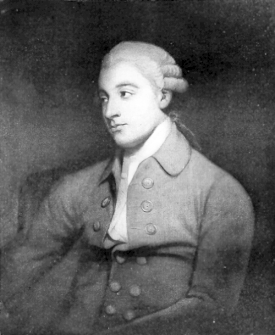
Frederick Howard, fifth Earl of Carlisle
From a painting by George Romney.
Sceaux†4; you know my ecstasies when I am really pleased. By the end of next week I shall be in town, and hope to find you there, that I may satisfy both ourselves with larger details.
When I mentioned the attentions paid to me, I am ungrateful to forget the sun, who was complaisance itself, shone all day, gilt an hundred haycocks that were spread over the great lawn, and illuminated the mausoleum during my dinner. And now, will you tell me that Lord Carlisle is not nearer related to him than some folks thought? Let me tell you, this is much better authenticated than his Lordship's priority to Howard of Corbie, in which you are mistaken, and so good night.
Yours most cordially,
HOR. WALPOLE.
1422. To the Rev. William Mason.
Aug. 24, 1772.
I should be very ungrateful, dear Sir, after all your goodness to me, particularly for your kind request in asking an account of my journey, if I did not immediately thank you for all your favours. My journey was as agreeable as it could be after leaving so pleasant a place and such good company, and was attended by no accident, except an escape from being drowned in a torrent of whores and apprentices at Barnet races. I passed through Clumber and Thoresby Parks, and saw no one temptation to stop in either. Strawberry I found parched to the bone. It has rained for three days since, which has only brought down bushels of dead leaves, and advanced autumn without its change of hues. To make me amends, I found my new bedchamber finished,
and it is so charming that I have lost all envy of Castle Howard. The bed would become Cleopatra on the Cydnus, or Venus if she was not past Cupid-bearing. In truth, I fear I must call it Sardanapalus's, who Margaret may, without breach of veracity, assure strangers lived still longer ago than the Goths.Pray remember what I am going to tell you against you find yourself en chapitre. Your church of York enjoys an estate given by Queen Philippa on the burial of her son William of Hatfield, and yet you have the conscience to let the poor Prince's tomb be tossed about without a yard of earth it can call its own†1! My compliments to Mr. Alderson, to Argentile and Curan†2, &c.; nay, to the old woman's picture if you insist upon it.
Yours ever,
H. WALPOLE.
Arlington Street.
I happened to come hither to-day on business, and find Dr. Brown has called twice, and left me in his own and your names a Goa-stone†3 and a blood-stone seal, which both belonged to Mr. Gray. You know how really I shall value them, and I thank you very much, but I am greatly distressed how to thank Dr. Brown. He has not left a direction where he lodges, and I am impatient to express how much I am obliged, of which I will beg you, dear Sir, to bear witness: I certainly would not neglect waiting on him directly, if I knew where to find him. If I do not, I will write to Cambridge.
1423. To the Rev. William Cole.
Strawberry Hill, Aug. 25, 1772.
I thank you for your notices, dear Sir, and will deliver you from the trouble of any further pursuit of the Peleryne of Thomas: I have discovered him among the Cottonian MSS. in the Museum, and am to see him.
If Dr. Brown is returned to Cambridge, may I beg you to give him a thousand thanks for a present he left for me at my house, a Goa-stone and a seal, that belonged to Mr. Gray? I shall lay them up in my cabinet at Strawberry among my most valuables. Dr. Brown, however, was not quite kind to me, for he left no direction where I might find him in town, so that I could not wait on him, nor invite him to Strawberry Hill, as I much wished to do.
Do not these words invite him to Strawberry make your ears tingle? September is at hand, and you must have no sore throat. The new chapel in the garden is almost finished, and you must come to the dedication.
I have seen Lincoln and York, and, to say the truth, prefer the former in some respects. In truth, I was scandalized in the latter. William of Hatfield's tomb and figure is thrown aside into a hole; and yet the Chapter possess an estate that his mother gave them. I have charged Mr. Mason with my anathema, unless they do justice. I saw Roche Abbey†1, too, which is hid in such a venerable chasm, that you might lie concealed there even from a 'squire-parson of the parish. Lord Scarborough, to whom it belongs, and who lives at next door, neglects it as much as if he was afraid of ghosts. I believe Montesino's cave lay in just such a solemn thicket, which is now so overgrown that, when one finds the spot, one can scarce find the ruins.
I forgot to tell you that in the screen of York Minster there are most curious statues of the kings of England, from the Conqueror to Henry VI, very singular, evidently by two different hands, the one better than the other, and most of them, I am persuaded, very authentic; Richard II, Henry III, and Henry V, I am sure are; and Henry IV, though unlike the common portrait at Hampton Court†2, in Herefordshire, the most singular and villainous countenance I ever saw. I intend to try to get them well engraved. That old fool, James I, is crowded in, in the place of Henry 6th, that was taken away to make room for this piece of flattery--for the Chapter did not slight live princes.
Yours ever,
H. W.
1424. To the Rev. William Cole.
Strawberry Hill, Aug. 28, 1772.
Your repentance is much more agreeable than your sin, and will cancel it whenever you please. Still I have a fellow-feeling for the indolence of age, and have myself been writing an excuse this instant for not accepting an invitation above threescore miles off. One's limbs, when they grow old, will not go anywhere when they do not like it. If yours should find themselves in a more pliant humour, you are always sure of being welcome here, let the fit of motion come when it will.
Pray what is become of that figure you mention of Henry VII†1, which the destroyers, not the builders, have rejected? and which the antiquaries, who know a man by
his crown better than by his face, have rejected likewise? The latter put me in mind of characters in comedies, in which a woman disguised in a man's habit, and whose features her very lover does not know, is immediately acknowledged by pulling off her hat, and letting down her hair, which her lover had never seen before. I should be glad to ask Dr. Milles if he thinks the crown of England was always made, like a quart pot, by Winchester measure? If Mr. Tyson has made a print from that little statue, I trust he will give me one; and if he, or Mr. Essex, or both, will accompany you hither, I shall be glad to see them.At Buckden, in the Bishop's palace, I saw a print of Mrs. Newcome†2, I suppose the late mistress of St. John's. Can you tell me where I can procure one? Mind, I insist that you do not serve me as you have often done, and send me your own, if you have one--I seriously will not accept it, nor ever trust you again. On the staircase, in the same palace, there is a picture of two young men, in the manner of Vandyck, not at all ill done; do you know who they are, or does anybody? There is a worse picture in a large room, of some lads, which, too, the housemaid did not know†3. Adieu! dear Sir.
Yours ever,
H. W.
1425. To Sir Horace Mann.
Strawberry Hill, Aug. 29, 1772.
Your letter arrived just time enough, my dear Sir, for me to deliver the maps I had got to Sir William Hamilton, who
is on the point of returning to Naples, and as you do not expect soon the person they are designed for, they will arrive early enough. Some of them are not in excellent condition, but they are the best I could get of the size prescribed.How can you speak so slightly of the fine chest of Benvenuto? It is most beautiful, and fitted up in the prettiest manner; nor do I at all perceive ill usage in it. Mr. Chute, who is here, is delighted with it; and the more, in that the top is copied from a most scarce print after Raphael, by Marc Antonio, which Stosch procured for him, and which is different from three others. The chest is deposited in a new glazed closet in a sumptuous state bedchamber, which was finished but to-day, and which completes my house. I must terminate it, for I have at last exhausted all my hoards and collections: and such a quantity of things were scarce ever amassed together!
It has been said in our newspapers that the Cardinal of York was dead; but your silence makes me conclude it is not true, which is probable too by its being in our papers, for they are absolutely nothing but magazines of lies, blunders, scandal, virulence, and absurdity. Of true news we have none at all at present. This very brief epistle must, therefore, set out, ill provided as it is. Wars in Poland are out of our reach, and the Turkish war or peace is like a Chancery suit, of which one just hears once in a term, and then it goes to sleep again. Common, small events, like fine ornaments at a great height, will not do for so great a distance as we stand at.
†1426. To the Duchess of Gloucester.
Having long known, Madam, that your understanding is as good as your heart is excellent, I must believe that you have not changed a plan of conduct which I thought so right†1 without having still stronger reasons for what you have done. I am very happy to hear that, though forced to act impartially, his Majesty has softened his justice with kindness. It must be my prayer, as well as expectation, that your virtues will reconcile the King to you and ease his Royal Highness's mind of the only pang which, I flatter myself, you will ever occasion to him.
My wish is to pay my duty to you, Madam, immediately, and to the Duke, if I might be allowed that honour; but as I think that would be too great a liberty to take without his Royal Highness's permission, I must hope that the kind familiarity which you still show me, Madam, and which I burn to return, but restrain from a proper respect, will prescribe the conduct to me which his Royal Highness and you choose I should observe, and which may best express the regard with which I am his and your
Royal Highness's
Most faithful and most obedient
Humble servant,
HORACE WALPOLE.
September
1427. To the Rev. William Mason.
Strawberry Hill, Sept. 19, 1772.
I am ashamed of having been so awkward about the direction, but in good truth I did not think it was necessary
to specify what market-town of Parnassus you lived near. For the future, I will remember that a letter to Governor Macdregs at Muxaduvad would in this age find its way better than to Virgil, if he was living at Hampstead. I shall go to town next week, and will consign Gray's letters, as you order, to Mr. Fraser†1. I need not say that there are several things you will find it necessary to omit, and indeed, though to any one that knew him and me they would be charming, I question whether you will find more than a very few proper for the public taste. That same public taste is the taste of the public, and it is a prodigious quantity of no tastes, generally governed by some very bad taste, that goes to the composition of a public: and it is much better to give them nothing, than what they do not comprehend and which they consequently misunderstand, because they will think they comprehend, and which, therefore, must mistake. I do not know whether it is not best that good writings should appear very late, for they who by being nearest in time are nearest to understanding them, are also nearest to misapprehending. At a distant period such writings are totally dark to most, but are clear to the only few that one should wish to enjoy them. It must be a comfort to great authors to reflect that in time they will be little read but by good judges.Thank you for the new couplet. I have repeated it to myself forty times, and laughed as often; it is at least as good as any of the rest. The papers, alas! will tell you that I am doomed to sojourn in Egypt, and must call cousins with Colonel Luttrell, who thinks it
The sweetest of all earthly things,
To live with princes and to talk of kings†2!
Not that I am removing to the palace neither. No, I hear the Five Mile Act is drawing up against us too†3, but I have a strange sang-froid, and bear my honours and disgraces with equal temper: yet the former are showered upon me. But this very day, Mr. Garrick, who had dropped me these three years, has been here by his own request, and told Mr. Raftor how happy he was at the reconciliation. I did not know we had quarrelled, and so omitted being happy too. He would not have been so much diverted as I was the other day, I believe. Mr. Granger lent me a book, called Sketches and Characters of the most Eminent and Singular Persons now Living, printed a year or two ago. My brother is mentioned, and said to be the only surviving son of a late great minister. I was charmed with finding that though I have so often played the fool, I am still so fortunate as to be thought dead and gone. I will take care not to undeceive the kind person, who scorns to disturb my ashes. Apropos to Mr. Granger, he is dying to have your print, and swears as much as he loves a print of anybody only because it is a print of somebody, that he shall value yours for your own sake, and because he admires you infinitely. He has promised me an unique print, in return, of King Charles the First's chimney-sweeper, and I am sure you will not prevent my collection from being enriched with such a curiosity.
You are perfectly indifferent I hope about the revolution in Sweden†4, and do not care whether the poor people are to be slaves to the King or House of Lords.
I intend to make a list of all that are going to shun me in public and squeeze my hand in private, assuring me how
excessively glad they are of my niece's good fortune; and of all that will not squeeze my hand till they see me at St. James's again, and then pinch half my fingers off with protestations of their joy. I have gone through all this farce in the former part of my life, therefore the repetition will divert me the more. When my father fell, the good Bishop of Carlisle†5, my old friend, came to condole with me, and to express his fears that we should all go to the Tower, though he could scarce contain his button-mouth from smiling. Even then I had the happy carelessness to be indifferent to what was passing, and it grievously offended Sir John Barnard. I was sitting under him in the House of Commons: somebody asked me if I would go to Vauxhall one day in the next week--'Vauxhall,' said I, 'bless me--we are all going to Siberia.' Well! one can't help it if one's niece Dolgoruchi marries the Czar, but at least one is not liable to have the knout, if there is a change of decoration. I am not at all desirous that Kirgate†6 my printer should, as no doubt he would, say like Caxton of Earl Tiptoft (I had rather it had been Earl Rivers for the royal marriage sake†7), 'O good blessed Lord God! what grete losse was it of that noble, vertuous, and well disposed Lord! The axe then did at one blow cut off more learning, than was left in the heads of all the surviving nobility.'--I hope he would except my Lord Chancellor†8, my Lord Rochford, and the Bishop of London†9.
1428. To Sir Horace Mann.
Strawberry Hill, Sept. 20, 1772.
There is an end of palliating, suppressing, or disbelieving: the marriage (my niece's marriage) is formally notified to the King by the Duke of Gloucester. Many symptoms had convinced me of late that so it would be. Last Wednesday night I received a letter signed Maria Gloucester, acquainting me the declaration had been made, and been received by his Majesty with grief, tenderness, and justice. I say justice, tout oncle as I am, for it would have been very unjust to the Duke of Cumberland to have made any other distinction between two brothers equally in fault, than what affection without overt acts cannot help making. This implies that the Duke of Gloucester must undergo the same prohibition as his brother did, which I am told is to be the case, though the step is not yet taken.
Having acted so rigorously while I could have any doubt of any sort left, it was but decent now to show that respect, nay gratitude, for so great an honour done to the family, which was due to the Prince, and still more to his honour and justice. I accordingly begged the Duchess to ask leave for me to kiss his Royal Highness's hand, which was immediately granted. I went directly to the Pavilions at Hampton Court, where they were, and the Duke received me with great goodness, even drawing an arm-chair for me himself when I refused to continue sitting by the Duchess, or even to sit at all. He entered into the detail of his reasons for declaring the marriage, which he knew, by a former letter to the Duchess, I had approved their not publishing so far as her taking the title; and by something that dropped apropos to the title, I am persuaded that my having obstinately avoided all connection with him, had
been a principal cause of his anger, though I do not doubt but some who were averse to the marriage had said everything they could to the disadvantage of the family; and as I had shown most disapprobation of the connection, impressions against me naturally took the easiest root. Well, here ends my part of this history; I neither shall be, nor seek to be a favourite, and as little a counsellor. Were I to advise, it should be to submit themselves entirely to the King. A Prince of the blood, especially of a character so esteemed, may give great trouble, but whom do they hurt but their own family? The Duke of Cumberland was slighted by the opposition, because he married the sister of the man in England†1 the most obnoxious to them. To them the Duke of Gloucester is a very different case, and they are not likely not to make the distinction; but I shall think the Duchess very ill-advised, if she does not dissuade everything that can displease the King. Her temper is warm, but she has an admirable understanding and a thousand virtues. You will be charmed, I am sure, with an instance of her modesty and humility†2. She asked me if I did not approve her signing herself Maria Gloucester, and not simply Maria, in the royal style. 'I thought,' said she, 'it was ... to assume it, but ... I recollected that Maria was once all the name I had any right to. I thought this ...' We have another instance in our family, and I set it down as the most honourable alliance in the pedigree. The Dowager Lady Walpole†3, you know, was a French staymaker's daughter. When Ambassadress in France, the Queen expressed surprise at her speaking so good French. Lady Walpole said she was a French woman. 'Française!' replied the Queen. 'Vous, Française, Madame! et de quelle famille?'--'D'aucune, Madame,' answered my aunt. Don't you think that aucune sounded greater than Montmorency would have done? One must have a great soul to be of the aucune or ...†4 families, which is not necessary, to be a Howard.Don't trouble yourself any more about the head of Stephens; I have got one here. I will subscribe for anything of Mr. Patch's, but have very little taste for those gates†5; though the originals are fine. Jesses seem to me still less agreeable. Zoffany†6 is delightful in his real way, and introduces the furniture of a room with great propriety; but his talent is neither for rooms simply, nor portraits. He makes wretched pictures when he is serious. His talent is, to draw scenes in comedy, and there he beats the Flemish painters in their own way of detail. Butler, the author of Hudibras, might as well be employed to describe a solemn funeral, in which there was nothing ridiculous. This†7, however, is better than his going to draw naked savages, and be scalped, with that wild man Banks†8, who is poaching in every ocean for the fry of little islands that escaped the drag-net of Spain.
So they do not think at Rome that the Pretender is worthy to have his face engraved! And yet they wonder the King of Spain is not a bigot, when even the Pope himself does not pretend to be so. It is well for the world when there is a grain of honesty amongst the great umpires
of the earth. The King of Sweden is not quite so frank; he is taking oaths on the Bible that he means to keep the oath he is breaking! Truly, between him and the nobility, I am very neutral. Nobility harassed Poland, till they see it parcelled out as if a company of brokers had bought it at an auction; the brokers, however, would have paid the purchase-money; three or four righteous sovereigns are above such mechanic dealings! Oh, by how much is the only rational being†9 in the world the worst! Pious Maria Theresa! Humane Joseph, the father and the idol of his people! Catherine, the legislatress! Well, I vow I think Frederick of Prussia, who never pretended to a single virtue, is the best of the set. He never had the impudence to deny that there is nothing he would not do. He quarters Poland, deposes the Queen of Denmark, inspires the nobility to enslave their King, and prompts the King of Sweden to enslave nobility and people; and yet one must say for him that he does not go to church, and invite God to be of the plot. A highwayman is an honest fellow compared to a priest that poisons you in the Sacrament. Bless us! bless us! who would not tremble to have power!
October
1429. To the Rev. William Mason.
Strawberry Hill, Oct. 13, 1772.
Dear Sir,
I doubt you will have thought me very inattentive to your orders, but, alas! it is far from being my fault. I have been in my bed this fortnight with the gout in every limb, and have not the use of either hand or foot.
Were I at liberty, I fear I could be but of little use to your friend†1. The acquaintance I had in the Parliament
have left Paris, and are retired into the provinces. I have left off and had not seen in my three last journeys the philosophers and litterati; the house of Choiseul is dispersed. The Président Hénault, where I used to sup frequently, is dead and the house broke up. In short, I have no connection left at Paris but with my old blind friend and her society, which would not at all suit a young man of three-and-twenty. The best person to whom I could have recommended him, the Duchesse d'Aiguillon, mother of the Duke, is lately dead, and I have no more friends at court. If the young gentleman goes into Italy I can be useful to him at Florence and Naples, and will give him letters thither very willingly. I don't know whether anybody had had a curiosity about your last letter but one, but I did not receive it till six days after it was dated.I will not say any more, because I have no more to say, but about my own sufferings, with which I do not wish to grieve anybody.
I am, &c.
†1430. To the Duchess of Gloucester.
Strawberry Hill, Oct. 27, 1772.
I thank you extremely, my dear Madam, for your answer to my letter, and for the permission of concealing what is passed from the two persons in question†1, who, I am sure, would suffer as much as I have done; but I had rather bear anything from my friends, and for my friends, than give them the pain, and the world the pleasure, of knowing it.
I wish I had strength to add a few more explanations, Madam, that would be for your satisfaction, or was able to send you a letter, which, as far as my confused head can recollect, would be a better justification of the elder than all I have said; but I am not capable yet of searching for it, nor can employ anybody to look for it. I must, therefore, wait till I am better.
Indeed I am now so low and faint to-day that I must stop; and will take advantage, my dear Madam, of your late reproof for my too abundant ceremony, though nothing can ever make me forget the respect I owe to the Duke of Gloucester's wife--no, not even the kindness of my niece.
I am, &c.
November
1431. To Sir Horace Mann.
Strawberry Hill, Nov. 4, 1772.
It is so very long since I heard a word of you, my dear Sir, that I can almost fancy you have been laid up with the gout, as I have been. Yes, to-day commences the sixth week of my confinement, close confinement, almost to my bed, and strictly to my bedchamber. I have had this terrible illness in every limb and every joint; and it is but to-day that I can say every symptom is mending; but how the comfort of recovery is abated by the reflection on the returns I must expect of the same complaint! To what satisfaction can one look forward, when one sees the gout peeping over happiness's shoulder, and threatening one with being of the party? This thought puts an end to all views; I resign myself to age and its proper nurse, retirement; and only propose to be so reasonable as neither to wish to live or die.
Being in a perfect solitude here, and incapable, from
weakness and languor, to see even my friends, you may conceive I can have nothing to tell you. The papers, my only informers, will have given you the whole history of Wilkes, of which I know not one tittle more. He was on the point of being Lord Mayor; and it would have been a phenomenon!I have been told, I know not how truly, that there has been a revolution not only in the Czarina's Cabinet, but bedchamber; and that while her favourite Orloff†1 was making and breaking the peace with the Turks, a new Adonis or Hercules has supplanted him at St. Petersburgh. I have an opinion, that when violent systems once begin to be deranged, they do not last long; the present scene in the North is throughout so violent and unjust, that no reflecting being can be sorry for any catastrophe that befalls any of the principal actors.
The iniquities of our East India Company and its crew of monsters seem to be drawing towards a conclusion, at least to be falling on their own heads. They have involved themselves in such difficulties, that the Parliament is forced to meet earlier than was intended, in order to assist or correct them. Tisiphone, Alecto, and Megæra should correct them!
Are Lord Huntingdon and Mr. Nicholls still at Florence? You never say a word to me of the latter, who I thought likely to please you. Consider, we have not so many people left that we both know, that you need be sparing of naming those we can talk about. I am often going to ask you what remains there are of my Florentine acquaintance; but you never indulge my curiosity that way, though it would amuse me. Well.--Adieu.
P.S. If Mr. Nicholls has not left you, he might bring me a parcel of my letters.
1432. To the Rev. William Cole.
Strawberry Hill, Nov. 7, 1772.
Dear Sir,
I did receive the print of Mrs. Newcome, for which I am extremely obliged to you, with a thousand other favours; and should certainly have thanked you for it long ago, but I was then, and am now, confined to my bed with the gout in every limb, and in almost every joint. I have not been out of my bedchamber these five weeks to-day, and last night the pain returned violently into one of my feet, so that I am now writing to you in a most uneasy posture, which will oblige me to be very short.
Your letter, which I suppose Mr. Essex left at my house in Arlington Street, was brought to me this morning. I am exceedingly sorry for his disappointment, and for his coming without writing first, in which case I might have prevented his journey. I do not know, even, whither to send to him, to tell him how impossible it is for me just now, in my present painful and helpless situation, to be of any use to him. I am so weak and faint, that I do not see even my nearest relations, and God knows how long it will be before I am able to bear company, much less application. I have some thoughts, as soon as I am able, of removing to Bath; so that I cannot guess when it will be in my power to consider duly Mr. Essex's plan with him. I shall undoubtedly, if ever I am capable of it, be ready to give him my advice, such as it is, or to look over his papers, and even to correct them, if his modesty thinks me more able to polish them than he is himself. At the same time, I must own, I think he will run too great a risk by the expense. The engravers in London are now arrived at such a pitch of exorbitant
imposition, that, for my own part, I have laid aside all thoughts of having a single plate more done.Dear Sir, pray tell Mr. Essex how concerned I am for this mischance, and for the total impossibility I am under of seeing him now. I can write no more, but shall be glad to hear from you on his return to Cambridge; and, when I am recovered, you may be assured how glad I shall be to talk his plan over with him. I am his and
Your
Obliged humble servant,
HOR. WALPOLE.
†1433. To the Earl of Hardwicke.
[Strawberry Hill, Nov. 1772.]
Mr. Walpole has received Lord Hardwicke's commands and has in town what his mother always kept as the best picture of Sir R. Walpole, done when about forty. It is painted by Richardson in a green frock and hat, and the dogs and landscape by Wootton. The most like print, which is in the Garter robes, was taken from this. At Rainham is a very good one by Sir Godfrey Kneller. If Lord Hardwicke chooses that in Arlington Street to be copied, it is very much at his Lordship's service.
Mr. W. begs pardon for writing so ill, but is in bed with the gout.
1434. To the Rev. William Mason.
Strawberry Hill, Nov. 10, 1772.
Dear Sir,
Having from the shipwreck of all my limbs recovered the use of three fingers, I cannot employ them better than in thanking you for your kind letter and inquiry. Six weeks
finish to-morrow, and I have not been yet out of my bedchamber, and little out of my bed, till lately, and in the middle of the day. The amendment is so slow, and so dispiriting, that I find it almost as difficult to recover of the recovery, as of the gout; but I will not talk of it, though I pay it off with thinking.You will oblige me much with that print of Mr. Gray†1. You may guess how much I have thought of him lately, and how I have been weighing a shorter life against pain!
I see nobody: I know nothing: I cannot amuse you, and will not tire you. The most pleasing thing that you could tell me, would be, that you had some thoughts of London. Adieu!
†1435. To the Duchess of Gloucester.
Strawberry Hill, Nov. 15, 1772.
That you have many enemies, my dear Madam, I do not doubt; your merit and fortune will raise you numbers of such in those who have not the former, and are given up to the pursuit of the latter. Lies will be the consequence, as your very merit will prevent them from hurting you, were they to speak nothing but truth. All I take the liberty to beseech of you is, not to let your own honest warmth and sincerity add to the number. At least wait till you can make your resentment felt as well as known--or, what is more like you, till it will be noble to forgive. You are now in a position in which your every word will be weighed and, if possible, misinterpreted. In this country nobody escapes; and you are capable of being hurt till the King and Duke are reconciled. I know how ready you are to bear anything for the Duke's sake, therefore for his sake bear ill-nature;
and when your own virtue is so great as to be willing to waive the honours due to his wife rather than obstruct his Royal Highness's return to court, carry the sacrifice so much farther as not to let the malicious know you know them, since by that frankness you will whet their claws in this only moment in which they can hurt his Royal Highness by keeping him from the King.You will say it is very fine in me to preach, who am warm and imprudent, like you and your father; but that is the very reason, my dear Madam, why I do preach. I have felt the inconvenience of incautious anger, and wish my experience may all turn to your service.
That lies swarm in plenty I know by ancient and recent personal experience too. I was told two days ago that a lady said I had been the cause of the last full publication of your marriage, and that the King believed so. I did not vouchsafe to make an answer. You know, Madam, better than anybody does or can, how true that assertion is. If the King has been told such a gross untruth, I shall certainly be one of the least proper persons in the world to convey to his Majesty what you wish he should be told of your self-denial; yet it does you so much honour, it is such just gratitude to his Royal Highness, and I am so indifferent about myself, that I shall certainly take care your declaration shall be made known to his Majesty--nor have I any doubt but Lord Hertford will be happy to be the messenger. He knows too well the King's affection for the Duke not to be sure he shall execute a welcome office by doing anything that may tend to a reconciliation between the royal brothers; and his letter, which I have already mentioned to you, Madam, and which I here enclose, will convince you Lord Hertford could not think for one moment that he should make his court to his Majesty by inflaming the difference between him and the Duke of Gloucester. The letter, I give you my
honour and oath in the most solemn manner, is the genuine identic letter that I received at the time; nor has Lord Hertford the most distant idea or suspicion of what he was accused, or of my sending you his letter. I do both, in justice to him and myself, to prove to you, my dear Madam, that I would not put your interests into his hands if I were not thoroughly convinced of his zeal to obey you. He is now in Suffolk, or shooting in Norfolk with my excellent nephew†1. As soon as I am able to see him in town or here, which I have not yet done, I will not lose a moment. I will only beg you to return me his letter, because, though so strong a vindication of him, I am not sure he would like my showing it; but the goodness of my intention must justify me.P.S. 21st. I wrote the above some days ago, but was in too much pain then, and for almost all the week since, to finish it; and as Lord Hertford was not in town, nor I able to go thither, there was no hurry. In my tedious and sleepless nights I have thought this matter over and over; and should the method you prescribe not succeed, I think there might be still more direct and more efficacious ways taken; but I know it does not become me to give advice, and therefore I can only show my zeal by implicit obedience, which you may always depend upon, my dear Madam, in
Your Royal Highness's most faithful humble servant,
H. W.
1436. To the Rev. William Mason.
Strawberry Hill, Nov. 26, 1772.
The papers, my only company at present, tell me that Elfrida†1 is brought upon the stage, and pleases exceedingly.
I am rejoiced, and want to go and see it; but as I am not near being in a situation of going to plays, I trust I shall only wait to see it more agreeably; for you cannot be so unnatural a parent as not to come and see Miss Mason in her glory, and then I flatter myself you will let me accompany you. Nothing could make me in cold blood expose myself to that fiery trial. Yours was not so, for Elfrida's character was established long ago, and you have had none of the plague and anxiety; but I own I scarce conceive a greater pleasure than to see a dramatic work of one's own crowned with success, and be witness to it, provided it were well acted. Come, come, you must come and see it; do not deny yourself so lawful a pleasure and that you deserve to enjoy. I mend so slowly, that it seems to me that it will be supreme enjoyment to walk 'cross my own room.
December
†1437. To the Rev. William Cole.
[Dec. 15, 1772.]
I have had a relapse, and not been able to use my hand, or I should have lamented with you on the plunder of your prints by that Algerine hog†1. I pity you, dear Sir, and feel for your awkwardness, that was struck dumb at his rapaciousness --the beast has no sort of taste neither--and in a twelve-month will sell them again. I regret particularly one print, which I dare to say he seized, that I gave you, Gertrude More†2; I thought I had another, and had not; and, as you liked it, I never told you so. This Muley Moloch used to
buy books, and now sells them. He has hurt his fortune, and ruined himself, to have a collection, without any choice of what it should be composed. It is the most underbred swine I ever saw; but I did not know it was so ravenous-- I wish you may get paid anyhow. You see by my writing how difficult it is to me, and therefore will excuse my being short.Yours ever,
H. W.
1438. To Sir Horace Mann.
Arlington Street, Dec. 22, 1772.
Upon my honour I will pack up my house at Strawberry Hill, and send it you, if you send me any more presents. Why, it is full of them, and belongs more to you than to me. Have you no mercy? Do you take me for an East Indian governor, that you give me lacks of precious things, and suppose I have no conscience. Consider, how ill I have been, and that upon a sick bed at least one begins to have scruples. I could not look round me, without hearing a qualm whisper, Restitution! I cannot carry all your curiosities along with me, and to leave them behind will but add to my regrets. Well! but I will not die though, till I have seen Donatello†1. After eleven weeks of suffering, I am come to town, and though rid of pain, cannot stir; consequently want amusement: Donatello will be a new plaything for an old child. Verily, I put myself in mind of Gay's sick fox, who, after preaching to his young kin against pullicide, cries,
But, hark! I hear a hen that clocks:
Go--but be moderate in your food--
A chicken, too, might do me good.
I am sorry to hear you know more of the gout than by what you have seen in your own family, and from my relation. The muscular pain in your breast came from cold that mixed with your disorder; I had it so violently for twenty-four hours, that I could only sit up double in bed. Three spoonfuls of Sir Walter Raleigh's cordial, known by the learned name of Confectio Raleana, took it entirely away, and a coughing with it, that exhausted me more than my gout, in this very fit. Why will you not have the bootikins? Not that I think the gout in your feet, when it begins so late, will do you anything but good, and prolong your life. What physician have you had since poor Cocchi? Not that I think any physician will do you more good than the gout will do you harm. The consolation in this terrible disorder is, that it does not want a physician; and, if it did!
I am sorry you saw no more of Mrs. Pitt†2. She is the most amiable of beings, and the most to be pitied; her brutal half-mad husband, with whom she is still not out of love, and who has heaped on her every possible cruelty and provoking outrage, will not suffer her to see, or even hear from, one of her children. Of Lady Ligonier†3 she has heard too much. Then, all her beauties and good nature are poisoned by deafness and danger of blindness. I cannot profess, ungrateful as I am, equal admiration for the other lady†4, my ingenious friend, as you call her; a title I did not even know I was honoured with, and which I believe was assumed solely to make court to you. I will not call them pretensions, for there is a mixture of humility, but I own
I think there is little more in that dame than an ambition of having pretensions. What do you think of physicians, when they prescribe the air of Rome?We have no public news, but new horrors coming out every day against our East India Company and their servants. The latter laid a tax on our Indian subjects, without the knowledge of the former. One article was twenty-four thousand pounds a year--yes--to Mr. Sykes for his table-- yes, yes,--and this appeared at the bar of the House of Commons from a witness he brought thither himself--ex uno disce omnes. Poor Indians! I fear they will be disaffected. Would you believe, I read that epithet the other day in a Portuguese relation of a mutiny among their negroes in the Brazils. Hacked, hewed, lamed, maimed, tortured, worked to death, poor Africans do not love their masters! Oh, Tyranny, thy name should henceforth be Impudence! I am sick of all northern profligacy, of the Czarina's murders or amours; nor care whether she poisons Emperors or enriches her discarded lovers with provinces. I pity the Duchess of Parma†5, who is not allowed to choose her own little creatures; and yet I forgive the King of Spain for persisting in rooting out the Jesuits, though he does not know why. A whirlwind brushes the air and clears it. I do not know whether the honours of Mantua will console Lord H.†6 for those he idly forfeited here.
My niece of Gloucester's pregnancy has been declared here. I am as little clear whether that will be of any advantage to her.
The Prince of Condé has made his peace. The Duke of Orléans is supposed to have a hankering the same way, but is retained by his son. The Chancellor and d'Aiguillon
are sworn foes; the mistress omnipotent. Some truth there was, I am assured by a person just returned from France, in the Prince of Conti's story. M. de Sartine, lieutenant de police, went with his officers to the Temple to search for libels: the Prince immediately stripped stark, and showed he had not a rag of paper about him. He told M. de Sartine that, knowing him for a man of honour, he would dispense with his stripping; he believed the other gentlemen were also men of honour, but not being acquainted with them, and having heard of officers of justice, who, being sent to houses of obnoxious persons to search for libels, had contrived to find libels which they had brought with them on purpose, he insisted on their stripping to the skin likewise, and when they had done so, he bade them go and search wherever they pleased. For my part, I did not expect so much cleverness from his Highness.Adieu! my dear Signor Donatello! It is a title I am sure you have purchased dearly. I shall grow afraid of Danaos et Donaferentes: and the more you give me, the less I will be, yours ever.
P.S. I think I have received but one of the two letters you mention. I hope your new commissioner will be regular; but I must not complain when it is three months since I wrote myself. I never was so guilty--but the gout!
†1439. To the Countess of Ailesbury.
Arlington Street, Dec. 29, 1772.
Indeed, Madam, I want you and Mr. Conway in town. Christmas has dispersed all my company, and left nothing but a loo-party or two. If all the fine days were not gone out of town, too, I should take the air in a morning; but
I am not yet nimble enough, like old Mrs. Nugent, to jump out of a postchaise into an assembly.You have a woful taste, my Lady, not to like Lord Gower's bon mot. I am almost too indignant to tell you of a most amusing book in six volumes, called Histoire Philosophique et Politique du Commerce des Deux Indes†1. It tells one everything in the world;--how to make conquests, invasions, blunders, settlements, bankruptcies, fortunes, &c.; tells you the natural and historical history of all nations; talks commerce, navigation, tea, coffee, china, mines, salt, spices; of the Portuguese, English, French, Dutch, Danes, Spaniards, Arabs, caravans, Persians, Indians; of Louis XIV and the King of Prussia; of La Bourdonnais, Dupleix, and Admiral Saunders; of rice, and women that dance naked; of camels, ginghams, and muslin; of millions of millions of livres, pounds, rupees, and cowries; of iron cables and Circassian women; of law and the Mississippi; and against all governments and religions. This and everything else is in the two first volumes. I cannot conceive what is left for the four others. And all is so mixed, that you learn forty new trades, and fifty new histories, in a single chapter. There is spirit, wit, and clearness--and, if there were but less avoirdupois weight in it, it would be the richest book in the world in materials--but figures to me are so many ciphers, and only put me in mind of children that say an hundred hundred hundred millions. However, it has made me learned enough to talk about Mr. Sykes†2 and the secret committee†3, which is all that anybody talks of at present, and yet Mademoiselle Heinel is
arrived. This is all I know, and a great deal, too, considering I know nothing--and yet, were there either truth or lies, I should know them; for one hears everything in a sick-room. Good night both!
†1440. To Viscount Nuneham.
Don't think you shall be kind to me every day, my dear Lord, and that I will never be grateful. I must thank you in detail, for the debt would otherwise be enormous. The print is valuable, your own etchings are more, your company most so. I have another little pain in one foot, so you see even my gratitude is interested,--but if you corrupt me is my venality quite criminal?
Yours most faithfully,
H. WALPOLE.
1773
January
1441. To the Rev. William Cole.
Arlington Street, Jan. 8, 1773.
In return to your very kind inquiries, dear Sir, I can let you know, that I am quite free from pain, and walk a little about my room, even without a stick; nay, have been four times to take the air in the Park. Indeed, after fourteen weeks, this is not saying much--but it is a worse reflection, that when one is subject to the gout, and far from young, one's worst account will probably be better than that after the next fit. I neither flatter myself on one hand, nor am impatient on the other--for will either do one any good? One must bear one's lot whatever it be.
I rejoice Mr. G.†1 has justice, though he had no bowels.
How Gertrude More escaped him I do not guess. It will be wrong to rob you of her, after she has come to you through so many hazards--nor would I hear of it either, if you have a mind to keep her, or have not given up all thoughts of a collection since you have been visited by a Visigoth.I am much more impatient to see Mr. Gray's print, than Mr. What-d'ye-call-him's†2 answer to my Historic Doubts. He may have made himself very angry, but I doubt whether he will make me at all so. I love antiquities: but I scarce ever knew an antiquary who knew how to write upon them. Their understandings seem as much in ruins as the things they describe. For the Antiquarian Society, I shall leave them in peace with Whittington and his cat. As my contempt for them has not, however, made me disgusted with what they do not understand, antiquities, I have published two numbers of Miscellanies, and they are very welcome to mumble them with their toothless gums. I want to send you these--not their gums, but my pieces, and a Grammont, of which I have printed only an hundred copies, and which will be extremely scarce, for twenty-five copies are gone to France. Tell me how I shall convey them safely.
Another thing you must tell me, if you can, is, if you know anything ancient of the Freemasons. Governor Pownall†3, a Whittingtonian, has a mind they should have been a corporation erected by the popes. As you see what a good creature I am, and return good for evil, I am engaged to pick up what I can for him, to support this system, in which I believe no more than in the Pope; and the work is to appear in a volume of the Society's pieces. I am very willing to oblige him; and turn my cheek, that they may
smite that also--Lord help them! I am sorry they are such numpsculls, that they make me almost think myself something!--but there are great authors enough to bring me to my senses again. Posterity, I fear, will class me with the writers of this age, or forget me with them, not rank me with any names that deserve remembrance. If I cannot survive the Milles's, the What-d'ye-call-him's, and the compilers of catalogues of topography, it would comfort me very little to confute them. I should be as little proud of success as if I had carried a contest for churchwarden.Not being able to return to Strawberry Hill, where all my books and papers are, and my printer lying fallow, I want some short bits to print. Have you anything you wish printed? I can either print a few to amuse ourselves, or, if very curious, and not too dry, could make a third number of Miscellaneous Antiquities.
I am not in any eagerness to see Mr. What-d'ye-call-him's pamphlet against me; therefore pray give yourself no trouble to get it for me. The specimens I have seen of his writing take off all edge from curiosity. A print of Mr. Gray will be a real present. Would it not be dreadful to be commended by an age that had not taste enough to admire his Odes? Is not it too great a compliment to me to be abused, too? I am ashamed! Indeed our antiquaries ought to like me; I am but too much on a par with them. Does not Mr. Henshaw†4 come to London? Is he a professor, or only a lover of engraving? If the former, and he were to settle in town, I would willingly lend him heads to copy.
Adieu! dear Sir.
Believe me ever most faithfully yours,
HOR. WALPOLE.
1442. To the Rev. William Mason.
Arlington Street, Jan. 9, 1773.
I want to send you my Grammont and two numbers of Miscellaneous Antiquities. How shall I convey them? The latter are published; of the other there are only a hundred copies printed, and as a quarter of the number is gone to France, you must take it as a great present. I do not say it was printed for my friends; who would have an hundred? all I meant was not to make my favourite book common. For the Antiquities, I care not whether the Critical Review, or Dr. Milles, dislikes them. There is, I heard yesterday, another man†1 who wrote about some college in Cambridge, that has printed a new pamphlet against my Richard III: it is to appear in the second volume of the Society's discoveries. I shall wait with patience to see it then or never.
I have been here about three weeks, but have not yet arrived at more than taking the air, when there is a morsel of sun. As I have been fifty-five years in town, I find it extremely tolerable to see nothing but Piccadilly as I go to Hyde Park: you may comfort yourself, dear Sir, in your way too. If Mr. Colman has violated Elfrida, Mr. Garrick has cut out the scene of the grave-diggers in Hamlet. I hope he will be rewarded with a place in the French Academy. I was indeed surprised at that play being revived by so good a courtier.--The adulterous Queen of Denmark was certainly revived with great propriety just now. I suppose grave-diggers shock kings and queens more than the gallantries of their relations. O'Brien's†2 Duel, translated from the Philosophe sans le sçavoir†3, was damned the first night. I saw the original at Paris when it was first acted, and
though excessively touched with it, wondered how the audience came to have sense enough to taste it. I thought then it would not have succeeded here, the touches are so simple and delicate and natural. Accordingly it did not. I have been reading the translation, and cried over it heartily.From Cambridge I am told there is a very good print of Gray, done by one Henshaw, as a companion to yours. Is it for your account of him? How does that work advance? You have forgot, but pray remember to send me one of your own prints for my friend Mr. Granger.
Lord Nuneham is come to town, and has been so good to visit my invalidity twice. What a meritorious pilgrimage it would be if you would too! I am perfectly reliques; I have nothing but dry bones left. You shall be rewarded with a shin-bone, which is of as much use to anybody as to the owner.
H. W.
P.S. You know to be sure why I am exceedingly disappointed.
†1443. To the Earl of Hardwicke.
My Lord,
I was in pain this morning and could not have the honour of answering your Lordship's letter. I am very sorry that it does not depend on me, without a breach of promise, to obey your Lordship's commands. You must allow me to explain the circumstances which prevent my indulging myself in the flattering pleasure of obedience when it would do me so much honour. There is an unfortunate page or two in my book, which would hurt a person now living,
though I thought I had guarded with the utmost caution against any such case. My dread of offending even near relations of very indifferent artists has long obstructed the completion of the work, and has kept it back, though printed off for some time. The concern this accident has given me not only made me determine to suppress my book till a fitter period, but made me give my honour to a friend of the person interested, that I would not suffer a copy to go out of my hands till that time.Indeed, when I am well enough, I intend to alter the article in question, and then your Lordship shall certainly command the first proof, which you see, at present, I am not at liberty to send you, though I am,
My Lord,
Your Lordship's
Most obedient
Humble servant,
HOR. WALPOLE.
Arlington Street, Jan. 21, 1773.
1444. To Sir Horace Mann.
Arlington Street, Jan. 21, 1773.
I wish I had received your last a few days sooner, as it would have told you I was mending, though slowly, and had begun to take the air. It would have saved your hearing I have a little relapsed, and by the time you receive this I shall probably be airing again. I do not expect much more yet awhile: four months, which ended yesterday, shatter such a frame as mine dreadfully; a codicil of ten or twelve days throw it back a vast way. The gout is returned into both feet, and a little into one elbow: I could rise neither yesterday nor to-day; but I flatter myself it is already going off, and will carry away these dregs that have set up for themselves. This is very well
for the present; but what a prospect, if distemper, as they say, prolongs life, instead of shortening it! Your specimen, I trust, will have that effect, and that great torture is not a necessary ingredient of living.To the latter part of my imprisonment I am very well reconciled: I have had a great deal of company. Fine young ladies, the finest and youngest, have made it the fashion to visit me; and, as old ladies never fail to go after the young, I have wanted neither sort, so that I have had a constant circle, without living in a crowd, as everybody else does. It suits my age, and the gravity I ought to have by this time, but which my spirits resist, as they have done my illness.
Though people that sit at home hear all current news, true or false, I have none to tell you. The Parliament has nothing to do, or does nothing, for want of an opposition; as if ministers acted out of contradiction, like their antagonists. There are, indeed, bankruptcies, that shake almost our foundations; there is an eastern empire to be settled, governed, or held in commendam; and there is a little war, and not a little tyranny, at St. Vincent's†1; but none of them will give the Parliament a quarter of the trouble that a turnpike bill has often done. A few bankrupts have hanged themselves; we, I doubt, shall have hanged many more Caribbees; and we shall not hang the East India Company and their servants, who richly deserve it. So will end the lesson of this year, though it is but just begun.
Your brother knight and minister, Sir James Gray, is dead. He had a stroke of an apoplexy at court, was carried
home, and died the next morning. You may see I want news, when I acquaint you with what the newspapers told you a fortnight ago. It is time to finish, lest I should inform you of some event in last year's historical register.
1445. To the Countess of Upper Ossory.
Arlington Street, Jan. 25, 1773.
Proud I am indeed, Madam, when such lines as mine, like a coarse, ugly, bulbous root, can produce such flowers! Next to the honour of being your lover, what glory can be equal to that of being your Apollo? You have explained to me that old story of his turning his mistress into a laurel, and the devil is in it if I have not as good a title to a chaplet of it as he had. Well, methinks, it is ten times more creditable to wear a garland stripped from one's lady's own fingers, than to dress oneself up in honour of one's own self. Your verses are charming, delightful; write on, write on, Madam: you shall have two dozen bottles of Aganippe by the next coach. I am going to bespeak a side-saddle for Pegasus; and the moment I am able to dress, that is, undress, like a god, you may depend on my appearing to you in a dream, as like the Apollo Belvedere as two peas; so pray don't pretend to lay your next poem to Lord Ossory, for it will not be his.
Mr. Crawfurd came in and read your verses twice with great admiration. They are natural, easy, and genteel. I am charmed to be your Phaon, as well as your Phœbus, and sacrifice all my beauties to you, tutte quante. I do not think I should stoop to even an affaire passagère with Melpomene, but alas! I, to talk of beauties! who have not been out of my bed till to-day since Tuesday night last. The gout returned the Friday before into six places, and I have lain flowing through bootikins, and dissolving like a Jupiter Pluvius; but you shall not be tired, Madam, with
the details--especially as I doubt they would compose a considerable part of my poor remainder!I flatter myself I shall see Lord Ossory to-morrow. If he carries you back any news, he must make it, for none grows here. There is a new opera that pretends to be liked, and consequently is crowded to excess. Lord Holdernesse gives his Telemachus†1 a ball on Wednesday, and the ladies give themselves another the same night at their club. This is all I, who hear everything by seeing everybody, can tell you. Who Fatima la questionneuse is, I do not guess. One of the few on whom I have not set eyes is Mr. Fitzpatrick; but, as he wrote my epitaph, he probably thinks I am dead.
I had forgotten--there is a book you will see, that makes and intends to make noise enough. It calls itself Letters to Lord Mansfield. It is no panegyric: it is not written by Wilkes. Lord Bristol could not behave to my Lord Chief Justice with more decorum; Mr. Dyson twist and turn, and torture him with more subtlety; nor the gentle Serjeant-Surgeon, Mr. Hawkins, soothe him to have his legs and arms cut off, or persuade him only to allow him to extract his heart, and rinse it and put it back, with more delicacy. This tender intercourse is penned by Mr. Andrew Stewart: it is not yet published, but the Duchess of Bedford, who had two copies, gave me one, and I have perused it with much edification: indeed it is admirable, and it must be confessed that a Scot dissects a Scot with ten times more address than Churchill and Junius. They know each other's sore places better than we do.
Tuesday, half an hour after three.
No news of Lord Ossory: at least, none for me. If he is arrived, he will dine with Maccaroons, and be hurried with the tide to Mademoiselle Heinel.
Well! there is no reason, because the husband does not come near me, that I should not thank the wife for her dear poetry. Can I have a better opportunity than when he is running after a dancer?
Let him be charmed with her many-twinkling feet, I declare I would erect a statue of your Ladyship, like a tenth Muse, if unfortunately you would not be obliged to be only the eleventh, for I hear Lord Bute has lately bricked up an old statue of one Mrs. Hutchins, a friend of Mr. Heron†2, which he found in the garden at Luton, and bedizened it with a coronet and emblems proper to one of the nine ladies, your predecessors, in honour of---- Oh! I do not guess whom--yes, yes, I do; to be sure, in memory of his mother-in-law, Lady Mary Wortley; but what a strange creature I am, to have forgot scolding for your not finishing your verses. I declare I will print my fragments of living authors. Pray don't let me be one of the points in which you resemble Sappho, if you have a mind that people should say so of me,
'Blest as the immortal Gods is he†3,' who has the
honour of being your Ladyship's devoted
PHAON THE SECOND.
P.S. Pray remember that, as King Rhoderic turned his harp into a harpsichord, you must convert your guitar into a lyre.
February
1446. To the Rev. William Mason.
Arlington Street, Feb. 1, 1773.
I have received and thank you much, dear Sir, for the print of Gray and the two Indian paintings. Pray tell me
more about the latter: the Minerva is very curious, and both are prettily painted. I am sorry they are inseparable, like Indamora and Lindamira. You would have been thanked sooner, but I have had a relapse and kept my bed five days, nor can yet put on a shoe again. Mr. Garrick, who has had both stone and gout, is still Ranger†1, and dances a country dance! I do not envy his performances, but his capabilities.I agree with you heartily about Lord Nuneham; nor know anything so comfortable as one that talks and thinks just as one likes; which I find a greater rarity than any print or picture in my collection, and to my sorrow I observe that the rareness increases every day; though, unlike other curiosities, they are not to be bought. Your Elfrida, Mrs. Hartley†2, I am told, is the most perfect beauty that was ever seen. I can neither go to see Mrs. Hartley, nor Elfrida; but as I can read, I long for any of Elfrida's relations.
Have you heard of Mr. Andrew Stewart's Letters to Lord Mansfield? They will inform you how abominable abuse is, and how you may tear a man limb from limb with the greatest good breeding. Alas! we are barbarians and know nothing of these refinements.
Yours ever.
1447. To the Countess of Upper Ossory.
Arlington Street, Feb. 4, 1773.
This pretends to be at most but half a letter, and indeed is little more than a cover to Lauragais's epistle to Bottarelli, which your Ladyship ordered me to send; and replies to a few questions I omitted. Fashionable as I am,
and charming, my attractions are not great enough to draw Miss Pelham hither. I should neither flatter her nor fret her, and anything is insipid to her that does not make her temper ferment. On the other hand, I keep such sober company, that I shall take care not to scandalize them with your Ladyship's profane conundrums. I have not even guessed. I have not seen Lady Craven's†1 poetry, nor anything of Lady Jane†2 and her Dutch†3. I have seen Lord L.'s†4--what shall I call it? in which he says he delivered Lord Townshend's message exactly, but hopes the public will be so good as to believe he delivered it wrong. Lord Charlemont, whom I have just seen, has great confidence in Lord Bellamont's†5 recovery, though they have not yet discovered where the ball is lodged. The accounts of my nephew†6 are much more favourable, and prove that he does not always want his reason. The weather is so bitter that I must not dare to recover,--indeed, I can scarce keep myself warm on the hearth where I sit, and my fingers beg to be dismissed.
1448. To the Countess of Upper Ossory.
Arlington Street, Feb. 11, 1773.
How can you write when the hands are numbed and the eyes put out? Alas! Madam, you would have wanted many a sheet of nonsense if I could not write like Buckinger, without hands, feet, and move without eyes. I have had a violent cold, that put out the latter, and has brought the gout, not only back into both feet, but into my cheek, which has kept me awake, and has now, as the gout could not make me leaner, made half of my face much fatter. In short, here I am, going into my twentieth week, and in pain from head to foot, though not more than is amusing --at least I bear it with so much tranquillity, that I cannot conceive why they make such a rout about Job's patience; but saints are so much flattered and cuddled, that a poor sinner with twenty more virtues cannot obtain a good word. I declare I have behaved with more good humour for these five months, than half the canting martyrs in the Rubric; and then comes my good Lady Ossory, and as provoking as Madam Job herself, tells me I am not so patient as herself. By Jove! as my Lord Hertford says, for fear of swearing, but no--nothing shall spoil my temper. Stay, stay, you talk of solitude: can solitude pet one like folks one is forced to let in?
If it had not been for a fit of laughing, I really should have lost my sang-froid t'other morning. My Phœnician, Irish, antiquarian friend kept me two hours with a new system of the Mosaic creation, which he has discovered to be the true meaning of the Book of Genesis. He told me this world had originally been all mud, and was inhabited by a set of animals proper to such a quagmire; that it was the natural progress of things, and that there were many
orbs round the sun now changing from water to earth. 'Lord!' said I, a little fired, 'why you talk as if there were several worlds hung out to dry.' Instead of being angry, he replied gravely, and glad to find I was so apt a disciple. Just that,--no, I own, I could then keep my countenance no longer, and so resumed the empire of my temper.
But, Madam,
To cut things short, let's come to Adam†1;
or rather to his descendants; and in the first place to that granddaughter of his that is always in my mind, your Ladyship. You have to be dug up again, and have your ashes raked into. You must not wonder; people will violate your dust, if they find verses mixed with it, as they did in Laura's tomb. I give Mrs. Fitzroy credit, and will never believe that your answer to my Shell-lines†2 were the first you ever wrote; unless, like Gray, you were a perfect poet at your first appearance. If harmony and ease are the rust you contract in retirement, you may send Lord Ossory to polish us, not to learn the newest varnish; but yes, let him come; he shall be taught to wear a black coat, red waistcoat, and red sash, and dance quadrilles with nymphs in white satin, trimmed with flowers: or, as there was a tredrille of quadrilles at the French Ambassador's, he may, if he chooses it, and the weather is cold enough, be dressed in brown silk with cherry waistcoat and breeches. One of the bands succeeded very ill, and as Swift makes the physician say to a lady in the old ballad on Quadrille, should have been told, non debes quadrillare. When your Lord has taken his degrees in these sports, he must then learn and teach your Ladyship a Cossack dance, and you must both dance it as well as the Prince and Princess Czartoriski.
In the meantime I shall be exceedingly glad to have him first here. I trust he knows how happy he makes me by having so much goodness for me.My nephew is not well yet, nor do I like the accounts of him: he is less recovered than I had been assured. Lord Bellamont is thought out of danger; yet Lady Greenwich (on Lord Townshend's account†3) put off her assembly. His Lordship, full of sensibility too, wrote a buffoon letter to Mr. Foote the very night of the duel. Garrick, by the negotiation of a Secretary of State, has made peace with Foote, and by the secret article of the treaty is to be left out of the puppet-show. Colman has been half murdered by a divine†4 out of jealousy, who keeps Miss Miller; and apropos to puppets, there is a Mrs. Wright†5 arrived from America, to make figures in wax of Lord Chatham, Lord Lyttelton, and Mrs. Macaulay. Lady Aylesbury literally spoke to a waxen figure of a housemaid in the room, for the artistess has brought over a group, and Mrs. Fitzroy's aunt is one of them.
What shall I tell you more, my Lord and Lady, of equal dignity with balls, quadrilles, puppet-shows, duels, and waxworks? Oh, of the House of Commons. Lord North is turned into Wilkes; the English of which is, that he was beaten on Tuesday, on the half-pay for the navy†6, and had but the famous number 45 with him, against 154. You may imagine this event makes some folks stare, and others laugh; for my part, I am convinced Lord North was in the wrong, for the Patriot Sir Gilbert Elliot headed the
opposition; and some say the K. himself will resign if his minister is so parsimonious.Mr. Crawfurd intended to be with you to-day, but as yesterday was to be spent in reading papers, and examining witnesses, on the affairs of St. Vincent, the debate will not come on till to-morrow, and will keep him here.
The Duke of Northumberland lost 2,000l. at quinze, at the ball; the victorious name of Marlborough won most of it†7.
I this moment hear that Friday will again be passed in examination, and that the debate will not be till Monday.
1449. To Sir Horace Mann.
Arlington Street, Feb. 17, 1773.
Mr. Patch brought me last week, with his brother's engravings, the beautiful St. John of Donatello, and its as lovely and graceful pedestal. My dear Sir, how I thank you! and how pleasing is your remembrance of me! but you must send me no more. I not only cannot accept more presents from you, but it would be heaping them on my tomb. My health is gone; pain is my lot; and what are the fair things of this world to me any longer? I leave off making purchases, and put a stop to my collection: it were the hoarding of a miser to pile my house with curiosities,
when I shall enjoy them so little; and extravagance to buy, when my lease of life is running out very fast. It will be five months to-morrow that I have been a close and anguished prisoner: besides several relapses, a great cold has added a rheumatism in one side of my face; and when I shall be quit of my actual sufferings, what a shattered tenement will remain! How refit it before I am called upon to sustain another storm?If I change this subject from my own person, I must not go out of the family: I have a melancholy tale to tell you of another branch of it, my Lord Orford. He had a cutaneous or some scorbutic eruption. By advice of his groom, he rubbed his body all over with an ointment of sulphur and hellebore. This poison struck in the disease. By as bad advice as his groom's, I mean his own, he took a violent antimonial medicine, which sweated him immoderately; and then he came to town, went to court, took James's pills, without telling him of the quack drops, sat up late, and, though ordered by James to keep at home, returned into the country the next day. The cold struck all his nostrums and ails into his head, and the consequence is--insanity! To complete the misfortune, he is in a public inn, on the great road to Newmarket and Norfolk. His mother, the only proper directress, is in Italy; I am in the state of pain and weakness you know; and my brother has so long shut himself up in his own house, that no consideration could draw him out of it. I need but tell you that his daughter, the Duchess†1, even in summer, could not prevail on him to wait on the Duke. It is an additional distress that Lord Orford has for so many years dropped all connection, all decency, with both my brother and me, that nothing but tenderness for his lamentable position could bear us out in assuming the least authority in what regards him. We
have the precaution, however, not to take a single step but at the request of his physicians, or with the advice and approbation of his own most particular friends. His life, we are assured, is safe, and we have hopes given us of the recovery of his reason. His death would be the completion of the family's ruin: his continuance as he is, dreadful to himself and his friends: his total recovery liable to dismal moments for his own mind. His case is a heavy addition to my sufferings, and the anxiety I am under on every step I take in concert with my brother lest, one way or other, we should be censured, cannot accelerate my own recovery.Let me turn, for your sake, from this gloomy scene to a little episode or two of politics. What do you think has been the first event of this halcyon or soporific session, in which the opposition had fairly retreated, confessing their impotence? Why, the first event of this calm was the shipwreck of the Prime Minister. Lord North was yesterday se'nnight beaten by 154 to 45, and on a question of revenue. Oh, so you suppose the opposition was lying in ambush at Knightsbridge, and attacked and defeated him by surprise. Well! you are totally mistaken in every part of your conjecture. The opposition may be still at Knightsbridge, for aught I know; or if on the field of battle, had no more share in the honour of the day than you or I. A friend made the fatal motion, a friend espoused it, friends supported and carried it. The outward and visible lines of this interlude were these; Lord Howe presented to the House of Commons a petition from the naval captains on half-pay for increase of allowance. Lord North had thought of taking no part, and had spoken to nobody against it; for, indeed, when all are on his side, how could he suspect that nobody would be with him? Sir Gilbert Elliot backed the petition; Lord North resisted; the consequence I have told you. The next day Lord North, angry with good reason, was on the point
of making the affair very serious, and was with difficulty kept from resigning. The world is large in its comments on this mystery, and somehow or other the commentators do not in general impute very pure motives to Sir Gilbert, though some make his conduct personal, others more cabalistic. I am no expounder of unrevealed revelations.Yesterday the fortune of war was changed, and Lord North triumphed. It was on the affair of St. Vincent's, for the expedition to which administration was called to account. Caribs, black Caribs, have no representatives in Parliament; they have no agent but God, and he is seldom called to the bar of the House to defend their cause; 206 to 88 gave them up to the mercy of their persecutors; and as the Portuguese call their negroes, the Caribs are deemed disaffected. Alas! dare I complain of gout and rheumatism, when so much a bitterer cup is brewed for men as good as myself in every quarter of the globe! Can one be a man and not shudder at all our nature is capable of! I welcome pain: for it gives me sensibility, and punishes my pride. Donatello loses his grace when I reflect on the million of my fellow creatures that have no one happiness, no one comfort! Adieu!
1450. To the Rev. William Cole.
Arlington Street, Feb. 18, 1773.
The most agreeable ingredient of your last, dear Sir, is the paragraph that tells me you shall be in town in April, when I depend on the pleasure of seeing you; but, to be certain, wish you would give me a few days' law, and let me know, too, where you lodge. Pray bring your books: though the continuation of the Miscellaneous Antiquities is uncertain. I thought the affectation of loving veteran anecdotes was so vigorous, that I ventured to print five
hundred copies. One hundred and thirty only are sold-- I cannot afford to make the town perpetual presents, though I find people exceedingly eager to obtain them when I do: and if they will not buy them, it is a sign of such indifference, that I shall neither bestow my time, nor my cost, to no purpose. All I desire is, to pay the expenses, which I can afford much less than my idle moments. Not but the operations of my press have often turned against myself in many shapes. I have told people many things they did not know, and from fashion they have bought a thousand things out of my hands, which they do not understand, and only love en passant. At Mr. West's sale I got literally nothing; his prints sold for the frantic sum of 1,495l. 10s. Your and my good friend Mr. Gulston threw away above 200l. there.I am not sorry Mr. Lort has recourse to the fountain-head: Mr. Pownall's system of Freemasonry is so absurd and groundless that I am glad to be rid of intervention. I have seen the former once: he told me he was willing to sell his prints, as the value of them is so increased--for that very reason I did not want to purchase them.
Paul Sandby promised me ten days ago to show Mr. Henshaw's engravings (which I received from Dr. Ewin) to Bartolozzi, and ask his terms, thinking he would delight in so very promising a scholar; but I have heard nothing since, and therefore fear there is no success. Let me, however, see the young man when he comes, and I will try if there is any other way of serving him.
What shall I say to you, dear Sir, about Dr. Prescot†1? or what shall I say to him? It hurts me not to be very civil, especially as any respect to my father's memory touches me much more than any attention to myself, which I cannot hold to be a quarter so well founded. Yet, how dare I write
to a poor man, who may do, as I have lately seen done by a Scotch woman†2 that wrote a play, and printed Lord Chesterfield's and Lord Lyttelton's letters to her, as Testimonia Auctorum. I will therefore beg you to make my compliments and thanks to the Master, and to make them as grateful as you please, provided I am dispensed with giving any certificate under my hand. You may plead my illness, which, though the fifth month ended yesterday, is far from being at an end. My relapses have been endless; I cannot yet walk a step; and a great cold has added an ague in my cheek for which I am just going to begin the bark. The prospect for the rest of my days is gloomy. The case of my poor nephew†3 still more deplorable: he arrived in town last night, and bore his journey tolerably-- but his head is in much more danger of not recovering than his health, though they give us hopes of both. But the evils of life are not good subjects for letters--why afflict one's friends? Why make commonplace reflections? Adieu!Yours ever,
H. W.
March
1451. To the Rev. William Mason.
March 2, 1773.
I am not surprised, my dear Sir, that satire should be bought off, when infamous scandals on the most virtuous characters are printed at the Louvre in usum Delphini. But shall the muse of retribution be silent? shall a censeur royal clip her eagle wings? shall she not dip her penfeather in the blood of Patriot martyrs, and write their vindicias in crimson hues? You to whom the noble quill is descended, must wield the weapon, and revenge Sidney and Russell;
probably, deplore the sinking cause for which they fell in vain! Your writings will outlive the laws of England-- I scorn to say of Britain, since it implies Scotland. Her laws will replace ours, though their most remarkable one is suspended in favour of him, whom you call Sir Andrew Stewart; I mean, that against leasing-making. You shall have the odious book†1, which is indeed as silly as it is detestable: nor does one know whether the man is more malignant or absurd. He has given such proofs of the villainy, folly, and infamous treachery of Charles II, James II, and Louis XIV, as would make any nature but a royal one shudder, nay, laugh, if indignation did not harrow up the muscles. Come, I will make you laugh even in your scornful mood. He justifies James II against Burnet's charge of thinking only of saving his dogs, when he was in danger of being shipwrecked. How does he defend him from the prelate's lie? (it is Sir John's own word)--why, by a Scot's letter which says the Duke of York insisted on preserving a trunk of papers of such consequence to himself and his brother, that he would as soon part with his life. The tenderness of a trunk's life is indeed superlative proof of humanity. The dear trunk filled at least, I suppose, the place of one or two drowned men! and what damning papers must that trunk have contained! Need I tell you at whose expense†2 these treasures were transcribed? Read the fond letters between their most religious and Christian Majesties Charles II and Louis XIV, and very few mutatis mutandis will suffice to open your ideas. Need I tell you that Sir John Dalrymple, the accuser of bribery, was turned out of his place of Solicitor of the Customs for taking bribes from brewers?--sed Jove nondum barbato.--I will only wash my hands and change the subject.What shall I say? how shall I thank you for the kind
manner in which you submit your papers†3 to my correction? But if you are friendly I must be just: I am so far from being dissatisfied, that I must beg leave to sharpen your pen, and in that light only, with regard to myself, would make any alterations in your text. I am conscious, that in the beginning of the differences between Gray and me, the fault was mine. I was too young, too fond of my own diversions, nay, I do not doubt, too much intoxicated by indulgence, vanity, and the insolence of my situation, as a Prime Minister's son, not to have been inattentive and insensible to the feelings of one I thought below me; of one, I blush to say it, that I knew was obliged to me; of one whom presumption and folly perhaps made me deem not my superior then in parts, though I have since felt my infinite inferiority to him. I treated him insolently: he loved me, and I did not think he did. I reproached him with the difference between us, when he acted from conviction of knowing he was my superior. I often disregarded his wishes of seeing places, which I would not quit other amusements to visit, though I offered to send him to them without me. Forgive me, if I say that his temper was not conciliating; at the same time that I will confess to you that he acted a more friendly part, had I had the sense to take advantage of it--he freely told me of my faults. I declared I did not desire to hear them, nor would correct them. You will not wonder that with the dignity of his spirit, and the obstinate carelessness of mine, the breach must have grown wider, till we became incompatible. After this confession, I fear you will think I fall far short of the justice I promised him, in the words which I should wish to have substituted to some of yours. If you think them inadequate to the state of the case, as I own they are, preserve this letter, and let some future Sir John Dalrymple produce it to load my memory; but I own I do not desire that any ambiguity should aid his invention to forge an account for me. If you have no objection, I would propose your narrative should run thus, and contain no more, till a more proper time shall come for stating the truth, as I have related it to you. While I am living, it is not pleasant to read one's private quarrels discussed in magazines and newspapers.In Section Second.
'But I must here add, in order to forewarn my readers of a disappointment, that this correspondence (viz. during his travels) is defective towards the end, and includes no description either of Venice or its territory, the last places which Mr. Gray visited. This defect was occasioned by an unfortunate disagreement between him and Mr. Walpole, which arising from the great difference of temper between the pensive, curious philosophy of the former, and the gay and youthful inconsideration of the latter, occasioned their separation at Reggio.'
Note to be added. 'In justice to the memory of so respectable a friend, Mr. Walpole enjoins me to charge him with the chief blame in their quarrel, confessing that more attention, complaisance, and deference on his part to a warm friendship and to a very superior understanding and judgement might have prevented a rupture, which gave much uneasiness to both, and a lasting concern to the survivor, though in the year 1744 a reconciliation was effected between them by a lady, who wished well to them both.'
This note I think will specify all that is necessary, and though humiliating to me, it is due to my friend, and a vindication I owe him. It is also all that seems necessary either in section the second or fourth. As to section third,
it is far from accurate, and in one respect what I am sure you will have too much regard to me to mention, as it would hurt me in a very sensible part. You will I am sure sacrifice it to my entreaty, especially as it is to introduce nothing to the prejudice of Mr. Gray: nay, I think he would rather dislike the mention. I mean the place that I might have obtained for him from my father. That I should have tried for such emolument for him, there is no doubt; at least have proposed it to him, though I am far from being clear he would have accepted it. I know that till he did accept the Professorship from the Duke of Grafton, it was my constant belief that he would scorn any place. My inclination to be serviceable to him was so intense, that when we went abroad together, I left a will behind in which I gave him all I then possessed in the world--it was indeed a very trifling all!With regard to what my father would have done, let me recall the period to you or tell it to you, if you do not know it. I came over†4 in the end of September; my father resigned in the beginning of the following February. Considering how unfavourable to him the new Parliament was, it would, I believe, with any partiality to me, have been impossible for him to have given away any place worth Gray's acceptance, but to a member of Parliament during those four critical months; but this, my dear Sir, is not the part that touches me most. They are your kind words, favourite son. Alas! if I ever was so, I was not so thus early! nor were I so, would I for the world have such a word dropped; it would stab my living brother to the soul, who I have often said adored his father, and of all his children loved him the best. You see I am making a pretty general confession, but can claim absolution on no foundation but that of repentance; you will at least, I am
sure, not wound an innocent, meritorious brother from partiality to me. Do just as you think fit about his letters†5 to me: I never thought above a very few proper for publication, but gave them up to you to prove my deference and unreserve. As I still think them charming, I beg to have them again; I have scarce any of his letters that I can call literary, for they only relate to informations he gave me for my own trifling books; and I should be ashamed to show how ill I employed such time as his. Indeed they contain little more than the notices I have mentioned to have received from him. Whatever I have of that sort are at Strawberry, and as I am but just able yet, after two-and-twenty weeks, to take the air in Hyde Park, God knows when I shall be able to go to Twickenham. Life itself is grown far less dear to me, since I seem to see a prospect of surviving all that is worth living for. Mr. Martin, my reversionary heir, is ready in every sense to encourage me in these sentiments. Three months ago, when the newspapers proclaimed me dying, he sent a Treasury creature to my clerk to know the worth of my place. The young man was shocked, and asked why Mr. Martin did not apply to me? No, said the agent, Mr. Martin would think that too indelicate. However, not to be too delicate himself when his principal's interest was concerned, he threatened my clerk with Mr. Martin's turning him out as soon as I should be dead. I recollect Martin's practising at the target for six months before he fought Wilkes, and say if I am to blame in a resolution of never dining with my heir-apparent.I have written such a volume here, and so much on Dalrymples and Martins and kings, that my hand pretends to feel a little gout, and pleads that it is too hard to be forced to talk of Macpherson too. You may be sure,
however, that I have not read nor shall read his Homer travesti†6; all I will add is, that the Scotch seem to be proving they are really descended from the Irish. Dalrymple has discovered humanity to a trunk; Macpherson, I suppose, has been proving by his version, how easy it was to make a Fingal out of Homer, after having tried to prove that Fingal was an original poem. But we live in an age of contradictions. Mr. Mac Jenkinson, the other day on the Thirty-nine Articles, called Laud a very very great man, and in the same breath, stigmatized those apostles of the Stuarts, David Hume and Lord Bolingbroke. Can a house divided against itself stand? Did not Bolingbroke beget Lord Mansfield and Andrew Stone? Did not Mansfield and Stone beget the Bishop of Chester†7? Are not atheism and bigotry first cousins? Was not Charles II an atheist and a bigot? and does Mr. Hume pluck a stone from a church but to raise an altar to tyranny? Thank God, if we have as great rogues as Buckingham, Arlington, and Lauderdale, at least they are as great fools as Father Petre†8. For King James I find no parallel--he was sincere in his religion. Adieu! I leave my name out to be supplied bySIR JOHN DALRYMPLE.
1452. To the Rev. William Mason.
Arlington Street, March 2, 1773.
I received your letter so late yesterday, and had company all the evening, as I have had to-day, that there was no possibility for me to answer the particulars of it. Nay, I do not know whether you will receive my answer this week or fortnight, for I am at the mercy of everybody that
pleases to visit me, and cannot be denied till I am able to visit too. You will receive the books as you directed. How you or your curate could want taste so much as not to go through Sir Thomas Wyat's Oration†1, is inconceivable. It is the finest piece that has been composed, as some pedant said, since the Romans died. To punish you, I will certainly send you Mr. Home's new tragedy†2 as soon as it is published --or one of his former; I dare to say it will be all the same; though he says this is his best.I do not wonder Lord Nuneham forgot my bons mots, for I am sure if I committed any I have forgotten them myself.
Garrick has written a cantata for Millico's benefit: a lyre tumbled out of heaven to play to it; but it was so bad, the audience wished themselves at the devil. The only good thing I have seen this winter is an excellent Papal Bull. I forgot to say above, that the town is so much of your and your curate's opinion about Sir T. Wyat's Oration, that the Miscellaneous Antiquities have not sold above a fifth of them, so there will be no more. If Sir Thomas had abused Cranmer and Latimer instead of Bonner, he would have been more fashionable. Adieu!
1453. To the Countess of Upper Ossory.
Arlington Street, March 11, 1773.
I was unlucky, Madam, and did not see Lord Ossory the two last days. I hope you did not like Les Lois de Minos†1 which I sent by him.
We have two new tragedies: I read the two first acts of the one and the three last of the other, and they sufficed.
Mr. Home's Alonzo seems to be the story of David and Goliah, worse told than it would have been if Sternhold and Hopkins had put it into metre.Did your Lord bring you the Heroic Epistle to Sir William Chambers†2? I am going mad about it, though there is here and there a line I hate. I laughed till I cried, and the oftener I read it the better I like it. It has as much poetry as the Dunciad, and more wit and greater facility. It is said to be Anstey's, and certainly is not unworthy of the Bath Guide; but I shall dread his next production, lest he should tumble again as he did in his second piece.
The occupation of the week is the new quadrilles for Monday. You country gentlefolks, who believe even the Gazette, conclude, I suppose, from the court mourning†3 that they will be dressed like pall-bearers, in black, with sashes of white sarcenet. No such thing. Being antiquarians or historians, one set is to appear like the court of Henri Quatre--Mrs. Hobart, perhaps, as la belle Gabrielle; and with so much propriety, to be sure their tune will be Quand Biron voulut danser. The other band, aiming at accuracy, said they must be contemporaries, and accordingly pitched upon the reign of our Charles the Second. They have, however, been shoved an hundred years back, and are to dance the brawls in ruffs and fardingales. I am afraid I shall not be able to see these carousals. Though I go out twice a day, it is only like a witch upon my crutch; and though masquerading is so much the fashion, I do not care to appear with anything beneath a crook.
My Lord Chesterfield bought a Claude the other day for four hundred guineas, and a Madame de la Vallière for four. He said, 'Well! if I am laughed at for giving so much for a landscape, at least it must be allowed that I have my
woman cheap.' Is not it charming to be so agreeable quite to the door of one's coffin?Mr. Burke is returned from Paris, where he was so much the mode that, happening to dispute with the philosophers, it grew the fashion to be Christians. St. Patrick himself did not make more converts.
As Lady Mary†4 is with you, I will not attempt more news. Selwyn is to be at your inn on his way to meet the Carlisles. He and Lady Mary will know a thousand histories of Almack's and other clubs that do not reach such an antiquated creature as I am in a fortnight. I have not heard a more recent duel than that of Chevy Chase, or the one between Mrs. F. and Miss P. They have not found the ball in the latter yet. Good night to the good company.
1454. To Sir Horace Mann.
Arlington Street, March 12, 1773.
I was a brute to forget desiring you in my last to thank Mr. Patch for his dedication of Fra Bartolomeo. Sure the gout had fallen upon my memory! Pray tell him it is very lame. His prints both from the Fratre†1 and from Giotto are very well executed; but the former does not strike me like Masaccio. I used to admire his works equal to Raphael's; but certainly it must have been from the colouring, not, as I thought, from his great ideas, for they are far inferior to those of his two cotemporaries.
I am very sorry you feel like me, as well as sympathize with me: I hope your fit will neither be so sharp nor so long. I am just got out after two-and-twenty weeks; think of two-and-twenty weeks! And for walking, I might as well stay at home; but I force myself, lest I should take root in my chair.
They tell us the new Queen of Sardinia†2 is another Elizabeth Farnese. France is making a new family-compact with that court. The Comte d'Artois marries his sister of Provence's sister†3, and his sister Madame is to be Duchesse de Savoie.
Alack! All their Alps will be of no use in the north. French letters say troops are going from Dunkirk to Sweden, and that English men-of-war are to convey them. No soul tells us a syllable of this here: yet methinks the King of Prussia believes so, for he has marched an army to the Lippe, which they say is very much in the way to Hanover.
You tell me how dear you pay at your theatres. I will tell you how cheap we buy pictures. Sir Watkin Williams gave six hundred and fifty pounds last week for a landscape of Nicolò Poussin; and Lord Chesterfield four hundred guineas for another; which somebody was so good as to paint a few months ago for Claude Lorrain. Books, prints, coins, do not lose their rank in proportion. I am every day tempted to make an auction; what do you think all your presents would sell for? They would make me a Crœsus, but I think them invaluable.
The physicians have fancied my poor nephew cured; but yesterday he wrote a letter that proved the very reverse. For my own part I am of the desponding side. It would not be proper for me to write to his mother; but I think, if she is at Florence, you might from yourself break a hint of his situation to her. I am grieved that she is not in England.
We have none but Indian politics. The Government is to lend the Company fourteen hundred thousand pounds, and to have great share in the direction. I am one that
believe the Indies will leave us stranded, as the South Sea did.A winter without politics is errant summer; and accordingly my letters are forced to be laconic. The fund, you know, is inexhaustible, but I cannot supply you with current cash. Even our Maccaronis entertain the town with nothing but new dresses and the size of their nosegays. They have lost all their money and exhausted their credit, and can no longer game for twenty thousand pounds a night. Everything degenerates. Adieu!
P.S. I saw last night, at the Duchess of Gloucester's, a Lady Hesketh†4, who asked most kindly after you, and desired me to mention her to you.
1455. To the Countess of Upper Ossory.
Arlington Street, March 16, 1773.
Your Ladyship is but too apt to think of me far above my merit; yet never did you overrate my parts so much as in bestowing the Heroic Epistle on me. However, excuse me for saying, that, if in one respect you have done me greatly too much honour, you have at least lowered my character in another. What must I be, if, living in intimacy with Lord Holland, and being a frequent witness of his unhappiness, I had stabbed him by a most barbarous line†1? I must be a rascal and a brute: after that need I, and yet I do, give you my honour solemnly that that Epistle is not mine. I hope you, Madam, and Lord Ossory will treat me as I should deserve, if you ever find it is. Having said this
very seriously, I have no scruple to own how much I admire that poem, and care not who knows I do. To-day I heard that other relations of royalty are more guilty than I am; the Epistle is given to Temple Luttrell. I doubt it; but, if he is the author, I am sure the Duchess of Cumberland has better poets for her kin than the Duchess of Gloucester has.About Sir John Dalrymple I have very little to say, Madam. I did not want to know that Charles II was a knave, or James and his daughter Anne drivellers. If Algernon Sidney took money from France, it was making one tyrant help to pull down another, and that were a crime my conscience would not be much shocked at. In truth, I am rather tired of the subject: the town and the newspapers have so fully discussed the book, that I neither listen to the one nor read the other. If it is comfortable to any scoundrel to find himself in better company than he expected, to be sure he has nothing to do but to be introduced by Sir John Dalrymple into history.
I am launched little into the world yet. I was not at the ball last night, and have only been at the Opera, where I was infinitely struck with the Carrara, who is the prettiest creature upon earth. Mrs. Hartley I am to find still handsomer, and Miss Linley†2 is to be the superlative degree. The King admires the last, and ogles her as much as he dares to do in so holy a place as an Oratorio, and at so devout a service as Alexander's Feast. To the club I shall go to-night for the first time, but have not yet seen Thomyris or Thalestris. I was t'other morning at Lady Powis's: her great room is hung with a glorious scarlet damask. She told me it was only silk and worsted; I could not believe my eyes, but insisted it came from Genoa. She vowed it was made in Spitalfields: the sound struck me; I asked
if that chamber had not been the scene of battle? and, as it was, I have desired that it may for the future be called Spittlefields.There was a new play by Dr. Goldsmith last night, which succeeded prodigiously; but how is it possible your Ladyship can bear such stuff as Alonzo, without characters or probability? A gentlewoman embraces her maid when she expects her husband; he goes mad with jealousy, without discovering what he ails, and runs away to Persia, where the post comes in from Spain with news of a duel that is to be fought the Lord knows when! As Persian princes love single combat as well as if they had been bred in Lucas's Coffee-house†3, nobody is surprised that the Prince of Persia should arrive to fight a duel that was probably over before he sets out. The wife discovers the Prince to be her own husband, and the lad her own son, and so, to prevent mischief, stabs herself, and then tells the whole story, which it was rather more natural to do first. The language is as poor as the plot. Somebody asked me, apropos to the Heroic Epistle, what prose the Home had ever written? I said I knew none but his poetry. His tragedy comes just in time to prove I was in the right.
Your Ladyship's conclusion of your letter being copied from King James's, I dare not trust to such flattering, because Jesuitical sounds; but were there any reality in your promises, I would sacrifice the three goddesses above named, and be content with the Helen that offers to be as kind as I can desire. She may depend on my being as grateful as she can expect from a Paris a little sur le retour.
P.S. George Selwyn has raked himself into a fever, but hopes to be able to meet his friend at Highgate at least.
†1456. To the Rev. William Mason.
Strawberry Hill, March 27, 1773.
I received your letter, dear Sir, your MS. and Gray's letters to me, by Mr. Alderson. Twenty things crowd about my pen and jostle and press to be said. As I came hither to-day (my first flight since my illness) for a little air, and to read you undisturbed, they shall all have their place in good time; but having so safe a conveyance for my thoughts, I must begin with the uppermost of them, the Heroic Epistle. I have read it so very often that I have got it by heart, and as I am now master of all its beauties, I profess I like it infinitely better than I did, and yet I thought I liked it infinitely before: there is more wit, ten times more delicacy of irony, as much poetry and greater facility than, and as, in the Dunciad. But what signifies what I think? all the world thinks the same, except a dark corner, where its being so much disliked is still better praise. No soul, as I have heard, has guessed within an hundred miles. I caught at Anstey's name, and I believe contributed to spread that notion. It has since been called Temple Luttrell's†1, and to my infinite honour mine. Lord Nuneham swears he should think so, if I did not commend it so excessively! oh, how very vain I am! Sir William Chambers consoles himself with its having sold him three hundred copies of his book. I do not hear that the patron of arts†2 consoles himself with anything, but is heartily sore: he would read it insultingly to Chambers, but soon flung it down in a passion. It is already of the fourth
edition. Thank you for giving my impatient heir, Sam Martin, a niche. There is published a defence of negro slavery by his father.But now, my dear Sir, as you have tapped this mine of talent, and it runs so richly and easily, for Heaven's and England's sake do not let it rest. You have a vein of irony and satire that the best of causes bleeds for having wanted. Point all your lightnings at that wretch Dalrymple, and yet make him but the footstool to the throne as you made poor simple Chambers. We are acting the very same scene Dalrymple has brought to fuller light, sacrificing friends to stab heroes and martyrs. There are repeated informations from France that preliminaries of strict union are signed between that court and ours; Lord Stormont†3 is the negotiator, and Lord Mansfield, who has not courage enough even to be Chancellor, hopes the Chancellor of France has courage and villainy enough to assist him in enslaving us, as the French Chancellor†4 has enslaved his own country! If you mind not me, depend upon it you will meet the indignant shade of Sidney in your moonlight walk by your cold bath, who will frown inspiration. You see what you can do, what Milton trusted to prose, what Pope had not principles elevated enough to do, and for doing what Gray's bards will bless you. In short, you have seated yourself close to all three, and you must now remain in full display of your dignity. When Gray's Life is finished, you are not permitted to write anything inferior to the Dispensary. Thank you for your admirable remark on Barillon's†5 letter: I will communicate it to Mrs. Macaulay, without naming you. She
will defend Sidney in her next volume, but he demands a higher pen.I am extremely pleased with the easy unaffected simplicity of your MS., nor have found anything scarce I would wish added, much less retrenched; unless the paragraph on Lord Bute, which I do not think quite clearly expressed, and yet perhaps too clearly, while you choose to remain unknown for author of the Epistle. The paragraph I mean might lead to a suspicion: might it not look a little too, as if Gray, at least his friends for him, had been disappointed? especially as he asked for the place, and accepted it afterwards from the Duke of Grafton? Since Gray (and I am sorry he did not) has left no marks of indignation against the present times, I do not know whether it were so well to mix politics with a life so unpolitical. But I only suggest this: you are sure I do not speak from disinclination to the censure, but from infinite regard both for him and you. The page and reflections on poor West's†6 death are new, most touching, most exquisitely worded.
I send you Mr. Andrew Stewart's book; and as I had two given to me, I beg you will accept that I send. It will be a great curiosity, for after all his heroism, fear or nationality have preponderated, and it will not be published.
I can add nothing to your account of Gray's going abroad with me. It was my own thought and offer, and was cheerfully accepted. Thank you for inserting my alteration; as I survive, any softening would be unjust to the dead; and nobody can justify him so well as my confession and attestation. It must be believed that I was in the wrong, not he, when I allow it. In things of that nature, the survivor has the better chance of being justified; and for
your sake, dear Sir, as well as his, I choose you should do justice to your friend. I am sorry I had a fault towards him: it does not wound me to own it.I return you Mr. Trollope's verses, of which many are excellent, and yet I cannot help thinking the best were Gray's, not only as they appear in his writing, but as they are more nervous and less diffuse than the others. When we meet, why should not we select the best, and make a complete poem†7?
Dr. Goldsmith has written a comedy†8--no, it is the lowest of all farces. It is not the subject I condemn, though very vulgar, but the execution. The drift tends to no moral, no edification of any kind. The situations, however, are well imagined, and make one laugh, in spite of the grossness of the dialogue, the forced witticisms, and total improbability of the whole plan and conduct. But what disgusts me most is, that though the characters are very low, and aim at low humour, not one of them says a sentence that is natural or marks any character at all. It is set up in opposition to sentimental comedy, and is as bad as the worst of them. Garrick would not act it, but bought himself off by a poor prologue. I say nothing of Home's Alonzo and Murphy's Alzuma, because as the latter is sense and poetry compared to the former, you cannot want an account of either.
Mr. Nicholls is returned, transported with Italy. I hope he will come hither with me next week; Gothic ground may sober him a little from pictures and statues, which he will not meet with in his village, and which I doubt will at first be a little irksome. His friend Mr. Barrett†9 stands for Dover, I suppose on the court interest, for Wilkes
has sent down a remonstrating candidate. I like the Parliamentary right†10 in his City remonstrance. I forgot to tell you too, that I believe the Scotch are heartily sick of their Dalrymplyan publication. It has reopened all the mouths of clamour; and the Heroic Epistle arrived in the critical minute to furnish clamour with quotations. You cannot imagine how I used it as fumigation. Whenever I was asked, Have you read Sir John Dalrymple? I replied, Have you read the Heroic Epistle? Betty†11 is in raptures on being immortalized; the elephant and ass†12 are become constellations, and he has stolen the Earl of Denbigh's handkerchief†13 is the proverb in fashion--good night.Pope--Garth--Boileau--you may guess whether I am or not
Your sincere admirer,
HOR. WALPOLE.
1457. To the Countess of Upper Ossory.
Strawberry Hill, March 27, 1773.
What play makes you laugh very much, and yet is a very wretched comedy? Dr. Goldsmith's She Stoops to Conquer. Stoops indeed!--so she does, that is the Muse; she is draggled up to the knees, and has trudged, I believe, from Southwark Fair. The whole view of the piece is low humour, and no humour is in it. All the merit is in the situations, which are comic; the heroine has no more
modesty than Lady Bridget†1, and the author's wit is as much manqué as the lady's; but some of the characters are well acted, and Woodward speaks a poor prologue, written by Garrick, admirably.You perceive, Madam, that I have boldly sallied to a play; but the heat of the house and of this sultry March half killed me, yet I limp about as if I was young and pleased. From the play I travelled to Upper Grosvenor Street, to Lady Edgecumbe's, supped at Lady Hertford's. That Maccaroni rake, Lady Powis, who is just come to her estate and spending it, calling in with news of a fire in the Strand at past one in the morning, Lady Hertford, Lady Powis, Mrs. Howe, and I, set out to see it, and were within an inch of seeing the Adelphi buildings burnt to the ground. I was to have gone to the Oratorio next night for Miss Linley's sake, but, being engaged to the French Ambassador's ball afterwards, I thought I was not quite Hercules enough for so many labours, and declined the former.
The house was all arbours and bowers, but rather more approaching to Calcutta, where so many English were stewed to death; for as the Queen would not dis-Maid of Honour herself of Miss Vernon†2 till after the Oratorio, the ball-room was not opened till she arrived, and we were penned together in the little hall till we could not breathe. The quadrilles were very pretty: Mrs. Damer, Lady Sefton, Lady Melbourne†3, and the Princess Czartoriski in blue satin, with blond and collets montés à la reine Elizabeth; Lord Robert Spencer, Mr. Fitzpatrick, Lord Carlisle, and I forget
whom, in like dresses with red sashes, de rouge, black hats with diamond loops and a few feathers before, began; then the Henri Quatres and Quatresses, who were Lady Craven, Miss Minching, the two Misses Vernons, Mr. Storer†4, Mr. Hanger†5, the Duc de Lauzun†6, and George Damer, all in white, the men with black hats and white feathers flapping behind, danced another quadrille, and then both quadrilles joined; after which Mrs. Hobart, all in gauze and spangles, like a spangle-pudding, a Miss I forget, Lord Edward Bentinck, and a Mr. Corbet, danced a pas de quatre, in which Mrs. Hobart indeed performed admirably.The fine Mrs. Matthews†7 in white, trimmed down all the neck and petticoat with scarlet cock's feathers, appeared like a new macaw brought from Otaheite; but of all the pretty creatures next to the Carrara (who was not there) was Mrs. Bunbury†8; so that with her I was in love till one o'clock, and then came home to bed. The Duchess of Queensberry had a round gown of rose-colour, with a man's cape, which, with the stomacher and sleeves, was all trimmed with mother-of-pearl earrings. This Pindaric gown was a sudden thought to surprise the Duke, with whom she had dined in another dress. Did you ever see so good a joke?
I forgot to tell your Ladyship that Miss Loyd is in the new play†9 by the name of Rachael Buckskin, though he has altered it in the printed copies. Somebody wrote for her
a very sensible reproof to him, only it ended with an indecent grossièreté. However, the fool took it seriously, and wrote a most dull and scurrilous answer; but, luckily for him, Mr. Beauclerk and Mr. Garrick intercepted it.Lord Chesterfield was dead before my last letter that foretold his death set out. Alas! I shall have no more of his lively sayings, Madam, to send you. Oh yes! I have his last: being told of his quarrel in Spitalfields, and even that Mrs. F. struck Miss P., he said, 'I always thought Mrs. F. a striking beauty.'
Thus, having given away all his wit to the last farthing, he has left nothing but some poor witticisms in his will, tying up his heir by forfeitures and jokes from going to Newmarket.
I wrote this letter at Strawberry, and find nothing new in town to add but a cold north-east that has brought back all our fires and furs. Pray tell me a little of your Ladyship's futurity, and whether you will deign to pass through London.
April
1458. To the Rev. William Cole.
Arlington Street, April 7, 1773.
I have now seen the second volume of the Archæologia, or Old Women's Logic, with Mr. Masters's answer to me. If he had not taken such pains to declare it was written against my Doubts, I should have thought it a defence of them, for the few facts he quotes make for my arguments, and confute himself; particularly in the case of Lady Eleanor Butler†1; whom, by the way, he makes marry her own nephew, and not descend from her own family, because she was descended from her grandfather. This
Mr. Masters is an excellent Sancho Panza to such a Don Quixote as Dean Milles! but enough of such goosecaps!Pray thank Mr. Ashby for his admirable correction of Sir Thomas Wyat's bon mot; it is right beyond all doubt, and I will quote it if ever the piece is reprinted.
Mr. Tyson surprises me by usurping your Dissertation. It seems all is fish that comes into the net of the Society. Mercy on us! What a cart-load of brick and rubbish and Roman ruins they have piled together! I have found nothing tolerable in the volume but the Dissertation of Mr. Masters, which is followed by an answer, that, like Masters's, contradicts him, without disproving anything.
Mr. West's books are selling outrageously. His family will make a fortune by what he collected from stalls and Moorfields. But I must not blame the virtuosi, having surpassed them. In short, I have bought his two pictures of Henry V and Henry VIII and their families, the first of which is engraved in my Anecdotes, or, as the Catalogue says, engraved by Mr. H. Walpole, and the second described there. The first cost me 38l. and the last 84l., though I knew Mr. West bought it for six guineas. But, in fact, these two, with my Marriages of Henry VI and VII, compose such a suite of the house of Lancaster, and enrich my Gothic house so completely, that I would not deny myself. The Henry VII cost me as much, and is less curious; the price of antiquities is so exceedingly risen, too, at present, that I expected to have paid more. I have bought much cheaper at the same sale, a picture of Henry VIII and Charles V in one piece, both much younger than ever I saw any portrait of either. I hope your pilgrimage to St. Gulaston's†2 this month will take place, and that you will come and see them. Adieu! dear Sir.
Yours ever,
H. W.
†1459. To Viscount Nuneham.
I will certainly wait on your Lordship and Lady Nuneham on Wednesday, and endeavour to prepare Mrs. Clive's spirits to hazard even a vole sans prendre, which is the thing she dreads the most in the world next to a crowd. I am going to Princess Amelie, my greatest earthly joy next to going to St. James's.
1460. To Sir Horace Mann.
Arlington Street, April 27, 1773.
Last post carried you a war between us and France: this mail will bring you peace again. Guicciardini himself would have difficulty to make a long history of such a transaction. Last Wednesday, fifteen ships of the line were ordered to be equipped for the Mediterranean, for a French fleet was sailing thither from Toulon, and a Spanish one was ready at Carthagena, and the Russian squadron was their object. We were to devour both the former, as soon as they had swallowed the latter. Sir Charles Saunders†1, who loves no dish like a French ship, was begged to fall to; and the stocks, who are subject to a panic, fell away to a skeleton: but France, ten times more afraid still of our puissance, has begged the stocks to pluck up their spirits, and swears upon her honour not a ship of hers shall sail. Ours, being so formidable, will, I suppose, be towed overland to Warsaw, and restore the Polish constitution and their King to his full rights--how frightened the King of Prussia must be!
The House of Commons, I assure you, has no share in
scattering these terrors. Its thunders are a joke, and even affect to joke in their turn, instead of menacing. There was to be a call of the House yesterday: the Speaker ordered the sheriffs to summon their members. The sheriffs of Middlesex, sans cérémonie, summoned Wilkes, instead of Luttrell. Such flagrant contempt has not been noticed!Balls and masquerades supply the place of politics. France, to be sure, dreads the expensive spirit of our nabobs and Maccaronis, and a little, our weavers, who are all starving, and would have crowded aboard the fleet.
Lord Orford continues as he was; that is, sometimes very well; sometimes very sullen and suspicious--I doubt much of his recovery. I wish for some answer from his mother; but by a letter received last week by her lawyer, I fear she will not come over herself. This will be a great distress to my brother and me, who are most unwilling to take the direction of his affairs.
I am very sorry your gout hangs so long upon you. Mine is quite gone, though not its consequences. I walk very poorly, but I am not young enough or strong enough to recover entirely: every fit will leave its mark. I submit to my lot with patience. My portion has, in general, been very happy, and I must not repine if pain dashes the conclusion. Adieu!
1461. To the Rev. William Cole.
Arlington Street, April 27, 1773.
I had not time this morning to answer your letter by Mr. Essex, but I gave him the card you desired. You know, I hope, how happy I am to obey any orders of yours.
In the paper I showed you in answer to Masters, you saw
I was apprised of Rastel's Chronicle, but pray do not mention my knowing of it, because I draw so much from it, that I lie in wait, hoping that Milles, or Masters, or some of their fools, will produce it against me, and then I shall have another word to say to them, which they do not expect, since they think Rastel makes for them.Mr. Gough†1 wants to be introduced to me! Indeed! I would see him, as he has been midwife to Masters, but he is so dull that he would only be troublesome--and besides you know I shun authors, and would never have been one myself, if it obliged me to keep such bad company. They are always in earnest, and think their profession serious, and dwell upon trifles, and reverence learning. I laugh at all those things, and write only to laugh at them, and divert myself. None of us are authors of any consequence, and it is the most ridiculous of all vanities to be vain of being mediocre. A page in a great author humbles me to the dust, and the conversation of those that are not superior to myself reminds me of what will be thought of myself. I blush to flatter them, or to be flattered by them, and should dread letters being published some time or other, in which they should relate our interviews, and we should appear like those puny conceited witlings in Shenstone's and Hughes's†2 Correspondence, who give themselves airs from being in possession of the soil of Parnassus for the time being, as peers are proud, because they enjoy the estates of great men who went before them. Mr. Gough is very welcome to see Strawberry Hill, or I would help him to any scraps in my possession that would assist his publications, though he is one of those industrious who are only reburying the dead--but I cannot be acquainted with him.
It is contrary to my system and my humour; and, besides, I know nothing of barrows, and Danish entrenchments, and Saxon barbarisms, and Phœnician characters--in short, I know nothing of those ages that knew nothing--then how should I be of use to modern litterati? All the Scotch metaphysicians have sent me their works. I did not read one of them, because I do not understand what is not understood by those that write about it, and I did not get acquainted with one of the writers. I should like to be intimate with Mr. Anstey, even though he wrote Lord Buckhorse, or with the author of the Heroic Epistle.-- I have no thirst to know the rest of my cotemporaries, from the absurd bombast of Dr. Johnson down to the silly Dr. Goldsmith, though the latter changeling has had bright gleams of parts, and the former had sense, till he changed it for words, and sold it for a pension. Don't think me scornful. Recollect that I have seen Pope, and lived with Gray. Adieu!Yours ever,
H. WALPOLE.
P.S. Mr. Essex has shown me a charming drawing, from a charming round window at Lincoln. It has revived all my eagerness to have him continue his plan.
1462. To the Countess of Upper Ossory.
Arlington Street, April 30, 1773.
It is most true, Madam, that I did purpose to regale myself with a visit to Ampthill; but this winter, which has trod hard upon last week's summer, blunted my intention for a while, though revivable in fine weather. Oh, but I had another reason for changing my mind; you are leaving Ampthill, and I do not mean only to write my name
in your park-keeper's book. Yes, in spite of your Ladyship's low-spirited mood, you are coming from Ampthill, and you are to be at Strawberry Hill to-morrow se'nnight. You may not be in the secret, but Lord Ossory and I have settled it, and you are to be pawned to me while he is at Newmarket. He told me you certainly would if I asked it, and as they used to say in ancient writ, I do beg it upon the knees of my heart. Nay, it is unavoidable; for though a lady's word may be ever so crackable, you cannot have the conscience to break your husband's word, so I depend upon it. I have asked Mr. Crawfurd to meet you, but begged he would refuse me, that I might be sure of his coming. Mrs. Meynel has taken another year's lease of her house, so you, probably, Madam, will not be tired of me for the live-long day for the whole time you shall honour my mansion. Your face will be well and your fever gone a week before to-morrow se'nnight, and you will look as well as ever you did in your life, that is, as you have done lately, which is better than ever you did before. You must not, in truth, expect that I your shepherd should be quite so fit to figure in a fan mount. Besides the gout for six months, which makes some flaws in the bloom of elderly Arcadians, I have been so far from keeping sheep for the last ten days, that I have kept nothing but bad hours; and have been such a rake that I put myself in mind of a poor old cripple that I saw formerly at Hogarth's auction: he bid for the 'Rake's Progress,' saying, 'I will buy my own progress,' though he looked as if he had no more title to it than I have, but by limping and sitting up. In short, I have been at four balls since yesterday se'nnight, though I had the prudence not to stay supper at Lord Stanley's. That festival was very expensive, for it is the fashion now to make romances rather than balls. In the hall was a band of French horns and clarionets in laced uniforms and feathers. The dome of the staircase was beautifully illuminated with coloured glass lanthorns; in the anteroom was a bevy of vestals in white habits, making tea; in the next, a drapery of sarcenet, that with a very funereal air crossed the chimney, and depended in vast festoons over the sconces. The third chamber's doors were heightened with candles in gilt vases, and the ball-room was formed into an oval with benches above each other, not unlike pews, and covered with red serge, above which were arbours of flowers, red and green pilasters, more sarcenet, and Lord March's glasses, which he had lent, as an upholsterer asked Lord Stanley†1 300l. for the loan of some. He had burst open the side of the wall to build an orchestra, with a pendent mirror to reflect the dancers, à la Guisnes; and the musicians were in scarlet robes, like the candle-snuffers who represent the senates of Venice at Drury Lane. There were two more chambers at which I never arrived for the crowd. The seasons, danced by himself, the younger Storer†2, the Duc de Lauzun and another, the youngest Miss Stanley†3, Miss Poole, the youngest Wrottesley†4 and another Miss, who is likewise anonymous in my memory, were in errant shepherdly dresses without invention, and Storer and Miss Wrottesley in banians with furs, for winter, cock and hen. In six rooms below were magnificent suppers. I was not quite so sober last night at Mons. de Guisnes's, where the evening began with a ball of children, from eighteen to four years old. They danced amazingly well, yet disappointed me, so many of them were ugly; but Lord†5 Delawarr's two eldest daughters†6 and the Ancaster infanta†7 performed a pas de trois as well as Mdlle. Heinel, and the two eldest were pretty; yet I promise you, Madam, the next age will be a thousand degrees below the present in beauty. The most interesting part was to observe the anxiety of the mothers while their children danced or supped: they supped at ten in three rooms. I should not omit telling you that the Vernons†8, especially the eldest, were not the homeliest part of the show. The former quadrilles then came again upon the stage, and Harry Conway the younger was so astonished at the agility of Mrs. Hobart's bulk, that he said he was sure she must be hollow. The tables were again spread in five rooms, and at past two in the morning we went to supper. To excuse we, I must plead that both the late and present Chancellor†9, and the solemn Lord Lyttelton, my predecessors by some years, stayed as late as I did,--and in good sooth the watchman went four as my chairman knocked at my door.Such is the result of good resolutions! I determined during my illness to have my colt's tooth drawn, and lo! I have cut four new in a week. Well! at least I am as grave as a judge, looked as rosy as Lord Lyttelton, and much soberer than my Lord Chancellor. To show some marks of grace, I shall give up the Opera (indeed it is very
bad), and go and retake my doctor's degrees among the dowagers at Lady Blandford's; and intending to have no more diversions than I have news to tell your Ladyship, I think you shall not hear from me again till we meet, as I shall think it, in heaven.
†1463. To Sir Horace Mann.
Arlington Street, April [May] 2, 1773.
I write you but a line or two, my dear Sir, that I may not make the packet too large. I am very glad of Lady Orford's message, as it gives me an occasion of writing to her, and laying the whole scene before her, as I have done in the enclosed, which I beg you will take care she should receive safe. My brother and I are very earnest to have her come over, as we really do not know how to act. If you see her, I will rely on your adding your persuasion to ours. I doubt very much of her son's recovery, though as the physicians say they expect it, at least intervals of sense, I have given her those hopes, not being willing to say the contrary against their opinions. As we cannot, will not meddle with his monied affairs, which might draw imputations on us, they will certainly be much deranged, unless his mother will come over, or put them into a proper method, which she alone can do with authority. We are ready in the meanwhile to obey her orders implicitly; but will do nothing more than what is absolutely necessary without them.
I make this letter short with less regret, as I have news of no kind to tell you. Lord Chesterfield's death you will see in the papers.
My feet begin to walk very tolerably. I must now set
myself to enjoy my interval of health, which so long a fit promises me. It would be silly to flatter myself, if delusion were not preferable to despondence. Adieu!
May
1464. To the Rev. William Cole.
Arlington Street, May 4, 1773.
I should not have hurried to answer your letter, dear Sir, the moment I receive it, but to send you another ticket†1 for your sister, in case she should not have recovered the other, and I think you said she was to stay but a fortnight in town. I would have sent it to her, if I had known whither: and I have made it for five persons, in case she should have a mind to carry so many.
I am sorry for the young engraver†2, but I can by no means meddle with his going abroad without the father's consent; it would be very wrong, and might hurt the young man essentially, if the father has anything to leave. In any case, I certainly would not be accessory to sending away the son against his father's will. The father is an impertinent fool--but that you and I cannot help.
Pray be not uneasy about Gertrude More; I shall get the original or at least a copy. Tell me how I shall send you martagons by the safest conveyance, or anything else you want. I am always in your debt, and the apostle-spoon will make the debtor side in my book of gratitude run over.
Your public orator†3 has done me too much honour by far--especially as he named me with my father, to whom
I am so infinitely inferior, both in parts and virtues. Though I have been abused undeservedly, I feel I have more title to censure than praise, and will subscribe to the former sooner than the latter. Would not it be prudent to look upon the encomium as a funeral oration, and consider myself as dead? I have always dreaded outliving myself, and writing after what small talents I have should be decayed. Except the last volume of the Anecdotes of Painting, which have been finished and printed so long, and which, appear when they may, will still come too late for many reasons, I am disposed never to publish any more of my own self--but I do not say so positively, lest my breaking my intention should be but another folly. The gout has, however, made me so indolent and inactive, that if my head does not inform me how old I grow, at least my mind and feet will--and can one have too many monitors of one's weakness?I am sorry you think yourself so much inconvenienced by stirring from home. This is an incommodity by which your friends will suffer more than yourself, and nobody more sensibly than
Yours most sincerely,
HOR. WALPOLE.
1465. To the Rev. William Mason.
Strawberry Hill, May 15, 1773.
You may imagine I am impatient to hear the history of the ten golden guineas. Though anybody will take such a sum, I thought few would fish for so little. We are in a higher style of cheating and plundering.
What can I tell you of literary matters? nothing of the poem you inquire after by Monsr. de Nivernois. He has written an hundred or two of fables, and read some of them
to the Academy, but told me it was thought wrong for a nobleman in France to publish. How could he write, when he could be so far prejudiced? The fables are good, as far as anything can be so, that gives one no pleasure. There is, I am told, a dialogue of Boileau and Horace written by the same nobleman and even published, not very lately. I have seen it formerly and thought I liked it.Lady Russell's Letters†1 too I have seen formerly; they are to and from her director, a Jacobite clergyman, who triumphs on her husband's martyrdom, and whom with her sense and spirit I should have thought she would have kicked out of her house. I am much surprised in this our day that the Duchess†2 gives leave for the publication. I should have expected that her conjugal piety, blended with perdigious loyalty, would have concurred with her Lord's shade in calling Lord Russell a very silly fellow, as his Grace did in Ireland, though he was pleased with the compliment of the Mayor of Calais, who told him he hoped he was come with more pacific intentions than his great ancestor and namesake John Duke of Bedford, who had been their Regent. There are two other answers to Sir John Dalrymple, but not very good. The best answer is what he made himself to George Onslow, whom he told on warning him for traducing the immortal Sidney, that he had other papers which would have washed him as white as snow. With this Sir John has been publicly reproached in print and has not gainsaid it. The upright soul!
Lord Holdernesse and you, who ought to be better judges than I am of the capabilities of court-bards, must excuse me if I think Soame Jenyns could no more have written the Heroic Epistle than I could the best scene in Shakespeare.
Please to point out any poetry in Jenyns's works: his best are humour rhymed; and sneers checked by the Court of Chancery from laughing out. Pope is more likely to have written the Heroic Epistle since his death, than Soame Jenyns during his life.So much for what we have been reading, at present our ears listen and our eyes are expecting East Indian affairs, and Mr. Banks's voyage, for which Dr. Hawkesworth†3 has received d'avance one thousand pounds from the voyager, and six thousand from the booksellers, Strahan†4 and Co., who will take due care that we shall read nothing else till they meet with such another pennyworth. Sir John Dalrymple, over and above all his glory, has gained toward four thousand. Our Scotch Aldus's and Elzevirs keep down every publication they do not partake; and there is a society who contribute to every purchase they make of books, to keep the price at high-water mark. Another club of printsellers do the same. Woe be to those who do not deal with, and indeed enrich themselves by, the monopolists!
The House of Commons has embarked itself in a wilderness of perplexities. Though Lord Clive was so frank and high-spirited as to confess a whole folio of his Machiavelism, they are so ungenerous as to have a mind to punish him for assassination, forgery, treachery, and plunder, and it makes him very indignant. T'other night, because the House was very hot, and the young members thought it would melt their rouge and shrivel their nosegays, they all on a sudden, and the old folks too, voted violent resolutions, and determined the great question of the right of sovereignty,
though, till within half an hour of the decision, the whole House had agreed to weigh and modify the questions a little more. Being so fickle, Lord Clive has reason to hope that after they have voted his head off, they will vote it on again the day after he has lost it.I have been looking over all Mr. Gray's letters as you desired, but cannot find one relating to the Long Story: he therefore probably gave it me at some time that he was with me. I do not know where Mr. Nicholls resides in the country, or would ask your question; he is gone out of town.
Though it will certainly be more convenient to you to have the Life printed under your eye at York, I cannot but lament my press is not to be honoured with it, though in sooth two capital reasons are strong against it. The first, that the pace of my single printer, who has not even an aide de camp or devil, is so wondrous slow that your work would not be finished in this century; the other is, that I have not the patience necessary for correcting the press. Gray was for ever reproaching me with it, and in one of the letters I have just turned over, he says, 'Pray send me the proof-sheets to correct, for you know you are not capable of it.' It is very true; and I hope future edition-mongers will say of those of Strawberry Hill, they have all the beautiful negligence of a gentleman. Mr. Jerningham†5 has just desired my consent to his dedicating a new poem to me. I remonstrated, and advised him to Augustus†6, the patron supreme; he would not be said nay, and modesty, as it always does when folks are pressing, submitted, but it was to be a homage to my literary merit. Oh, that was too much, I downright was rude. 'Sir,' says I, 'literary merit I have none, literary merit will be interpreted,
learning, science, and the Lord knows what, that I have not a grain of. I have forgot half my Latin and all my Greek. I never could learn mathematics; never had patience for natural philosophy or chess; I have read divinity, which taught me that no two persons agree, and metaphysics, which nobody understands: and consequently I am little the wiser for either. I know a little modern history of France and England, which those who wrote did not know; and a good deal of genealogy, which could not be true unless it were written by every mother in every family. If I have written anything tolerable, it was to show I had common sense, not learning. I value my writings very little and many others value them still less, which it would be very unreasonable in me to resent, since nobody forgets them so soon as myself, and, therefore, dear Sir,' &c. Well, he has consented, and I hope from his example, I never shall be called the learned author again, as I have been by magazines, when magazines were so cruel as to wish me well.I should not have said, my pen is my witness, half so much of myself, if I had had anything else to say. Oh yes, I have. Mr. Duncombe†7 has published a volume of my good Lord of Cork's letters to him from Italy. I fear Pliny would not give him his library for writing them, no more than his father did for thinking he could not write. I am glad your cathedral shuts its doors on you†8: you did not want that omen of your never wearing a mitre. The cap of liberty becomes such head much better; though I believe you would be as singular as good Hoadley--and wear them together; 'tis therefore I am so much
and ever yours,
H. W.
1466. To Sir Horace Mann.
Arlington Street, May 29, 1773.
The Duchess of Gloucester was delivered of a Princess†1 this evening; so even their holidays are taken from the Stuarts. The marriages of the two royal Dukes, at the request of his Highness of Gloucester, have been authenticated this week. The King sent the Archbishop, the Chancellor, and the Bishop of London, this day se'nnight, to examine the proofs, and report them with their opinions. They declared themselves fully satisfied with the validity of both marriages, made their report in full council before the King last Wednesday, and the depositions were entered in the Council books.
You will be surprised after this account to hear that the good-natured part of the Duchess's sex has opened its triple mouths to call in question the legality of the Duke of Gloucester's marriage, because there were no witnesses. The law of England requires none. The declaration of the parties is sufficient. The Duke (on his death-bed, as he believed, at Florence) declared it to the Colonels Rainsford and Heywood†2, who have taken their oaths of it, and the Duchess had owned it to the Bishop of Exeter†3, which he has attested in like manner--but envy is no lawyer. The Duke was advised to be married again with the King's consent, but he had too much sense to take such silly counsel, though the King would have allowed it. The Duke, however, submitted to the King's pleasure, if it should be thought necessary, though fully satisfied himself with the validity. The King sent him word by the Archbishop, that as his Royal Highness was satisfied, and as his Majesty
had heard no objections to the validity, he did not think any further steps necessary. In fact, the noise of those who repine at the Duchess's exaltation is a proof that they are convinced her marriage is indissoluble.I told you the attack on Lord Clive was begun: oh, he is as white as snow. He has owned all, and Machiavel would be the first to acquit him--for he has pleaded supreme policy as his motive. The House of Commons have been of Machiavel's opinion. The censure was rejected, and even a vote of applause passed. Cortez and his captains were not more spotless heroes. The East India Company have broke off the treaty with Government†4, but are to be forced into submission.
Your neighbour the Pope has lost a good friend, the Duchess of Norfolk†5. The old Duke is eighty-nine; the next heir drunken and mad. His son a doubtful Catholic†6. Then come two zealous branches; and then Lord Carlisle†7.
Lady Orford distresses us much by not writing. Her son is very bad, and something must be done--but who will do it, I know not--not I, I am sure, without authority, when I might be blamed afterwards. Her not writing makes it the more dangerous for me to direct.
This is a short epistle, but you must look on it as part of my last.
1467. To the Rev. William Cole.
Arlington Street, May 29, 1773.
Dear Sir,
I have been so much taken up of late with poor Lord Orford's affairs, that I have not had, and scarce have now,
time to write you a line, and thank you for all your kindnesses, informations, and apostle-spoon. I have not New-court's Repertorium, and shall be obliged to you for the transcript; not as doubting, but to confirm what Heaven, King Edward I, and the Bishop of the Tartars have deposed in favour of Marlibrunus the Jew-painter's abilities--I should sooner have suspected that Mr. Masters would have produced such witnesses to condemn Richard III. The note relating to Lady Boteler does not relate to her marriage.I send you two martagon roots, and some jonquils: and have added some prints, two enamelled pictures, and three medals: one of Oliver, by Simon, a fine one of a Pope, and a scarce one of the Seven Bishops. I hope the two latter will atone for the first. As I shall never be out of your debt, pray draw on me for any more other roots, or anything that will be agreeable to you; and excuse me at present.
Yours most assuredly,
H. WALPOLE.
June
1468. To the Countess of Upper Ossory.
Arlington Street, June 4, 1773.
The royalty of my niece and nieceling give me very little pleasure indeed, Madam. You will believe me, I trust, at last, now it is proved, as I always assured you, that I knew nothing of the wedding till it was publicly declared. You must have heard by this time of the depositions that have been registered. If you ever call me mysterious again, I will appeal to the books of the Privy Council.
It is not possible for me to make you a visit yet; poor Lord Orford and his affairs take up my whole time, and keep me in town, much against my will. He is not only worse, but seems growing childish, in which state he may
live a great many years. His mother, who was turned to stone sooner than Niobe, will not come over nor concern herself about him. Nobody has authority to regulate his affairs, which run to ruin without having recourse to Chancery, which is too shocking a step. We cannot sell his horses, and one of the best has literally been starved by his ministers. I beg pardon for troubling your Ladyship with such details; but they are both my excuse and all my news.The East India Bill†1 has gone through the Committee, and the Parliament will probably break up in a fortnight. Great ocean's King†2 is going to see his kingdom. Lady Caroline Seymour†3 is dead of a putrid fever: Mr. Seymour will probably very soon try again for a future Duke of Somerset. Lord Bute has voided a quarry of gall-stones; one of them is so large, that it takes place of an immense one in the Museum: as nobody would believe he was ill, I hope it will be registered too in the annals of the Privy Council. Lord Grosvenor has been at Gloucester House; if the Duchess of Cumberland had lain in, I suppose he would have offered to stand godfather with Madame Rheda, or the Countess Dennoff†4. If you ask me who are to be the other gossips, I swear Council books I do not know.
1469. To the Countess of Upper Ossory.
Strawberry Hill, past midnight, June 11, 1773.
Unless I borrow from my sleep, I can certainly have no time to please myself. I am this minute arrived here, Madam,
and being the flower of chivalry, I sacrifice, like a true knight, the moments I steal from my rest to gallantry. Save me, or I shall become a solicitor in Chancery, unless business and fatigue overset my head, and reduce me to my poor nephew's state. Indeed, I am half hurried out of my senses. Think of me putting queries to lawyers, up to the ears in mortgages, wills, settlements, and contingent remainders. My lawyer is sent away that I may give audience to the Honourable Mr. Manners†1, the genuine, if not the legitimate, son of Lord William. He came civilly yesterday morning to ask me if he might not seize the pictures at Houghton, which he heard were worth threescore thousand pounds, for nine thousand he has lent Lord Orford. The vulture's throat gaped for them all--what a scene is opened! Houghton will be a rookery of harpies--I doubt there are worse scenes to follow, and black transactions! What occupation chalked out for an end of a life that I had calculated for tranquillity, and which gout and law are to divide between them!In the midst of this prospect must I keep up the tone of the world, go shepherdizing with Maccaronies, sit up at loo with my Lady Hertford, be witness to Miss Pelham's orgies, dine at villas, and give dinners at my own. 'Tis well my spirits and resolution have survived my youth: you have heard how my mornings pass--now for the rest. Consultations of physicians, letters to Lady Orford, sent for to my brother, decent visits to my court†2, sup at Lady Powis's on Wednesday, drink tea with all the fashionable world at Mr. Fitzroy's farm†3 on Thursday, blown by a north wind there into the house, and whisk back to Lady Hertford's; this morning to my brother's to hear of new bills, away to dine at Muswell Hill, with the Beauclerks, and florists
and natural historians, Banks and Solanders; return to town, step to ask a friend whether reversions of jointures can be left away, into my chaise and hither. To-morrow come two Frenchmen to dinner--on Monday, a man to sell me two acres immensely dear as a favour,--Philip, I cannot help it, you must go and put him off; I have not a minute, I must go back to-morrow night to meet the lawyers at my brother's on Sunday morning. Margaret†4 comes in. 'Sir, Lady Bingham†5 desires you will dine with her at Hampton Court on Tuesday;' I cannot. 'Sir, Captain What-d'ye-call'm has sent twice for a ticket to see the house'--Don't plague me about tickets. 'Sir, a servant from Isleworth brought this parcel.' What the deuce is in it?--only printed proposals for writing the lives of all British writers, and a letter to tell me I could do it better than anybody, but as I may not have time, Dr. Berkenhout†6 proposes to do it, and will write mine into the bargain, if I will but be so good as to write it first and send it him, and give him advice for the conduct of his work, and point out materials, and furnish him with anecdotes.My dear Madam, what if you should send him this letter as a specimen of my life! Alas, alas! I have already lost my lilac tide. I have heard but one nightingale this year, and my farmer cut my hay last Tuesday morning without telling me, just as I was going to London. Is it to be borne? O for the sang-froid of an Almackian, who pursues his delights,
Though in the jaws of ruin and codille!
Thank you a thousand times, Madam, for your letter,
which I received as I got into my chaise, and which called for this. Believe me, Lady Orford's absence will not mend matters--I know not what will. For my royal niece, her spirits, like her uncle's, do not sink under difficulties: her beauty I think they augment. The Duke is in no dangerous way, as the papers say. I hope he will not lose his temper neither. All I fear is, lest party should want to make him an instrument of its purpose, and lest resentment should drive him to that course. I drop a soft word when I have an opportunity; but where one has no interest, one does not increase it by moderation or contradiction.Good night, Madam; how comfortable to have nothing better than militia to do!
P.S. If I run into arrears, do not wonder nor repine, for can I know news or politics in the midst of such a scene of confusion as I have sketched?
1470. To Sir Horace Mann.
Arlington Street, June 15, 1773.
My Lady Orford has employed great art and pains, after a study of six weeks, to write a letter without any meaning, which, with very ordinary talents, might have been written in half an hour. In order to guard every outwork of interest and cunning, she has left the heart of the place naked. Well! since she has no feeling for her son, and since she so much suspects my brother and me, who have acted in the fairest and most respectful manner, she teaches us to be cautious on our side. A week after her long-meditated letter came another, desiring I would admit Sir John Pringle to her son--she might as well have sent a tooth-drawer. I did, however, give the doctor notice that he might visit Lord Orford--but the doctor, who has left off business, and never
attended mad folks, had too much sense to go on a silly errand, and refused. This, if she inquires, you may tell her, my dear Sir--farther we intend to have no correspondence with her. All you may hint, if you will be so good, is that her Ladyship's letter was so indefinite, and betrayed so little confidence in Sir Edward and me, that you conclude, from the dryness and dissatisfaction of my answer, that I understood it as a rebuke to my officiousness, and that I had only said, that Sir Edward and I, finding our zeal received so coldly, should not trouble her Ladyship any farther; that it is her son, not ours; that we have neither authority nor interest to meddle in his affairs, and that excepting in our care of his person and health, for which too we could not be responsible as we have no power to keep very improper persons from him, we should not concern ourselves any longer. This you will be so good as to say with caution and reserve, and only on being pressed by her--not as a message to her. Do not read this to her, nor let her see it. We cannot be too much aware of a woman, who may have very ill designs to us, when she has no tenderness for her own and only child. Indeed, on consultation with the greatest and best lawyers, my brother and I find ourselves possessed of no kind of authority whatever--we could obtain none but by the horrid extremity of taking out a commission of lunacy--we find on inquiry, that Lord Orford's affairs and fortune are in the most deplorable situation. We could not undertake the management without the greatest danger to our characters and fortunes; and though we were ready to undergo any trouble under the sanction of a mother, we certainly are not inclined to expose ourselves to persecution from her. Her professed resolution, we know, is to secure herself from all trouble and expense, with no, even pretended, excuse, but that of her health. She came over two years ago on much less cause, and was perfectly well here. It is her business to justify such conduct, if she deigns to think it worth her while--we lament the ruin we see advancing; we cannot prevent it, and we do not care to partake of it. The estate is wasted, and should either my brother or I survive my Lord, which besides the great difference in his age and ours, is still more improbable now that his health will run no risks, we could reap very little advantage indeed, infinite trouble certainly; and perhaps we have reasons for doubting whether even the small remainder, which naturally ought to come to one or other of us, would not be intercepted. Can it be expected that we will send our private fortunes after that of our family? In one word, all we can do is to watch over my Lord's person and to take care that every attention of humanity and tenderness be paid to him, and that his unfortunate life may be made as comfortable as possible. The recovery of his senses is, I fear, hopeless; his constitution is robust, and his health perfectly good. The physical people that attend him say he may live these forty years.My dear Sir, I will make you no excuse for these tedious details: it would be doubting what I am so certain of, your attachment to our family. My time passes in the most melancholy and fatiguing details. We see nothing but physicians, stewards, lawyers, and creditors of the family. We must hear claims and complaints, though we cannot redress them. We must listen to what the world says, and we must guard even against opposite censures. People will give us advice, even unasked--and some, only to condemn us for not taking it, or to draw us into scrapes by following it. After every repeated trial whether we could do any good, we are reduced to the necessity, and that a difficult one, of disengaging ourselves from taking any part. My brother's temper, constitution, and his own affairs, make it impossible for him to go through all this fatigue. I, almost
as warm, have more command of myself, and though with much less strength, have more patience and resolution. I offered to undertake the whole, if Lady Orford, the law, and my own security, could have indemnified me. All discourage me. I must disembarrass myself, and wait with fortitude and composure, as I have long done, after leaving nothing undone to retrieve it, to see the shipwreck of my family brought on inadvertently and by mistaken love for it by the best and wisest of men†1, pushed on by a thoughtless man†2, and completed by a poor man, who I doubt not only is, but always was, mad. I say nothing of the woman, who, though the source of all, was originally to be pitied, by being forced into our family against her will--I wish the interests of her son had reconciled her to it. Nay, I would excuse her entirely, if she would but come over and do, or try to do, all she can for him. Let her return to Italy after she has done it, or finds it vain to endeavour. She is unpardonable if she sits still, wrapping herself up in a resolution of giving herself no trouble, of putting herself to no expense, of risking no inconvenience to her health, which being subject to an asthma only, is not in danger. My good Sir, hint this to her from yourself; suggest to her that the world will condemn her if she makes no essay, and represent to her that, however short her stay, it is a tribute that would satisfy decency--but I have done, though my mind is so full!Do not wonder I can tell you little news: could you know the unceasing fatigue and perplexities I have lately gone through, you would wonder that I can find time to execute all my business, or for repose; much less can I attend to the affairs of others.
All I do know is, that the Parliament is still sitting, and will sit a fortnight longer, on Indian affairs. Lord North gets through his Regulations, though with many désagrémens.
The world has expected that he would retire: I hope he will not: he is an honest and a moderate man. On Friday Sir W. Meredith and Charles Fox drove Lord Clive out of the House, by apostrophes, like 'Quousque, Catilina†3?' and Charles's was admired as much as Tully's: yet Charles's fortune is as desperate as Catiline's, though he is not in opposition.All the world are preparing for Portsmouth; whither the King is going to see the fleet. I sigh after my own Thames, and its barges; and the more, as I can walk much better than I expected I ever should: I will not tell you how little that is; but I am content without running races, as our Maccaronis do every Sunday evening in Kensington Garden, to the high amusement and contempt of the mob; and yet the mob will be ambitious of being fashionable, and will run races too. Indeed, indeed, were not the constitution, the boasted constitution of England, a dead letter, it ought to take out a commission of lunacy against all its members. Adieu!
P.S. I hear nothing of Mr. Knightley and the parcel.
Second P.S. I must cancel all the directions in this letter, though I continue to send it for your information, and for want of time to write another. Lady Orford, I suppose from the hints I sent her at her own interest, has written a penitential to Mr. Sharpe, her lawyer, and directs him to concur with us in proper management. All I will beg of you therefore is to speak with much reserve and caution: encourage her to act in concert with us, advise her to send necessary powers to Sharpe, and state to her how much her character and interest may suffer if she abandons her son, and forces us to abandon him. We will do all we can if she does not mean trouble to us.
Third P.S. I had sealed my letter and open it again to tell you I have this very instant received the packet of letters by Mr. Knightley from Jan. 15, 1771, to Mar. 12, 1773, inclusive: and a most kind billet from yourself, for all which thank you a thousand times.
1471. To the Countess of Upper Ossory.
Arlington Street, June 21, 1773.
It is very fortunate for me, Madam, that what is not in my letters excites your Ladyship's and Lord Ossory's curiosity. When I have nothing to say, I will be very mysterious: it will give me, besides, an air of importance at the Post Office. My summer will certainly make me a very dull correspondent, unless my new neighbour Lady Bridget†1 enlivens us mightily. I have not yet seen her, Mrs. Meynel, or my new friend Lady Bingham; for though I have been five days at Strawberry, I have only visited the Benchers yet, Lady Blandford and the Duchess of Newcastle. Mr. Conway, Lady Aylesbury, Lady Lyttelton, and the Churchills passed Thursday and Friday with me, and quitted me on Saturday for the review of the Blues. On Thursday, as we were at dinner, we heard music, and looking out, saw three village-fiddlers on the lawn. I sent to ask the reason: they said they were come to congratulate my honour on my wedding. Mr. Conway's servants were come with favours for the marriage of his nephew†2 and your Ladyship's cousin, and I had the credit of the espousals. I assure you I am very happy that I am related to you by any of these ways.
On Friday we went to see--oh, the palace of palaces!-- and yet a palace sans crown, sans coronet, but such expense!
such taste! such profusion! and yet half an acre produces all the rents that furnish such magnificence. It is a jaghire got without a crime. In short, a shop is the estate, and Osterley Park†3 is the spot. The old house I have often seen, which was built by Sir Thomas Gresham; but it is so improved and enriched, that all the Percies and Seymours of Sion must die of envy. There is a double portico that fills the space between the towers of the front, and is as noble as the Propyleum of Athens. There is a hall, library, breakfast-room, eating-room, all chefs-d'œuvre of Adam, a gallery one hundred and thirty feet long, and a drawing-room worthy of Eve before the Fall. Mrs. Child's†4 dressing-room is full of pictures, gold filigree, china, and japan. So is all the house; the chairs are taken from antique lyres, and make charming harmony; there are Salvators, Gaspar Poussins, and to a beautiful staircase, a ceiling by Rubens. Not to mention a kitchen-garden that costs 1,400l. a year, a menagerie full of birds that come from a thousand islands, which Mr. Banks has not yet discovered: and then, in the drawing-room I mentioned, there are door-cases, and a crimson and gold frieze, that I believe were borrowed from the Palace of the Sun; and then the park is--the ugliest spot of ground in the universe--and so I returned comforted to Strawberry. You shall see these wonders the first time you come to Twickenham.I hope you are heartily provoked at the new Voyages, which might make one a good first mate, but tell one nothing at all. Dr. Hawkesworth is still more provoking. An old black gentlewoman of forty carries Captain Wallis†5 across a river, when he was too weak to walk, and the man
represents them as a new edition of Dido and Æneas. Indeed, Dido the new does not even borrow the obscurity of a cave when she treats the travellers with the rites of love, as practised in Otaheite.I came to town to-day again to see relations and lawyers, and find nothing else left. All England is gone to meet King George at Portsmouth. The Duchess of Northumberland gives forty guineas for a bed, and must take her chambermaid into it. I did not think she would pay so dear for such company. His Majesty, because the postchaises of gods are as immortal as their persons, would not suffer a second chaise to be sent for him, and therefore, if his could and did break down, he would enter Portsmouth in triumph in a hack. Lord Robert Bertie meets him at Petersfield, and then curru portatur eodem; so everybody will know exactly all the celestial conversation on the rest of the road.
Lord Shelburne, who apprehends the car of administration to be more brittle just at present than that of Neptune, has adopted the Regulation Bill†6; and they say made a good figure on it. The games of the ocean do not finish till Friday.
I know nothing of the baptism of my royal nieceling, but that her name is to be neither Neptune nor Amphitrite†7. The former was invited, but would not bestow a drop of cerulean water; so no message went any further. I tell a lie; one is gone to Zell; but as the lady at Zell†8 is a Nereid, I don't know whether she can dispose of a teacup of element without a patent under the trident: and therefore, I see no gossips to be had, but brother Pluto and sister Proserpine†9. I beg pardon for troubling your Ladyship
with the secrets of the deep, of which I know little more than the man that set the coral. My little bark neitherPursues the triumph nor partakes the gale.
My allegiance is confined to Ampthill, and I swear by the cross that, like the Jacobites of the last age, I am devoted to good Queen Anne, and am
Your Majesty's true liegeman and cousin,
H. W.
1472. To the Countess of Upper Ossory.
Strawberry Hill, June 26, 1773.
I believe I shall soon be a fitter correspondent for Lord Ossory than for your Ladyship, for I can talk of nothing but sweepstakes and forfeits. Adieu, all my old system of knights, and giants, and fairies! If I write any more Hieroglyphic Tales, the scene will lie on Newmarket Heath. I must turn Pegasus to grass and mount Alipes. In short, I have begun my whole education again. Mr. Burlton†1 comes to me three times a week to give me lectures on jockeyship; the other days I study conveyancing, mortgages, and annuities; and my head not happening to be very clear, I make sad jumbles, and confound jockeys and usurers, and t'other day asked my tutor when the match was to be run between Mr. Manners and Black-and-all-black. All this, however, is no joke: I am seriously ill with the fatigue I undergo; and the application I am forced to give to what I do not understand half turns my brain, and has brought back terrible headaches, to which I was formerly subject, but have not had these twenty years. If I had a moment's time, I would come and consult Lord Ossory,
and must put a question or two to him at the end of this letter.News it is impossible for me to send or know; I shall soon be as ignorant of everything but Westminster Hall as the Widow Blackacre. Your own Lord will tell you more of the Georgics at Portsmouth than I can, where his Majesty,
Like Cimon triumphs over land and wave.
My own court goes to St. Leonard's Hill†2 on Wednesday. The christening is to-night, and the new Christian is to be the Princess Sophia; the Queen of Denmark and the Duke and Duchess of Cumberland sponsors. The maternal relations are not to be present, for it would not be civil to kiss the lips of gossips, whose hands one has not kissed. I was very glad to have a few holidays here; nothing can reconcile me to royal courts, or courts of law. The season is divine, and Strawberry Hill greener than the Elysian Fields. I have no objection but to so numerous a neighbourhood, which interferes with the repose I want so much.
Mrs. Meynel talks of calling on your Ladyship on her way to Derbyshire. Lady Bridget enlivens Twickenham extremely. I cannot say that I am much struck with her wit, though she has certainly a great deal more than she can hold. I saw the Duchess of Queensbury last night; she was in a new pink lutestring, and looked more blooming than the Maccaronesses. One should sooner take her for a young beauty of an old-fashioned century than for an antiquated goddess of this age--I mean by twilight. Adieu! Madam. Enter Lord Ossory.
My dear Lord, I must ask your counsel even about my own counsellors, and I will beg it by the return of the post. Brief, may I trust Mr. B.? I am advised to let him sell Lord
Orford's horses in this July meeting; and his mares, fillies, &c., in October. He says he must pay for their keeping. He did tell Lord O.'s solicitor that he reckoned the whole would fetch 4,000l. T'other day I got him to give me a rough sketch of the value of each, and it amounted in all but to 2,000l. This frightens me. I dare not beg you to take the trouble of talking to him, unless you should be there in July, and it came in naturally. He sold Stoic for 500 guineas, but with what he has paid, he makes a balance against us of near 300l. All this is so alarming that I am afraid to go on. I dare not run risks either for Lord Orford or for myself. No soul will meddle but I; but, if I cannot trust the agents, I know no harm of Mr. B., but I do not know him. It will be the utmost kindness, and shall be an inviolable secret whatever you are so good as to say to me. The little strength I had is so shattered with the last gout, that I find this ocean of business overwhelms me. I venture my health to do my duty to this poor man, who has ruined himself, and is abandoned. His mother will not contribute a shilling--everybody is plundering him. To take out the statute would throw away his places†3; and without it, what security have I? If the agents are not upright, dare I proceed? Should you see B., will you hint my difficulties? they are not suspicions, but common caution. Forgive me this liberty. I never wanted friendship more, for I never wanted courage so much. You have always been good to me, my dear Lord; and Lady Ossory and you have perhaps spoiled me.P.S. I had sealed my letter, but am forced to open it, to beg the answer may be directed to London, as I shall be there.
†1473. To Sir Horace Mann.
June 1773.
Your letter, my dear Sir, of the fourth of this month, is come, and it grieves me much to find Lady Orford has so much repugnance to the journey hither, which indeed would be advisable on her own account, as well as most necessary to her son. It is not proper to tell a mother directly that her interest is concerned, in case she should have the misfortune to lose him, but as such an accident may happen, I believe that if he died without a will, her Ladyship would be heir to a great part of his personal estate, which I doubt will suffer much by her absence; for I must repeat that I am determined, and my brother has the same sentiments, not to meddle with my Lord's pecuniary interests, which are much confused, and which, do the best we could, would only subject us to ill-natured reflections. Her Ladyship's agents, both for her sake and her son's, are the most proper persons to undertake that direction; but it can only be done in the present situation by her Ladyship's verbal authority--she has only the authority of a mother, and the entire submission of the family to her pleasure. A legal act she cannot execute, but under what her Ladyship must wish to avoid as much as we do, a commission of lunacy. Compassion, humanity, tenderness, pride, hope, all make us dread such a step--and were it taken, the Court of Chancery would undoubtedly not vest the care of her son in her Ladyship unless she came to England, though were that dreadful measure absolutely necessary, in her hands alone we wish to see that trust deposited. To avoid that extremity, we presumed to
press her Ladyship to come over. If that could not be obtained, we offered with the utmost deference to obey implicitly any orders she should please to give us. If we must go farther and tender our advice, we think her Ladyship's agents the proper persons to supervise my Lord's affairs, and to report them to her. The superintendence of his person and health, with the advice of his physicians and relations, we will cheerfully and most tenderly undertake.These things, my dear Sir, I beg you to represent most respectfully to Lady Orford; and I think it due to her in justice to give her a hint of her own personal interest, which no other consideration than justice should induce me to suggest: as it would not be honest in me, when she does me the honour to repose any trust in me, not to mention it. I must for like reasons inform her Ladyship that among other motives of aversion to a commission of lunacy, one is, that my Lord's posts under the Government would probably be taken from him; which on his recovery would not be so easily recovered, as they were bestowed. I wish, alas! I could give her Ladyship better hopes of such amendment, but am sorry to let her know that the physicians have little expectation of it. Lord Orford has sometimes good intervals, but relapses so often, that they, from experience in such vicissitudes, conclude he is likely to continue in that alternate state.
I will say no more now, because as I am flattered with the hopes of a letter from her Ladyship herself in a few days, and shall then probably have occasion to trouble her again, I will wait till I can speak with more foundation. Having submitted myself to her Ladyship's directions, I must hope she will e'er this have given some; and it is from that deference that I have refused to take the least upon me before I receive them, though I hear the physicians
wish we would give them authority to use more restraint, an ill occasion having been taken by some of his friends to visit, and even once to carry him into company, extremely with the disapprobation of his physicians.My brother has seen this letter, and approves it. I must beg you to keep it, as I have not time to copy it, though it may be necessary hereafter, if we should be censured for any remissness.
We are full of talk, particularly East Indian. Lord Clive and the nabobs are warmly attacked--and if the cause could have been precipitated, would have been condemned last week--but the world is already softened, I will tell you more when I have time.
1474. To the Rev. William Mason.
Strawberry Hill, June 28, 1773.
Not that I have anything to say, but if I do not write to say so, when shall I have a minute's time? I have given myself two or three holidays, and must enjoy them by conversing with my friends. I am not going to India, nor have been at Portsmouth. It is not sure that I am not going to as unlikely a place, Newmarket. All Lord Orford's affairs are devolved upon me, because nobody else will undertake the office. I am selling his horses, and buying off his matches. I live in town to hear of mortgages and annuities, and do not wonder that Titus was called the delight of mankind, for he put the Jews to the sword. Mr. Manners, who was the son of Lord William, who was the son of Beelzebub, deserves to be crucified. He was so obliging the other day to make me a visit, and tell me he should seize the pictures at Houghton--I sent for a lawyer to exorcise him. My dear Sir, what vicissitudes have I seen in my family! I seem to live upon a chess-board;
every other step is black or white. A nephew mad and ruined, a niece a princess; Houghton, the envy of England, last week Mr. Vernon†1, the jockey, offered to vouchsafe to live in it, if he might have the care of the game. You do not think, I believe, that I need hear sermons-- I have moralities enough at my elbow. The only shaft that pierces me deep, is the apprehension of losing the tranquillity I had so sedulously planned for the close of my life. To be connected with courts or Inns of Courts is equally poison. To trifle here was my whole wish. My little castle was finished, I was out of Parliament, and temperance had given me her honour, that being as unsubstantial as a sylph, I should be as immortal. I would as soon put my trust in Lady St. Huntingdon. I have been six months in purgatory with the gout; another's ambition has engrafted me upon Sandford's genealogical tree†2, and I must converse with stewards and money-changers in the Temple every term. Here is a Hieroglyphic Tale with a witness.You are fretting at being shut up in York, instead of sauntering and piping to your sheep in your own grounds. I grieve for that as much as you, yet you have whole evenings to loll in your chair as you do in your print here. Lay down that paper in your hand, and write me a letter upon it, I shall be transported to receive a line that is not upon business. Does the Life†3 increase? does it take up all your time? We have nothing new but what is as old as Paul's--the Voyages to the South Sea. The Admiralty have dragged the whole ocean, and caught nothing but the fry of ungrown islands, which had slipped through the meshes of the Spaniard's net. They fetched blood of a
great whale called Terra Australis incognita, but saw nothing but its tail. However, Lord Sandwich has given great ocean's King a taste for salt water, and we are to conquer the Atlantic, or let the sea into Richmond Garden, I forget which. Adieu; pray do not drop me, though I am got upon the turf.
July
1475. To the Rev. William Mason.
Strawberry Hill, July 5, 1773.
Though it was inconvenient, it looks like sympathy, that we wrote to each other at the same time. I resume my pen as yours requires an answer: mine contained nothing material.
The Duke of Gloucester has frequent returns of his asthma, but they are short. Dr. Jebbe is confident that there are no dangerous symptoms; still as there is a latent cause, for which he is not likely to be soon touched by either pretender, one must not be too sanguine. I hope you like the Princess Sophia. The history attending her birth is indeed curious, but fitter for a book than a letter. You must wait for it, dear Sir, till we meet; for as I told you in my last, I am too much occupied by another nephew, to have time for being the historian of the royal one. I am not the ass that puts its trust in princes†1, nor that believes that Mr. Cambridge can come within a thousand leagues of the Epistle†2. Indeed, I should have thought him as little
likely to attempt adopting that vein as my Lord Bristol, who vows he would as soon read blasphemy.I firmly believe the story of Sir J. D.'s†3 bribery; it was palliated by the intercession of Charles Yorke, but Lord Rockingham would not let it be totally suppressed. Onslow certainly told the other anecdote; but when I questioned him about it lately, he owned he had told it, but that Sir John had spoken to him since and explained away a good deal of the strength,--you will judge whether satisfactorily or not.
I now come to Gray's letters. The first I well remember: the second you may be sure I never saw before. I cannot say that either of them satisfy me, nor do I know whether they would do him honour; though very well, considering how young he was in French; but readers are more apt to criticize than excuse. The language is not correct, nor elegant; many of the idioms are downright English, and what gives them a French air chiefly, is a fault; I mean the phrases, which betray the tone of the provinces, not of the capital. Take them away, and you will not, I think, find the spirit French. If you print them, I have no objection to your inserting the passage you have marked for reprobation, and which alludes to me. You see how easily I had disgusted him; but my faults were very trifling, and I can bear their being known, and forgive his displeasure. I still think I was as much to blame as he was; and as the passage proves what I have told you, let it stand, if you publish the whole letter. I send it with some corrections, most of which I am sure are necessary; but as I am a very imperfect Frenchman myself, a native of France I doubt would find several more, and deem the style very baroque. Des ombres d'Idées may be Spanish, but I doubt the expression will be unintelligible to French ears.
Cela is never ça, I believe. The beginning of the second letter is full of Anglicisms: I have endeavoured to make them a little more academic, but you should not rely on my judgement: Madame du Deffand has told me that I speak French worse than any Englishman she knows.I have almost waded through Dr. Hawkesworth's three volumes of the Voyages to the South Sea. The entertaining matter would not fill half a volume; and at best is but an account of the fishermen on the coasts of forty islands.
I must conclude, that my letter may go by a private hand to town, and be delivered to Mr. Fraser time enough for to-morrow's post. I use this method for the safety of Gray's letters, not for any secrets contained in this. Had I more leisure, I could tell you nothing but melancholy stories of my nephew, who is again grown furious, and has made several attempts lately to destroy himself, which keeps me in unceasing anxiety. Adieu, dear Sir; you do not send me a line, or a couple of lines, with which I am not charmed.
1476. To Dr. Berkenhout.
July 6, 1773.
Sir,
I am so much engaged in private business at present, that I have not had time to thank you for the favour of your letter; nor can I now answer it to your satisfaction.
My life has been too insignificant to afford materials interesting to the public. In general, the lives of mere authors are dry and unentertaining; nor, though I have been one occasionally, are my writings of a class or merit to entitle me to any distinction. I can as little furnish you, Sir, with a list of them or their dates, which would give me more trouble to make out than is worth while. If I have any merit with the public, it is for printing and preserving some valuable works of others; and if ever you
write the lives of printers, I may be enrolled in the number.My own works, I suppose, are dead and buried; but as I am not impatient to be interred with them, I hope you will leave that office to the parson of the parish, and I shall be, as long as I live,
Your obliged humble servant,
HOR. WALPOLE.
1477. To Sir Horace Mann.
Strawberry Hill, July 13, 1773.
I have delayed writing to you from day to day, my dear Sir, that I might be able at last to say something precisely to you about my poor nephew and myself, with regard to his affairs, chiefly for the information of his mother, who has not allured me to write to herself. Her son has had a terrible relapse, and for above a fortnight kept me under dreadful alarms by attempting to destroy himself. He is now quieter, and is settled at Hampstead in a house I have taken for him, and with which he is pleased. He was to have gone to a farm he has near Newmarket, but as I am much upon my guard, I asked whether there was water near it, and being answered yes, a mill-pond and wet ditches, I would not hear of it. Dr. Jebbe reckons this relapse favourable, as opposite to idiotism, into which he seemed sinking. It may be so, but idiotism would guarantee his life; and such relapses (after recovering from the immediate cause of his malady, the violent quack medicines) indicate strongly to me a radical cause. It is not for his mother's ear, but she knows that he may have inherited the seeds from her own family.
Mr. Sharpe, her lawyer, will give, I hope has given, her
a circumstantial account of the bad posture of his affairs. He has promised me to tell her that, perplexing and almost desperate as they are, I have offered to undertake the management of them, and to endeavour by inspection, control, and economy to put them on a better foot. Mr. Sharpe has assured me this will be agreeable to her Ladyship; but I demand and insist on her giving me a positive confirmation of that request under her own hand, or I will immediately throw up the trust, which must be part of my warrant to Chancery, or no consideration shall prevent my relinquishing so difficult and intricate a charge, so fatiguing and troublesome to one of my shattered constitution, and to my love of ease. This, my good friend, for my sake, for the salvation of the family, for the only chance of unravelling the perplexity of affairs in which your own family is concerned, nay, for her own sake, as the whole burden or whole shame will fall on herself, you must persuade her to comply with immediately. The whole world will justify me in refusing if she refuses. My brother, Lord Walpole, and his next brother, have signed to me this request in form. The whole family is happy that I will sacrifice myself to this duty, and everybody approves my conduct. I will say to you that I have but too much reason to think that neither Lord Orford nor a distant view to my own interest call upon me, or even Sir Edward, who is nearer, to thrust ourselves into an invidious situation. We have been told by one that ought to know that my Lord has disinherited us both--indeed, I have the less repugnance for that very reason. My behaviour can then be influenced only by duty. I was a very untractable nephew myself, but I will be a just uncle, though my uncle was not so.I will trouble you with no more details, though my head and heart are full of them. They have jostled out every
other idea, and I fear will occupy the rest of my life, for the vanity of restoring my family engrosses me. My father, excellent and wise as he was, ruined it by pushing this vanity too far. It will be mine to try to repair the havoc of three generations; and this I have had the confidence to call duty. But it would please my father, and that thought will be my reward; or I shall cease from this labour and all other thoughts in that small spot that puts an end to vainglory!When my mind reposes a little, I smile at myself. I intended to trifle out the remnant of my days; and lo! they are invaded by lawyers, stewards, physicians, and jockeys! Yes; this whole week past I have been negotiating a sale of race-horses at Newmarket, and, to the honour of my transactions, the sale has turned out greatly. My Gothic ancestors are forgotten; I am got upon the turf. I give orders about game, dispark Houghton, have plans of farming, vend colts, fillies, bullocks, and sheep, and have not yet confounded terms, nor ordered pointers to be turned to grass. I read the part of the newspapers I used to skip, and peruse the lists of sweepstakes: not the articles of intelligence, nor the relations of the shows at Portsmouth for the King, or at Oxford for the Viceroy North†1. I must leave Europe and its kings and queens to you; we do not talk of such folks at the Inns of Court. I sold Stoic†2 for five hundred guineas: I shall never get five pence by the monarchs of the empire, and therefore we jockeys of the Temple, and we lawyers of Newmarket, hold them to be very insignificant individuals. The only political point that touches me at present is what does occasion much noise and trouble,--the new Act that decries guineas under weight. Though I have refused to receive a guinea myself
of Lord Orford's income, yet I must see it all paid into my Lady's banker's hands, and I am now in a fright lest the purchase-money of the racers should be made in light coin,--not from suspicion of such honourable men, but from their inattention to money. I must tell you a story apropos, which I had this morning from the person to whom it happened last summer. My deputy, Mr. Tullie, has an estate in Yorkshire, where clipping and de-coining is most practised. He was to pay an hundred guineas to a farmer there, and desired the man to stay till he could send for them to the next market town. The man was in haste, and as Mr. Tullie was just arrived from London, was sure he must have money in the house. With much persuasion he opened his bureau and took out an hundred new pieces, which he did not care to part with in that county where there were none but bad. The man started, and refused to take them. 'Sir,' said he, 'there are so many coiners in these parts, that if I was seen to have so many new guineas, I should be sent to prison as one of the gang,' and he literally waited till an hundred bad guineas could be fetched from Gisborough. They say the bank is to issue five-pound notes: at present all trade is at a stop, and the confusion is extreme. Yea, verily, the villainy and iniquities of the age are bringing things rapidly to a crisis! Ireland is drained, and has not a shilling. The explosion of the Scotch banks has reduced them almost as low, and sunk their flourishing manufactures to low-water ebb. The Maccaronis are at their ne plus ultra: Charles Fox is already so like Julius Cæsar that he owes an hundred thousand pounds. Lord Carlisle pays fifteen hundred, and Mr. Crewe†3 twelve hundred a year for him--literally for him, being bound for him, while he, as like Brutus as Cæsar, is indifferent about such paltry counters: one must talk of Clodius when one has no Scipio. Yet, if the merit of some historian does not interest posterity by the beauty of his narration, this age will be as little known as the annals of the Byzantine Empire, marked only by vices and follies. What is England now?--A sink of Indian wealth, filled by nabobs and emptied by Maccaronis! A senate sold and despised! A country overrun by horse-races! A gaming, robbing, wrangling, railing nation, without principles, genius, character, or allies; the overgrown shadow of what it was! Lord bless me! I run on like a political barber. I must go back to my shop. I shall let farms well, if I attend to the state of the nation! What's Hecuba to me? Don't read the end of my letter to the Countess; she will think I am as mad as her son.P.S. St. John Donatello comes down to-morrow to occupy his niche in my new chapel in the garden. With Houghton before my eyes, I am indulging myself in making this place delightful.
Monday, 19th.
This letter was to have set out last Friday; but it was mislaid by an accident. I heard yesterday that the brother and sister-in-law of one†4 who gave you so much uneasiness near a year ago are going to Italy for some time: the first to Milan. You are at least safe from having them for guests, which you must not even offer. The moment you hear of their approach you had better write for specific directions. The person on whose account you was so ill-treated has no reason to alter his opinion on that transaction; except in being convinced that a want of sense was not the cause, which does not add to the opinion of the heart.
1478. To Viscount Nuneham.
Strawberry Hill, July 17, 1773.
I have had two reasons, my dear Lord, for not offering myself to Nuneham till now. The first was that I could not, the second that I would not; no, not till you should be free from your royal guests. As I hear they are to be with you next week, I am humble enough to be content to succeed them; and so, as Bishop Burnet says, if you will accept of me any day after Monday se'nnight, the 26th, I am at your commands, provided it is not too near your embarkation†1, and that I shall not interrupt your packing up. Do not make any ceremony with me, but tell me freely if so late a visit will be inconvenient. I can come, you know, next summer, as I suppose the King of Ireland will not make an Interregnum, and your Royal Highness probably does not intend to make the inhabitants of your Principality quite so happy. If you should not have leisure to receive me, I most cordially wish Lady Nuneham and your Lordship a good voyage, as tolerable a sojourn as possible, a quick return, and that you may soon, like Roderick O'Connor,
Turn your harp into a harpsichord.
So prays your faithful Beadsman.
†1479. To Viscount Nuneham.
Strawberry Hill, July 27, 1773.
I received your Lordship's two kind letters with the gratitude they deserved, and will thank you for them on
Monday evening next, the 2nd, trusting you will harbour me till Thursday morning, which is long enough to trespass on you, when you have so many state affairs on your mind.Lady Nuneham is very good to bestow a thought on me, and it brings forth an hundredfold.
I was in London yesterday, where there is scarce a soul but Maccaronis lolling out of windows at Almack's like carpets to be dusted; and not a syllable of news. Foote's new play†1, they say, is very dull, and so is
Your Lordship's faithful humble servant,
HOR. WALPOLE.
1480. To the Rev. William Mason.
Strawberry Hill, July 29, 1773.
Your letter, dear Sir, arrived here while I was at Ampthill, which prevented my answering it so soon as I ought to have done. I do not know a soul in town at present that is acquainted with Baretti†1; but I expect to see Mr. Chute in a week, who lived seven years in Italy, and is master of Italian. As far as I recollect that language, I cannot say I am at all pleased with the letter: it is made up of phrases and patches, and does not go off glibly at all--in short, it seems to me totally unlike an Italian, and so very unlike Gray's sense, that I think it would discredit him as much as a boyish exercise could. Surely you might mention his having spoken of the Venus of Medici to West, without producing the letter itself; and only as an introduction to the latter's verses. Indeed, as Gray's fragments will not add to the perfection of his reputation, I should be averse to inserting anything that might lower him to the level with others. He was not only great, but original. Forty young
men that I have known wrote French better than he did, and though few catch Italian so well, yet I would not publish the letter, as it has neither an Italian nor an English understanding. You and I mean the same thing in different ways. You are for showing the universality of his talents; I, only the excellence of them, and there I think and feel as he felt himself. Mr. Chute will tell me whether the verses are Gray's or not: at least he knows where to find Martinelli†2, who will do as well as Baretti.I like the idea of West's letter, but not at all the execution, which I think falls very short of what it might have been. As I loved and esteemed poor West very much too, I am glad you have condemned it.
Your design for the tomb†3, dear Sir, is as classic as I like those things should be, and the epitaph as Greek. You order me to object, and therefore I do, but only to the epithet ambrosial, which, however proper to health, seems to clash with the sorrow in the end of the line. I do not believe I should have refined so much, if you had not invited me to be nice; so if you will retract the one, I will the other; as you may be sure I am pleased, when I have but a criticism so slight to make.
I shall go to Nuneham on Monday next, for two or three days, and to Houghton not till the 20th of August; before which you will receive back the two letters.
As the Fishers are at York, I wish they were inclined to take casts of the kings in the screen before the choir, which struck me so much. I am persuaded they might sell them well; at least I should be glad to have exact drawings of Henry IV and Richard III, if they would do them reasonably. Henry's is one of the most remarkable and
characteristic countenances I ever saw, and totally unlike the common pictures of him, which have all but one dubious original. Pray remember I do not desire James I, which ought to be changed, in the spirit it was put up, for every reigning king.The etching of Gray†4 has great resemblance, and I should approve it for the frontispiece, though with some corrections. The eye is too open and cheerful for his; and the eyebrow, towards the ear, rises too much from the end of the eyelid. The top of the head behind is too flat, and the dark shade from the ear to the chin is hard, too black, and should be softened off. In general there is more vivacity than was in his countenance; and yet I think it will be difficult now to produce a more faithful likeness.
My poor nephew is now worse or better, according to the moon; all I mean is, periodically, for I have little faith in moons or physicians. These returns, however, renew my anxiety for his safety; and though every precaution is taken that can be, it is impossible not to be alarmed, as he has all the sullenness and cunning of people in that condition.
Have you got the Annual Register? You will like the article on Sweden, which is remarkably well done; and so is that on Poland.
Are not you escaping to your sensible house and agreeable garden? I have a pedestal making for the tub in which my cat was drowned: the first stanza of the Ode is to be written on it, beginning thus:--
'Twas on this lofty vase's side, &c.
However, as this and much of my collection is frail, I am printing the Catalogue; that is, like so many other men, I am pretending to step an inch beyond the grave into
endless futurity, and record porcelain on paper. Apropos to such trifles, has not a Dr. Berkenhout sent to you for lists of your works and anecdotes of your life? I am sure he ought, for he thought even of me. I sent him word that the only merit I was conscious of, was having saved and published some valuable works of others; and that whenever he should write the lives of printers, I should have no repugnance to appear in the catalogue.Mr. Adam has published the first number of his Architecture. In it is a magnificent gateway and screen for the Duke of Northumberland at Sion, which I see erecting every time I pass. It is all lace and embroidery, and as croquant as his frames for tables; consequently most improper to be exposed in the high-road to Brentford. From Kent's mahogany we are dwindled to Adam's filigree. Grandeur and simplicity are not yet in fashion. In his Preface he seems to tax Wyatt with stealing from him; but Wyatt has employed the antique with more judgement, and the Pantheon is still the most beautiful edifice in England. What are the Adelphi buildings? warehouses laced down the seams, like a soldier's trull in a regimental old coat.
I will enliven the conclusion of a heavy letter with a riddle by George Selwyn, the only verses I believe he ever made, and marked with all his wit:--
The first thing is that thing without which we hold
No very good bargain can ever be sold.
The next is a soft white prim delicate thing,
Which a parson has got 'twixt his knees and his chin.
Then what at the playhouse we all strive to get,
Or else are content to go in the pit.
Then all this together will make an odd mess
Of something in something,--and that you must guess.
So you will; therefore I need not tell you the subject, nay, nor who writes this letter.
August
1481. To the Countess of Upper Ossory.
Strawberry Hill, Aug. 9, 1773.
Here is a pause from my journeyings, Madam. I returned yesterday from Park Place and Nuneham, and hope for a letter before I go to Houghton on Thursday se'nnight.
Nuneham astonished me with the first coup d'œil of its ugliness, and the next day charmed me. It is as rough as a bear, but capable of being made a most noble scene. There is a fine apartment, some few very good pictures, the part of a temple acted by a church, and a flower-garden that would keep all Maccaronia in nosegays. The comfort was a little damped by the constant presence of Sir William Lee†1 and Dame Elizabeth his wife, with a prim Miss, whose lips were stuffed into her nostrils. They sat both upright like macaws on their perches in a menagerie, and scarce said so much. I wanted to bid them call a coach! The morning and the evening was the first day, and the morning and the evening was the second day, and still they were just in their places! I made a discovery that was more amusing: Lady Nuneham is a poetess, and writes with great ease and sense, and some poetry, but is as afraid of the character as if it was a sin to make verses. You will be more entertained with what I heard of Lord Edgecumbe. Stay, I dare not tell it your Ladyship--well, Lord Ossory must read this paragraph. Every scrap of Latin Lord Edgecumbe heard at the Encænia at Oxford he translated ridiculously; one of the themes was Ars Musica: he Englished it Bumfiddle.
I wish you joy, Madam, of the sun's settling in England. Was ever such a southern day as this? My house is a
bower of tuberoses, and all Twitnamshire is passing through my meadows to the races at Hampton Court. The picture is incredibly beautiful; but I must quit my joys for my sorrows. My poor Rosette is dying. She relapsed into her fits the last night of my stay at Nuneham, and has suffered exquisitely ever since. You may believe I have too; I have been out of bed twenty times every night, have had no sleep, and sat up with her till three this morning; but I am only making you laugh at me; I cannot help it-- I think of nothing else. Without weaknesses I should not be I, and I may as well tell them as have them tell themselves.P.S. I am going to make a postscript of a very old riddle, but if you never saw it you will like it, and revere the riddle-maker, which was, I am told, one Sir Isaac Newton, a great star-gazer and conjurer:--
Four people sat down at a table to play;
They play'd all that night, and some part of next day.
This one thing observed, that when they were seated,
Nobody played with them, and nobody betted;
Yet when they got up, each was winner a guinea;
Who tells me this riddle, I'm sure is no ninny.
1482. To Viscount Nuneham.
August 10, 1773.
You must forgive my troubling you with my gratitude, my dear Lord. It is impossible to be silent after experiencing so much kindness, and receiving so much pleasure at Nuneham. The scenes and prospect made great impression on me, but your Lordship's and Lady Nuneham's goodness much more. Can neither you nor she guess, my Lord, what made the strongest impression of
all? Not the showing me what your park may be--not that it may be paradise, but that it is Parnassus; that one of the Muses resides there, and is so bashful as to pretend to be only one of the Graces. I hope her eight sisters, who are seldom modest, will be provoked at her possessing a virtue they want, and will expose her stark to the eyes of the whole world. A Vice-Queen blushing in a brazen age, and in a brazen kingdom!--well, well, she will return intrepid--it is incredible how many awkward virtues a crown can cure people of! Such talents were not given to be locked up in a little flower-garden, though it is enamelled, and fit for the loves of Vertumnus and Pomona. She must be transplanted. Oh that ever I might be honoured so far as to be allowed to join certain lines to those of Lady Temple! The editions of Strawberry would be immortal, and Cipriani should design a frontispiece in which Friendship should present the sister poetesses to Apollo--and the best engraver in England should etch it. No, my Lord, not Bartolozzi, but an idle creature†1, as humble as his wife, who is able to do justice by his landscapes to the rich vale that is bounded by Abingdon and Oxford, and who leaves a thousand venerable oaks, that stand before his nose, unengraved, as his father leaves their site unimproved. Oh, I pray to all the Dryads to do justice on such a family-- and that justice, I hope, will be poetical!Well! ye are, however, a tender-hearted set of people-- some of ye--you will pity me, I am sure. Rosette has suffered dreadfully ever since she was seized at Nuneham; it seems a mixture of complaints, paralytic, and in her bowels. I dare scarce flatter myself with a glimpse of hope! but it is a bad return to give you concern. Pray, my Lord, tell Mr. Jerningham that the next pair of true lovers he kills, I insist on their being buried in your church,
which is so unlike a parish, and worthy of entombing Abélard and Heloïsa. Nay, I beg the whole plan may lie at Nuneham; the swain shall talk to the nymph through the grate of your flower-garden; they shall wander in the wood over the lock. I hope Corydon will not be too pressing; the spot is savage and tempting; and then think what a gloomy evening walk for the funeral procession, along the terrace to the church! There is no resisting such a subject.Before I take my leave, I must beg you would not be too impatient to embark. I have heard a whisper, as if the King of Poland would not be the first monarch in Europe that may resign his crown rather than meet a refractory Diet. I should not congratulate any other Prince on being reprieved from a throne, but your Lordship; no, your Lordship, not unless I was entirely
Your devoted humble servant,
HORACE WALPOLE.
1483. To the Countess of Upper Ossory.
Strawberry Hill, Aug. 13, 1773.
I do not care a straw, Madam, for having heard the story of Mrs. Garnier and King Louis, before I received your letter. You told it so well, that it was new again; and I again doubt the truth as I did at first. It would be marvellous indeed that a comely old monarch should be the first man to receive a refusal from a gentlewoman who never refused any man. I doubt whether my friend Mrs. Macaulay herself would be so anti-monarchical.
The history of Lady Mornington†1 is much more credible.
Where should bawds and bishops pay court but to youthful hypocrisy! Could her Ladyship apprehend a cold reception where Lord Pembroke is a Lord of the Bedchamber? But how, Madam, can you wonder that her story was no secret there? When was piety unread in the Chronique scandaleuse? There are none but the wicked that are not uncharitable, and that never trouble themselves about the sins of others.I could not help saying thus much in answer to your Ladyship's letter; but mine, I believe, will not set out immediately, I have so little to put into it. I have been two days in town, and heard not a syllable but the death of Lord Barrymore, who died of a fever in seven days, at Lady Grandison's. His little widow lies in, but will not follow him. His mother is the only person to be pitied.
George Selwyn was here this evening, which was a great compliment, as he left Lord March at Richmond ill of a bad sore throat, but mending. Our neighbourhood furnishes us as little as London. I saw Crauford in town, who takes the air, and talks of going to Scotland next week. He looks much the better for his gout, but will not allow it.
You don't flatter me, Madam, by being more concerned for me than for Rosette. She is still alive, but I despair of her recovery. However, you have so little dogmanity, that I will say no more about her, nor about anything else to-night, but his Grace of Devonshire, who seems to be buying the character of singularity very dear. May not his passion for antiques bring forth more dresses after old pictures?
17th.--It is in vain to wait for news; none will happen, and my letter must set out, so shall I next Friday, and probably be absent ten days. As the thunder has turned our glorious summer sour, I am the less concerned at
going from home. From Houghton it will be impossible to tell your Ladyship anything, unless of the neighbouring court of Denmark.When I was in town I sent again to Hamilton for your picture†2, and to Bonus†3 for Barnaby Fitzpatrick's, but could obtain neither.
†1484. To Sir Horace Mann.
Strawberry Hill, Aug. 15, 1773.
Lady Orford really astonishes me! though she may feel total indifference about her unhappy son, how can she proclaim it? But she must do as she pleases. All I shall insist upon is the letter to me under her hand--I go to Houghton next week to regulate all matters there; and when I have reduced the extravagances and settled everything upon the most prudent and economic foot, so that anybody else might go on with my Lord's affairs, I shall throw up the management, unless her Ladyship makes it safe for me; and from this resolution nothing shall make me depart. I begin to doubt indeed whether, without this, the trust will continue long in my hands; my Lord seems to me to grow so much worse. The people about him call it his fit, and fancy he is worse periodically once a month. The great and uncommon heats we have had lately may have contributed--but this fit, as they call it, has lasted longer than the month. He is forced to be confined in his bed at night, and pinioned in the day, as he incessantly tries to escape, or to do himself mischief. He swallows nothing but broth, and that by force; consequently, you may imagine, falls away. I do not understand these cases,
and his alarms me extremely, though I do not find the physical people under apprehension for his life, if he can be kept from hurting himself, to which his cunning seems to tend; but to guard against which all possible care is taken.This is the whole matter of my letter, as indeed it is what takes up almost all my time. There is a total stagnation both of news and politics. One must go to Poland or the Danube for any of the latter.
The Duke and Duchess of Cumberland are, I believe, embarked for Italy. I told you they proposed to reside at Milan.
Pray tell me what you think of Lady Orford's health. Some English that saw her lately have told my brother that she is in a bad way. I doubt it. Of your family I know very little indeed. I have made offers of visiting your brother, who is so near me as Richmond, but he always finds civil excuses for waiving it. You are sure I would not be wanting to him--but perhaps we shall not agree the worse for not meeting. I have heard nothing lately of your nephew's imprudences, and the last time I saw your brother he seemed to think him more prudent. One should hear it probably if he was not. The extravagance of our young men of fortune or no fortune is no secret. Some of them are so ingenious as to contribute their follies to the public papers, and the public is not mollified by the relation of their exploits. They make no compensation by parts. Such of them as live will be dull old devils. Adieu!
1485. To Viscount Nuneham.
Aug. 17, 1773.
Your pinks, your tulips live an hour;
A fortnight binds your utmost power.
Flora, the niggard goddess, pays
With short-liv'd joys the toil of days.
But, Walter Clark†1, your happy lot
Is fallen in a fairer spot:
A Muse has deign'd to view your bower,
And stamp'd immortal every flower.
Her breath new perfumes can disclose,
Her touch improve the damask rose:
And ages hence the buds you raise
Shall bloom in Nuneham's living lays.
The lilies of the field, that shone
With brighter blaze than Solomon,
Shall beg to quit their rural stations,
And mix with Walter Clark's carnations.
Had Lady Nuneham condescended to let me see the other lines you tell me of, my dear Lord, they would I trust have inspired me with a better return. Those I have scribbled are, however, more disinterested, though not worthy of the subject, which, without a flower, would make St. Paul run mad. Well, you are a fortunate husband! I do not wonder you despise crowns and sceptres. If you had those of an Emperor, you should not make me destroy the lines you have sent me, though I give you and Lady Nuneham my honour that they shall never go out of my hands.
I have neither read the Ode nor the Spiritual Quixote†2: but you are too hard on their panegyrist. Would it not be cruel on bad authors if nobody was found to like their writings? For my own part, I am persuaded that foolish writers and readers are created for each other; and that Fortune provides readers as she does mates for ugly women.
I shall be found to appear in the Oxford Guide†3. One's works are sure to live and pass through many editions, when one labours in such vineyards. I submit to Bassan with an O, but Titiano, I doubt, will sound too formal and in the style of General Guise.
Mrs. Clive is gone to Marlow on a visit for a week. If she does not meet with a harvest of cards, she will not think there was any prospect. My poor Rosette is better, though I still fear not likely to recover. I shall set out for my Viceroyalty on Thursday; a shorter, indeed, but not a pleasanter journey than your Lordship's. May we meet in Leicester Fields sooner than you expect! and as a prosperous reign would only prolong your calamities, I shall not be sorry if your Highness's father is speedily dethroned, which is the hearty prayer of, my dear Lord, &c.
1486. To the Hon. Henry Seymour Conway.
Arlington Street, Aug. 30, 1773.
I returned last night from Houghton†1, where multiplicity of business detained me four days longer than I intended, and where I found a scene infinitely more mortifying than I expected; though I certainly did not go with a prospect of finding a land flowing with milk and honey. Except the pictures, which are in the finest preservation, and the woods, which are become forests, all the rest is ruin, desolation, confusion, disorder, debts, mortgages, sales, pillage, villainy, waste, folly, and madness. I do not believe that five thousand pounds would put the house and buildings into good repair. The nettles and brambles in
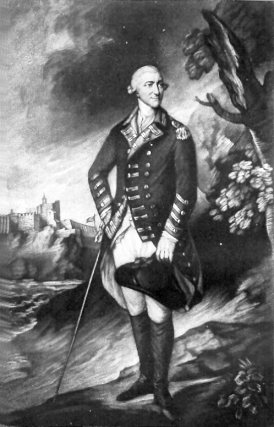
from a print after Gainsborough.
the park are up to your shoulders; horses have been turned into the garden, and banditti lodged in every cottage. The perpetuity of livings that come up to the park-pales have been sold--and every farm let for half its value. In short, you know how much family pride I have, and consequently may judge how much I have been mortified! Nor do I tell you half, or near the worst circumstances. I have just stopped the torrent--and that is all. I am very uncertain whether I must not fling up the trust; and some of the difficulties in my way seem insurmountable, and too dangerous not to alarm even my zeal; since I must not ruin myself, and hurt those for whom I must feel, too, only to restore a family that will end with myself, and to retrieve an estate from which I am not likely ever to receive the least advantage.If you will settle with the Churchills your journey to Chalfont, and will let me know the day, I will endeavour to meet you there; I hope it will not be till next week. I am overwhelmed with business--but, indeed, I know not when I shall be otherwise! I wish you joy of this endless summer.
September
1487. To the Countess of Upper Ossory.
Strawberry Hill, Sept. 1, 1773.
Your Ladyship was particularly kind in letting me meet so agreeable a letter at my return, which made me for some minutes forget the load of business and mortification that I have brought from Houghton, where I was detained four days longer than I intended. You would I fear repent your love of details, were I to enter on particulars of all I have seen and heard! far worse than my worst apprehensions!
You know, Madam, I do not want a sufficient stock of
family pride, yet perhaps do not know, though I think it far from a beautiful place, how very fond I am of Houghton, as the object of my father's fondness. Judge then what I felt at finding it half a ruin, though the pictures, the glorious pictures, and furniture, are in general admirably well preserved. All the rest is destruction and desolation! The two great staircases exposed to all weathers, every room in the wings rotting with wet, the ceiling of the gallery in danger, the chancel of the church unroofed, the water-house built by Lord Pembroke tumbling down, the garden a common, the park half-covered with nettles and weeds, the walls and pales in ruin, perpetuities of livings at the very gates sold, the interest of Lynn gone, mortgages swallowing the estate, and a debt of above 40,000l. heaped on those of my father and brother. A crew of banditti were harboured in the house, stables, town, and every adjacent tenement; and I had but too great reason to say that the out-pensioners have committed as great spoil--much even since my nephew's misfortune. The high-treasurer who paid this waste and shared it is a steward that can neither read nor write. This worthy prime minister I am forced to keep from particular circumstances--I mean if I continue in office myself; but though I have already done something, and have reduced an annual charge of near 1,200l. a year, the consequences of which I believe were as much more--I mean the waste made and occasioned by bad servants, dogs, and horses--still I very much doubt whether I must not resign, from causes not proper for a letter.In the shock and vexation of such a scene was I forced to act as if my mind was not only perfectly at ease, but as if I, who never understood one useful thing in my days, was master of every country business, and qualified to be a surveyor-general. Though you would have pitied
my sensations, you would have smiled, Madam, I am sure, at my occupations, which lasted without interruption from nine every morning till twelve at night, except that a few times I stole from the steward and lawyer I carried with me, to peep at a room full of painters, who you and Lord Ossory will like to hear, are making drawings from the whole collection, which Boydell is going to engrave. Well, the morning was spent in visiting the kennels, in giving away pointers, greyhounds, and foreign beasts, in writing down genealogies of horses--with all my heraldry I never thought to be the Anstis of Newmarket; in selling bullocks, sheep, Shetland horses, and all kind of stock; in hearing petitions and remonstrances of old servants, whom I pitied, though three were drunk by the time I had breakfasted; in listening to advice on raising leases, in ordering repairs, sending two teams to Lynn for tiles, in limiting expense of coals, candles, soap, brushes, &c., and in forty other such details.About one or two, arrived farmers to haggle on leases, and though I did not understand one word in a score that they uttered, I was forced to keep them to dinner, and literally had three, four, and five to dine with me six days of the eight that I stayed there; nor was I quit so, for their business literally lasted most days till eight or nine at night. They are not laconic, nor I intelligent; and the stupidity and knavery of the steward did their utmost to perplex me and confound the map of the estate, every name in which he miscalled, as if he was interpreting to an Arabian ambassador. The three last hours of the night were employed in reducing and recording the transactions of the day, in looking over accounts and methodizing debts, demands, and in drawing plans of future conduct. Oh, I am weary even with the recollection--is not your Ladyship with the recapitulation? For the first four days I was
amazed at the quickness of my own parts, and almost lamented that such talents had lain so long unemployed. I improved two leases 150l., and thought I had raised another more; and let a farm which my Lord kept in his own hands, and has received not a shilling from for seven years, for 500l. a year. Alas! I soon found I had been too obstinate or too sanguine, and absolutely had done nothing but blunder. My farmers broke off when I thought them ready to sign, and the second lease I found my Lord had been overreached in, and had engaged for 400l., though I was offered 600l. by two different persons. I came away chagrined and humbled.As King Phiz says in The Rehearsal, if I am turned off, nobody will take me; I am glad, therefore, your Ladyship did this time resist your propensity to praising me. I am glad to have done with my own chapter, and to come to your Ladyship's entertaining letter--I should not say entertaining, as you have been a month in apprehensions of you know not what. I hope Lord Ossory will soon be without apprehension, and see what he wishes. Good Madam, do not scamper about like some ladies of antiquity, I forget their country, who thought fatigue went halfway in the procreation of a son and heir. I was not so much frightened at Mrs. Page's†1 news; on the contrary, I was diverted, concluding the antiquated beauty was a lady famous for making ducal captives, and was going to be restored.
Lady Barrymore has, I think, two thousand a year, and I believe will not break her little heart, as you may see I thought by this stanza to the tune of Green grow the rushes, oh!
O, my Lady Barrymore,
O, my Lady Barrymore,
If I was you,
I'd bill and coo,
But I would never marry more.
I promise you I will not myself; nor do I think the lady in question will choose another skeleton.
You guessed right, Madam; musicians is the key to the riddle. If it is too easy, which I am bound not to think, as I could not guess it, remember Sir Isaac was more famous for solving problems than for wrapping them in obscurity.
I must beg not to have my details mentioned to the Grace of Courts, nor to your jockeyhood. I doubt they would neither touch the one nor reform the other, though such a theme for moralizing. For my part, I sat down by the waters of Babylon, and wept over our Jerusalem-- I might almost say, over my father's ashes, on whose gravestone the rain pours!
Adieu! Madam, the reading your letter over again made me cheerful. I shall want many such before the impression made by these last ten days will be obliterated.
1488. To Sir Horace Mann.
Strawberry Hill, Sept. 2, 1773.
You have been as kind and zealous in my cause as I expected, my dear Sir; though to little purpose. Lady Orford is only sincere when she avows her insensibility for her son; or rather her resolution of caring for nothing but herself. I found your two letters at my return from Houghton, and though there was but an interval of four days between their dates, she had contrived to deceive you and break her promise between the tenth and the fourteenth,
for she has neither sent to me nor to Mr. Sharpe the letter she made you believe she would write and had written. This extreme art, if it is art to be false without deceiving, will recoil on herself. The applications made to her have persuaded her that I am eager to have the management of her son's affairs, and consequently she thinks it would be for my interest. Now, it happens that nothing would give me so much joy as to be dispensed with from the undertaking. I engaged, because I thought it indecent to decline, when nobody else would submit to the labour, danger, and expense. When his own mother will not deign to ask me to undergo that fatigue, I am clearly exculpated if I refuse. I have shown my zeal and everybody applauds it. What will the world think of her, when she will neither take any trouble herself nor encourage me to do it? The blame must light on her, if she is the cause that her son and his estate are abandoned to plunderers, or that the disgrace of a commission of lunacy is taken out against him by the whole family, or at the instance of his creditors, to the loss of his employments--then he will want her support, and I believe will want it. So much for her Ladyship's finesse --in short, she is flint, and very silly--does she think she has parts enough to draw me on from time to time without giving me the satisfaction I claim? I happen to have a little more sense than she has, as well as more integrity. I have acquainted Mr. Sharpe in form, that if she does not send me the letter by the first of November, I will throw up the trust--then we shall see what resources there are in her cunning to draw me on farther. I care not a straw for her letter; I am sick of the trouble; but I scorn her suspicions, and they shall fall on herself. You must tell her, I beg and insist you will, that she is much mistaken in imagining I am ambitious of the trust. I have desired Mr. Sharpe to tell her so too, and after November 1st she shall know my opinion of her very plainly from myself, the first feature of which is contempt of her paltry cunning, the supreme point of sense in a woman that has not enough, and a certain mark of the want of it. She has affronted the warmth with which I have sacrificed myself, I resent the usage, for I value the good opinion of mankind, though she does not. My uprightness and disinterestedness were never called in question before: I believe it is a match for art--at least it is not afraid of coming to a trial. Were I desirous of the trust, the sanction of the family would bear me out, whether she would or not--but I am above taking the charge of her son, if his own mother will not deign to ask it of me. It was a compliment and an unnecessary one, for she has no power to confer; the Chancery would laugh at her, if she in Italy were to pretend to it when she refuses to come and take care of him. I, who happen to have a little more delicacy, will not proceed without the approbation of his mother, nothing shall make me. Though she uses me ill I will do what I think right, not for her sake but my own. It would be justifying her suspicions to thrust myself into the office against her will-- I have her consent under Mr. Sharpe's hand; but I will have it under her own, for her delay implies diffidence, and no man living shall say I took advantage of a half assent. Her jealousy cannot hurt me; I should be wounded if she had a shadow of pretence for saying that I asked her approbation, and content myself with it at second hand. I must insist therefore, my dear Sir, that you press her no more, but acquaint her that it is perfectly indifferent to me whether she sends me the letter or not, since I shall be more glad to be delivered of the burden than she can be to have me undertake it or decline it; and for my honour's sake take care to use no arguments to convince her she ought to send it. She would think them dictated by me, and though I think address allowable in a good cause, I shall use none to carry a point which can only lead me into a labyrinth of uneasiness--I am not so artful!You would not wonder I am provoked, my dear Sir, if you knew what I had just suffered, when I met with this unworthy treatment. How can I describe the devastation I found? A new debt, contracted by Lord Orford, of above 40,000l. added to those of his grandfather and father! The estate overwhelmed by mortgages, the livings sold, the glorious house dilapidated, and open in many parts to the weather; the garden destroyed by horses, the park half-unpaled, and overgrown with nettles and brambles; a crew of plunderers quartered on all parts, and the house and park mortgaged to my Lady Orford; so that if my Lord were to die, my brother would have an empty title, with no estate to come to, and no house to live in. This is the splendid reversion which her Ladyship thinks I am reserving for myself! Madness and thieves have anticipated my harvest, and I may glean if I please after the prodigal son, his led captains, grooms, horses, dogs, jockeys, mortgagees, and creditors! That is, when I have driven the money-changers out of the Temple, I may cleanse it for her Ladyship, and enrich myself by selling their joint-stools. The poor man himself is now in one of his raving fits, as he is generally at the beginning of the month, with no hopes of recovery even from his intervals. Besides his accidental frenzy, I have heard many instances that corroborate my opinion of his having been long out of his senses.
You say I attend to no politics--it is most true, and you will not wonder. At present I believe there are none in action, at least I know none, nor even news. Their Highnesses of Cumberland, I believe, are not yet sailed. You will have time enough to ask instructions, especially if it is true that they intend a long residence at Milan.
Lord Lyttelton is dead. His worthy son†1 has added so much to his mass of character by histories too opprobrious to be entertaining, that even this age has the grace to shun him; but then he is neither a monarch nor a nabob.
The vacant green riband will certainly not bring home Lord Cowper. It is given to Lord Northington. When I want one of any hue, I will not make interest through the Great Duke. The Pope's policy in tormenting the Jesuits, when he wants to save them, passes my understanding --at least it is not the daring style of roguery in vogue.
Adieu! I am not in a pleasing temper; but fortune and spirits generally remove my greatest difficulties, and I will not distrust such old friends.
1489. To the Rev. William Mason.
Strawberry Hill, Sept. 3, 1773.
Does one break a promise, dear Sir, when one cannot perform it? I have not seen Mr. Chute yet, consequently could not show him the two Italian letters: he is still at the Vine, and I have been learning to moralize in the land of mortification. In one word, I am just returned from Houghton, where I had an ample lecture on the vanity of sublunary grandeur. If I had not suspected myself of being too like Ananias and Sapphira, and of purloining a favourite miniature, I think I should have sold Strawberry the moment I came back, and laid the purchase-money at the feet of the first Methodist apostle I met. This is telling you the havoc and spoil that my poor wretched nephew and a gang of banditti have made on the palace and estates of my father. The pictures alone have escaped the devastation. Methinks I could write another
sermon on them; it would be crowded with texts from the Lamentations of Jeremiah. What can I say to you but Woe, woe, woe? I know nothing; I see nobody but lawyers, stewards, and jockeys. I have given up every occupation and amusement of my life, and think of nothing but saving my family; not that I have any prospect of doing so, but merely because it is less uncomfortable than totally to despair of re-establishing it. I know this is folly and visionary pride: I am sensible that I sacrifice the remains of an agreeable life to disquiet and melancholy and trouble, but I cannot help it: the arrow is shot; it sticks in my breast, and I should not feel the pain of it the less for not trying to pluck it out. Go and write a moral satire on me; I deserve it, for I act with my eyes open.You know Lord Lyttelton is dead: the papers say Mr. Garrick is to be the editor of his papers. I shall not be impatient to see the text or the comment, but truly I believe he left none. He was timid to write anything that he would have been afraid to publish, and was equally in dread of present and future critics, which made his works so insipid that he had better not have written them at all. His son does not seem to have equal apprehensions of the world's censure. Though he was such a
Foe to the Dryads of his father's groves†1,
the shades of Hagley are safe from his axe; they are not liable to the fate of Houghton. When the forests of our old barons were nothing but dens of thieves, the law in its wisdom made them unalienable. Its wisdom now thinks it very fitting that they should be cut down to pay debts at Almack's and Newmarket. I was saying this to the lawyer I carried down with me. He answered: 'The law hates a perpetuity.' 'Not all perpetuities,' said I; 'not
those of lawsuits.' Well, I will have done, for I find every paragraph will close in the same way.By the way, have I told you that I have been at Nuneham? no, I did not; I was strangely disappointed at my arrival and thought it very ugly. The next morning totally changed my ideas; it is capable of being made uncommonly beautiful. Lord Nuneham's garden is the quintessence of nosegays. I wonder some Maccaroni does not offer ten thousand pounds for it; but indeed the flowers come in their natural season, and take care to bring their perfumes along with them. Do you know that the Muses have a little cabinet there? and a female votary†2 who writes with great facility and genteelly. I was trusted with the secret, and mind I don't betray it. Adieu.
1490. To Sir Horace Mann.
Strawberry Hill, Sept. 9, 1773.
Mr. Sharpe has succeeded, though you could not, my dear Sir. I have received a satisfactory, and even flattering, letter from Lady Orford this very day; and I enclose an answer to it, which I hope will be more welcome to her than hers was to me, for it now pins me down to the oar, and the best part of the remainder of life must be given up to this painful duty. I shall do everything in my power to please her, and to do justice to her son and my family. I shall not often trouble her with letters, as she cares so little to be troubled, but you may assure her, and she may depend upon it, that if she will at any time but give me a hint through you or Mr. Sharpe, I will do whatever she commands. I have told her the truth, that nothing should have persuaded me to go on but the approbation of my Lord's own mother. I think the authority of a parent so
sacred that I should have respected it, though she had used it unjustly against me. I am sensible how extremely unfit I am for the office I have undertaken. Necessity excuses my undertaking: the scrupulous exactitude of my conduct shall atone as much as is possible for unwilling errors. Were I an angel I could not do half I wish. My life is too far spent to retrieve so much ruin!I have had another letter from you, with the total demolition of the Jesuits. A series of foolish kings had established them: one foolish king†1 has put a stop to the mischief. An hundred wise Popes had supported them: one wise Pope†2 could not save them. This proves that worldly wisdom or folly are pretty indifferent. Times make men, not men times. Well! but here is a large vacuum in the mass of folly,--what will replace it? I ask, upon a maxim of mine, that it is idle to cure men of a folly, unless one could cure them of being foolish. Some new grievance will succeed to the Jesuits. Mankind will not be cheated, or tyrannized the less, because a certain black habit is abolished. There are still ermine and scarlet coats left. St. Ignatius is no more, but St. Frederic of Prussia, St. Catharine of Muscovy, are still red-lettered in respective rubrics. It is no matter whether disciples of enormous incendiaries wear beads or bayonets. Mankind, that hunts wolves, admires usurpers; and, to the disgrace of talents, Voltaire satirizes Jesuits, and hymns the ravages of Poland. I should like to know for how many paltry roubles and florins he has prostituted his incense and character,--for the florins, I will trust the King of Prussia for half of them being of base metal†3. Gray could not hear Voltaire's name with patience, though nobody admired his genius more; but he thought him so vile, that for the last years
of his life he would read nothing he wrote. Well! but one must read him! Is there another author left in Europe who one wishes should write?I hope to overwhelm you with no more details relating to my family. I shall jog on now in a steward's routine, but will not plague my friends with accounts of mortgages and leases. They may spoil my style, but shall not fill my letters, though they will make me a very uninteresting correspondent. I have no time for anything but business. Adieu!
1491. To the Rev. William Mason.
Strawberry Hill, Sept. 17, 1773.
Dear Sir,
I have been absent from home five days and found twelve letters: after reading them and answering five on business, it is relaxation, dear Sir, to write to you. I will say no more on my occupation: I wish there were such mere merit in it, as to deserve what you say to me.
I enclose the two letters: I kept them to show to Mr. Chute, and am just come from him. He who is a much better Cruscan than I am, dislikes the Italian letter still more; says it is not tolerably pure, and composed of scraps of poetry; that the lines beginning 'Te Dea' are certainly Gray's, they are so incorrect; and yet more poetic than Salvini's†1 lines. I do not wonder; but what would he have been if a Tuscan? You have found by your journey into Westmoreland that his inspired eyes even
Made those bleak rocks and barren mountains smile.
The Swedish curate†2 certainly has not the same talent. With regard to the friendship of the Dedication, I compounded
for it in lieu of more pompous compliments: I might, had I so pleased, have been a patron of learning.The drawings of the kings at York will be time enough next year for any leisure I shall have to bestow on them. I give up my idea of casts, and any thought that implies an opinion of real curiosity or taste in the present age. The nymphs holding necklaces on the outside of a bridge for Sion in Adam's first number, is a specimen of our productions in architecture, as the Preface is of modesty and diffidence. The lottery for the Adelphi buildings will, I suspect, be an example of rather more address. What patronage of arts in the Parliament, to vote the City's land to those brothers, and then sanctify the sale of the houses by a bubble!
I have so totally forgotten what the riddle was I sent you, that I do not know whether your solution with all its humour is right; you may judge with what rubbish my head is filled.--I have learned so many new things of late, that I have lost my memory. I believe poor Lord Nuneham will return in the same situation. You who have all your faculties in perfection may remember when I see you, which I long for, that I tell you of the success I have had in a contest, nay, in a money-contest, with a mitre†3. It will divert you, but is not proper for a letter. I know nothing of higher import, and must therefore bid you good night!
1492. To the Earl of Strafford.
Strawberry Hill, Sept. 24, 1773.
The multiplicity of business which I found chalked out to me by my journey to Houghton has engaged me so much, my dear Lord, and the unpleasant scene opened to me there struck me so deeply, that I have neither had time nor cheerfulness enough to flatter myself I could amuse my friends by my letters. Except the pictures, I found everything worse than I expected, and the prospect almost too bad to give me courage to pursue what I am doing. I am totally ignorant in most of the branches of business that are fallen to my lot, and not young enough to learn any new business well. All I can hope is to clear the worst part of the way; for, in undertaking to retrieve an estate, the beginning is certainly the most difficult of the work--it is fathoming a chaos. But I will not unfold a confusion to your Lordship which your good sense will always keep you from experiencing--very unfashionably; for the first geniuses of this age hold that the best method of governing the world is to throw it into disorder. The experiment is not yet complete, as the rearrangement is still to come.
I am very seriously glad of the birth of your nephew†1, my Lord; I am going this evening with my gratulations; but have been so much absent and so hurried, that I have not yet had the pleasure of seeing Lady Anne†2, though I have called twice. To Gunnersbury I have had no summons this summer: I receive such honours, or the want of them, with proper respect. Lady Mary Coke, I fear, is in chase of a Dulcineus that she will never meet. When
the ardour of peregrination is a little abated, will not she probably give in to a more comfortable pursuit; and, like a print I have seen of the blessed martyr Charles the First, abandon the hunt of a corruptible for that of an incorruptible crown? There is another beatific print just published in that style: it is of Lady Huntingdon. With much pompous humility, she looks like an old basket-woman trampling on her coronet at the mouth of a cavern.--Poor Whitfield! if he was forced to do the honours of the spelunca!--Saint Fanny Shirley†3 is nearer consecration. I was told two days ago that she had written a letter to Lady Selina†4 that was not intelligible. Her Grace of Kingston's glory approaches to consummation in a more worldly style. The Duke is dying, and has given her the whole estate, seventeen thousand a year. I am told she has already notified the contents of the will, and made offers of the sale of Thoresby. Pious matrons have various ways of expressing decency.Your Lordship's new bow-window thrives. I do not want it to remind me of its master and mistress, to whom I am ever the most devoted humble servant,
HOR. WALPOLE.
October
1493. To the Countess of Upper Ossory.
Strawberry Hill, Oct. 1, 1773.
I do not agree with your Ladyship that the Duchess of Kingston will have recourse to the protection of the King of Prussia. His Majesty has not shown such partiality to Hymen as implies a propensity to bigamy. It might be charity to continue her Maid of Honour, after she was married and had two children, and was starving at Chudleigh
House, like poor fat Mrs. Pritchard in Jane Shore; but every court is neither so pious nor so gallant as to wear favours every time a virgin loses her vestality. I am charmed with what you say, that much will be said that she does deserve, and more that she does not. One may always venture to bet that the world's ill-nature will outgo anybody's ill deeds; and I am persuaded that Nero and Cæsar Borgia will, as well as Richard III, come out much better characters at the Day of Judgement, and that the pious and grave will be the chief losers at that solemnity. I have not yet heard the Duke†1 and Duchess's will. She moved to town with the pace of an interment, and made as many halts between Bath and London as Queen Eleanor's corpse. I hope for mercy she will not send for me to write verses on all the crosses she shall erect where she and the horses stopped to weep; but I am in a panic, for I hear my poor lines at Ampthill are already in the papers. Her black crape veil, they say, contained a thousand more yards than that of Mousseline la Sérieuse, and at one of the inns where her grief baited, she was in too great an agony to descend at the door, and was slung into a bow-window, as Mark Antony was into Cleopatra's monument. I trust I shall learn more before this letter sets forth, but you will know all as soon as I shall, and as authentically. All my intelligence here arrives dislocated through dowager prisms, who pretend to see everything in its true colours, and represent nothing as they received it. I always begin my answers the moment I receive your Ladyship's, to keep up the conversation, but they often wait two or three days before they get their complement, and then I am ashamed of their scantiness, for the liberality of your pen scampers over a page of paper in a dozen lines, while my narrow-minded tool crams more words into a line.Like your Ladyship, I hear of nothing but matches, but, alas! all mine are at Newmarket. I never saw Lady Wrottesley's†2 sister, much less do I know who her lover is. It is plain how old I grow, for I am quite ignorant of all that relates to the reigning and rising generation. I was showed the other day a very long and bitter lampoon upon many nymphs and swains, now dancing on the present turf of Arcadia, and lo! I could not guess at half the names or characters; yet all the fashionable world are there. It seemed to me a satire on a boarding-school, written by a schoolboy.
Mr. Browne's flippancy diverted me: it is what was called wit two thousand years ago. There are twenty such pieces of impertinence recorded of the Grecian philosophers, and I shall wonder if this does not make its fortune. The moment a fashionable artist, singer, or actor is insolent, his success is sure. The first peer that experiences it laughs to conceal his being angry at the freedom; the next flatters him for fear of being treated as familiarly; and ten more bear it because it is so like Browne!
George Onslow was here this morning, and told me the Parliament is not to meet till after Christmas; so Lord Ossory's cares will not be divided, Madam, between the nation and your month. I beg you be very exact about your reckoning, and take the utmost care not to creep on into the new year; there will be nothing but girls in seventy-four. Lord Gowran's manhood depends upon his being born before the first of January, and till then you are sure of a son. I don't see why you should take the pains to have a child at all next year.
I must entreat you not to shorten your letters for want of matter. Am not I your Cicisbè established? Do you
think those sentimental pairs in Italy who whisper from morning to night for forty years together, talk of nothing but their passion and news? Dear Madam, depend upon it, in the intervals of love the Signora Antonia tells the Cavalier Giovanni Battista what she had for dinner, how she scolded her maid, and whether her husband allows her a piccion grosso every day or not. I never knew a fair one but poor Lady Rochford who could talk about it and about it to all eternity. In short, every line from your Ladyship's pen will be welcome; and the trifles I tell you prove how little I think of anything but amusing you. Good night!Saturday noon†3.
Hymen, O Hymenaee! Well! I have got my budget full, and my letter shall set out incontinently. The post is come in and the mail is come in, and I shall decant all my news to my Lord and our Lady. The Duchess†4 is a miracle of moderation! She has only taken the whole real estate for her own life, and the personal estate for ever. Evelyn Meadows†5 is totally disinherited. The whole real estate after Andromache the Duke gives to the next brother†6 (who took the Hermione), and in failure of his heirs to his three brothers in succession; and in default of issue thence, to the Duke of Newcastle's second son, Lord Thomas Clinton†7. Wortley Montagu gets an estate of 1,200l. a year that was settled on him. There are small legacies to the amount of 1,200l., and Mr. Brand†8 is not mentioned. Still, the most curious part I am yet to learn;
my letters do not tell me by what style, as the heralds call it, he has proclaimed his heiress.The next scene lies in Calais. You shall have the identical words of my Lady Fenouilhet's letter:--
'I must acquaint you with a piece of insolence done to the Duke and Duchess of Cumberland. Their Royal Highnesses, upon their arrival here on Saturday se'nnight, went to the play, as likewise on Sunday. On Monday morning two of the players waited on their Royal Highnesses to thank them for the honour that had been done them, and to receive the gratification usual upon such occasions. The Duke gave them three guineas for the two representations, which was so far from satisfying these gentry, that, by way of impertinence, they sent their candle-snuffer, a dirty fellow, to present a bouquet to the Duchess, who was rewarded for his impudence with a volley of coups de bâton. This chastisement did not intimidate the actors, who sent one of their troop after the Duke to St. Omer, with a letter, to know if it was really true his Royal Highness gave but three guineas, for that they, the players, suspected their companions had pocketed the best part of what was given. What answer the Duke gave I know not, but the man who went with the letter has been put in prison, and the whole troop has been ordered to leave the town--voilà qui est bien tragique pour les comédiens. This affair is as much talked on at Calais as if it was an affair of state.'
Well, Madam, by their début I think this cour ambulante ne laissera pas de réjouir l'Europe. Oh, I forget, I ought to be highly offended; but, I don't know how it is, my royal blood does not always take fire immediately.
1494. To Sir Horace Mann.
Strawberry Hill, Oct. 4, 1773.
I am glad, my dear Sir, that you was satisfied my Lady Orford had written to me, and that you did not deliver my message. Her delay was so critical, and distressed me so much, that you must not wonder I was hurt. The claim she pretends is not quite new to me, though I trust no more to be realized than it is well founded. Take no notice of my having any idea of it. I have reason to think her intention most malicious--but I am satisfied with knowing it, as it will put me on my guard.
The court†1 that is on the road to Milan began their journey with ugly omens. They went two nights to the play at Calais. Next morning a deputation of players went with a compliment, and to be paid. They received only three guineas. In revenge they dispatched a dirty candle-snuffer with a bouquet for the Princess. He was received as he deserved, à coups de bâton. Not content, a third messenger followed to St. Omer to know if really no more than three guineas was given, the company suspecting that their comrades had pocketed part of the gratuity. The French Government have imprisoned the last ambassador, and banished the dramatis personae. This is very proper; but methinks we are seldom lucky when we are transplanted.
This is not much known here. All tongues are busy with her Grace of Kingston; the Duke is dead, and has given her his whole landed estate for her life, and his personal for ever: but the quintessence of the history is, that, to be secure of the wealth, she has avowed how little claim she had to it, being intituled in the will, 'My dearest
wife Elizabeth Duchess of Kingston, alias Elizabeth Chudleigh, alias Elizabeth Hervey.' Did you ever hear of a Duchess described in a will as a street-walker is indicted at the Old Bailey? Perhaps the house of Hervey does not make a much brighter figure in the narrative.There is not a syllable of other news. The Parliament is not to meet till after Christmas. Wilkes and all the lately popular ringleaders of the City are squabbling who shall be Lord Mayor. At court they are struggling who shall have the three vacant Garters. I believe nobody else cares who has.
From France I hear that Monsieur d'Aiguillon begins to display the talons he has long been suspected to have. The Comte de Broglie was named to fetch the Comtesse d'Artois. As his family is Piedmontese, instead of receiving her on the confines, he asked leave to go to Turin to make his court to the King of Sardinia†2 a month before the intended time. Receiving no answer from the Duc d'Aiguillon, Broglie wrote to reproach him. The letter gave offence, and the Duke carried it to the King. It was read in council, and his Majesty as his minister's minister wrote himself to the Count, took away his new office, and banished him to his own seat, a hundred and twenty miles from Paris. The Count is the sort of man to have done just so by anybody else.
My poor nephew is at present quite furious, as he is at the beginning of every month, and apt to attempt mischief. At best he seems to have quite lost his head, knows nobody, is restless, and walks incessantly. You will mention these particulars, as proper for me to send, though I doubt there is little curiosity to know. My life, which, though always occupied, has in reality been an idle one, is now passed in business. Combating rogues is not the least part of
my employment. The vultures stick to the carcase of the estate, as if they had not been gorged with its flesh. The lawyers press on me with offers of managing; the servants cannot break themselves of pilfering; and my Lord's friends set up promises, as if they had left him anything to give. It is strictly true, that, from the instant he was seized, there has been but one universal thought of plundering. I create enemies at every step, and must expect torrents of abuse, because I am determined not to deserve it. In good truth the expectation of it will be a sufficient check-- for can one trust oneself when one sees so much vileness?My administration is an epitome of greater scenes; and, happily, I enter upon it at an age when every passion is cooled. I shall be inexcusable if I do anything but right. My father alone was capable of acting on one great plan of honesty from the beginning of his life to the end. He could for ever wage war with knaves and malice, and preserve his temper; could know men, and yet feel for them; could smile when opposed, and be gentle after triumph. He was steady, without being eager; and successful, without being vain. He forgot the faults of others, and his own merits; and was as incapable of fear as of doing wrong. Oh, how unlike him I am! how passionate, timid, and vain-glorious! How incapable of copying him, even in a diminutive sphere! in short, I have full as much to correct in myself as to control in others; and I must look into my own breast as often as into bills and accounts. I had done with the world and reposed myself on my own indifference--now I must engage with men again, and take care that the passions which had agitated my life, and which were rather become drowsy than were eradicated, may not be roused again--for my part is not merely the care of an estate. I have jealousy, malice, design, and art to encounter, and an irascible temper ready to betray me.
I must be just and honest to farmers that mean to cheat me, and must keep fair with lawyers that watch to involve me. I must even be careful not to risk my own safety by impetuosity to embrace plans for extricating the estate --but what is all this to you, my dear Sir? I perceive that I am only repeating my own lesson, and am talking to myself rather than to you--no, it is not quite indifferent to you. You feel for me, and will even listen to me when I commune with myself--but enough at present--I shall but too often return to the subject. Adieu.
1495. To the Countess of Upper Ossory.
Strawberry Hill, Oct. 7, 1773.
I cannot yet tell you positively, Madam, whether the Duke of Kingston has indited the Duchess by all her alias's or not. I believed so, positively, for two days; but I heard to-night that the will was made before they were married. I will not swear to this, nor to what I heard farther, that her first husband has been seen coming out of her house since she arrived.--I do not mean his ghost, for the first husband is not dead, though the second is. I hope it is true, and that Augustus Hervey will be as like Cato as two peas, and take his Portia again after the loan of her.
I have now learned that Miss Courtney's lover is my niece's brother-in-law, and am just as indifferent about their history as I was before. Since I am answering your Ladyship's last letter again, I must tell you that I have recollected a passage in Madame de Sévigné exactly applicable to Browne's impertinence to the Duke of Marlborough, and still more just. An upstart gentleman playing at picquet with the Marshal de Grammont, and being very flippant, the Marshal said to him, 'Monsieur, gardez ces familiarités-là pour quand vous jouerez avec le Roi'--and yet, that Mr. Browne was not the King's playfellow.
In lieu of novelties, you must be contented to-day with an account of a dinner, that at least to me was new indeed. Lady Shelburne had engaged me to meet Lady Bingham on Monday. When I arrived, what company do you think I found?--fourteen: herself, her second son†1, two nieces, Lady Bingham and her niece, Townshend the Lord Mayor and his wife, Mr. Deputy Paterson and his, Adair†2 the surgeon, a Mr. Kelly, and a Dr. Bruce, a parson with whom I once had a great quarrel. I cannot say I was sorry, for two of the personages are famous in their generation, and I never had seen them before, Adair and Townshend. I cannot say I was much prejudiced in favour of the latter, nor made any acquaintance with him, though the Countess presented us to each other. I fear I did not even drink the City's health to him as everybody else did. His wife, a bouncing dame, with a coal-black wig, and a face coal-red, called him My Lord at every word, and our hostess much'd him as Mrs. Quickly does Falstaff; but I can tell you something more fashionable than these cits. Count Walderen is just returned from Petworth, where he saw Lord Egremont's†3 new liveries; the postilions have white jackets trimmed with muslin, and clean ones every two days. Who will be the first to refine on this delicacy, and give Brussels lace? I know one that will not; that is, I know but one young man who, without affecting wisdom, has no faults; who has all the passions of youth without its ridicules; who loves gaming without making or losing a fortune, and Newmarket without being a dupe or a sharper; who has good sense without vanity, and good nature without weakness; who can live with Maccaronies, and be in fashion without folly; and who does everything
right and proper so naturally, that both the sensible part of the world and the absurd part always think he is just what he ought to be. If your Ladyship thinks this character is flattered or exaggerated, depend upon it you will never guess whom I mean, and yet it would be wronging your penetration to say you have not discovered the person†4.Lady Bingham is, I assure you, another miracle. She began painting in miniature within these two years. I have this summer lent her several of my finest heads; in five days she copied them, and so amazingly well, that she has excelled a charming head of Lord Falkland by Hoskins†5. She allows me to point out her faults, and if her impetuosity will allow her patience to reflect and study, she will certainly very soon equal anything that ever was done in water-colours.
They are amazingly bold, high-coloured, and finished. She draws them herself; and so far from being assisted, no painter in England could execute them in half the time. It is still more surprising that she copies from oil full as well, and her only fault is giving more strength than the originals have.
Oct. 9, 1773†6.
As I do not write my letters in a breath, feasts increase upon me. I have quitted the city for the clergy. Yesterday I dined at George Onslow's with the Archbishop†7, the Dean of Westminster†8, a head of a college, two more divines, Lady North, and Madam the Metropolitan. Yesterday they all breakfasted here, and Lord North; I enthroned the Primate in the purple chair from the Holbein room, and it will never be filled with a better prelate. I went with
them and dined in Bushy Park, and played at loo till ten at night, and came home in a tempest. I hope Jupiter Pluvius has not been so constant at Ampthill: I think he ought to be engraved at the top of every map of England. Mrs. Onslow†9 screamed at the likeness of your picture, and yet I am not satisfied with it.The post is come in, and I have not had a line from your Ladyship this week. I do not mention it to complain, but for fear it should proceed from any-out-of-orderness.
†1496. To the Earl of Hardwicke.
[Oct. 1773.]
Mr. Walpole presents his compliments to Lord Hardwicke, and should have had the honour of waiting upon his Lordship before now, but has not been at Twickenham for two days together, being most unfortunately so involved in the care of Lord Orford's affairs that he has not one minute of time to give even to his own. Lady Orford has refused to meddle, Sir Edward Walpole has other business of consequence, and the whole burthen lies on Mr. Walpole, who is obliged to see the physicians, lawyers, and stewards; and what he still less expected would ever happen to him, he is now perplexed with Lord O.'s concerns at Newmarket, where the horses are to be sold next week.
Mr. W. is therefore forced to entreat Lord Hardwicke will excuse him at present, but as soon as he has a minute's leisure he will look out the papers his Lordship wishes to see, and will beg the honour of his Lordship's company at Strawberry Hill, where he could amuse him with many things, which he is now obliged to abandon for objects
he is little capable of executing as they ought to be, and which make him very unhappy, and will probably perplex the remainder of his life.
1497. To the Countess of Upper Ossory.
Arlington Street, Oct. 26, 1773.
The Pope gave a fellow, who pretended to know the art of making gold, a purse. Your Ladyship has sent one to me, who, I assure you, have not that secret--anzi, I only know how to dissolve it, though not to the perfection of some of my contemporaries. I thank you for it, however, and contrary to custom, value the extrinsic, which is beautiful, and I believe copied from some pattern of Iris's. Thank Heaven it is complete, and did not remain imperfect like a watergall: I don't know if I spell well. I will try if fortune can be dazzled by it, though they say she is blind, the first time I play at loo, but I have left it off: the ladies are all Maccaronies, and game too deep for me. The last time I was in town, Lady Hertford wanted one, and I sat down to what they call crowns. I lost fifty-six guineas before I could say an 'Ave Maria.'
I swear by all the saints that I have not the glimpse of an objection to Lord Ossory's going to Houghton, but an insurmountable one to his sojourning at the inn. Trust me, Madam, he will be almost as poorly accommodated at the mansion-house, except in beds; and unless he carries his batterie de cuisine, cook and camp equipage, I doubt he must eat the game raw. The Philistines have been there before him and devoured everything. I shall write incontinently to the housekeeper and order beds to be aired. It is well I did not receive your commands yesterday: I should have sent an excuse. In short, I had resigned the Seals--and did not shed tears. I am plagued out of my
senses; cheated, thwarted, betrayed--a very minister in miniature. I plucked up spirit, threw up my office, and hugged myself with my otium sine dignitate. My brother has been very kind, and has softened me, and I must go on; but with so little prospect of doing any good, that, without the vanity of a martyr, it will be impossible to persevere. I now conceive what I could scarce believe, that there were men capable of plundering Lisbon while it lay in ruins and ashes. I am almost afraid of trusting Lord Ossory,--as he calls himself Lord Orford's friend, I am afraid he should steal a picture. Apropos, he will find but one young pointer there: two have been carried off in spite of my teeth, though I have gnashed them horribly. To Lord Ossory I am obliged for the first and only notice I have received yet of the sale of my horses. I sent down the lawyer and the steward, and neither of them have deigned to send me a line. They mind me as little as if I was really Lord Orford. Seriously, unless there is an Act of Parliament to make all First Ministers absolute, there will be no going on. Lord Mansfield is very good, and I am sure would support my prerogative, but the forms of law are tedious: I want to have power of hanging and beheading everybody that contradicts me on the spot.Now I have vented my own cares, I can attend to your Ladyship's. You need not press me to be violent against the Irish tax†1--follow you to the Queen's County! why, I must cross the Channel, if I have a mind to see a friend I have in the world, and I must carry them clothes too: they will not have a shirt left to their backs. Pray write me all Lord Ossory hears thence. I shall be at Strawberry, and know nothing. Cannot you raise a rebellion? There
is a very pretty precedent that I read in the papers this morning from Palermo†2. They make nothing in Spain and Sicily of shipping off a Viceroy or Secretary of State. Cannot you order a band of O'Bloods to tie Lord Harcourt hand and foot, and send him directed to St. James's? I will be ready at a minute's warning to put on King Francis's armour, and make a diversion in your favour.Where are Charles Fox, and Mr. Fitzpatrick with the forlorn hope? Come, bustle, bustle, as my friend King Richard says; never despair, you fight for your household gods--they are mercenary folks, and never stay where there is no house.
As to Miss Pelham, she will have neither house nor Lares left. The latter can never believe a syllable she says. It is well our gods are only made of bread, and I wish she may have a manchet of them to eat! Poor soul, I heartily pity her, for she is quite mad!
I do not know a teaspoonful of news. I dined and passed the evening of Saturday with the Hertford party at Sion--not at the great Sion, but at Lady Holdernesse's. I could tell you what was trumps, but that was all I heard. In truth, I know nothing, think of nothing but my poor nephew's affairs and Rosette. I left her this morning so ill and weak, that I shall not be surprised, though shocked, if I find her dead. Margaret sat up with her the whole night before last; I have sat up half the night many times, and raised all the family. Well! there ends the last of my favourites! I cannot get rid of nepotism, but at least Pope Horace will govern by himself.
November
†1498. To Sir Horace Mann.
Strawberry Hill, Nov. 4, 1773.
I am sorry, my dear Sir, that our correspondence has almost dwindled into my making you a letter-carrier! Alas! we must only lament the melancholy cause, which, added to a total dearth of events in this country, reduces me to think of nothing but the most disagreeable kinds of business. My life is worn out with fatigue, for I give up my whole time to my duty, and it does not suffice. I not only write all my letters myself, but I am forced to take copies of them too, for it is of too much consequence to me not to know what I say; and many I cannot trust to a copyist, as you will see by the enclosed, which I send you opened, for I cannot write it over a third time. Put a seal that my Lady will not know; but make yourself master of the contents first, that you may be able to assist me if necessary, and say I sent you a summary account of the matter. Pray tell me exactly how she takes it--Mr. Sharpe would have persuaded me against this step; everybody else approves it. In short, I can do nothing else--and if she will do nothing, she, not I, must be answerable for the consequences. I am forced to combat at every step. Jealousies, knavery, interest, beset me at every turn. I act as steadily and uprightly as human nature and my own ignorance will let me. I am sometimes forced to fight art at its own weapons. In short, I think in the space of six months I have employed as much labour, address, circumspection, and have made as many enemies, as if I governed a kingdom. I defend the remains of the estate with as great pains as it was raised, and endeavour to do it with the
same integrity--but ah! when I grow vain and reflect a minute, I find I am in everything but the ape of my father! and no more like him than to Hercules!--yet Voltaire says I am precisely at the age from which great men date their course. Oh yes, he says that Charles V resigned his crowns 'à l'âge de cinquante-six ans, c'est-à-dire, à l'âge où l'ambition des autres hommes est dans toute sa force, et où tant de rois subalternes nommés ministres ont commencé la carrière de leur grandeur.'-- I am sure I have none of the symptoms but the age and the subalternity. I never knew the feel of ambition, and I have not cut it at this time of day! nor, if I have not more repose than I have had lately, will my grandeur's career be very long. Little did I think my glory would consist in being an excellent steward! no more than the Pope thought he should wish the Jesuits at the devil.No mortal here thinks of that holy squabble, except one or two good Catholics, who publish mournful letters in our papers about those persecuted saints--or more probably they publish them themselves, for, as I told the Abbé Chauvelin†1 at Paris, I could not congratulate him on his victory, since I believe he had only sent the Jesuits to us.
We have literally no news, public or private. They talk of a tax on absentees that is to be passed in Ireland, and that is to make a noise here. They now begin to say it will not be passed there--and how can one think about the egg of an egg that may be addled?
Justice Fielding has revived the hypothesis of the Beggar's Opera making all our rogues. Garrick has in a manner given it up, but they continue it at Covent Garden--so we shall have but half the number. Did you know before that Macheath begot all our nabobs?
My hand is so weary that I could not write any more
if I had anything more to say. Consider I have written out these six sides to Lady Orford since dinner.
1499. To Viscount Nuneham.
Strawberry Hill, Nov. 6, 1773.
My Dear Lord,
I have once or twice begun to write to you, and commenced my epistle with 'May it please your O'Royal Highness†1,' but as I conclude you are as weary of royalty, by this time, as I am of my portion of it, I will use the freedom you have long allowed me, and only tell you how happy I shall be to hear you and Lady Nuneham are well. When you get into your closet and have locked your door, and have washed off pounds of snuff that you have taken against everybody that has approached you, pray, before you double yourself up, take a pen and write me a line; 'tis all the tax I will lay on your absenteeship. Mrs. Clive has long threatened to write before me, but the campaign is not yet finished, nor all the kings, queens, and knaves retired into winter-quarters; so, at most, she can tell you but of a miraculous draught of fishes that she took in a vole sans prendre. In truth, I have no better materials. London is a desert, and nobody asks but if there is a mail from Ireland! There is not a new book, play, wedding, or funeral. Duchess Hervey is already forgotten. My life is passed alone here, or in going to London to talk with lawyers and stewards, and writing letters to Norfolk about farms; so that your Lordship is not singular in being out of your element. The rest of my time has been employed in nursing Rosette--alas! to no purpose. After suffering dreadfully for a fortnight from the time she was seized at Nuneham, she has only languished till about ten days ago. As
I have nothing to fill my letter, I will send you her epitaph; it has no merit, for it is an imitation, but in coming from the heart, if ever epitaph did, and therefore your dogmanity will not dislike it.
Sweetest roses of the year
Strew around my Rose's bier.
Calmly may the dust repose
Of my pretty faithful Rose!
And if, yon cloud-topp'd hill behind,
This frame dissolved, this breath resign'd,
Some happier isle, some humbler heaven
Be to my trembling wishes given,
Admitted to that equal sky,
May sweet Rose bear me company!
Lady Nuneham should not see these lines, if she had time to write any herself; but Clio hates crowds and drawing-rooms, and I am persuaded took leave when her Ladyship embarked. I hope they will meet again in Wales, and that we shall all meet again in Leicester Fields. So prays, &c.
1500. To the Earl of Strafford.
Arlington Street, Nov. 15, 1773.
I am very sorry, my dear Lord, that you are coming towards us so slowly and unwillingly. I cannot quite wonder at the latter. The world is an old acquaintance that does not improve upon one's hands: however, one must not give way to the disgusts it creates. My maxim, and practice, too, is to laugh, because I do not like to cry. I could shed a pailful of tears over all I have seen and learnt since my poor nephew's misfortune--the more one has to do with men the worse one finds them. But can one mend them? No. Shall we shut ourselves up from them? No. We should grow humorists--and of all
animals an Englishman is least made to live alone. For my part, I am conscious of so many faults, that I think I grow better the more bad I see in my neighbours; and there are so many I would not resemble that it makes me watchful over myself. You, my Lord, who have forty more good qualities than I have, should not seclude yourself. I do not wonder you despise knaves and fools; but remember, they want better examples; they will never grow ashamed by conversing with one another.I came to settle here on Friday, being drowned out of Twickenham. I find the town desolate, and no news in it, but that the ministry give up the Irish tax--some say, because it will not pass in Ireland; others, because the City of London would have petitioned against it; and some, because there were factions in the Council--which is not the most incredible of all. I am glad, for the sake of some of my friends who would have suffered by it, that it is over. In other respects, I have too much private business of my own to think about the public, which is big enough to take care of itself.
I have heard of some of Lady Mary Coke's mortifications. I have regard and esteem for her good qualities, which are many; but I doubt her genius will never suffer her to be quite happy. As she will not take the Psalmist's advice of not putting trust, I am sure she would not follow mine; for, with all her piety, King David is the only royal person she will not listen to, and therefore I forbear my sweet counsel. When she and Lord Huntingdon meet, will not they put you in mind of Count Gage†1 and Lady Mary Herbert, who met in the mines of Asturias, after they had
failed of the crown of Poland?--Adieu, my dear Lord! Come you and my Lady among us. You have some friends that are not odious, and who will be rejoiced to see you both--witness, for one,Yours most faithfully,
HOR. WALPOLE.
1501. To the Countess of Upper Ossory.
Arlington Street, Nov. 18, 1773.
I do not know, Madam, whether my satisfaction has not overflowed a little too soon. The fate of the tax†1 is tant soit peu more uncertain than I thought it, though still not expected to pass in Ireland. I hate to send you false news, therefore you must hear my authority. Lady Hertford told me on Sunday night, with great pleasure, that the Duchess of Bedford had assured her it was given up; and the next morning I heard so as positively from others. It is still believed that instructions for damping it have been sent to Dublin. Mr. Fortescue Clermont, the intended mover, declares he finds it unpopular, and will not propose it. Commentators say he has been prevailed on to drop it. However, an account is come that Colonel Blaquière†2, who, contrary to usage, has opened the budget instead of the Attorney-General†3, has mentioned a tax on absentees among the possible ways and means of replenishing the national purse. This is not imputed to that first minister's address. He has talked of a tontine, too, still more likely to be obnoxious than the tax, as it must be provided for by a permanent revenue, a measure that would annihilate the necessity of Parliaments. This is the totality of my intelligence, collected solely for the information of your
Treasury. I have nothing of so small moment as the public to think of: nor did Irish politics ever before come under the meridian of mine; but I have been such a harlequin, and changed my habit so often of late, that it would scarce be wonderful if I were to turn Whiteboy.I am so cowed by having given you unauthentic history, that I must protest devoutly I do not affirm one syllable of what I am going to tell you. I know nothing of the following legend, but from that old maid, Common Fame, who outlies the newspapers. You have read in Fielding's chronicle the tale of the Hon. Mrs. Grieve; but could you have believed that Charles Fox could have been in the list of her dupes? Well, he was. She promised him a Miss Phipps, a West Indian fortune of 150,000l. Sometimes she was not landed, sometimes had the small-pox. In the meantime, Miss Phipps did not like a black man; Celadon must powder his eyebrows. He did, and cleaned himself. A thousand Jews thought he was gone to Kingsgate to settle the payment of his debts. Oh no! he was to meet Celia at Margate. To confirm the truth, the Hon. Mrs. Grieve advanced part of the fortune--some authors say an hundred and sixty, others three hundred pounds--but how was this to answer to the matron?--why by Mr. Fox's chariot being seen at her door. Her other dupes could not doubt of her noblesse or interest, when the hopes of Britain frequented her house. In short, Mrs. Grieve's parts are in universal admiration, whatever Charles's are.
I went last night to see Mrs. Hartley. She is beautiful indeed, but has not quite so much sense in her countenance as Mrs. Grieve, and I think will never be half so good an actress. You will be sick of the sight of my letters. I will not even tell you if the tax is thrown out.
1502. To the Rev. William Mason.
Arlington Street, Nov. 19, 1773.
I know nothing of you: you have left me off. I know you are alive, for Lord Strafford has seen you twice. Yet it is plain I am not out of charity with you, for I have been to see Elfrida; think it was out of revenge, though it is wretchedly acted, and worse set to music. The virgins were so inarticulate, that I should have understood them as well if they had sung choruses of Sophocles. Orgar had a broad Irish accent: I thought the First Virgin, who is a lusty virago, called Miss Miller, would have knocked him down, and I hoped she would. Edgar stared at his own crown, and seemed to fear it would tumble off. For Miss Catley†1, she looked so impudent and was so big with child, you would have imagined she had been singing the 'black joke,' only that she would then have been more intelligible. Smith†2 did not play Athelwold ill; Mrs. Hartley is made for the part, if beauty and figure could suffice for what you write, but she has no one symptom of genius. Still it was very affecting, and does admirably for the stage under all these disadvantages. The tears came into my eyes, and streamed down the Duchess of Richmond's lovely cheeks.
Mr. Garrick has been wondrously jealous of the King's going twice together to Covent Garden, and to lure him back, has crammed the town's maw with shows of the Portsmouth review, and interlarded every play with the most fulsome loyalties. He has new-written the Fair Quaker of Deal, and made it ten times worse than it was originally, and all to the tune of Portsmouth and George
for ever! not to mention a Preface in which the Earl of Sandwich, by name, is preferred to Drake, Blake, and all the admirals that ever existed.Dr. Hawkesworth is dead, out of luck not to have died a twelvemonth ago.
Lady Holdernesse has narrowly escaped with her life; she fell on the top of the stairs at Sion, against the edge of a door, which cut such a gash on her temple, that they were forced to sew it up; it was within half an inch of her eye, which is black all round, but not hurt, and her knee was much bruised.
This good town affords no other news, and is desolate; not that I make you any apologies for being so brief. I have ten times more business than you, and millions of letters of business, and sure you might always find as much to say as I had now.
1503. To the Rev. William Mason.
Arlington Street, Nov. 27, 1773.
Dear Sir,
Mr. Stonhewer has sent me, and I have read, your first part of Gray's Life, which I was very sorry to part with so soon. Like everything of yours, I like it ten times better upon reading it again. You have with most singular art displayed the talents of my two departed friends†1 to the fullest advantage; and yet there is a simplicity in your manner, which, like the frame of a fine picture, seems a frame only, and yet is gold. I should say much more in praise, if, as I have told Mr. Stonhewer, I was not aware that I myself must be far more interested in the whole of the narrative than any other living mortal, and therefore may suppose it will please the world still more than it will ----. And yet if wit, parts, learning, taste, sense,
friendship, information, can strike or amuse mankind, must not this work have that effect?--and yet, though me it may affect far more strongly, self-love certainly has no share in my affection to many parts. Of my two friends and me, I only make a most indifferent figure. I do not mean with regard to parts or talents--I never one instant of my life had the superlative vanity of ranking myself with them. They not only possessed genius, which I have not, great learning which is to be acquired, and which I never acquired; but both Gray and West had abilities marvellously premature. What wretched boyish stuff would my contemporary letters to them appear, if they existed; and which they both were so good-natured as to destroy. What unpoetic things were mine at that age, some of which unfortunately do exist, and which I yet could never surpass; but it is not in that light I consider my own position. We had not got to Calais before Gray was dissatisfied, for I was a boy, and he, though infinitely more a man, was not enough so to make allowances. Hence am I never mentioned once with kindness in his letters to West. This hurts me for him, as well as myself. For the oblique censures on my want of curiosity, I have nothing to say. The fact was true; my eyes were not purely classic; and though I am now a dull antiquary, my age then made me taste pleasures and diversions merely modern: I say this to you, and to you only, in confidence. I do not object to a syllable. I know how trifling, how useless, how blamable I have been, and submit to hear my faults, both because I have had faults, and because I hope I have corrected some of them; and though Gray hints at my unwillingness to be told them, I can say truly that to the end of his life he neither spared the reprimand nor mollified the terms, as you and others know, and I believe have felt.These reflections naturally arose on reading his letters again, and arose in spite of the pleasure they gave me, for self will intrude, even where self is not so much concerned. I am sorry to find I disobliged Gray so very early. I am sorry for him that it so totally obliterated all my friendship for him; a remark the world probably, and I hope, will not make, but which it is natural for me, dear Sir, to say to you. I am so sincerely zealous that all possible honour should be done to my two friends, that I care not a straw for serving as a foil to them. And as confession of faults is the only amendment I can now make to the one disobliged, I am pleased with myself for having consented, and for consenting, as I do, to that public reparation. I thank you for having revived West and his, alas! stifled genius, and for having extended Gray's reputation. If the world admires them both as much as they deserved, I shall enjoy their fame; if it does not, I shall comfort myself for standing so prodigiously below them, as I do even without comparison.
There are a few false printings I could have corrected, but of no consequence, as 'Grotto del Cane,' for 'Grotta,' and a few notes I could have added, but also of little consequence. Dodsley, who is printing Lord Chesterfield's Letters, will hate you for this publication. I was asked to write a Preface--Sic notus Ulysses? I knew Ulysses too well. Besides, I have enough to burn without adding to the mass. Forgive me, if I differ with you, but I cannot think Gray's Latin poems inferior even to his English, at least as I am not a Roman. I wish too that in a note you had referred to West's Ode on the Queen†2 in Dodsley's Miscellanies. Adieu! go on and prosper. My poor friends have an historian worthy of them, and who satisfies their and your friend
HOR. WALPOLE.
P.S. Since I wrote my letter, which is not to go till to-morrow, I have received your letter, and most delightful lines: you are sure I think them so, and should if they were not yours. The subject prejudices me enough, without my affection for your writings. I cannot recollect now (for I lose my memory by having it over-stuffed with business) who told me the story of the blasphemy†3, and I will never affirm to you anything where I cannot quote my evidence. Perhaps I shall remember; the story however ought not to be lost, and may be reserved for even a twentieth edition; no, I don't know whether there will be a twentieth. If what you tell me of a message be true, there will not be one. I had not heard it, but can easily believe it, and I could tell you exactly what it would cost, and will by word of mouth, if I ever see you again: for though I shall get some courtier to direct this, that it may pass safe, I cannot name my authority in writing. The fact is a secret yet, but will not be so long.
I will send for the Life again to Mr. Stonhewer, since the impression is not perfect, and will add two or three corrections and perhaps a note or two, which you may reject if you please. I do not recollect the notes on Education†4, but will look for them, if I can get to Strawberry Hill next week, but I am demolished both in health and spirits by my poor nephew's affairs. I have neither strength nor understanding to go through them. I sometimes think of throwing them up and going to lay my bones in some free land, while there is such a country. This does not deserve to be so, but Qui vult tyrannizari tyrannizetur!
I did not know the Preface to the new Shakespeare was
Garrick's, which I suppose is what you mean. He is as fit to write it, as a country curate to compose an excellent sermon from having preached one of Tillotson's. I will send you the volume, and you will return it when you have done with it.I don't know when the young lady's†5 head will be broken, they say next week. If her heart is not tough and Dutch, that may be broken too.
Saturday.
I cannot possibly recollect who told me the story above, but I am certain it was related as an undoubted fact, nor does it sound at all like invention.
1504. To the Countess of Upper Ossory.
Sunday night, Nov. 28, 1773.
We are told that he that runs may read. It would not do me, who cannot run, much good, if it were said that he that runs may write--and yet, unless I could write so little at my ease, it would be difficult to find time, as our Lord will tell your Ladyship, who found me up to the chin in papers. You, perhaps, think I find too much time to write to you, especially when it is so unnecessary, as he is in town, and I have told him all the news I know, and he may have picked up ten times more. I write for that very reason. It at least shows I think of you, when you are thinking of another, and when I know another's letters will be more welcome than mine. There is, besides, more merit in writing when one has nothing to say, which everybody else makes an excuse for not writing. There is again more merit in writing when one has other business; other folks pretend it, when they have none: in short, if I must
write twenty letters on disagreeable affairs, I will write one for pleasure, and about nothing.I have talked Lord Ossory to death, for my mind runs over, and I have not a drawer in my head that will hold any more. I have lost my memory too, for being obliged to empty my brain and new-furnish it, I have mislaid the inventory, my recollection, and know not where to look for anything. My soul is a perfect chaos; and Governor Pownall, who came this morning to tune my spheres, snapped several of the wires, and I write to beg that you would send me some notes to restore me to harmony with myself.
Our Lord will tell you about the Opera, and the absentee tax, and Charles Fox's debts, and Lord Holland, and Lady Bridget's match with Mr. Tall-Match†1, and the Duke of Leinster's will, and Peter Oliver's miraculous picture, &c., &c. I only mention these articles to help your Ladyship to catechize him. You are to adore a bon mot of Madame de Sévigné, and you are to know that because I have a great deal of idle time, I have undertaken to carry an election at Cambridge for Lord Sandwich. Nothing comes amiss to my universal capacity. In truth, I am in the meantime worn to a mere skeleton, as if a witch had rid me to the sabbat; I am nervous from head to foot; and shall be dead like Harlequin's horse, when I am just arrived at the point of perfection. I will take care to let you know the moment I am dead, that you may not expect a letter, and may find a new gazetteer forthwith. I grudge nobody my places when I can enjoy them no longer, but Mr. Martin, who was a little too impatient last year. Now I think of him, I will take more care of myself.
I have not wished you joy, Madam, of Lady Mary Fox's
son†2: I told Lord Ossory I call it a Messiah come to foretell the ruin and dispersion of the Jews; but I doubt they will continue to drive the same trade they have done ever since they were chased out of the Temple; and that Charles Fox will not, like Titus, though the delight of mankind too, put them to the sword, as they deserve. Pray take notice, Madam, that if my letters are very frequent, they are at least not long.
1505. To Sir Horace Mann.
Arlington Street, Nov. 28, 1773.
Don't commend me yet, my dear Sir; I will be a good man before I die, if it is possible; but at present I am only learning virtues at the expense of all the world. For some time I had wrapped myself up in my indifference and integrity; and hoped the former, like cedar-chips, would preserve the latter, as it lay useless by me in my drawer. The swarms of rogues that my nephew's affairs have let loose upon me oblige me to produce all my little stock of honesty; and all the service I intend to do myself by my endless fatigue, shall be to make myself better. The possession of one vice, pride, and the want of two more, ambition and self-interest, have preserved me from many faults; but into how many more have I fallen! The fruit is past; but the soil shall be improved. I do not talk with a lawyer, that, at the same time, I am not looking into him as a glass, and setting my mind into a handsomer attitude. When he gives me advice, I often say, silently, 'This I will be sure not to follow'; for, if many try to cheat me, some are as zealous to make me defraud for my family; which, though more likely to tempt me than if it
was for myself, shall not make me swerve from that narrow middle path, that does exist, but is seldom perceptible, especially as we rarely look for it but through spectacles that we take care should not magnify.Oh, my dear Sir, we are wretched and contemptible creatures! Have I not been writing a panegyric here, when I meant a satire on myself, and did not dare to finish it? I am not mercenary, and therefore lash those that are. I pick out a single negative quality, which I happened to be born without, and think that, like charity, it is to cover a multitude of sins! I am a Pharisee, and affect the modest humility of the publican! Well! I give up all pretensions; but I will try to have some positive merit. I never thought of it while I was idle--my life is now a scene of incessant business. I shall never learn my business; but, thank God! virtue is not so intricate as law and farming. My honesty shall not be a sinecure like my places. I will learn economy for my nephew's estate, though I never had it for the care of my own fortune. My pride,--no, pray let me keep that: if I expel it, seven worse devils will enter in; and I should sell another passion, a very predominant one, the love of liberty. While all the world is selling the thing, pray let me, if but as a virtuoso, preserve the affection, which is already a curiosity, and will soon, I believe, be an unique.
Luckily for you, I have not time to talk any longer about myself, which you see one loves to do, even though it be to rail at oneself: indeed, like Montaigne, one contrives to specify no failings without giving them a foil that makes them look like virtues. For my part, I forswear any good qualities; I am mortified at knowing I have none; or, if I have had, and Virtue fathered them, Pride was their mother, and, whoever she laid them to, Hypocrisy was her gallant. Still, if she be not
past child-bearing, her husband shall yet have some lawful issue.You receive my letters very late, unless it may happen that you do not answer soon, for yesterday, November 27, I received yours of the 9th, which mentions getting mine of the 4th. At first I was rejoiced, and did not consider that mine of November 4 could not possibly have reached you, as I wish most earnestly to hear it has--but, alas! it was mine of October 4, and what is worse, I find Lady O. is gone to Naples, which will be an excuse for her not answering mine to her this age; though it is of so much consequence that she should determine immediately; and it is still much more unfortunate that you are not where she is, to hasten her decision. Her delay may ruin all, and I hope you have at least wrote to press her, or the object I wish to preserve may be gone, as I am told it will be--I hope you understand me. I fear she will be so cunning as to deceive herself, in order to show her cunning. Her son grows worse, for he is more furious and mischievous, and for longer seasons. I will not enter on the theme again now, but I am half-dead with the fatigue, anxiety, difficulty, and unrelaxing trouble this misfortune has brought upon me! It will destroy any talents I have, and already affects my memory, by the multiplicity of new names and new matter with which I am forced to stuff my head, and which crowd out every other idea.
News there is none; and if there were, have I time to hear or remember it? There are scarce three themes. The great one is the Irish absentee tax, which the ministers first espoused, then tried to avoid, and is now likely to be saddled on them by mismanagement at Dublin. They have got too great a majority there, who will carry it for them in spite of England's and Ireland's teeth too.
Lord Holland is dying, is paying Charles Fox's debts, or
most of them, for they amount to one hundred and thirty thousand pounds! ay, ay; and has got a grandson and heir. I thought this child a Messiah, who came to foretell the ruin and dispersion of the Jews; but while there is a broker or a gamester upon the face of the earth, Charles will not be out of debt. Pray, do your crews of English at Florence emulate their countrymen? I saw a letter the other day from Aix, which said a young Englishman there had lost twenty-two thousand pounds at one sitting. Madness and perdition are gone forth! Is it possible that we should not be undone?I can tell you of two English above the common standard coming to you. The great Indian Verres, or Alexander, if you please, Lord Clive, is one: the other, Lady Mary Coke†1. She was much a friend of mine, but a late marriage†2, which she particularly disapproved, having flattered herself with the hopes of one just a step higher†3, has a little cooled our friendship. In short, though she is so greatly born, she has a frenzy for royalty, and will fall in love with, and at the feet of, the Great Duke and Duchess, especially the former†4, for next to being an Empress herself, she adores the Empress-Queen, or did-- for perhaps that passion, not being quite reciprocal, may have waned. However, bating every English person's madness, for every English person must have their madness, Lady Mary has a thousand virtues and good qualities. She is noble, generous, high-spirited, undauntable; is most friendly, sincere, affectionate, and above any mean action. She loves attention, and I wish you to pay it, even for my
sake, for I would do anything to serve her. I have often tried to laugh her out of her weakness; but, as she is very serious, she was so in that, and if all the sovereigns in Europe combined to slight her, she still would put her trust in the next generation of princes. Her heart is excellent, and deserves and would become a crown, and that is the best of all excuses for desiring one. I am glad you will have so little trouble with those that are nearer†5.Thank you a thousand times for your anecdotes of the Jesuits. It is comfortable to see the world ever open its eyes. If it had all Argus's, it would have need to stare with every pair; but I think it was said of them, that some watched while others slept. Just so would the world's, and would say with the sluggard in the Psalms, 'A little more slumber, a little more sleep, a little more folding of the arms to sleep.' The Jesuits have many collaterals, besides other monks. Adieu!
P.S. We have just heard that the tax on Irish absentees has been thrown out even at Dublin.
December
1506. To the Rev. William Mason.
Arlington Street, Dec. 1, 1773.
I have again perused your sections very carefully, dear Sir, and have made some slight but necessary corrections, and have added a few still more inconsiderable notes. But there are two errors in point of dates of more consequence. They relate to Crébillon's works and The Churchyard, and I think you will alter them. Crébillon's Écumoire was his first, and is perhaps his most known work, and is also the most indecent.
The Churchyard was, I am persuaded, posterior to West's death at least three or four years†1, as you will see by my note. At least I am sure that I had the twelve or more first lines from himself above three years after that period, and it was long before he finished it. As your work is to be a classic, I wish therefore that you would give me leave to see the rest before it is published. A dull but accurate commentator may be useful before publication, however contemptible afterwards; and I am so anxious for the fame of your book, that I wish you not to hurry it. It may have faults from precipitation which it could have no other way.
I think you determined not to reprint the lines on Lord H.†2 I hope it is now a resolution. He is in so deplorable a state, that they would aggravate the misery of his last hours, and you yourself would be censured. I do not of all things suspect you of want of feeling, and know it is sufficient to give your heart a hint. As Gray too seems to have condemned all his own satirical works, that single one would not give a high idea of his powers, though they were great in that walk:--you and I know they were not inferior to his other styles; and I know, though perhaps you do not, that there never was but one pen as acute as his with more delicacy and superior irony.
I have read to-day a pretty little drama called Palladius and Irene, written by I know not whom. The beginning imitates Gray's Runic fragments, the rest Shakespeare.
P.S. Lady Emily was married last Monday.
1507. To Viscount Nuneham.
Strawberry Hill, Dec. 6, 1773.
I wanted an excuse for writing to you, my dear Lord, and your letter gives me an opportunity of thanking you; yet that is not all I wanted to say. I would, if I had dared, have addressed myself to Lady Nuneham, but I had not confidence enough, especially on so unworthy a subject as myself. Lady Temple, my friend, as well as that of human nature, has shown me some verses; but alas! how came such charming poetry to be thrown away on so unmeritorious a topic? I don't know whether I ought to praise the lines most, or censure the object most. Voltaire makes the excellence of French poetry consist in the number of difficulties it vanquishes. Pope, who celebrated Lord Bolingbroke, could not have succeeded, did not succeed, better; and yet I hope that, though a meaner subject, I am not so bad an one! Well! with all my humility, I cannot but be greatly flattered. Madame de Sévigné spread her leaf-gold over all her acquaintance, and made them shine; I should not doubt of the same glory, when Lady Nuneham's poetry shall come to light, if my own works were but burnt at the same time; but alas! Coulanges' verses were preserved, and so may my writings too. Apropos, my Lord, I have got a new volume of that divine woman's letters. Two are entertaining; the rest, not very divine. But there is an application, the happiest, the most exquisite, that even she herself ever made! She is joking with a Président de Provence, who was hurt at becoming a grandfather. She assures him there is no such great misfortune in it; 'I have experienced the case,' says she, 'and, believe me, Paete, non dolet†1.' If you are not both transported with this, ye are
not the Lord and Lady Nuneham I take ye to be. There are besides some twenty letters of Madame de Simiane†2, who shows she would not have degenerated totally, if she had not lived in the country, or had anything to say. At the end are reprinted Madame de Sévigné's letters on Fouquet's trial, which are very interesting.I do not know how you like your new subjects, but I hear they are extremely content with their Prince and Princess. I ought to wish your Lordship joy of all your prosperities, and of Mr. Fludd's†3 baptism into the Catholic or Universal Faith; but I reserve public felicities for your old Drawing-Room in Leicester Fields. Private news we have little but Lord Carmarthen's†4 and Lord Cranborne's†5 marriages, and the approaching one of Lady Bridget Lane and Mr. Tall-Match. Lord Holland has given Charles Fox a draft of an hundred thousand pounds, and it pays all his debts, but a trifle of thirty thousand pounds, and those of Lord Carlisle, Crewe, and Foley†6, who being only friends, not Jews, may wait. So now any younger son may justify losing his father's and elder brother's estate on precedent.
Neither Lord nor Lady Temple are well, and yet they are both gone to Lord Clare's, in Essex, for a week. Lord Temple had a very bad fall in the Park, and lost his senses for an hour. Yet, though the horse is a vicious one, he has
been upon it again. In short, there are no right-headed people but the Irish!As it is ancient good breeding not to conclude a letter without troubling the reader with compliments, and as I have none to send, I must beg your Lordship not to forget to present my respects to the Countesses of Barrymore and Massareene, my dear sisters in loo. You may be sure I am charged with a large parcel from Cliveden, where I was last night. Except being extremely ill, Mrs. Clive is extremely well; but the tax-gatherer is gone off, and she must pay her window-lights over again; and the road before her door is very bad, and the parish won't mend it, and there is some suspicion that Garrick is at the bottom of it; so if you please to send a shipload of the Giant's Causey by next Monday, we shall be able to go to Mr. Rofey's rout at Kingston. The papers said she was to act at Covent Garden, and she has printed a very proper answer in the Evening Post. Mr. Raftor told me, that formerly, when he played Luna in The Rehearsal, he never could learn to dance the hays, and at last he went to the man that teaches grown gentlemen.
Miss Davis†7 is the admiration of all London, but of me, who do not love the perfection of what anybody can do, and wish she had less top to her voice and more bottom. However, she will break Millico's heart, which will not break mine. Fierville has sprained his leg, and there is another man who sprains his mouth with smiling on himself--as I have heard, for I have not seen him yet, nor a fat old woman and her lean daughter, who dance with him. London is very dull, so pray come back as soon as you can. Mason is up to the ears in Gray's Life; you will like it exceedingly, which is more than you will do this long letter. Well! you have but to go into Lady Nuneham's
dressing-room, and you may read something ten thousand times more pleasing. No, no! you are not the most to be pitied of any human being, though in the midst of Dublin Castle.
1508. To the Rev. William Mason.
Arlington Street, Dec. 8, 1773.
I have been to Strawberry Hill, but cannot find the notes you mention on Education†1, and which I do not remember ever to have seen. By Mr. Fraser's assistance I send you four more of Gray's letters; all I can select that are printable yet--I mean that would not be too obscure without many notes, or that contain criticisms on living authors, very just, but therefore offensive. Your book will have future editions enough, and then they may appear. I have added an epitaph on West, that he well merited, and nine of his letters to me, that you may use if you have room, reject if you please, or if you please, reserve.
The passage you desire to see is in the Preface to the new Fair Quaker of Deal, or, as for the puppet-show's sake it is now called, The Fair Quaker of Portsmouth. Take notice that you are not to suppose the corrections Garrick's, for they are dedicated to him, and he, you know, never flatters himself. You will not find Drake and Blake and Raleigh totidem verbis, but what you will find is a new mode of reasoning, viz., that a man, not bred to the sea, may draw a marine character in perfection, because Lord S., who was not bred there neither, is an excellent First Lord of the Admiralty; ergo, anybody that is dead might have written the Ghost in Hamlet as well as Shakespeare. But here is the passage itself: 'perhaps some may say that none but a sailor could have made these alterations; the answer to that is simple and apposite; that many dramatic writers have drawn
strong characters of professional men, without serving an apprenticeship to the trade. At present we have a strong instance to the contrary in the E. of S., who, not bred a sailor, yet governs the department in every minute sense of it, as well as any sailor that ever presided at the board!'There is another little misfortune in this passage, which is, that nobody could have made these alterations but a man who had picked up some sea-phrases, and had not the least idea of character at all. There is a rough sailor and a delicate one, which, bating the terms, are Garrick's own 'Flash' and 'Fribble' over again: I leave you to judge who was the author.
Mr. Palgrave shall certainly have a Grammont, but I told you that I forgot everything,--my mind is a chaos, and my life a scene of drudgery. I must now quit you to write letters on farming and game. I have quarrels with country gentlemen about manors. Mr. Granger teases me to correct catalogues of prints, Dodsley for titles of Lord Chesterfield's works, and for a new edition of the Noble Authors; at least I may take the liberty to refuse myself. My printer is turned into a secretary, and I myself into a packhorse. I have elections of all sorts to manage, and might as well be an acting justice of the peace; I could not know less of the matter. All my own business stands still; all my own amusements are at an end. Yet I have made one discovery that gives me great consolation, for the sake of the species. I see one may be a man of business and yet an honest man. I have cheated nobody yet; indeed, by the help of a lawyer, I was on the point of doing an unjust thing. I spend my own money, and there is no probability of my ever being the better for all my trouble. My family will, but they shall have no reason to be ashamed of their benefactor; that is, my vanity hopes that when the sexton shows my grave
in the parish church at Houghton, he will say, 'Here lies old Mr. Walpole, who was steward to my Lord's greatuncle.' Well, that is better than having played the fool all the rest of one's life, as I have done.
1509. To the Hon. Mrs. Grey.
Dec. 9, 1773.
Dear Madam,
As I hear Lady Blandford has a return of the gout, as I foretold last night from the red spot being not gone, I beg you will be so good as to tell her, that if she does not encourage the swelling by keeping her foot wrapped up as hot as possible in flannel, she will torment herself and bring more pain. I will answer that if she will let it swell, and suffer the swelling to go off of itself, she will have no more pain; and she must remember, that the gout will bear contradiction no more than she herself. Pray read this to her, and what I say farther--that though I know she will not bear pain for herself, I am sure she will for her friends. Her misfortune has produced the greatest satisfaction that a good mind can receive, the experience that that goodness has given her a great many sincere friends, who have shown as much concern as ever was known, and the most disinterested; as we know her generosity has left her nothing to give. We wish to preserve her for her own sake and ours, and the poor beseech her to bear a little pain for them.
I am going out of town till Monday, or would bring my prescription myself. She wants no virtue but patience; and patience takes it very ill to be left out of such good company.
I am, dear Madam,
Your obedient Servant,
DR. WALPOLE.
1510. To Lord Hailes.
Arlington Street, Dec. 14, 1773.
Sir,
I have received from Mr. Dodsley, and read with pleasure, your Remarks on the History of Scotland, though I am not competently versed in some of the subjects. Indeed, such a load of difficult and vexatious business is fallen upon me by the unhappy situation of my nephew, Lord Orford, of whose affairs I have been forced to undertake the management, though greatly unfit for it, that I am obliged to bid adieu to all literary amusement and pursuits; and must dedicate the rest of a life almost worn out, and of late wasted and broken by a long illness, to the duties I owe to my family. I hope you, Sir, will have no such disagreeable avocation, and am your obliged servant.
1511. To the Countess of Upper Ossory.
Arlington Street, Dec. 14, 1773.
Pray, Madam, where is the difference between London and the country, when everybody is in the country and nobody in town? The houses do not marry, intrigue, talk politics, game, or fling themselves out of window. The streets do not all run to the Alley, nor the squares mortgage themselves over head and ears. The play-houses do not pull themselves down; and all summer long, when nobody gets about them, they behave soberly and decently as any Christian in the parish of Marylebone. The English of this preface is, that I have not the Israelitish art of making bricks without straw. I cannot invent news when nobody commits it.
We have been at short allowance, and lived three weeks upon Charles Fox's debts, two marriages, and Lady Bridget's coupling. We are now picking a duel between a Mr. Temple
and a Mr. Whately†1, the latter of whom has been drilled with as many holes as Julius Cæsar or a cullender, and of which I know no more than the newspapers, who tell everything I have told you. His Majesty, who though as talkative, is not quite so communicative, will not tell a soul, but his friends, who is to have the vacant Garters and bishopric; and all his friends will tell is that Lord North's friend, Dr. Dampier†2, is not to have the latter; nay, nor Lord Mansfield's Dr. Hurd. For my part, I guess that Lord Barrington will have the riband, and General Harvey the mitre, or vice versâ, for I take it for an opposition lie that Madame Schwellenberg is to have a Garter, and be declared Prime Minister, Lord Bute's panic after such a false step not being yet forgotten.Tell me, of all loves, who is Mr. Hanbury and his play, and whether at Mr. Hanbury's play they have always two prologues to an epilogue, as Miss Chudleigh had two husbands. Oh, I mistake, I see it is two epilogues to a prologue, like my friend Mr. Burlton. I like the prologue; Mr. Cumberland's Epilogue is a very long riddle, which I guessed from the two first lines; the short wife is much prettier from not being so gossiping. There is an antique statue of Saturn going to eat Jupiter, which Guido imitated divinely in the 'Simeon and Child' at Houghton, which I have mentioned in the Aedes Walpolianae, and which I suppose the bard confounded. I will return these pieces, and send you my Sévigné, a new poem by Voltaire, in which there is an admirable description of an army, and some very pretty lines by M. de Lisle, who
was here with the Châtelets; but I must, yes, must have my Sévigné again, and La Tactique†3, or I will never lend you a tittle again.Poor Miss P.†4 outgoes her usual outgoings. She sits up all night at the club without a woman, loses hundreds every night and her temper, beats her head, and exposes herself before all the young men and the waiters; in short, is such an object that one cannot but be heartily sorry for. I am sorry too to say that the affair of Lord Carlisle's debt†5 makes still more noise.
I dined and passed Saturday at Beauclerk's, with the Edgecumbes, the Garricks, and Dr. Goldsmith, and was most thoroughly tired, as I knew I should be, I who hate the playing off a butt. Goldsmith is a fool, the more wearing for having some sense. It was the night of a new comedy, called The School for Wives†6, which was exceedingly applauded, and which Charles Fox says is execrable. Garrick has at least the chief hand in it. I never saw anybody in a greater fidget, nor more vain when he returned, for he went to the play-house at half an hour after five, and we sat waiting for him till ten, when he was to act a speech in Cato with Goldsmith! that is, the latter sat in t'other's lap, covered with a cloak, and while Goldsmith spoke, Garrick's arms that embraced him made foolish actions. How could one laugh when one had expected this for four hours?
Mrs. Fitzroy has got a seventh boy. Between her and the Queen, London will be like the senate of old Rome, an assembly of princes. In a few generations there will be no joke in saying Their Highnesses the Mob.
1512. To the Rev. William Mason.
Arlington Street, Dec. 14, 1773.
If your aphorism and the inference you draw from it did not seem to include a compliment, I would thank you, dear Sir, for your letter as the kindest possible, for you reprove me like a friend, and nothing comes so welcome to me as to be told of my faults; the great business of my life being to mend as many, at least as much of them as I can. It is for this reason that though I have lived many useless years, yet I shall never think I have lived too long, since, if I do not flatter myself, I have fewer faults than I had. The consciousness of the number still humbles me, and causes the self-dissatisfaction you have perceived; and which I hope you will no longer call self-love, but a great desire of meriting my own esteem. When I have acquired that, I will eagerly claim the friendship you are so good as to offer me. At present I am in the predicament of devout persons, who sincerely reject all praise, and sigh if they are commended.
With the same spirit of verity I allow the force of all your arguments, nay, I go farther. Whatever I feel on my own account, I had rather be mortified than subtract a little from the honour your pen is conferring on my two dead friends†1. It would be base to rob their graves, to save my own vanity; and give me leave to say, that were I capable of asking it, you would be scarce less culpable in granting it. I communicated to you the reflections that naturally arose to my mind on reading your work--but I prefer truth and justice to myself, and for a selfish reason too. I mean, I had rather exercise those virtues, than have my vanity gratified; for I doubt whether even you and La Rochefoucault will not find that the love of virtue itself is founded on self-love--at least I can say with the strictest
veracity, that I never envied Gray or West their talents. I admired Gray's poetry as much as man ever did or will; I do wish that I had no more faults than they had! I must say too, that though I allow he loved me sincerely in the beginning of our friendship, I wish he had felt a little more patience for errors that were not meant to hurt him, and for that want of reflection in me which I regret as much as he condemned. I have now done with that subject, and will say no more on it. As I mean to be docile to your advice, whenever I have the pleasure of seeing you, we will read over the remainder of the letters together, and burn such as you disapprove of my keeping. Several of them I own I think worth preserving. They have infinite humour and wit, are the best proofs of his early and genuine parts, before he arrived at that perfection at which he aimed, and which thence appear to me the more natural. I have kept them long with pleasure, may have little time to enjoy them longer, but hereafter they may appear with less impropriety than they would in your work, which is to establish the rank of his reputation. At least I admire them so very much, that I should trust to the good taste of some few (were they mine) and despise any criticisms.The note on Crébillon is certainly of no importance, if you, like me in what I have just said, repose on taste and laugh at tasteless criticisms. Your account of the Elegy puts an end to my other criticism.
I have sent you in the manner, and by the hand you pointed out, a few more of Gray's and West's letters, and the extract from the Dedication you wot of. I hope all is arrived in safety--and you may swear, I pray as fervently for what you tell me. Adieu! I must answer three more letters, and in fact have nothing to tell you that deserves another paragraph.
Your much obliged,
HOR. WALPOLE.
P.S. I have reason to think all letters to and from me are opened since my relation to royalty. I know not what they will find that will answer but the blunders I make in letting farms.
1513. To Countess Temple.
Dec. 20, 1773.
I had a person with me that prevented my answering your Ladyship's kind letter immediately, which I wished to do, and to thank you for having relieved my mind from the greatest anxiety imaginable. The enormous sum of 800l. compared with 300l., which I had thought a very great price, makes me apprehensive that I should seem to have offered far below the value of the pictures, the plain English of which could only be that I would have defrauded orphans for my own advantage, an idea that would make me shudder. If a lady in the country is so amazingly deceived as to expect to get half the sum of 800l. I doubt she will keep them till they are of no value at all, which must be the case in miniatures, that must lose their beauty by time, and which makes them so greatly less valuable than enamels.
My behaviour to Miss Stapleton†1, I hope, has been perfectly respectful, and allow me to repeat, Madam, that my great esteem for her character, and gratitude for having made me the offer of purchasing the pictures, carried me beyond my judgement, and made me desirous of pleasing her by the handsomeness of the offer. I heartily beg her pardon, if regard for my own honour has carried me too far in disculpating myself.
The more esteem I had for her, the more shocked I was at seeming to have acted in an unworthy manner; and I own I should still wish that she should show the pictures to some good judge, and see what such a person would say of 800l. for them. I shall always be Miss Stapleton's obliged humble servant, if she justifies me, and I shall be, if possible, more than ever Lady Temple's most devoted humble servant, who I am sure will forgive my not being able to bear the thought of being lowered in her esteem.
P.S. I am prevented to-day, but will have the honour of calling on your Ladyship to-morrow.
1514. To Sir Horace Mann.
Arlington Street, Dec. 21, 1773.
It is an age since I have written to you, my dear Sir, but I have had nothing to say, and too much to do. Not that my business would have prevented my hearing common events; the calm of the times and the emptiness of the town have given birth to nothing singular; the newspapers are my witnesses, which, though always full of lies, seldom fail to reach the outlines at least of incidents. To talk of the manners of the age is the occupation of a morose old man. That they augment, I must not say improve, in extravagance, is not the symptom of my growing old (though I do), but of our country's growing so--and what is the old age of a country? Is it not its approaching to dotage and caducity? If the definition is true, we grow every day more blind, deaf, tottering, and distempered.
Examples are better than doctrines, especially in a letter, from their brevity. Charles Fox, the type, the archetype of the century, is just relaxed by his father from part of his
debts. Lord Holland has paid an hundred thousand pounds more for him, and not above half as much remains unpaid. How one should detest Lord Holland if one were a father, when he sets such a precedent before the eyes of younger sons! Nay, elder sons must hate him too: they used to think profusion was to descend only like titles in the right line. My thoughts naturally revert to that right line. My poor nephew, I hope, is sinking into imbecility, but the passage is dreadful. For above eight weeks he has been furious, and disposed to be to the last degree mischievous. The physicians declare him absolutely incurable, and never fit to go abroad more--yet I can have no peace till I shall cease to tremble for his life by his growing childish. From his mother I have not had a word, nor expect it yet. My letter, I conclude, will be well pondered, and probably sent over first to her council here. I cannot help it. Delays are added to all my other vexations, and all must be borne. Indeed I ought not to blame Lady Orford yet, for she is at Naples, and I have not heard, though I wrote on the fourth of last month, that you yourself have yet received my letter with that enclosed for her. I do not know whence this procrastination proceeds, but formerly I used to receive an answer from you in a month, and since I have had more cause for observation by the importance of my nephew's affairs, I have remarked that the expedition is much less-- I do not guess why, for who can have any interest in knowing or retarding such melancholy affairs? if my unhappy connection higher is the cause, no curiosity can be gratified, for I neither know nor can communicate any secrets. I adhere strictly to the line I prescribed to myself of behaving respectfully, ceremoniously, and silently in a case that I could not prevent.My business occupies my whole time. I have none for politics, public or private. My health declines, and so do
my animal spirits, as I am sensible my letters show you. My amusements are at end, for I have no leisure for them; and therefore whatever curiosity intercepts our correspondence, it will be gratified with no entertainment. I am sorry for your sake that it is grown so dull,--I will not say uninteresting, for whatever touches me so nearly is not indifferent to you. When I revive, or the world is more animated, you will know it, for the lifelessness is not all my own: I am apt enough to be infected with the temper of the times, though but a distant spectator; but I will have done accounting for having nothing to say, which the account itself proves. You have seen me a Proteus in temper; you now find that Proteus's decline is like that of other old folks.P.S. Andrew Stone†1 is dead suddenly, who, I remember, made you pay very dear for the no-protection he gave you.
1515. To the Countess of Upper Ossory.
Strawberry Hill, Christmas night, 1773.
You must not expect, Madam, not to be scolded, when you excuse yourself so well. You and the King of Prussia, and Major-General Xenophon, shine more by retreats after a defeat occasioned by your own faults, than others by victories. I am now doubly obliged to rate you, for you have made me your ghostly father, and confessed your sins of omission; indeed, we old directors are more tickled with details of those committed, and are so afraid the penitent should forget the minutest circumstance! This part of my office, you tell me, is to be a sinecure for the
future; it is well I have so good an opinion of you, Madam, or don't you think my imagination would help me a little, as well as you suppose it does in filling up your sentences?Your reflection on Madame de Grignan's letter after her mother's death is just, tender, and admirable, and like the painter's hiding Agamemnon's face, when he despaired of expressing the agony of a parent. No, Madame de Sévigné could not have written a letter of grief, if her daughter had died first. Such delicacy in sentiment women only can feel. We can never attain that sensibility, which is at once refined and yet natural and easy, and which makes your sex write letters so much better than men ever did or can; and which if you will allow me to pun in Latin, though it seems your Ladyship does not understand that language, I could lay down as an infallible truth in the words of my godfather,
Pennis non homini datis,
the English of which is, 'it was not given to man to write letters.' For example, how tiresome are Corbinelli's†1 letters, and how he wears out the scélérat and the jealousy!
The President Moulceau†2, I doubt, was not de l'extrêmement bonne compagnie, and only served as a pis aller de province, or, as I rather guess, by Madame de Simiane, was a man whose interest and credit they made use of. The dates do not contradict one another, but the editors, from an unpardonable laziness, have not taken the pains to range them in order.
The Address to Kings is not Voltaire's. I thought I had said it was written by M. de Lisle, who was here with the Châtelets.
As I am here, and do not know when this letter will
have got its cargo, I will not tell you all I have yet to tell you, Miss Leveson's several legacies. It would, indeed, be sending coals to Newcastle, to acquaint you with the wills and testaments of your own relations. I only mention the event to wish you joy of Miss Vernon having a remembrance.Crawfurd I have not yet seen; he called one day at past four o'clock. I am rejoiced he is better, and, indeed, concluded so; he oftenest calls on me when it is low water.
I have not a word more to say; and this being but a parcel of answers to questions, no matter when it sets out. As your confessor, I dispense with, nay, enjoin your breaking your last rash vow, of writing no more long letters; nay, you have not written a long one yet. The god of letter-writing does not, like the god of Chancery Lane, count by sheets of paper or parchment. If your Ladyship's pen straddles, like the giant's boots, over seven leagues or pages at once, the packet is the heavier, but the letter has not a word the more in it. I am grateful for every syllable you do write, nay, am reasonable, and do not expect volumes from the country; but I cannot allow that a sheet and a half are longer than one sheet, when they hold no more. I speak from self-interest; I write so close that these two pages and a bit would make three sheets in your Ladyship's hand; and then what apologies and promises I should have to make for the enormity of my letters. Well, this is not a reproof, but a mark of my attention to all you say and do; and how determined I am to bate nothing of the intrinsic. This has been a very barren half-year. The next, I hope, will reinstate my letters in their proper character of newspapers.
Arlington Street, 27th†3.
I have seen Crawfurd, who positively denies the accusation of being in health and spirits, which he protests he
never was guilty of in his born days. He goes to-morrow to Althorp, and will call on you again as he goes or comes to or from Winterslow. I know nothing of any sort. If the town will not commit news, it is no fault of mine, nor can I help my letters being as barren as the Gazette.
†1516. To the Countess of Upper Ossory.
From the House that Jack Built,
Childernmass Day.
Madam,
By the Dunstable coach I make bold to send your Ladyship the raw head and bloody bones of the only giant I have killed this season, very few having come over this year on account of the scarcity and dearness of provisions; besides that a whole flock has gone to St. Petersburg to recruit the Empress's menagerie, since the disgrace of the Orlows: so that indeed I have had very little sport, and have only kept my hand in practice by shooting at flights of ostriches as they sat on the roof of our barn. We have no news, please your Ladyship, but that Tom Hickathrift has had two children in a wood by Patient Grizzel; and that Tom Thumb has betted a thousand pounds that he rides three horses at once next Newmarket meeting. Mother Goose begs her duty; poor soul, she is nothing the woman she was; in my mind, Madam, Charlotte Edwin, the old Scotch-woman that says nothing but 'Waal! waal! what do you tall one now?' is full as good company; so no more from your Ladyship's poor
Beadsman and Gamekeeper,
JACK THE GIANT-KILLER.
1517. To the Countess of Upper Ossory.
Arlington Street, Dec. 30, 1773.
I have twenty letters to write, Madam, but the first shall be to you, as it would have been, though I had not just received yours and the packet from the Duke of Dorset. Don't expect I should talk of plays; my heart is open to nothing but my own happiness and deliverance. I shall have time enough now soon to think of anything but myself; in short, by the most wonderful of all changes, my Lord Orford has come to his senses from the lowest ebb of misery and desperation. Now think what physicians-- nay, what experience is! Dr. Battie and Dr. Jebb have been with me this morning, and, to their honour, frankly declare that from total persuasion of his irrecoverability, they see great prospect of his being quite well. He talks and writes perfect sense. They have opened his past situation to him, and told him if he will keep himself cool and quiet for some time, not write, do business, nor see company, they think there is the fairest prospect of not falling back. He has promised all. Oh, Madam, what a burthen does this take off my mind! I shall have no care but dread of a relapse; and may be so happy as once more to be the idlest and freest of human beings. All the world shall be rogues if they will, and it will be no business of mine to reform them. If an empire were laid at my feet, I should toss its sceptre out of the window, and Lord Weymouth or Lord Rockingham might pick it up if they pleased, or my senior Lord Guilford, who is a more rising man, and is just made Treasurer to the Queen. The town laughs, and says the reversion of that place is promised to Lord Bathurst†1.
I am very sorry to hear the play at Winterslow is put off, not for want of young or old comedians, but on the dangerous state of both Lord and Lady Holland. The former would be happy for him, the latter a sensible loss to all who know her. One of the actresses at Cashiobury, Lady Elizabeth Capel†2, they say, is to marry the new Lord Grimston†3. Garrick has brought out what he calls a Christmas Tale, adorned with the most beautiful scenes, next to those in the Opera at Paradise, designed by Loutherbourg†4. They have much ado to save the piece from being sent to the devil. It is believed to be Garrick's own, and a new proof that it is possible to be the best actor and worst author in the world, as Shakespeare was just the contrary.
Have you read the character of Lord Chatham by Dr. Robertson†5 in to-day's Public Advertiser? It is finely, very finely written. I do not quite subscribe to the solidity of his Lordship's sense, or to the propriety of his means. He was a proper Prime Minister to Queen Fortune, who loves the bold, and favours those most who are for stretching her prerogative. Dr. Robertson, I should think, would not be appointed historiographer-royal soon.
The three Graces†6 leaving you! Bless me, Madam, what will become of you! What an awkward dowdy will you grow! What would Juno do without her peacock? What a fine figure will you make in your chaise and pair of turtles, without the body-coach and Maids of Honour following! Lady Spencer could as soon keep up her drawing-room
without Mrs. Howe and Miss Lloyd. You are hiring the Virtues, I perceive, to replace your loss: you have taken Miss Resignation, Miss Friendship, and Miss Their-own-good, to repair the gap in your circle: to be sure they are three pretty wholesome girls, and when they are a little fashioned, will do pretty well on your public days; but you can never produce such ungain country creatures in town. They will come with their Christian names embroidered in their arms in gunpowder, and ask blessing of you as their godmother when they are going to bed. Lord March will whisper them at the first public place, and George Selwyn will swear a child to him by the prettiest. It will not do, Madam, it will not do: keep the Graces and the Duke of Dorset at Ampthill; assemble everything that is agreeable round you, shine at the head of them, and do not imagine that your sisters will improve by being educated in London. Where, what will they see that are better models?
1518. To Sir Horace Mann.
Arlington Street, Dec. 30, 1773.
Oh, my dear Sir, you need not make me any apologies about the lady†1, who is so angry with your tribunals, and a little with you. If you have yet received the letter I wrote to you concerning her some time ago, you will have seen that I cannot be surprised at what has happened. It is a very good heart, with a head singularly awry; in short, an extraordinary character even in this soil of phenomena. Though a great lady, she has a rage for great personages and for being one of them herself; and with these pretensions, and profound gravity, has made herself ridiculous at home, and delighted de promener sa folie par toute Europe. Her perseverance and courage are insurmountable, as she
showed in her conduct with her husband†2 and his father, in which contest she got the better. Her virtue is unimpeachable, her friendships violent, her anger deaf to remonstrances. She has cried for forty people, and quarrelled with four hundred. As her understanding is not so perfect as her good qualities, she is not always in the right, nor is skilful in making a retreat. I endeavoured to joke her out of her heroine-errantry, but it was not well taken. As she does the strangest things upon the most serious consideration, she had no notion that her measures were not prudent and important; and, therefore, common sense, not delivered as an oracle, only struck her as ludicrous. This offence, and the success of my niece†3 in a step equally indiscreet, has a little cooled our intimacy; but, as I know her intrinsic worth, and value it, I beg you will only smile at her pouting, and assist her as much as you can. She might be happy and respected, but will always be miserable, from the vanity of her views, and her passion for the extraordinary. She idolized the Empress-Queen, who did not correspond with equal sentiments. The King of Prussia, with more feminine malice, would not indulge her even with a sight of him; her non-reception at Parma is of the same stuff; and I am amazed that the littleness she has seen in so many sovereigns has not cured her of royal admirations. These Solomons delight to sit to a maker of waxwork, and to have their effigies exhibited round Europe, and yet lock themselves up in their closets when a Queen of Sheba comes to stare at their wisdom!I am glad you are not likely to be embarrassed with our
court-ambulant†4. How you must dread your countrymen and women, from the highest to the lowest! Such a fund of follies, for which you must seem answerable without any power of control!Thank you for the Gazette on the Gunpowder Plot†5. How amazing that the Jesuits should have preserved that paper, after so long warning of their fate! Did they think it a monument that would redound to their honour?
My nephew, after being for nine weeks at the lowest pitch of deplorable frenzy, has suddenly emerged to a strange degree of reason, and has written three letters with more coolness and clearness than he did almost when he was, what was called, in his senses. I am afraid to flatter myself with the thought of this being a recovery; and as much alarmed lest he should avail himself of this interval to deceive his attendants, and do himself some harm. Indeed, no change leaves any comfortable prospect for me. I cannot expect he should not relapse -- his life entails slavery on me, and his death would ruin all my hopes of serving my family!
Dec. 31st.
As I wrote the above words yesterday the Doctors Battie and Jebb entered. They confirmed the wonderful recovery of Lord Orford, and though so contradictory to the sentence they had pronounced upon him three weeks ago, have the fairness to own their mistake and surprise. He is in fact come to his senses so much, that they have opened his whole case to him, and told him they expect he will be quite well if he keeps himself cool and quiet for some time, neither writing letters nor seeing company, which he has promised. Dr. Jebb is, I think, rather less sanguine than
Battie; but being less a mad doctor, seemed unwilling to take much decision upon him. My first sensation was, that it seemed to me as if I was recovered myself, such a load would be taken off my mind, such anxiety, such fatigue, such doubts removed--my cool reflections are not so comfortable. Can I trust to this sunshine? May he not relapse soon? May he not be acting that cunning deceit, so common to lunatics when they meditate mischief? If he is pronounced sane, will he remain so? Must I not tremble to hear that he is fallen back or worse? At best, can I flatter myself that lunacy is a remedy for excessive imprudence? Will he return to a discretion that he never possessed? I have chased out some devils, but will not seven worse enter in? Will not the old ones come back, with villainy improved into revenge? In a year more I could have put his affairs into much better order--but adieu those visions! All I have gained is to have refreshed my memory with the destruction of my family, to have been eye-witness to its ruin, and to have revived a concern for it, which time and keeping in ignorance of the details had in a manner seared over. From my Lord himself I doubt not I must expect at best disapprobation of all I have done, though I have done nothing but what I would repeat. I have nothing to palliate or conceal--yet how will he bear the sale of his horses and dogs, and the dismission of his favourites?--I can have no doubt how they will bear it. That storm must come, and I am prepared for it with that sole shield of the innocent, consciousness of having done right--but how many will pretend to have peeped behind it, and to have seen self-interest--at least black designs? Self-interest knows it has been behind forty shields itself, and will not make a compliment to me that it cannot make to itself. My character is at stake, and God knows I am not indifferent to it! The moment is critical--but still it shall have full scope; the instant the physicians shall pronounce he is fit to be free, he shall be so, happen what will. A friend of his own told me this morning I ought to warn the physicians not to be hasty--Jesus! I warn them! not for the wealth of the world--the instant I knew he was better I proclaimed it. 'Sir,' said the person who doubts his being well, 'you ought to be satisfied with doing what you think right.'--'Sir,' replied I, 'I doubt as you do, but I beg your pardon, I have not your courage: were I my Lord's father, I would still confine him, but I am his uncle, and his next heir but one. I have sacrificed my amusements, my own business, my time, my pains, my health, and my peace to my Lord and my family; I have not virtue enough to sacrifice my character.'Pray write my Lady Orford an account of her son's great amendment; I am going to write to her, but my letter may miscarry.
1774
January
1519. To the Countess of Upper Ossory.
Arlington Street, Jan. 5, 1774.
The physicians continue to flatter us with the fairest hopes of Lord Orford's recovery, yet I am far from seeing any solid ground to build on. He persists in only whispering, is impatient of all contradiction, cannot without authority be kept from wine, thinks of nothing but his dogs and horses, and the physicians themselves are afraid of telling him they are gone. My anxiety, instead of being lessened, is doubled. I dare not contradict the faculty, who, I fear, have been rash. I dread a relapse; I dread still more the consequences of a sudden release. The physicians have said he is so well, that all his acquaintance are pouring in upon him, and yet I am told I must keep him quiet and admit nobody. My whole time is employed
in sending messages to his house; while everyone gives me different advice, and expects I should attend to every contrariety; but though you are so very kind, Madam, as to interest yourself in my perplexed and grievous situation, ought I to weary you with the circumstances? Any other subject is preferable; but I have no news, and if I spin out of my own bowels, what can I find there but the poison I have been swallowing these eight months?The character of Lord Chatham was written by the Irish Mr. Flood†1, and published in Dublin a year ago in a book called Baratariana. Indeed there was little probability of its being the work of Dr. Robertson: could so much truth come out of Nazareth?
The play at Cashiobury†2 is much vaunted, both for acting and magnificence. Mr. Cradock, author of a bad tragedy called Zobeide, was introduced between the acts to repeat Gray's Eton Ode. It is a pity Sir Ralph Pain was not here to pronounce an oration of Demosthenes or Hurlothrumbo. I have seen the Christmas Tale: it is a due mixture of opera, tragedy, comedy, and pantomime, with beautiful scenes. This effort of genius is, among others, given to me:--one of the penalties one pays for having played the fool is to be suspected of being a greater fool, and oftener than one is. Not that I complain, for I am a considerable gainer on the balance of false reputation. If the School for Wives, and the Christmas Tale, were laid to me, so was the Heroic Epistle. I could certainly have written the two former,
but not the latter. Both show for what judges men become authors. I daresay the Heroic bard is as much offended at being confounded with me, as I am with the others, and with more reason. Mediocrity is much nearer to the bottom than to the top; but here am I talking of common writers, when I can tell you of a noble one to be enrolled in my Catalogue. The present Lord Granby†3 is an author, and has written a poem on Charity; and in prose a Modest Apology for Adultery. I am even assured they have been printed and published; I much doubt the latter, but have employed emissaries to find out the truth. They say his Lordship writes in concert with a very clever young man†4, whose name I have forgotten.I condole for your loss of the Graces, and the breaking up of your Academy†5. Methinks I wish Lord Ossory would employ Sir Joshua on a large picture like Rubens in the Luxembourg†6. Lady Anne's education will certainly turn out better than that of Mary de' Medici. You must hold her in your lap: our Lord, like Mercury, introduces the three Vernons, and with so much truth, you would not want allegory, which I do not love. You will stare at a strange notion of mine: if it appears even a mad one do not wonder. Had I children, my utmost endeavours should be to breed them musicians. Considering I have no ear, nor ever thought of music, the preference seems odd; and yet it is embraced on frequent reflection. In short, Madam, as my aim would be to make them happy, I think it the most probable method. It is a resource
will last their lives, unless they grow deaf: it depends on themselves, not on others; always amuses and soothes, if not consoles; and of all fashionable pleasures is the cheapest. It is capable of fame, without the danger of criticism; is susceptible of enthusiasm, without being priest-ridden; and, unlike other mortal passions, is sure of being gratified even in heaven.
1520. To the Rev. William Mason.
Jan. 14, 1774.
Dear Sir,
Whom I respect and admire more and more, do not be surprised at my sending an express: the subject of your letter†1 is of too much consequence to venture the answer by the post, and I do not mind the expense, when it is to show my zeal for you and the cause, and enables me to speak more plainly.
Never was a man less fit to give advice than I, who want it myself to the highest degree. I am in all lights in the most difficult and delicate situation upon earth, and have half lost my senses myself with fatigue, plagues, anxiety, and dread, for my nephew, my family, and my character. In short, Lord Orford is at once amazingly come to his senses, that is, to those he had or had not, before this time twelvemonth. The physicians, who must act by rules, declare they shall leave him this day month, because they dare not do otherwise by law. He will relapse, and perhaps kill himself, and I dare not stop them or him. My character is at stake and will suffer, whether I release or restrain him; indeed I cannot restrain him. Judge of my situation without my tiring you with it! Judge too of my perplexity about what you have sent me. It is glorious--it is truth;
has the noblest dignity of authoritative poetry,--must do good,--is wanted. Your country wants an avenger; you can do what a whole dirty nation will not do. Then what am I that would check your career a moment; yet hear me. Dr. ---- delivered it to me with great marks of apprehension, and protested he knew not what it contained; that he was ordered to deliver it to a person who was to call for it. This struck me extremely; the person I conclude is Almon†2, whom I know and have found to be a rogue. He has already bragged such a poem was coming out, and remember, if he guesses the author, that you must manage him. Money will be offered him to tell, and he will take it and tell. Hence arises my first difficulty, and on your account, who I am sure would not for the world hurt Dr. ----, whom Almon will name. My next difficulty is relating to myself. If Dr. ----, whom I cannot know, should name me, it would fall on one whom I am as tender of as myself, the Duchess of Gloucester.Do not imagine my paltry connection with royalty has changed me. I despise it, lament it,--did my utmost to prevent it, and am hated both by those who are angry at it, and by him†3 whom I would not humour in it. I have braved the King's resentment, and am ill-used by the Duke, whom I would not encourage. It is not for him I fear, but for my poor niece. If her uncle could be proved to be privy to your piece, she would be still more undone than she is; nay, what could I say, if the Doctor should name me? I never could tell a lie without colouring, and I trust you know that my heart is set on acting uprightly; that I lament my faults, and study to correct myself; in short, I would give the world the poem had gone to the press without coming to me in the manner it did. Do not
imagine that a man who thinks and tells you he should colour if he lied, would betray you to save his life. I give you my honour that I have not to the dearest friend I have named you for author of the other, nor would for this. I can answer for myself; I cannot for the Doctor, and I dare not hazard the Duchess.The result, therefore, of all is that I wish you could contrive to convey the poem to Almon without the intervention of Dr. ----, whom I may mistake, but who seemed uneasy; and as he did not venture to trust me with his knowledge of the contents, I am not in the wrong to be unwilling to trust. I will keep it till I get your answer; and shall enjoy reading it over and over. If it is more serious than the former, though it has infinite humour too, the majesty of the bard, equal to that of the Welsh bards, more than compensates. If it appears, as I hope, I will write to you upon it, as a new poem, in which I am much disappointed, and think it very unequal to the first. (This is the common style of little critics, who I remember said just so of the three last parts of the Essay on Man.) It will be hard if my letter is not opened at the post, when we wish it should. I am alone disappointed in not finding a hecatomb offered to Algernon Sydney,--that worst deed of the worst plan; for what is so criminal as a settled plot to depreciate virtue? I hope it is in the part on the press. I can give fifty additional motives and proofs to whet your anger.
How I wish I could see you but for a day: I am chained here by the foot to a madman; but can I avoid wishing you could steal to town for a day? It might be a secret; I would come to you wherever you would appoint. At least acquit me of royalty or court-serving. I am not a traitor--I am not corrupted: I am hated at court, and detest it. Keep my letter and print it in the Gazette either before
or after my death, if I deceive you. Tell, show here, under my hand, that I exhorted you to publish both the Heroic Epistle and the Postscript.I glory in having done so, but I own I would not have you risk hurting Dr. ----, nor would I have my niece, who is ignorant and innocent, suffer for the participation of her uncle and your friend,
HOR. WALPOLE.
†1521. To Sir Horace Mann.
Arlington Street, Jan. 19, 1774.
I was much pleased, my good Sir, with the letter Lady Orford told you she had written to me, and thank your kindness for transcribing part of hers to you. As the letter itself is not yet arrived, and as this is the second time (as Mr. Sharpe told me yesterday is her way) that she has used the past time for the future, I shall not hastily depend again on immediate performance. In fact, I believe her irresolution has called in a little cunning to its aid: she sees by the proofs I have given her of my sincerity, that it is not possible I should be deceiving her: and yet, having a little propensity to art herself, she thinks it would not be sensible to give me entire credit--well, no matter. I have written to her, and told Mr. Sharpe that if the letter does come, I shall not open it, but will leave it in his hands, unless her son relapses; for unless to serve him, what end can I have in meddling with her boroughs? When I have put her into a method of preventing myself of ever having her estate, I certainly do not intend to defraud her of the boroughs. Lord Orford is amazingly recovered--that is, has a most lucid interval, though neither I nor his own
friends, whom I have made visit him, look on him as perfectly in his senses. Dr. Battie, however, has been so precipitate as to promise to quit him in a month if he does not relapse, and he counts the hours eagerly and exactly, which makes us suspect that the temper he shows is but pretended. My situation will be frightful when the day shall come, if he is neither quite well nor worse, for nobody can restrain him, if the physicians pronounce him in his senses; and if he does mischief to himself or others, there will not be wanting kind friends to blame me for setting him free, though void of authority to confine him. I have passed three most anxious weeks in this suspense; and the delicacy of the crisis does not decrease. I know not what I shall do, though I know not how to do anything but submit.Don't imagine that my mind is so occupied with these affairs that I neglect talking to you of anything else. The times are favourable to indulging one's own reveries. The Parliament is met, but the opposition is so quiet, that even their general, Lord Rockingham, is not come to town; nor does anybody foresee one hostile debate. The Duke of Richmond alone maintains the war, but in that distant quarter, the India House, where he has given the ministerial forces a great defeat. It is not a season more fruitful of foreign news, unless a cloud in Russia increases to a storm. An impostor there, who calls himself Peter III, claims the crown for his pretended son, and has beaten the troops sent against him. I shall not wonder if this attempt costs him, and the Great Duke himself, their lives: nor shall I be surprised if France or Prussia has conjured up this phantom.
Methinks I wish Lady Mary had left you. Her disposition will always raise storms, and you may be involved in them as innocently as you have been. I expect to hear of her in some strange fracas at Rome; and as there is another Archduchess at Naples, whatever visions she is disappointed
in will be laid to the implacability of Juno†1. For yourself, however, you may be easy, for nobody here sees Lady Mary's disasters in a serious light.Your nephew Horace was a long time with me the other morning, and pleased me extremely by his sense, propriety, and good nature. I am mistaken if his youthful vapours are not dispersed.
What can I tell you else?--the Opera is a kind of Italian news: Miss Davis has great success. I cannot say she charms me. Her knowledge of music seems greater than her taste; or perhaps it is that I do not like the new taste. Millico is jealous of her, and they make something like parties; but operas are not upon the foot now of creating much discord. They are ill-attended, and the burlettas are so bad and the dancers so execrable that the managers are afraid of not being able to go on. What shall I tell you has succeeded to politics and pleasures? Nothing. Nothing has beaten out everything. The Maccaronis, amongst whom exists the only symptom of vivacity, are all undone; and can distinguish themselves by insensibility alone. They neither feel for their families nor themselves. How long this general lethargy will last I do not know; I remember when it would have grieved me. Adieu!
1522. To the Countess of Upper Ossory.
Arlington Street, Jan. 19, 1774.
I was disappointed, Madam, in not seeing Lord Ossory, who was promised to us on the Birthday. I hope there was no graver reason for his not coming than not having a coat trimmed with Brussels-point, or buttons to his clothes, edged with fur, which our English travellers, who never see good company at Paris, are made to believe by their
tailors are French fashions, and which I, who did live in good company, never beheld there; nor, indeed, anything in dress that was very absurd. Singularities grow here, and are not exotic. If French dragoons†1 kill themselves, it is to be à l'angloise. The most singular thing at present is there being no news; not an event since the destruction at Winterslow†2, where, I hear, that next day they drank to Ste Fox's fire-side. Oh yes, there is a bit of news; General Græme has resigned his places about the Queen, and old Hermes†3 of Salisbury, father of Harris†4 at Berlin, is made her Majesty's Secretary à la Guilford. I am glad to find that at my age one may still be a rising young man, and succeed one's ancestors.In Russia there is laid a great political egg--if it does but hatch. Nothing less than a revolt. An impostor†5 has declared himself Peter III, and demands the crown for the Great Duke, his pretended son, who, he says, is kept down by an infamous regency. This man may be the Great Duke's father, but the Czarina took due care that he should not be her husband. However, he has defeated some of her troops, is marching to Moscow, and she dares not send away the recruits to the army. I heartily wish the Pretender success, and I should be glad to see revolutions, not only in Russia, but in Sweden, Prussia, and Austria.
My nephew continues mending, but I doubt his recovery cannot be depended upon. I would compound for his remaining as well as the Duchess of Queensberry, and such out-pensioners of Bedlam.
I am ashamed to send this scrap by itself, but what can I do? the secret of making events is lost. Nobody makes even a debate but the Duke of Richmond, and I know no more of Indian politics than I did of farming, a year ago. All the marriageable royal family is married, and the next generation of princes is not ripe. Pactolus is dry both in Bengal and at Almack's: and even Juno, the goddess of match-making, forbids the banns, instead of tying them. Pray therefore, Madam, excuse my not knowing nothing. My pen has been listening all day for your service, but can tell you nothing newer than how much I am, &c.
1523. To the Rev. William Mason.
Jan. 21, 1774.
Dear Sir,
I have returned those letters of Gray†1 to your friend, and earnestly beg, as well as consent myself, that they should be printed. I should never forgive myself their being suppressed, as they will do him so much honour, and you have perfectly satisfied me that the lady†2 in question cannot be affected by them, which was my whole concern. I beg you will excuse all the trouble I have given you, but my mind was in such violent agitation about my nephew, that every object came magnified to my eyes; and my dread of doing wrong, when it is so difficult to do right in the variety of relations in which I stand, made me fearful that even so innocent a thing as Gray's letters might hurt a
person of whom I have no cause to complain; but I will say no more, than that I approve your reasons for omitting the epitaph on West, and the author of it, and that I wish it may not be too late to desire your silence on my Epistle to the same person. Neither he nor my lines deserve notice in such a book. I no longer care about fame: I have done being an author, and, above all, I should blush to have you stamp memory on anything that is not worthy of it. It is a sad place to offer you, especially considering that it has been self-filled, but you rise in my opinion as fast as I sink in my own. The spot, however, will be dignified by gratitude, of which I never can feel enough, considering the sacrifice you so generously offered to make, and which nobody could make, but one that can do what he pleases. What a beast should I be, had I been capable of accepting it!What can I tell you, I who for fifteen months have felt nothing but anguish in body and mind? Before I was delivered from the gout in every limb, my nephew's madness fell on me; since that, the burthen of his affairs; and for these last three weeks an anxious suspense between his recovery and fears of his relapse, all now heightened by the probability that the physicians will quit him in three weeks more, when he must be at full liberty--to destroy himself if he pleases! I neither dare restrain him, nor can approve his release, and shall probably be to answer for consequences that I foresee, without having power to prevent! In short, my mind is broken, and where I am free enough to own it, sunk. I have spirits enough left to conceal my serious thoughts from the world, but I own them to you my confessor. I have found I have sense enough to learn many common things that I never believed myself capable of comprehending. I have found that better sense of acting as I ought, when it was necessary; for till this year I never really had anything to do. I shall be rejoiced to resume
that happy idleness: I know not whether it will be my lot. I think I should taste my old amusements again of books and virtù, yet with much less eagerness, for I feel that even absolute idleness would be an enjoyment, though till eight months ago I never knew what it was to be unemployed for a quarter of an hour. My ghostly father, tell me if you can from this confession, what I really think, for I protest I do not know? or if you will, laugh at me, and tell me anything of yourself, a much more interesting subject. I know nothing, but that politics are dead, literature obsolete, the stage lower than in the days of mysteries, the actors as bad as the plays, the Maccaronis as poor as the nabobs are rich, and nothing new upon earth, but coats and waistcoats; as for the women, they think almost as little of their petticoats as the men do. We are to have my Lord Chesterfield's Works, and my Lord Lyttelton's Works, which will not much reanimate the age, the Saturnia regna. Adieu! when Gray can spare you, pray let me have a line.Yours most entirely,
H. W.
P.S. Gen. Græme has resigned, and old Hermes of Salisbury is made Secretary to the Queen; which I tell you, not as politics, which you do not care about, but as an event in a title-page.
1524. To the Duchess of Gloucester.
Jan. 27, 1774.
Madam,
The most proper mark of respect that I can show to the Duke or to your Royal Highness on a subject of such momentous importance, is to use as few words as possible. I am not wise enough to advise, much less to decide upon it; nor do I know a man in England who I think could advise the Duke upon it with good effect. All I can do is
to suggest what comes into my mind on the most intense thought and coolest reflection, submitting my sentiments, with the utmost deference, to his Royal Highness's judgement.No man living has a higher opinion of the Duke of Richmond's unequalled honour and integrity than I have. I respect his spirit and abilities, and am as sure as I can be of anything that he is incapable of an unworthy action. Still I should not recommend him for the mover†1, if the question is resolved upon. The D. of R. is particularly unwelcome to his Majesty; and the measure will be thought the more hostile if proposed by his Grace.
The question itself seems to me most unlikely of success. The ministers will plead that when the King, however necessitous, does not ask for an increase of income, from the present distressed situation of the country, it cannot be reasonable to augment the revenue of his brothers. An increase of the King's own revenue might be supposed to include the charge of his own children; but an addition to that of his brothers would not lessen the burthen of his own issue; and it would infallibly be urged that so numerous a progeny as his Majesty's makes it imprudent to establish a precedent of such large revenues for each Prince of the royal family.
In any case, so great is the power of the crown, and so infamous the servility of Parliament, that there cannot be the shadow of hope that an increase could be obtained for the two royal Dukes against the King's inclination.
But a question moved and lost, as undoubtedly this would be, could only make his Royal Highness's case worse, if possible, than it is at present. His Royal Highness's father†2, though heir-apparent to an old King, could not obtain an
increase of income when parties ran high, and were almost equally divided. His Royal Highness, the Duke of Gloucester, can hold out neither hopes nor rewards, and, in the very low ebb of opposition, would obtain scarce any support. When so few pay common respect by waiting on him, though not discountenanced for it, would they vote for him? no, not all that now pay their duty to him.The question moved and lost, would change the state of the case to his Royal Highness's disadvantage. His treatment may now be thought hard. When he should have had recourse to opposition, which a Parliamentary application would be called, the courtiers would term it an hostile measure, and thus claim a sanction for their servility, by affecting to support offended majesty.
The King himself would then too plead that he only acted by the opinion of Parliament, who did not think it reasonable to increase the income of the two Princes. And the most moderate ministers, if any such there are, who may have wished a reconciliation between the King and his brothers, will then oppose it, as concluding that, by voting against them, they have made the two royal Dukes their personal enemies.
Thus every door to a reconciliation in the royal family would be shut, and no advantage gained. On the contrary, his Royal Highness would only let the world know how few friends stand by him. When so few even of the opposition wait on him, I doubt whether they would be heartier friends to his interest.
These seem to me insurmountable difficulties. It is still more arduous for me to chalk out an alternative.
I presumed to tell your Royal Highness, Madam, when you first mentioned this great point to me, that I thought the first step in wisdom to be taken, was to engage the favour of mankind to the Duke's cause by showing he had
done everything rather than act in what might be called a hostile manner. His Royal Highness will, I flatter myself, forgive me if I use even an improper term. Will it be too free-spoken in so important a moment to say, that previous to an application to Parliament, which should in prudence be the last resort, I would recommend even that application, if the Duke could show he had tried every method of softening his Majesty's displeasure? Nobody knows so well as his Royal Highness how to mix dignity with propriety. Could not his Royal Highness, Madam, blend those two in a representation of his youthful error, of his concern for having afflicted an affectionate brother and King, of tenderness for a wife, and a sweet little innocent Princess, calling on his Majesty's piety for forgiveness, and by touching his heart on his own conjugal and parental affections; and, above all, by stating his own anxious cares on the incertitude of the fate of persons so dear to him as your Royal Highness and the infant Princess, his daughter? These, Madam, are noble motives, and would justify a tender and fraternal application to his Majesty's heart, and would distress it far differently from a question in Parliament. They would engage the compassion of the disinterested world, and in the last resort would corroborate in the strongest manner all arguments in Parliament, where it would certainly be asked if his Royal Highness had used any intercession with the King, his brother. When the Duke had tried all other methods in vain, such application could not be condemned; and the preference of all softer methods first would redound to his Royal Highness's honour.Having said thus much, Madam, I think my conscience and duty oblige me to add, that I think it indispensably incumbent on those who have the honour to be related to your Royal Highness, to give you no advice but such as may tend to repair the breaches which the Duke's tenderness
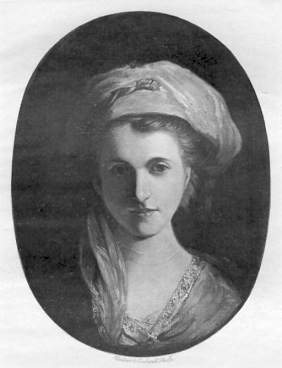
from a painting by Sir Joshua Reynolds, P.R.A.
for you has occasioned in the royal family. The good of his Royal Highness calls on you and on us to consult his welfare in the first instance. You have always told me how desirous you are of sacrificing yourself for him. I know the uprightness of your heart, Madam, and I know you spoke truth. Advise him to whatever is most for his benefit and credit. Do your duty by him, and trust to a just God for your reward. In the presence of that God I have given you the best advice in my power. I am sure I have not disobliged you by my freedom: I hope I have not offended his Royal Highness, but I declare on my conscience and honour, that I know not what better advice to give, and sign it with my name, as the firm opinion of, Madam, your Royal Highness's
Most faithful and devoted humble servant.
1525. To the Countess of Upper Ossory.
Jan. 29, 1774.
You must excuse my silence, Madam, which is not, nor can be, forgetfulness. While Lord Ossory was in town, I knew you could not want letters. Since he went, I have not had an instant's time; and though I write now, instead of dining, I have not a tittle to tell you that can entertain you, unless you will allow yourself to be diverted with the confusion of a methodist, as I am, who hate those knaves. So does King George, who has ordered the pure, precise Dr. Dodd to be struck off the list of his chaplains, not for gallantry with a Magdalen†1, as you would expect, but for offering a thumping bribe to my Lord Chancellor†2 for the fat living of St. George's†3. It is droll that a young comely divine should have fallen into the sin, not of Mary the Penitent, nor of her host, Simon the Pharisee, but of Simon
Magus, the founder of simony. Perhaps, as the Doctor married Lord Sandwich's mistress†4, he had had enough of des filles repenties.A parcel of Warwickshire colliers alarmed the court yesterday, and drew a great crowd round St. James's, but it was only a tribute to their sovereign from their mines. I hope no wicked ballad-monger will ridicule the loyalty of those poor men, and paraphrase the ancient song of 'Old King Cole,' who called for his fiddlers three, and there was fiddle faddle and twice fiddle faddle, &c.
I ought to be in great spirits to-day, if I knew where to find them; but they have been so long sunk under troubles, I have so many still, and my nerves are so shattered, that I do not know how to be so happy as I ought to be, when I can say with truth, that I do believe my nephew perfectly in his senses. He owns he thinks his disorder the greatest blessing of his life; that he is convinced all that has been done is right; that it is what he wished done, but could not undertake; and that he is determined to pursue the plan I have chalked out for him. You may judge, Madam, how very kind I think this treatment, and how much I feel myself obliged to him. I am to see him to-morrow, and have such a confusion of sensations that I dread the moment, though it is so delicious. Nay, I tremble more than ever lest he should relapse; for now my tenderness is interested in his health, which is still warmer than compassion. Nor am I yet out of this, or twenty other labyrinths!--but I must hold my tongue and drink the cup in silence.
Our Lord and I talked much on a subject that is much at my heart, though my heart is so full. The outward and visible signs are very promising: other prognostics are not so favourable. A deep silence is observed even on what
everybody else talks of--the late rupture. I sounded Lady P., who had not heard even of that; which confirms what I have told you, that two persons will not so much as mention anything that can lead to the subject. It was a curious scene on Wednesday night, when all the parties met at Lady Charlotte's; the rejected lover played at quinze with the Duchess; but what had happened and what I hope will happen, was not so well disguised by the rest of the young actors and actresses. I do not think any public decision will be taken soon; and I do not doubt but the interval will be employed to defeat it. Still I have nothing to judge by, but these observations; for if everything was settled, not a word the more would be said. For you know, Madam, discretion is like the bird that hides its head, and fancies it is not seen; a remark that comforts us, the indiscreet, prodigiously. The language of art is just as well understood as that of frankness: nay, even its silence is talkative, that is, intelligible. Cunning does not make dupes half so often as it is itself the dupe of good breeding. It would be ill-bred to tell people that one sees through them; and therefore they flatter themselves that they are not seen through: but all this is commonplace, and I had better bid you adieu, Madam, en attendant notre parenté.
February
1526. To Sir Horace Mann.
Feb. 2, 1774.
The more dealings I have with my Lady Orford the more I discover of her insensibility, falsehood, and folly. She is contemptible. How strange, that people will not learn that, if they would always speak truth, they would never be detected! I do not allude to her letter to me, which is not yet arrived, but to one Mr. Sharpe received from her a week ago, in which she repeats again her
having written to me, as truly as in hers to you, and in which, notwithstanding her canting, and her declaration to you that she had satisfied me, she tells him she has promised one seat at Callington to Sir William Hamilton, will not let me have the other, but will give me her interest at Ashburton, where on my Lord's I could choose without her. Why will this woman not be content with lying, but must drag in devotion to make her want of veracity more conspicuous? Did she think I should not perceive palpable contradiction, unless she added hypocrisy too? Well, if this is being artful, it is the clumsiest, silliest thing in the world. I am not surprised to find Sir William Hamilton on the carpet. He has a shrewd nose--my dear Sir, you have been thrice as long a minister, and have not yet learned to turn the penny!--but I have nothing to say against Sir William, who is agreeable; and I do not wonder at his turning a galant old woman to account. Nay, your old goats are so often bubbled, that I believe it teaches them to be cunning with everybody who has not the charity to offer them a civility--but I have done with her: I shall write her one more letter to tell her her son is quite recovered, and then forget her till she is burnt to a coal like the ancient tinder in Herculaneum.Yet her son is recovered entirely; and is certainly her son, whosever else he is. He has not indeed, like her Ladyship, given me a bill upon God for payment of his obligations to me, but I believe intends to refer me to the same audit. He is very gracious, but like her too, seems to intend to hurt himself rather than come into anything I propose for his benefit. I have offered to continue to be his steward. To make that post a sinecure, though too great an honour for me, he is dispersing already by handfuls and pocketfuls the savings of a whole year, which he found, not in my power or pocket, but in the hands of his own
steward. In short, I have done nothing wrong, and yet he will no more forgive me than if I had done all that my wildest enemies would have said they expected. I care not. I have set an example of an uncle treating a nephew, pronounced an incurable lunatic, with more tenderness and respect than ever was heard of, as if I had daily expected his recovery. I have humbled myself to his mother, who was my enemy, to engage her to assist him. This precedent, I hope, will make a good impression, and then I shall be fully content, though I shall see all my endeavours baffled and reversed. I have indeed another great satisfaction. I have explained my whole conduct to your nephew young Sir Horace, and he approves of it. Nay, sees that I had formed a plan that might have been of the greatest service to him and your family, which indeed was a chief object in my view. I fear a great deal will be intercepted now!-- but enough of this subject, since it is not proper to say all I could.By what you say in your last, which I received yesterday, there is no delay probably in our letters, but those that are natural. Indeed, I do not think anybody would have patience to read dull letters of business, with which they have nothing to do. I know little of public affairs, nor trouble myself with them but as news; and the only article in my letters which could excite particular curiosity is very rarely there, and of which I believe I know less than anybody. I never was a favourite in a certain place†1, and am now particularly ill there for having spoken my mind with more freedom than was welcome; but I shall die with the best legacy my father left me, his Fari quae sentiat--an impertinent motto, when the fari is unnecessary.
Your Scotch Princess†2, I doubt, is really mad. Does not
she put you in mind of your friend Lord Fane†3, who kept his bed six weeks, because the Duke of Newcastle, in one of his letters, forgot to sign himself 'your very humble servant,' as usual, and only put 'your humble servant'? These follies would have done very well, when folks fancied their stars did everything, and had good and bad demons; but toute demon as the Empress-Queen is, and womanish too, I don't believe that, like Juno, she persecutes the pious Æneas in every voyage and peregrination. Then, what an impertinent quarrel that with Lord Huntingdon†4! One sees indeed how peevish and persecuting her Ladyship would be, if she were Empress or Queen; but it is more ridiculous to proscribe Princes and Princesses, when one is nobody oneself. When the Sophi of Persia has dined, a herald gives leave to all other monarchs to go to dinner; but if a merchant's widow at Ispahan was to give the same permission to her sovereign, she would be shut up in a madhouse, though she was to insist that she had been married to Kouli Khan. I really wish you was well rid of her: cannot you persuade her to go to Rome, where there is a mock court that has nothing better to do than to quarrel about a mock etiquette?We have no news public or private; but there is an ostrich-egg laid in America, where the Bostonians have canted three hundred chests of tea into the ocean†5, for they will not drink tea with our Parliament. My understanding is so narrow, and was confined so long to the little meridian of England, that at this late hour of life it cannot extend itself to such huge objects as East and West Indies, though everybody else is acquainted with those continents
as well as with the map of Great Britain. Lord Chatham talked of conquering America in Germany; I believe England will be conquered some day or other in New England or Bengal. I think I have heard of such a form in law, as such an one of the parish of St. Martin's-in-the-Fields in Asia†6: St. Martin's parish literally reaches now to the other end of the globe, and we may be undone a twelve-month before we hear a word of the matter--which is not convenient, and a little drawback on being masters of dominions a thousand times bigger than ourselves. Well! I suppose, some time or other, some learned Jesuit Needham†7 will find out that Indostan was peopled by a colony from Cripplegate or St. Mary Axe, which will compensate for a thousand misfortunes.You see, my dear Sir, I forget my troubles the moment they are at an end. Lady Orford concerns me no more than the insurrection in the Massachusetts. Every year's events are stale by the next. One's cares, once at an end, are but old accidents, and to be flung by, like an old almanac. Politicians live by the future; I care only about the present; and the present being very calm, is worth enjoying. Adieu!
P.S. I sent my late letters to Lady O. in Sir W.'s packet, but I think it safer to convey the enclosed by you. Lord Orford has just been here; he will go into the country
on Monday, though a week sooner than the physicians had fixed--I shall be surprised at nothing!
1527. To the Countess of Upper Ossory.
Feb. 12, 1774.
I must seem extremely culpable to your Ladyship for not answering your very kind letter the instant I received it; but it has been absolutely impossible. Though I have given up my trust, I have had many things to settle before I was quite quit of it. I have been in arrears for visits, had neglected my own affairs, and have so many other duties and avocations that I have not a moment's leisure. I stayed at home this morning on purpose to write this and two other letters, but so many people have come in, that it is almost three, and I have only begun, as you see, Madam. I am quite well again, and think myself the happiest being alive, with having got so fortunately, in spite of all my ignorance and incapacity, through my dismal business, and with seeing it at an end. I should, as I told you before, be in great spirits, if I knew where to find them; but my mind has been tormented and oppressed, my nerves are affected, and the impressions remain, though the cause is removed. I feel what is passed, and tremble lest it should return. In short, I sometimes think of going abroad, to vary the scene, recover my health, and avoid a relapse, for so Lord Orford's would be to me, unless I can decline the charge, as I am determined to do if I possibly can. I should not say so much on myself, were it not an excuse to Lady Anne†1, as well as to your Ladyship; but how write a proper letter to her, or defend myself from the accusation of wit, unless by
proving how very dull I am! Oh, would I were capable of inventing stories of owls!I am rejoiced Lord Ossory is coming, and overjoyed that there is a prospect of your both passing some time here. As he will not be with you when you receive this, I shall take the liberty of hinting at a little selfishness, that appears in your purloining him from the world, because you are determined to quarrel with it.
His acquiescence gives the pas to his virtues over yours, and you will not be the perfect wife, in my eyes, till you give up those of a shepherdess.
The accounts of Lady Holland are most cruel and melancholy. I have not yet been able to go to Holland House; partly from my disorder and business; still more from not having spirits to bear the sight. But I will gather resolution, and perhaps she will not see me.
I know not a syllable of news. There is some political, but I care not about it, nor would it entertain your Ladyship. It relates to a quarrel between the Speaker†2 and the printer†3; and about Mr. Grenville's bill for elections†4. One must be deep in politics to be amused with such points.
The history of Charles Fox and Mrs. Grieve is published in very wretched verse, but curious for being authentic. There is a Postscript too to the Heroic Epistle, with some
excellent lines, but inferior to the first, as second parts generally are.I have again been interrupted; it is four o'clock, and I am not dressed; but I need not apologize for concluding such a letter. I am worn out; and, next to being a man of business, I find the worst thing in the world is to be a decayed one.
1528. To the Rev. William Mason.
Feb. 14, 1774.
I am most impatient for your Lyric section and the completion of the Ode†1. Nay, I am glad to have lost so much of schoolboy and schoolmaster, as to be charmed with the Fragment, though Dr. Barnard frowns on it. Pray remember, however, that when you have so much piety for Mr. Gray's remains, you are unpardonable in leaving your own works imperfect. I trust, as you will now enjoy your own garden in summer, and will have finished the Life by your return from York, that you will perfect your Essay on Modern Gardening: you have given a whole year to your friend and are in debt to the public.
My troubles are at an end, my nephew is as well as ever he was, and is gone into the country either to complete his own ruin and his family's, or to relapse. I shall feel the former, I dread the latter; but I must decline the charge a second time. It half killed me, and would entirely have ruined my health. Indeed, it has hurt me so much, that though my mind has recovered its tranquillity I cannot yet shake off the impressions and recall my spirits. Six months of gout and nine of stewardship and fears were too much for my time of life and want of strength. The villainy too
that I have seen has shocked me; and memory predominates over cheerfulness. My inclination will certainly carry me this summer into Yorkshire, if dread of my biennial gout does not restrain me. Sometimes I have a mind to go to a warmer climate; but either at Aston or at Strawberry will insist on our meeting before winter. What signifies a neighbour†2 you do not wish to see? Are our enemies to deprive us of our best satisfaction--seeing our friends? I will presume to say you cannot have a warmer or more sincere one than myself, who never call myself so when I do not feel myself so, and who have few pleasures left but that of saying what I think. You are too wise and too good not to despise the dirtiness of fools, or to regret a man, who came to years of discretion before he was past his childhood, and is superannuated before he is come to his understanding. He is decaying fast, and will soon exist but in his epitaph, like those poor Knights of Windsor who are recorded on their gravestones for their loyalty to Charles I.The House of Lords is busy on the question of literary property, a question that lies between the integrity of Scotch authors and English booksellers. The other House has got into a new scrape with the City and printers, which I suppose will end to the detriment of the press. The ministers have a much tougher business on their hand, in which even their factotum the Parliament may not be able to ensure success--I mean the rupture with America. If all the black slaves were in rebellion, I should have no doubt in choosing my side, but I scarce wish perfect freedom to merchants who are the bloodiest of all tyrants. I should think the souls of the Africans would sit heavy on the swords of the Americans.
We are still expecting the Works of Lord Chesterfield and Lord Lyttelton--on my part with no manner of impatience; one was an ape of the French, the other of the Greeks, and I like neither second-hand pertness nor solemnity. There is published a Postscript to the Heroic Epistle, certainly by the same author, as is evident by some charming lines, but inferior to the former as second parts are apt to be. The history of Charles Fox and Mrs. Grieve is come out too in rhyme, wretchedly done but minutely true. I think I have told you all I know, and more than you will care whether you know or not. It is an insipid age. Even the Maccaronis degenerate: they have lost all their money and credit, and ruin nobody but their tailors. Adieu!
1529. To the Countess of Upper Ossory.
Feb. 19, 1774.
I will say no more, Madam, on the subject of our last letters, for one reason that is worth all others. In one word, I leave that subject to your own reason, and I cannot trust it in better hands. You will do whatever is most proper, I am sure; all I presumed was to represent to you what I feared your own feelings might very naturally intercept; the only excuse for ever presuming to give advice.
Sensible people know all that can be said to them at least as well as their counsellors; but it is not always that they admit their own reason into the cabinet. It is only a disgraced minister to a dead king that plagues the successor with repeated remonstrances. I have no such opinion of my own wisdom, and am always glad to give up my place, and relapse into my own idleness. At present, I could tell you nothing but what Lord Ossory has brought you.
I saw him but one minute, which is not extraordinary, as the little time he passes in town cannot allow him leisure to sit with one that is out of the round of pleasure, and whose amusements even do not extend to politics or diversions. I am a little afraid that I shall not be here when you come yourself. I am to go either to-morrow se'nnight or to-morrow fortnight, with Lord Orford, to Houghton, a very unpleasant journey,--but I cannot decline it; nor would it become one that preaches to others to dispense with his own duty, which I have unluckily, though late, made my rule. You will smile, Madam, at the word unluckily, but it is peculiarly so to me. I came into the world when all my contemporaries were wise young men and hopeful senators. They had been bred at Leyden and Geneva, and it was a charm to behold such a promising generation! I only was a reprobate, and used to say and do whatever came into my head; I used to shock my Lord Hartington, and Lord Coke, and Lord Hillsborough, and Lord Barrington, and had more pleasure in George Selwyn's company, than in sucking wisdom at the feet of those Gamaliels, Mr. Pelham and the sage Duke of Newcastle. In my latter days I have changed my system, and have taken into keeping that old battered abandoned harridan, Common Sense--and still am in the wrong, and out of the fashion. If I went to Almack's and decked out my wrinkles in pink and green, like Lord Harrington, I might still be in vogue; or if I paid nobody, and went drunk to bed every morning at six, I might expect to be called out of bed by two in the afternoon to save the nation, and govern the House of Lords by two or three sentences as profound and short as the Proverbs of Solomon. Well! I must dress and dine and go to the comedy of The Man of Business†1. As a proof of my
incapacity, I read it this morning, and it is so full of modern lore, of rencounters and I know not what, that I scarce comprehended a syllable. No, I shall never be fit for anything as long as I live. A miscarriage I was born and shall die, without any merit but that of beingYour Ladyship's most attached.
1530. To Sir Horace Mann.
Arlington Street, Feb. 23, 1774.
I have taken care not to be too sanguine about the continuation of my nephew's recovery--and yet it begins to flatter me with a prospect of its duration--unless one is apt to be bewitched with whatever compliments oneself--but no, my dear Sir, I will not conclude that he is more in his senses than ever, because he is pleased with my conduct. I have a better reason for hopes. It is not because he loves me, but himself, which he never did before in a sensible way. I have convinced him that I can greatly raise his estate, and he has sent for me to go with him to Houghton. I shall add this codicil to all I have done, and then shall desire to depart in peace. I again see that my family might be saved; but this is a vision which the first warm weather may disperse! and though visions are amusing, I know their texture too well to sigh at their evanition. When one means nothing but what is right, the sting of disappointment only pains the surface: a very different sensation from what one's faults excite! The pleasantest system is to have no news at all. Even the best require so much management that it is irksome to a mind that delights in the indolence of truth, which has all its answers ready, has nothing to disguise or palliate, and hates to be flattering people for their own good. How delicious is every moment to me now, when I have no point to carry! With what joy
I went to Strawberry Hill the other day alone, where I had not been in two months! How my pictures and books and I embraced after so long a separation! What a knave or fool must Charles V have been to repent of having done with knaves and fools! I have reigned eight months, and have had the gout as he had, but know a little better than he did how to value health and liberty. But, though so much wiser than Charles V, I have not quite the sagacity of Solomon, who pronounced everything vanity and vexation of spirit. I have finished my temple, and enjoy it. I delight in my trees and shrubs, though I don't know why some are tall and some short; and learned doctors divert me, though they cannot solve my doubts. Our Sanhedrim entertained me last week, as I am no longer a member. They were grievously affronted in the person of their prolocutor; and, no doubt, by the instigation of the wicked one--at least it is certain that the agents were devils. In short, the press, which exceeds even the Day of Judgement, for it brings to light everybody's faults, and a good deal more, fell upon the Speaker of the House of Commons: he complained: the printer was taken up, and accused the Reverend Parson Horne as the author. The House concluded that the divine would shelter himself in the City, and that the magistrates there would protect him--no such thing; he came to the Bar, acted respect, denied the charge --nay, artfully reduced them to this dilemma: Was the printer's deposition the accusation or the evidence? whichever it was, the counterpart would be wanted. The janissaries of the law, who can tie knots more easily than loosen them, were at a nonplus, though they said a great deal. Horne burst out into a laugh. They were forced to vote they would get more evidence; and sent for the printer's devils, who appeared the next day, but still to no purpose. None of them knew a syllable, as they hoped to be saved, of Horne being the author. Well! what to do? Why, nothing. Horne was dismissed, and the printer remains in custody†1. The majesty of the senate is a little singed.Well; but I must do justice: the press has done some justice. There is just published a very good dialogue between three persons of some note--namely, the partitioners of Poland. There is a great deal of wit and just satire in this piece; but though the press can pass sentence, I doubt it cannot see it executed. I do not know but part of it may be put in force. The rebellion in Russia still exists, which looks a little serious. How the Poles must pray that it may prosper! The King of Prussia is so thorough-paced a villain, that I should not be surprised if he had set it on foot. I am sure he will support it, if he can see his interest in it. How happy would it be to have those three monsters punished by each other!
I am heartily glad you are rid of the posthumous Duchess†2, who thinks herself the object at which all the darts of one of those furies are aimed. She is got to Turin, and will be at home in about two months. Seriously, I apprehend that she is literally mad. Her late visions pass pride and folly. The world here is exceedingly disposed to laugh at her; and by a letter that is already come from her to Princess Amelie, she does not at all mean to keep her imaginary persecutions secret. Indeed, indeed, my dear Sir, I have long told you that we are all mad, and everything one hears proves it. Nay, don't you find every English man or woman that arrives at Florence out of their senses? I am persuaded that if you were not discretion itself, your letters would be as full of extravagant events as mine are. What think you of that pompous piece of effrontery and imposture, the Duchess of Kingston? Is
there common sense in her ostentation and grief, and train of black crape and band of music? I beg you would not be silent on that chapter; it is as comic a scene as that of the Countess Trifaldine in Don Quixote; and though she is the high and mighty Princess, at least she does not yet pretend to be a royal one.I have had mighty civil dispatches from my sister-in-law. She desires the continuation of our correspondence, which I shall now and then obey. I may be obliged to renew it; and, therefore, it is best to keep it up. I have no resentment to her. I wish to keep her and her son on good terms, and what signifies writing half a dozen letters more or less? I have done all I can to persuade him to write to her, and he promises it. There is an end I believe of her promise to your brother at Naples, who finds it would have proved a very expensive affair. I have good wishes for him, though I own I was piqued at his interfering in an affair so important to my nephew. Adieu!
P.S.--24th. The famous Charles Fox was this morning turned out of his place of Lord of the Treasury for great flippancies in the House towards Lord North. His parts will now have a full opportunity of showing whether they can balance his character, or whether patriotism can whitewash it. The Queen was brought to bed this evening of another Prince†3.
Lady Bute desires me to tell you that Mrs. Anne Pitt is going to Pisa, and that I would recommend her to you. I should do that on my own account, as I am very intimate with her. You know she is Lord Chatham's sister, as well as his very image; but you must take care not to make your court to her on that head, as they are no dear friends.
She has excellent parts, a great deal of wit, and not so sweet a temper as to contradict the likeness of her features. She has at times been absolutely English†4, but not in the present style of the fashion, and has much too good sense to exhibit any extraordinary scenes. She is extremely well-bred, and knows the world perfectly. In short, she will be much pleased with your attentions, and will please you in a very different way from the generality of our exports. I dread sending you anybody that I have not known long, and some that I do; but there is no danger from Mrs. Pitt, who has always lived in the great world, and is not of an age to play the fool--especially on a small theatre. She has not succeeded so well as she intended on a very large one†5; but you may depend upon it, Tuscany will not tempt her. I will not answer but she may take liberties with some†6 that have been tempted by great duchies; but you will have the prudence not to seem to hear what it is better not to answer.
March
1531. To the Rev. William Mason.
Arlington Street, March 19, 1774.
Dear Sir,
I arrived here but four hours ago from Houghton, where I have been this fortnight with my nephew. I find your letter, your printed Ode, and messages from Mr. Stonhewer, to whom I have not yet had an instant's time to send, nor have, but to say one syllable to you, as I approve your additions†1 exceedingly, and would not delay saying so; that, if my taste or judgement can have any weight, you may be determined to print what Gray might envy. I am
fond of modesty even in the flower of authors, but not carried too far, as you do now, by degrading Gray to an Appendix, because you, though unworthy, will not sit by him in his Works. You have finished him as well as he himself, with all his love of polishing, could have done, and I think truly that yours have more harmony than some of his lines. I wonder at it, for I dislike the metre, which in the fourth line has a sudden sink, like a man with one leg shorter than the other; but I have not time for a word more. You shall have a longer letter in a post or two. Adieu.Yours most devotedly,
HOR. WALPOLE.
1532. To the Rev. William Mason.
Strawberry Hill, March 23, 1774.
Dear Sir,
I wrote my last in a great hurry, and not much knowing what I said, being just lighted from my chaise after being a fortnight at Houghton with my nephew; where my head was filled with business, and my heart with anxiety and grief and twenty other passions, for (not to return to the subject) if he is recovered I doubt it will not be for a long season. He is neither temperate in his regimen nor conduct, and if I have chased away seven evil spirits, as many are ready to enter. In short, the rest of my life, I find, and they will shorten it, is to be spent in contests with lawyers, the worst sort of lawyers, attorneys, stewards, farmers, mortgagees, and toad-eaters. I do not advance and cannot retreat. I wished to live only for my friends and myself; I must now, I find, live for my relations--or die for them. You are very kind in pitying, and advising me to consult my ease and health; but if you knew my whole story, and it was not too long, even for a series of letters like Clarissa's, you would encourage me to proceed. For I
flatter myself that my duty is the incentive to my conduct, and you, whose life is blameless, would, I am sure, advise your friend to sacrifice his happiness at last to his family, and to the memory of a father to whom he owes everything. But no more on this, though it has, and does occupy my mind so much, that I am absolutely ignorant of the affairs of the world, and of all political and literary news, though the latter are the only comforts of the few moments I have to myself.I began Mr. Bryant's†1--what shall I call it?--preexistent History of the World, but had not time to finish the first volume. It put me in mind of Prior's Madam, who
To cut things came down to Adam†2.
There are two pages under the radical Macar that will divert you; an absolute account of Μακαρωνες, though I dare to swear the good man never dreamt that he was writing the history of Almack's. I have just got Mr. Warton's Life†3 of poetry, and it seems delightfully full of things I love, but not a minute to begin it; nor Campbell's long-expected work on Commerce†4, which he told me, twenty years ago, should be the basis on which he meant to build his reputation. Lord Lyttelton and Lord Chesterfield are coming forth, and one must run them over in self-defence. Still I say to you, O quando ego te aspiciam--yes, Te, both you and your Gray! I am impatient for the remainder, though I would not have it hurried.
Mr. Stonhewer will have told you what I said on the print; but if he could make sense of it I shall wonder,
for I was on both sides: for your print†5, as the more agreeable; for Wilson's picture as extremely like, though a likeness that shocks one. There are marks, evident marks, of its being painted after Gray's death. I would not hang it up in my house for the world. I think I am now come to know my own mind: it is to have prints of both; from yours at the beginning to front his Juvenilia; from Wilson's, at or towards the end, as the exact representation of him in his last years of life. The delay will not signify, as your book is a lasting one--no matter if it comes out in the middle of summer. It does not depend for its sale on a full London: it will be sent for into the country, and will always continue to be sold. Were I to write anything that I could hope to have minded, I would publish in summer. The first ball, duel, divorce, new prologue of Garrick, or debate in the House of Commons, makes everything forgotten in a minute in winter. Wedderburn's philippic†6 on Franklin†7, that was cried up to the skies, Chief Justice de Grey's on literary property, Lord Sandwich's honourable behaviour to Miller the printer†8, are already at the bottom of Lethe. Mademoiselle Heinel dances to-morrow, and Wedderburn and Lord Sandwich will catch their deaths, if they wait in either of the Temples of Fame or Infamy in expectation of admirers.I know not a word more than I told you, or you have
heard, of the affair of literary property. Lord Mansfield's finesse, as you call it, was christened by its true names-- pitiful and paltry. Poor Mrs. Macaulay has written a very bad pamphlet on the subject. It marks dejection and sickness. In truth, anybody that has principles must feel. Half of the King's opposition at least are hurrying to court. Sir William Meredith has ridden thither on a white stick†9; Colonel Barré†10 on the necks of the Bostonians, his old friends; Mr. Burke, who has a tolerable stake in St. Vincent's†11, seems to think it worth all the rest of America. Still, I do not know how, an amazing bill of an amazing parent has slipped through the ten thousand fingers of venality, and gives the constitution some chance of rousing itself--I mean Grenville's bill for trying elections. It passed as rapidly as if it had been for a repeal of Magna Charta, brought in by Mr. Cofferer Dyson. Well! it is one o'clock in the morning, and I must go to bed. I have passed one calm evening here alone, and have concluded it most agreeably by chatting with you. To-morrow I must return into the bustle; but I carry everywhere with me the melancholy impression of my life's tranquillity being at an end. I see no prospect of peace for me, whether my nephew lives, dies, relapses, or remains as he is at present. I love to be occupied, but in my own way, unobserved and unconnected. My joy is to read or write what I please: not letters of business, accounts, or applications. But good night; I have tired you and myself: my sole excuse is, if you will take it for one, that I had other things to do that I should have liked doing; but writing to you was the greatest pleasure, and according to my former habits I preferred what amused me best.Yours ever,
H. W.
1533. To Sir Horace Mann.
Arlington Street, March 28, 1774.
You will know by my letters, my dear Sir, long before this, that I have received a gracious epistle from the Countess, enclosing one to her son, open, and full of commendations of my behaviour. I have exerted all my eloquence to persuade him to answer it, and hope he has-- I am not sure. Openness to persuasion is not his most shining quality. I have just gone through a fortnight's experience of most of his characteristics. I have been with him at Houghton, and am returned full of sorrow, convinced, on one hand, that if he remains in what are called his senses, his conduct will not be more reasonable than formerly; and, on the other, expecting a relapse. In one word, he observes no regimen, eats intemperately, and drinks above a bottle a day. To me his behaviour is all courtesy and respect--but I have not only not the least weight with him, but the whole cunning of his temper is employed to bar my being one instant alone with him. Some of his old conductors have furnished him with a new attorney, who is indecently eager to riot in what I had gleaned from the ruin. This is the present situation and the future prospect. You may unroll the map in your own mind -- it hurts me to expatiate on it.
Your correspondent at Turin†1 has found so flattering a reception at that court, that it has smoothed all the royalty of her brow, and suspended hostilities against Vienna so far, that she has proclaimed an armistice, and sent orders to her ministers at home to observe a strict silence on her former dispatches. I am glad you will be relieved from all our wandering courts, except her Grace of
Kingston's, which is so contemptible, that, was I in your place, I should be extremely determined to let it give me no trouble.We are in profound tranquillity here. Even America gives us no pain--at least it makes little sensation, for the opposition have not taken up the cause; in the first place, because the opposition is very feeble; and, secondly, because it has a great mind to be less; that is, they are, many of the few, endeavouring to wriggle into court by different doors. The general tone against the Bostonians is threats. It remains to see whether America will be as pliant as we say they must be. I don't pretend to guess, for I seldom guess right; but we could even afford to lose America. Every day gives us more East Indies. Advice has just come that we have taken Tanjore, and a General Smith has got 150,000l. for his own share. Spaniards are forced to dig in mines before they are the better for the gold of Potosi; we have nothing to do but to break a truce, and plunder a city, and we find the pretty metal ready coined and brilliants ready cut and mounted. Nay, don't frown; depredation is authorized by Act of Parliament, at least by the vote of the House of Commons that acquitted and applauded Lord Clive. How much more just would that sentence of a barbarian ambassador be, if applied to our Parliament than to the Senate of Rome, that he thought he saw an assembly of kings: we sanctify such violences and iniquities, that one should think the House of Commons were composed of three hundred and sixty-five Empresses and Kings of Prussia.
The Duke of Devonshire marries Lady Georgiana Spencer†2; she is a lovely girl, natural, and full of grace; he, the first match in England. Your old friend, Lord Pelham, is made
Justice in Eyre. There are some other promotions of no moment to you, that you will read in the newspapers.I don't know what to do with the letter you sent me. I have sent a servant all round the town and to the Opera House, but can get no tidings of a Scultore Capezzuoli†3, you must send me a direction, or I shall never find him. Do his correspondents think that London would stand in the palm of one's hand, like Florence?
April
1534. To the Countess of Upper Ossory.
Strawberry Hill, April 6, 1774.
I like to obey your Ladyship in nothing so little as in talking of myself; and yet I must, as you inquire after it; and gratitude obliges me to thank you for so much goodness. I have been here these four days, have slept well, and have less pain in my breast, and fewer nerves. I am advised to go to Bath, which I will not do for the very reason I am advised to it, as I would do anything to avoid the gout or put it off, rather than seek it. In short, I shall try a good deal of this air, as long as it suits me; and if it does not, go somewhere to the seaside, which has always been more serviceable than any remedy, and as it is my year for the gout, I wish to get a little strength to support it. By Lord Orford succeeding to the last long fit, I have never recovered it. There, Madam, if you was my apothecary, I could not have been more circumstantial. Look in the glass, and see if you deserve to be treated like a nurse; but you are so very kind to me, that I write to your heart, not to your face and person. If you were not to be in London, the spring advances so charmingly, I think I should scarce go thither. One is frightened with the inundation
of breakfasts and balls that are coming on. Everybody is engaged to everybody for the next three weeks, and if one must hunt for a needle, I had rather look for it in a bottle of hay in the country than in a crowd. I don't want company here; Lord and Lady Strafford are at Twickenham, and the Meynells at your old residence. If I want literature or news, yonder is Mr. Cambridge; politics or places I do not want, or Lord and Lady North are at Bushy. At present I am immersed in Warton's History of Poetry, and can listen to no news that don't begin thus:--
Herkeneth now, bothe olde and yyng,
For Maries love, that swete thyng:
How a werre bigan
Bitwene a god Cristene kyng,
And an hethene heyhe lordyng,
Of Damas the Soudan†1.
If the Czarina takes Constantinople, I shall think it is the proper conclusion of the story, and only correct the MS. to 'god Cristene Queen.'
Dr. Goldsmith is dead, and my cousin Mrs. Harris†2. The owl hooted last night on the round tower, and I thought was going to tell me a story for Lady Anne, but had been reading Warton too, and only repeated these lines:--
Than shal you, doughter, aske the wyne,
Wyth spises that be gode and fyne:
Gentyll pottes, with genger grene
Wyth dates and deynties you betweene.
Fortie torches, brenynge bright,
At your brydges to bring you lyght.
Into youre chambre they shall you brynge
Wyth much myrthe and more lykynge.
Your blankettes shal be of fustyane,
Your shetes shal be of cloths of rayne,
Your head-shete shal be of pery pyght,
With dyamonds set and rubys bryght.
When you are layd in bed so softe,
A cage of gold shal hange alofte,
Wythe longe peper fayre burning,
And cloves that be swete smellyng,
Frankinsense and olibanum,
That whan ye slepe, the taste may come,
And yf ye no rest can take,
All nyght mynstrels for you shall wake†3.
Well, Madam, if Lady Anne does not like this promise as well as an Arabian tale, I will burn my books and give over fairie. What luxury to repose on fustian blankets and sheets made of the skins of reindeer†4! Rude and savage as we think our ancestors, you see they indulged in more delicacies than the Maccaronies do. The future Duchess of Devonshire will have nothing but tea and sack-whey, not gentle pots of ginger green; nor will her head lie soft on a bolster set with diamonds and rubies, unless Miss Loyd and Mrs. Howe hear of this sumptuous description, and insist on Lady Georgiana's having a still richer bolster,-- or the taste will never come. Adieu! my goddess of health; I cannot be ill or low-spirited when I am writing to you.
1535. To the Rev. William Mason.
Strawberry Hill, April 7, 1774.
Well, I have read Mr. Warton's book; and shall I tell you what I think of it? I never saw so many entertaining
particulars crowded together with so little entertainment and vivacity. The facts are overwhelmed by one another, as Johnson's sense is by words: they are all equally strong. Mr. Warton has amassed all the parts and learning of four centuries, and all the impression that remains is that those four ages had no parts or learning at all. There is not a gleam of poetry in their compositions between the Scalds and Chaucer: nay, I question whether they took their metres for anything more than rules for writing prose. In short, it may be the genealogy of versification with all its intermarriages and anecdotes of the family; but Gray's and your plan might still be executed. I am sorry Mr. Warton has contracted such an affection for his materials, that he seems almost to think that not only Pope but Dryden himself have added few beauties to Chaucer.The republic of Parnassus has lost a member; Dr. Goldsmith is dead of a purple fever, and I think might have been saved if he had continued James's powder, which had had much effect, but his physician interposed. His numerous friends neglected him shamefully at last, as if they had no business with him when it was too serious to laugh. He had lately written epitaphs†1 for them all, some of which hurt, and perhaps made them not sorry that his own was the first necessary. The poor soul had sometimes parts, though never common sense.
I shall go to town to-morrow and send for my Lord Chesterfield's Letters, though I know all I wished to see is suppressed. The Stanhopes applied to the Chancellor for an injunction, and it was granted. At last his Lordship permitted the publication on two conditions, that I own were reasonable, though I am sorry for them. The first, that the family might expunge what passages they pleased:
the second, that Mrs. Stanhope†2 should give up to them, without reserving a copy, Lord Chesterfield's Portraits of his contemporaries, which he had lent to his son, and re-demanded of the widow, who gave them up, but had copied them. He burnt the originals himself, just before he died, on disgust with Sir John Dalrymple's book, a new crime in that sycophant's libel.Campbell's book I have not looked into, and am told is very heavy. Thus I have given you an account of my reading as my confessor in literature. I know nothing else, and am happy to have time for thinking of my amusement.
Your old friend†3 passes by here very often airing, and I am told looks ghastly and going. It has been so much expected, that his post of Governor was destined, I hear, to Lord Bristol, and his Cinque Ports I know were offered to Lord [George] Germaine, for there seems to be a general comprehension, and nobody is to remain discontented, but those who see their reversions promised.
I don't ask about your own books, for I wish you to have a whole summer of readers to yourself, as I told you in my last. I do inquire when I shall see you, and hope it will be in the summer too, for in autumn I expect the gout, my biennial tyrant. If he is as severe as last time, he will be soon like the woman who killed her hen that laid golden eggs.
I forgot in my confession to say that I have gone through half of Mr. Bryant's first volume. Lord John†4 has read both, and likes them, and thinks there is a great deal made out. I got far enough to see that the Tower of Babel might have been finished, if you would allow the workmen to begin at the top and bottom at once; but this was not my
reason for mentioning the book. If you have it or it is in your neighbourhood, pray in the radicals read the article of Macar. You will find that there was a happy people, a favourite name, who lived in an island and were called Μακαρωνες. Mr. Bryant is no joker, and I dare to swear never thought on our Maccaronies, when he was talking of Cushites and Ammonians. But I forgot that you are not as idle as I am, nor are bound to hear of every book I read. I can only say in excuse that when one is alone one is apt to think of those one loves, and wishes to converse with them on common pursuits. Is not it natural too, to wish to engage them in a little conversation? One tells them news, and wants them to care for it, in hopes of an answer. In short, you have won my affection, and must sometimes be troubled with it; but you are at liberty to treat it coolly or kindly, as you please. The mass will remain, though you should not encourage me to send you papers full of it at a time. Adieu!9th April.
I was too late for the post on Thursday, and have since got Lord Chesterfield's Letters, which, without being well entertained, I sat up reading last night till between one and two, and devoured above 140. To my great surprise they seem really written from the heart, not for the honour of his head, and in truth do no great honour to the last, nor show much feeling in the first, except in wishing for his son's fine gentlemanhood. He was sensible what a cub he had to work on, and whom two quartos of licking could not mould, for cub he remained to his death. The repetitions are endless and tiresome. The next volume, I see, promises more amusement, for in turning it over, I spied many political names. The more curious part of all is that one perceives by what infinite assiduity and attention his Lordship's own great character was raised and supported; and
yet in all that great character what was there worth remembering but his bons mots? His few fugitive pieces that remain show his genteel turn for songs and his wit: from politics he rather escaped well, than succeeded by them. In short, the diamond owed more to being brillianted and polished, and well set, than to any intrinsic worth or solidity.
1536. To the Rev. William Mason.
April 17, 1774.
You may say what you please, my dear Sir, but yes, you will be tired with the sight of my letters; and this perhaps will be still less welcome than any of its predecessors. They, poor souls, had no excuse for their gossiping. This is written more seriously, and from good will prepense. In one word, my admiration has been ripened into warm friendship; and I do not see why friendship should be debarred of the privilege of telling one's friend his merits, when ill-nature may so cheaply borrow its mask to reprove him for his faults. Mr. Stonhewer brought me your section yesterday, before I received your letter; and do you know, I am exceedingly discontent with it? not for its faults, for there is not a single blemish, but for your honesty and rashness. What can provoke you to be so imprudent? or do you think I love you so little, as to enjoy your free spirit, and not tell you what a nest of hornets, nay of hyenas, you are incensing! I do beseech you to repress your indignation and cancel the papers in question. They will enrage, and you will have a life of warfare to lead to your dying day. Martyrdom itself might be delightful, if good could spring from the drops of blood. In the present case what benefit could arise?--to yourself endless disquiet must be the consequence. Well, but if I cannot touch your own intrepidity, I know I can stagger it, when your friend's
memory is at stake. In Gray's own letters there is enough to offend: your notes added will involve him in the quarrel; every silly story will be revived, and his ashes will be disturbed to vex you. You know my idea was that your work should consecrate his name. To ensure that end, nothing should be blended with it that might make your work a book of party and controversy. By raising enemies to it, you will defeat in part your own benevolent purpose of a charitable fund. When so numerous a host are banded against it, the sale will be clogged: reflect how many buyers you will exclude. At least, as there is no loving kindness in my mercy, reserve the objectionable letters and your own notes to a future edition; nay, it will be policy. If the book appears without its sting, Gray's character will be established, and unimpeached. Hereafter let them decry him if they can. I will dwell no longer on the subject; your letter tells me you are not in haste. Our Mr. Stonhewer will write, and tell you that the neighbouring inconvenience†1 will soon be removed one way, and my last that it is likely to be removed every way. I hope to see you at Strawberry Hill on the first dislodgement, and then we shall have time to squabble on the several articles I object to.I have a few other difficulties, not of much consequence. I would omit every passage that hints at the cause of his removal from Peterhouse. Don't you, or do you, know that that and other idle stories were printed in an absurd book called Lexiphanes†2? I would be as wary as the Church of
Rome is before they canonize a saint. They wait till he has been dead an hundred years, that no old woman may exist to tell a tale of the frailty of his youth, as a beldame did when Charles Borromée was to be sainted--'I am glad of it,' said she, 'for he had my maidenhead.' Now I descend to verbal criticism. In p. 234, line 17 of the note, there is an he that is obscure. It means Gray, but by the construction refers to Akenside. 'He would tire of it as soon as he did.' The second he should be Mr. Gray. In p. 241, note 1, Gray was not mistaken. Before the Duc de Choiseul was disgraced, I was privy to many abject solicitations made by Voltaire to both the Duke and Duchess for leave to go to Paris; but the Duke did not think it worth his while to quarrel with the clergy and Parliament upon his account. The moment the Duke was out, Voltaire renewed the battery of flattery to the breast of the Duc d'Aiguillon, but as the first part of the transaction was communicated to me in confidence, I would not have it made public while the parties are living. His letters on that occasion are extant, and some time or other I suppose will appear.In Algarotti's†3 letter are two false printings: for quan io porso it should be quanto io porrò, or rather I believe potrò; and for sottescrivam, read sottoscrivermi.
In defiance of my Lord Chesterfield, who holds it vulgar to laugh, and who says wit never makes one laugh, I declare I laughed aloud, though alone, when I read of the professor†4 who died of turbot and made a good end. If this is not wit, I do not know what is. I am much more in doubt of his
Lordship's wit, since I have finished his Letters. Half of the last volume has many pretty or prettyish ones, but sure no professor of wit ever sowed so little in two such ample fields! He seems to have been determined to indemnify himself for the falsehood and constraint of his whole life by owning what an impostor he had been. The work is a most proper book of laws for the generation in which it is published, and has reduced the folly and worthlessness of the age to a regular system, in which nothing but the outside of the body and the superficies of the mind are considered. If a semblance of morality is recommended, it is to be painted and curled, and Hippolytus himself may keep a w----, provided she is married and a woman of quality. In short, if the idea were not an old one, I would write on the back of this code, The whole duty of man, adapted to the meanest capacities.If you like my telling you literary news, I will whenever I have any. I now have time to read and enjoy myself. Your observation on Mr. Warton's civility to Macpherson is very just. It is like Protestants who in Catholic countries bow to the sacrament, but do not kneel; and I do not doubt but both the priests and the Scot would burn the heretics if they could. I wish I could satisfy you about the Parliament's intention on literary property, but as a bill is ordered in, you will know more of the event before you think of publishing. I scarce know more of the Parliament's transactions than what I read in the papers. When I was at Rome, I never pried into the actions of the Senatore di Roma. All I know of our senate is that it is held in the Temple of Concord.
I inquire so little after their transactions, that I did not hear your name had been mentioned on that bill. I was told that a name of much less consequence, my own, was quoted by Mr. Wedderburn; I protest I did not ask whether
in approbation or dislike, or to what end. Apropos, I did hear that the other day Lord North, declaiming against the opposition (I don't guess where he found them), and saying they meant nothing but pensions and places, turned to his right, and there sat Cornwall†5 blushing up to the eyes; turning short from a crimson conscience, on the right sat Wedderburn, pale as death; come, there is some merit in crimson.You ask about answers to books: in good sooth I never read such matters, nor can tell who does but their authors. At least I never heard of the one you mention, nor disturb the departed. I must now say a word about that insignificant personage myself. I will not quarrel with you about what you say of my wit. Whether I have it, or have had it, I neither know nor care. It was none of my doing; and even if I had it, I am guilty of never having improved it, and of putting it to very trifling uses. Whatever it was, it is gone with my spirits, or passed off with my youth, which I bear the loss of too with patience, though a better possession. But I am seriously hurt with those two words at the conclusion of your letter, perfect respect. Jesus! my dear Sir, to me, and from you, perfect respect! on what grounds, on what title? What is there in me respectable? To have flung away so many advantages in so foolish a manner as I have done, is that respectable? to have done nothing in my life that is praiseworthy, not to have done as much good as I might; does this deserve respect from so good a man as you are? Have I turned even my ruling passion, that preservative I call it, pride, to account? No; yet hear my sincere confession; I had rather be unknown, and have the pride of virtue, than be Shakespeare,
which is all I can say of mortal wit. Nay, I would rather accept that pride of virtue preferably to all earthly blessings, for its own comfortable insolence, though I were sure to be annihilated the moment I die; so far am I from thinking with the saint, that suffering virtue without a future reward would of all conditions be the most miserable. There are none, or few real evils, but pain and guilt: the dignity of virtue makes everything else a trifle, or very tolerable. Penury itself may flatter one, for it may be inflicted on a man for his virtue, by that paltry thing [in] ermine and velvet, a king. Pray, therefore, never respect me any more, till my virtues have made me a beggar. I am not melancholy, nor going to write divine poems. I have a more manly resolution, which is to mend myself as much as I can, and not let my age be as absurd as my youth. I want to respect myself, the person in the world whose approbation I desire most. The next title I aspire to, but not till that person is content with me, is that of being yourSincere friend,
H. W.
P.S. You will be diverted to hear that a man who thought of nothing so much as the purity of his language, I mean Lord Chesterfield, says, 'you and me shall not be well together,' and this not once, but on every such occasion. A friend of mine says, it was certainly to avoid that female inaccuracy of they don't mind you and I, and yet the latter is the least bad of the two. He says too, Lord Chesterfield does, that for forty years of his life he never used a word without stopping a moment to think if he could not find a better. How agreeably he passed his time!
May
1537. To Sir Horace Mann.
Strawberry Hill, May 1, 1774.
The period of time, rather than anything I have to say, brings you my letter. Political events are so much the materials of a distant correspondence, that I don't know how ours would have crept on for so many years, if the last thirty had been as barren as the present one. There is indeed a great business in agitation, and has been for some time; but, without the thorough-bass of opposition, it makes no echo out of Parliament. Its Parliamentary name is Regulations for Boston†1. Its essence, the question of sovereignty over America. Shall I tell you in one word my opinion? If the Bostonians resist, the dispute will possibly be determined in favour of the crown by force. If they temporize or submit, waiting for a more favourable moment, and preparing for it, the wound, skinned over, will break out hereafter with more violence--not that I lay any stress on my own conjectures. People collect their guesses from what they have read, heard, or seen; but times are unlike; and a single man†2 can sometimes give a new colour to an age.
Would not one think that people die or marry only out of opposition too? There is not anything more new in private than in public life. One would think the summer began two months sooner than it used to do; yet the Parliament will probably sit late, in expectation of hearing how the rigour exercised on the Bostonians is received by them and the other colonies.
Lady Mary Coke is not yet arrived, nor was even got to Paris; at least, a letter I received thence yesterday does not
mention her. She is expected at home some time in this month.I have not yet been able to discover Capezzuoli the sculptor, for whom you sent me a letter long ago. I have inquired at every statuary's in town to no purpose. Mr. Chute's servant, Martelli, is now upon the hunt for him; but his correspondent ought to know that London is a little bigger than Florence. It was directed to Capezzuoli, Scultore, a Londra. One cannot find a needle in such a bottle of streets. London increases every day; I believe there will soon be no other town left in England, for migrations increase as fast as buildings. All the Scotch and Irish that don't come to London go to America. If you ever return, as I devoutly wish, you will find a larger city than Florence, of which you never saw a street; without including half the adjacent villages, which the town has surrounded or joined. Perhaps it will be at last like Palmyra, in the midst of a vast desert!
Next to gaming, which subsides a little from want of materials, the predominant folly is pictures; I beg their pardon for associating them with gaming. Sir George Colbroke, a citizen, and martyr to what is called speculation, had his pictures sold by auction last week. A view of Nimeguen, by Cuyp, not large, and which he had bought very dearly for seventy guineas, sold for two hundred and ninety! If they could be sold in proportion, the collection at Houghton would fetch two hundred thousand. A Mr. Pearson†3, too, who married the Giacomazzi, brought over a few, particularly
from Venice. He sold one Guido for two thousand pounds to Mr. Duncombe†4. The 'Doctors' at Houghton, the first picture in England, and equal to any in Italy but Raphael's, cost but a little above six hundred pounds. Well! we are very rich, and very quiet. I hope it will last! Adieu!P.S. Miss Davis, the Inglesina, is more admired than anything I remember of late years in operas; but though music is so much in fashion, that some of our fine gentlemen learn to sing, it holds no proportion with hazard and Newmarket. The Cuzzoni and Faustina would not be paid higher than a race-horse.
1538. To the Rev. William Cole.
Arlington Street, May 4, 1774.
Dear Sir,
We have dropped one another, as if we were not antiquaries, but people of this world--or do you disclaim me, because I have quitted the Society†1? I could give you but two sad reasons for my silence. The gout kept entire possession of me for six months; and, before it released me, Lord Orford's illness and affairs engrossed me totally. I have been twice in Norfolk since you heard from me. I am now at liberty again--what is your account of yourself? To ask you to come above ground, even so far as to see me, I know is in vain--or I certainly would ask it. You impose Carthusian shackles on yourself, will not quit your cell, nor will speak above once a week. I am glad even to hear of you, and to see your hand, though you make that as much like print as you can. If you were to be tempted abroad, it would be by a pilgrimage, and I can lure you even with that. My chapel is finished, and the shrine will actually be placed
in less than a fortnight. My father is said to have said, that every man had his price: you are a Beatus, indeed, if you resist a shrine. Why should not you add to your claustral virtues that of a peregrination to Strawberry? You will find me quite alone in July. Consider, Strawberry is almost the last monastery left, at least in England. Poor Mr. Bateman's†2 is despoiled: Lord Bateman has stripped and plundered it; has sequestered the best things, has advertised the site, and is dirtily selling by auction what he neither would keep, nor can sell for a sum that is worth while. I was hurt to see half the ornaments of the chapel, and the reliquaires, and in short a thousand trifles, exposed to sneers. I am buying a few to keep for the founder's sake. Surely it is very indecent for a favourite relation, who is rich, to show so little remembrance and affection--I suppose Strawberry will have the same fate! It has already happened to two of my friends. Lord Bristol got his mother's†3 house from his brother†4, by persuading her he was in love with it. He let it in a month after she was dead--and all her favourite pictures and ornaments, which she had ordered not to be removed, are mouldering in a garret! You are in the right to care so little for a world where there is no measure but avoirdupois. Adieu!Yours sincerely,
H. W.
1539. To Sir Horace Mann.
Strawberry Hill, May 15, 1774.
This is a great morsel of news, indeed--nay, not that we know actually yet that Louis Quinze is dead; but we conclude so. Lord Stormont's courier arrived on Wednesday,
and had left Paris on Sunday night at eleven, when the hiccup was begun. He said he might not be able to write again soon, as all horses would be stopped. Some pretend to say the King died on Tuesday, others conclude he is recovered--but horses would not be stopped on that account --on the contrary. Many foretell war--not on knowledge. The Dauphin is little known--the first acts of a new King are seldom the expression of his meaning. There is a notion he likes the Chancellor†1. If Monsieur de Choiseul returns to power, it will want no prophet to announce war. Two of the King's daughters, though they never had the smallpox, attended him, and it is said the Dauphin saw him since the eruption, which was not very prudent. Madame du Barri was retired to the Duc d'Aiguillon's at Ruel. This is all I have heard that I believe. One never attains the last and first accounts of a reign truly, till half a century is past. What is first said is generally the least to be credited. Those reports are coined by vanity of knowing, by credulity, and conjecture. We believed firmly for two days that Sutton the inoculist was at Paris, and that Lord Stormont had been desired to carry him to the King. Sutton was actually in London†2.Well! this is an event that will have great consequences in Europe, or in France. Will the new King go to war, or restore the Jesuits? Will the Dauphiness have any weight? Will the Emperor?--Oh, but they say the King of Prussia is dying too. That would make a greater change. The Czarina pretends to have beaten Pugatscheff†3--but I don't think the story has much the air of truth. A rebel so often beaten, and that still makes a stand, is a new kind of rebel. They are not apt to have so many resources.
The Duke and Duchess of Cumberland have been landed this week. I can believe easily what you tell me of his confidence to Mr. G.†4 The honeymoon was waned to less than a half-moon before he left England†5.
Pray be very circumspect with your lodger†6. There is great art, and no sweet temper. I have received a bushel of thanks for your civilities, which I imputed to your own good nature and good breeding, as you deserve.
My late ward†7 has fairly washed his hands of me on some very necessary remonstrances on his health and affairs, which I could not in conscience avoid making. The first I knew from the cunning incident to persons in his predicament, would, though they displeased, have effect--and they have had. He now speaks in his natural voice. The other point I concluded would be neglected, though it will offend his mother--and neglected I depend it will be. However, it excuses any farther attendance on my side, and must dispense with my taking the charge again, as he will put it entirely out of my power to be of any use again. Nor have I had proper returns where I deserved them, if possible, more; but one must do what is right without reward; nor am I of an age to take disappointments to heart. To do right and be at peace is enough; nay, is not doing right being at peace? Kings may die, and men may be mad: can one save them, or cure them? Shall one not enjoy one's own little lot because inevitable events come to pass? Indeed for the loss of their Majesties it is not necessary to
preach patience to anybody. The smiles that waited on their every word are at the service of the successor.Apropos, the other day the Chapter of Westminster opened the grave of Edward I, and found his body, crown, velvet, and tissue perfect. The flesh of his lips and cheeks was sound, and his hands perfect, except that one had lost its nails. There was a gauze on the face which had grown into the grain, and they could not lift it up. His measure was six feet two. They had found in Rymer that they were obliged to bestow a new cerecloth on the corpse every year. That poor service was forgotten after two reigns, and curiosity alone recalled it now after five hundred years. The most extraordinary part is that it should have been kept up even for two reigns. The Church is seldom a more grateful courtier than a Lord of the Bedchamber. If they cry up a benefactor, it is to inculcate imitation of his largesses. I pity kings; they have more false friends than anybody; and those they love most are certainly the falsest, for they have flattered them most. Louis le Bien-aimé was stabbed, and Henry IV, who deserved that title, was murdered. Every action of a king's life is watched and recorded: what private man could stand such a scrutiny? The greater their power the less they can content, for every man measures his wishes by their power, not by his own merit; and, as Louis Quatorze said, 'When I give a place, I make twenty discontented and one ungrateful.' Who almost that ever reigned would not be shocked to read his own history?
The Duke of Cleveland†8 is dead: the greater part of his estate comes to the Duke of Grafton, and I believe either the title of Cleveland or Southampton. The rest of his fortune goes to his nephew, Lord Darlington.
Lord Ilchester†9 has had a stroke of palsy, and it is not
the first. How thick calamities fall on that family! Lord Holland drags on a wretched life, and Lady Holland is dying of a cancer. Their youngest and only good son†10 is just gone with his regiment to America.Tuesday, 17th.
Well! the King of France is dead; but nothing farther is yet known. The new King was not to see the ministers for nine days, so to-morrow will be a bustling day in that court, and of some importance to this! Adieu!