










Frontmatter
Copyright Page
Oxford University Press, Ely House, London W. 1
GLASGOW NEW YORK TORONTO MELBOURNE WELLINGTON
CAPE TOWN SALISBURY IBADAN NAIROBI LUSAKA ADDIS ABABA
BOMBAY CALCUTTA MADRAS KARACHI LAHORE DACCA
KUALA LUMPUR HONG KONG
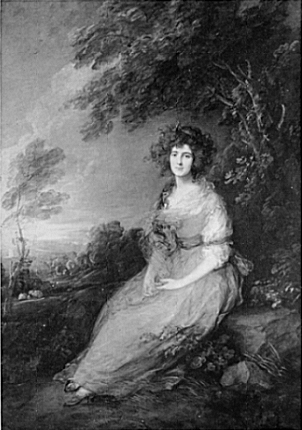
ELIZABETH SHERIDAN
by Thomas Gainsborough
National Gallery of Art, Washington, D.C. Andrew Mellon Collection
Title Page
THE LETTERS OF
Richard Brinsley Sheridan
EDITED BY
CECIL PRICE
VOLUME I

OXFORD
AT THE CLARENDON PRESS
1966
Printer's Page
© Oxford University Press 1966
PRINTED IN GREAT BRITAIN
Dedication Page
TO
JAMES MARSHALL OSBORN
Acknowledgements
I am obliged to Her Majesty the Queen for graciously permitting me to transcribe and publish the Sheridan letters in the Royal Archives at Windsor Castle.
I wish to thank descendants of Sheridan's family for their ready help. The owner of copyright, Mary, Comtesse de Renéville, has kindly allowed me to print the letters. Mr. H. F. Brinsley Sheridan has put the material in his possession at my disposal. To the Marchioness of Dufferin and Ava and Judge John Maude I am most grateful for access to, and help in studying, the Dufferin collections. My friend W. R. LeFanu has assisted me considerably by letting me draw on his family papers and on his own extensive knowledge of their background.
A number of owners of original letters have been good enough to allow me either to publish or to check them. For these privileges I am indebted to the Duke of Norfolk, the Duke of Devonshire, Earl Spencer, the late Earl of Ilchester, Earl Grey, the Earl of Lichfield, Viscount Sidmouth, Lord Kenyon, the late Lord Bolton, Lord Cottesloe, Sir Shane Leslie, Bart., and Sir Edward Hoare. Mr. Simon Whitbread kindly allowed me to see the relevant Whitbread papers, and to print the Sheridan letters among them. Miss Margaret J. M. Grubbe generously put John Grubb's papers in my hands. To Mr. and Mrs. J. R. Blackett-Ord, Mr. Brinsley Ford, Mr. Paul M. Gilmore, Mr. Bertram Shuttleworth, Mrs. Alfred Western, and Mrs. L. A. H. Wright I am grateful for opportunities of working through much valuable background material, and for permission to print original letters. I must also thank Mr. T. S. Blakeney, Mr. Alec Clunes, Mr. George Fortescue, Mr. R. G. E. Sandbach, and the late Richard Border for similar privileges.
American scholars and collectors have been equally generous in giving me the use of their manuscripts, and I must express my sincere gratitude for this kindness to Mr. F. W. Hilles, Mr. A. A. Houghton, Jr., Mr. and Mrs. Donald Hyde, Mr. Robert E. Keighton, Mr. E. L. McAdam, Jr.,
Mr. Gordon N. Ray, Mr. Jack H. Samuels, and Mr. Robert H. Taylor. My greatest debt in this respect is inadequately acknowledged in the dedication.Among the institutions that have granted me the privilege of working on and printing their manuscripts, I must record the names of the owners of the two largest Sheridan collections: the Harvard College Library and the British Museum. I am also grateful to the officials of the Bath Municipal Library, Bodleian Library, Brotherton Collection, Butler Library of Columbia University, Cornell University Library, Fitzwilliam Museum, the Goldsmiths' Company, Harrow School, the Historical Society of Pennsylvania, the Henry E. Huntington Library, the University of Indiana Library, the University of Kansas Library, Lehigh University Library, Maine Historical Society, the University of Michigan Library, Mitchell Library, Sydney, National Library of Ireland, National Library of Scotland, National Library of Wales, New York Public Library, Oesterreichische-Bibliotek, Pierpont Morgan Library, Princeton University Library, Public Record Office, Riksarkivet, Stockholm, the University of Rochester Library, Royal Irish Academy, Salt Library, Stafford, Saltikova-Schredin Library, Leningrad, Sheffield Public Library, Sir John Soane's Museum, the Victoria and Albert Museum, the Public Library of Victoria, Melbourne, the University of Virginia Library, and Yale University Library.
I have also received much help from the Registrar and staff of the National Register of Archives, as well as from the Archivists at the Record Offices of Bedford (Whitbread MSS.), Devon (Sidmouth MSS./D 152M), Hampshire (Tierney MSS.), Northern Ireland (Dufferin MSS.), and West Sussex (Norfolk MSS.). The staffs of the India Record Office, the Royal Academy of Arts, the Royal College of Physicians, the Prior's Kitchen, Durham University, and the City of Westminster Public Libraries have also given me much assistance. I am grateful, too, for the aid I received when working in the archives of the Duke of Devonshire at Chatsworth, and in those of the Duke of Northumberland at Alnwick.
The work of assembling the text has been greatly assisted
by the grants made to me by the Leverhulme Trust, the University College of Wales, University College, Swansea, and (from its Pilgrim Trust Fund) by the British Academy. I warmly appreciate the fellowship awarded me at the Folger Shakespeare Library, for it enabled me to find much new material, to study the account books of Drury Lane Theatre during Sheridan's management, and to enjoy the help of the Director, Dr. Louis B. Wright, and his staff.For much personal aid and advice I must first thank Professor Gwyn Jones and Mr. D. M. Davin. For other favours I am grateful to Dr. Arthur Aspinall, Mr. F. W. Bateson, Mr. John Carter, Mr. P. J. Croft, Dr. J. L. Clifford, Dr. Giles Dawson, Mr. C. I. E. Donaldson, Miss Elizabeth C. Ford, the late Dr. E. M. Hampson, Mr. John H. Harvey, Dr. C. B. Hogan, Dr. George M. Kahrl, Miss Letitia Kennedy-Skipton, the late William Van Lennep, Dr. Wilmarth S. Lewis, Dr. J. G. McManaway, Miss Dorothy Mason, Dr. Robert F. Metzdorf, Miss Eleanor Pitcher, Mr. E. V. C. Plumtre, Miss Sybil Rosenfeld, Mr. William H. Runge, the late Michael Sadleir, Dr. Arthur Sherbo, Mr. Grzegorz Sinko, Mr. Alexander D. Wainwright, Miss Helen Willard, Mr. J. L. Williams, Miss Marjorie Wynne, and Mr. R. C. Mackworth Young.
Mr. Robert K. Black, Mr. R. J. Dobell, Miss Emily Driscoll, Messrs. F. Edwards, Messrs. Maggs Bros., Mr. Michael Papantonio, Messrs. Bernard Quaritch, Mr. Philip Robinson, and Messrs. Sotheby have kindly aided me in locating missing Sheridan letters.
For permission to publish letters that have already appeared in print, I have to thank the Controller of Her Majesty's Stationery Office, Messrs. Constable & Co., Messrs. Ernest Benn, Messrs. Maggs Bros., Sir John Murray, Miss Winifred A. Myers, Messrs. Sotheby, and The Times Publishing Company.
For material that has reached me since this book went to press, I should like to record my gratitude to the Earl of Harewood, Lord Abinger, Lady Beaverbrook and the late Lord Beaverbrook, Dr. W. H. Bond, Dr. N. E. Enkvist, Mr. P. Highfill, Jr., Dr. and Mrs. A. M. Kinloch, Dr. Eric Jacobson, Miss Patricia Sigl, the Secretary and Committee
of the Garrick Club, and the Librarians of the Leeds Central Library, Liverpool City Library, and Nottingham Public Library.Thanks are too weak to acknowledge all the assistance my wife has given me over the years, in transcription, checking readings, and preparing an index. She has pored with me over the many puzzles presented by Sheridan's handwriting, and contempt for dates. Only I know how much I owe to her accurate eye and unstinting help.
C. P.
Contents
Volume I
| Elizabeth Sheridan by Thomas Gainsborough | Frontispiece |
| INTRODUCTION | page xiii |
| REGISTER OF LETTERS | xxvii |
| ABBREVIATIONS USED IN THE NOTES | lv |
| LETTERS 1-199 | 1-271 |
Volume II
| Richard Brinsley Sheridan from the engraving by Hall after the painting by Sir Joshua Reynolds | Frontispiece |
| LETTERS 200-631 | 1-311 |
Volume III
| Richard Brinsley Sheridan by George Romney | Frontispiece |
| LETTERS 632-937 | 1-248 |
| SUMMARY OF OTHER LETTERS | 249 |
| APPENDIX OF FURTHER LETTERS | 292 |
| INDEX | 345 |
Introduction
Collections of letters usually attract us because they are written by great men whose lives pique our curiosity, or by lesser men who report exactly what went on in their day or express a particular outlook on life. No one will find in Sheridan's letters a satisfying philosophy, but they show gleams of his greatness as well as glimpses of the theatrical, social, and political worlds of his time.
The main interest of the letters is biographical. Sheridan's character is so full of contradictions that it is difficult to assess. His biographers have been painstaking but hardly penetrating, and it is time that readers had the opportunity of studying his correspondence so as to be able to come close to the man and make their own judgements upon him.
His first efforts of any significance belong to 1769, when he tried to imitate the letters of 'Junius' that had appeared in the Public Advertiser and had bitterly satirized public figures. Two of Sheridan's attempts are careless drafts; the third is reprinted for the first time from the newspaper in which it was published. Not one of them is remarkable as a literary composition, but we are bound to perceive that even at the age of eighteen, Sheridan's mind was analytical and critical, and that his chief interest in life was politics.
Another important phase in his career is seen in seven letters written between September 1770 and August 1772, when he lived with his father, brother and two sisters, at Bath. The wit in him comes out early in an amusing letter to Mrs. Angelo. The romantic gallant, who accompanied the beautiful singer, Elizabeth Linley, to France, and afterwards fought two duels with her tormentor, Thomas Mathews, is found to be irascible and legalistic, as argumentative as he was brave.
After these escapades, he was banished to Waltham Abbey to pursue his studies and forget Elizabeth Linley. It is unfortunate that his letters to her over these seven months (September 1772 to March 1773) have never come to light. Percy Fitzgerald suggested that when Sheridan
came to woo his second wife, he copied from the love-letters he had written to his first, but I do not think we need take this view very seriously. Probably Sheridan learned early in his intimacy with Elizabeth a certain language of love, and used it habitually at a later date.The correspondence of the Waltham Abbey period contains eleven letters addressed to Thomas Grenville, and they often read like essays on a set theme. Their composer (perhaps suiting himself to his correspondent) seems very earnest and even humourless in his long and didactic epistles. Yet they are revealing in the way they bring out a side of his character that is often forgotten: one that was to have its fullest expression in his play Pizarro.
Letters in this lofty and improving strain came to an abrupt end in April 1773, when Sheridan was married to Elizabeth Linley. In spite of his father's displeasure and his own poverty, Sheridan was a happy man at this period, and his joy is shown in the whimsical statement, 'When a man's married, it is time he should leave off speaking in metaphor'. The tone of the ten letters to his father-in-law, Thomas Linley, is as light-hearted as it is purposeful.
Some of them concern The Duenna. As Sheridan's chief composer of music for this ballad-opera, Linley carefully followed the hints that its author gave him, and it is interesting to see how they were conveyed. Sheridan relied considerably on his wife's musical knowledge, but he was always essentially a man of the theatre, knowing exactly what effect he wanted to achieve and where to find the necessary illustration and assistance. His ability as an organizer of other people's talents is shown at an early date.
We look in vain for anything equally important about the composition of The Rivals, The School for Scandal, or The Critic, and the next group of letters is largely concerned with the management of Drury Lane Theatre. Sheridan had become one of the proprietors of this playhouse because of the impression he had made on Garrick and Ford, and his connexion with Linley. He had extended his hold by buying out another of the proprietors, Willoughby Lacy. In 1778 he had also taken control (with Thomas Harris of Covent Garden Theatre) of the King's Theatre, but here
he over-reached himself and the venture failed after two years. The amount of ready money Sheridan put into all three transactions was comparatively small, but he had now made such a name for himself as the author of highly profitable entertainments that it was taken for granted that he could raise ample money at any time by writing.As the dominant partner in the proprietorship of Drury Lane Theatre, his income was soon large enough to allow him to give time to his absorbing interest, politics. After taking a leading part in the anti-Government agitations of 1778-9, he was elected member for Stafford in September 1780, and became Under-Secretary of State in the Rockingham administration of 1782, and Secretary to the Treasury in the coalition of 1783.
There are sequences of excellent letters in 1782 and 1788 that show his standing as a trusted lieutenant of Fox, and afterwards of the Prince of Wales. They disclose a delight in intrigue and in the subtle manipulation of men; they imply that Sheridan was usually wary in his political dealings. The correspondence of the last decade of the century is much less informative on these matters. There is comparatively little here concerning the French revolution, the quarrel with Burke, the split in the Whig party, the government's repressive measures, or the naval mutinies. The letters that survive deal instead with the creation of the new Drury Lane Theatre as well as with the death of his first wife and his marriage to Hester Jane Ogle.
The first marriage that had begun so romantically was marred in its closing years by Sheridan's gallantries and by Elizabeth's liaison with Lord Edward Fitzgerald. Her illness is movingly described in Sheridan's letters to the Duchess of Devonshire and Lady Duncannon, and he was completely overwhelmed by his wife's death in June 1792.
In April 1795 he was married to the nineteen-year-old daughter of the Dean of Winchester, and his early letters to her are full of affection and tender absurdity. They become more sober as time goes on, and in some of them a brooding fit of melancholy takes possession of him. 'How unceasingly', he writes, 'do I meditate on Death and how continually do I
act as if the thought of it had never cross'd my mind.' These moods of self-criticism and flashes of self-knowledge give depth to offset the more superficial aspects of his character.At these moments he deplored worldly ambitions, but the fact remains that his days were almost wholly given to them. Of these the most troublesome was the creation of the new Theatre Royal, Drury Lane. Garrick's theatre was pulled down, and after much costly delay an immense building was erected. It was designed by Henry Holland to be the finest in Europe, and to stage the most spectacular productions. All this reflected Sheridan's delight in the flamboyant. Unfortunately Holland exceeded his estimates, and Sheridan had not sufficient capital to complete the original plan. Honourably but quixotically, he took on himself all the unpaid debts of the company. Then he had to resort to all kinds of expedients to improve his finances: he borrowed from his associates, John Grubb and Thomas Shaw; raised money by the sale of boxes; neglected his backers and his creditors. His extravagant tastes and unsound management even kept him short of pocket money, and in frequent notes to the under-treasurer, Richard Peake, he pleaded in a variety of passionate cries for small advances. I have printed many of these in full because they show his characteristic energy of phrasing, and give a fair idea of the way in which Sheridan was plagued with money troubles largely because of his own heedlessness.
This state of affairs was brought to a temporary halt in 1801-2, when the future of Drury Lane Theatre was discussed in detail in the Court of Chancery. The bankers, Hammersley and Company, declared that the proprietors had misapplied the takings of the theatre; and Sheridan appeared in person to rebut the charge. By his interruptions and lengthy defence, he successfully maintained his case; but Lord Chancellor Eldon also rebuked him by applying to him Johnson's famous words about Savage: 'negligence and irregularity long continued, make knowledge useless, wit ridiculous, and genius contemptible'.
The Chancellor also made an order for the payment of the theatre's liabilities from its takings in a certain scale of
priority; and he placed the concern under the control of a committee. Two of the leading figures in the new management were Sheridan's friends, Aaron Graham and Richard Wilson. More business-like methods were adopted, but control remained effectively in Sheridan's hands.In February 1806 he found himself once again for a short time in political office, in the lucrative post of Treasurer of the Navy. The correspondence of the year is very full but chiefly concerns the Stafford election, the abortive candidature for Westminster, and the successful but very costly Westminster contest of November 1806. Sheridan went out of office with All the Talents in 1807, and his political correspondence after that date is chiefly interesting for the part he played in denying control of the government to Grey and Grenville in 1811 and 1812. As usual, he behaved with that mixture of the quixotic and the calculating that won him the confidence of nobody.
The same is true of his actions as chief proprietor of Drury Lane Theatre. His squabbles with the trustees and the bankers were patched up from time to time, and their uneasy relationship looked as if it would continue indefinitely. Then the theatre that was planned to be fireproof burned down, and a new start had to be made. Sheridan's letter to his wife about this catastrophe shows him behaving (in a slightly histrionic way) with manly philosophy. The banker, Thomas Hammersley, thought the destruction no disaster. In fact, he believed it gave Sheridan a splendid opportunity to repair his theatre and his shattered fortunes by drawing on private benefactions for rebuilding, just as J. P. Kemble had done at Covent Garden Theatre. And so it might have happened had Sheridan acted quickly, but his very proper desire for independence was only exceeded by his habitual procrastination, and nothing was done. Two years later, when an agitation for a third theatre was at its strongest, he began to act with vigour. He obtained the help of the wealthy brewer Samuel Whitbread, and persuaded him to head the Committee for rebuilding. He had a most remarkable faculty for persuading his friends to come to his rescue; but even Whitbread, with all his initial goodwill, found that potential subscribers now had to be assured, before they would
consider the new propositions, that Sheridan had no concern in the management of Drury Lane Theatre. They were tired of his shifts and his dilatoriness. Sheridan was forced out of the controlling interest which he had enjoyed for thirty-five years. Still, the new proprietors had to buy this from him, and he looked forward to being paid in hard cash. Even this was denied him, and his demands were satisfied (after long discussion) in the same manner as he had fobbed off many a creditor--with shares in the theatre.The last years (1812-16) of his life saw him out of parliament and Drury Lane. Observers cried, 'Poor Sherry!' They quoted him as a genius ruined by drink and self-indulgence. Yet it must be remembered that this was the period when he made such a striking impression on Byron. Indeed, if Sheridan was in decline the letters written in these years hardly show it, for they indicate his delight in society, his critical yet appreciative temper, his eye for the main chance, his good nature and warm heart. He occasionally grumbled at not hearing from his wife or second son, but generally his letters were cheerful and optimistic. His wife commented on this tendency 'to eat the calf in the cow's belly', and it is certain that he always hoped to realize the many schemes, extravagant or sober, that passed through his mind. Sheridan was never short of invention, even though he too seldom applied that talent to writing plays. What he lacked was the power to stop himself squandering his energies in all directions. And what was worse was that he insisted on giving to his multiplicity of activities not as much time as they required, but as much as he felt disposed to yield to them.
Towards the end of his life he read some early verses of his and remarked, 'What an ardent romantic blockhead nature made me'. Surely what he meant (and what his letters reveal) was that there was a constant conflict in him between a shrewd, practical outlook that took full advantage of every situation, and a high-minded desire to show integrity in all his dealings. He liked (though he could seldom afford it) to be completely disinterested. He has had little credit for this scrupulous side of his nature; the other side has always been obvious, and it earned him a bad name.
He sometimes excused his procrastination as a 'perverse fatality in my nature', and meant this quite seriously. The moods of melancholy, the bouts of drunkenness, the cruel tricks, shifts, and excuses, the sophistries and winning words, were beyond his control. He would have us believe (and I believe him) that he usually meant well but could seldom manage to put his meaning into action.
He tantalizes us, but there is something so human in his foibles that he remains a curiously sympathetic character. Perhaps his gift of phrase-making catches our attention; or his rueful remarks about his own shortcomings endear him to us. Yet what holds us in the end is this intimate communing with a man of genius who knows his own faults only too well but can do nothing to change his nature. In that situation lies the pathos of these letters.
They are not brilliantly written, and anyone who expects them to be worthy of the author of The School for Scandal will be disappointed. To achieve elegance of that kind, Sheridan had to write and rewrite. He seldom gave his letters enough attention: 'I shall confess that I write much more precipitately and triflingly often than I could wish.'
Most of them are brief. John Taylor describes an evening at the Shakespeare Tavern when Sheridan wrote 'about thirty letters, which he tied up in a handkerchief, and then resigned himself to conversation'. Edmund Kean quotes Sheridan as saying that no gentleman ever turned over the page in a letter to a friend. Charles Brinsley Sheridan looked through his father's letters and noted that 'almost all are extremely short; and he always put off writing till post'.
Sheridan knew his weakness (the product of procrastination) only too well, and made one of his most clear-sighted statements when he told Garrick 'what I write in a hurry I always feel not to be worth reading, and what I try to take pains with, I am sure never to finish'. His long letters, in later life, were usually careful attempts at special pleading.
Secrecy, too, was necessary in his world of political manœuvre, financial juggling, and fashionable intrigue. This prevented the uninhibited expression of opinion, and robbed his letters of savour. In one of them he made this clear by remarking that he preferred to reserve 'the greater part of
what I meant to have written for personal communication'. Speech was less binding than writing. He knew how gifted he was in the art of oral persuasion: his genial, sympathetic manner and physical radiance all helped to convince. Sheridan was not a lazy man, but he could do so much with his tongue that his pen was always a more tedious medium. It is something of a wonder that he ever wrote any letters.Those that remain are valuable records of the day-to-day variations of an elusive but always interesting character. They remind us sometimes of Lady Holland's comment on Sheridan, 'About him my reason and impulse are always at variance; reflection convinces me he ought to be despised for his private life and doubted for his political, but whenever I see him, if but for five minutes, a sort of cheerful frankness and pleasant wittiness puts to flight all the reasonable prejudices I entertain against him.' At other times we recall the words spoken in his own defence before the Lord Chancellor: 'I have had to struggle with the disadvantages of uncertain income. These, in all cases, are known to be great, but they are particularly formidable to a man of a sanguine temper, blessed with but a small share of resolution, who might expect much from the exertions of talent, who forms hopes which are never realised, and makes to himself promises he is unable to perform.' More rarely we recollect Byron's warm praise, 'his very dregs are better than the first sprightly runnings of others'. Yet even if the letters too seldom show Sheridan at his best, they clearly reveal the nature of the man and are a necessary supplement to his actions, speeches, and plays.
The Text
When Sheridan died, his wife remarked on 'the incredible quantity of private papers' he had left behind him. Many of them were legal documents, and others were letters written to him as proprietor of Drury Lane Theatre and as a member of parliament. Some of the letters written by Sheridan himself seem to have been lent to Thomas Moore for the authorized biography, and to have been lost. Most of them were carefully preserved by Sheridan's grandson (and namesake) at Frampton Court, Dorset, and they remained in the family until they were dispersed at Sotheby's sale-rooms on 2 July 1930, 1 March 1955, and 18 February 1957. Another fine collection, gathered by Sophie, Lady Wavertree (Sheridan's great-great-granddaughter), was also sold there on 25 May 1954. These sources provide this edition with many letters. Others are drawn from the archives of the Prince Regent, C. J. Fox, Charles Grey, Samuel Whitbread, Thomas Creevey, and other public figures of the period. Sheridan's association with Drury Lane Theatre is well represented in numerous letters to his fellow manager, John Grubb, and to the Theatre's treasurer, Richard Peake. Letters to other correspondents are widely dispersed in public and private collections in this country and abroad.
I have made every effort to trace them all, but have now resigned myself to the probability that many have escaped me. It is to be hoped that when they come to light they will be found to be letters to his first wife, particularly of the Waltham Abbey period when Sheridan drafted some of the work that later made him famous.
Among the letters I have not traced are the following: eleven to Colonel Graham (sold to Spencer at Sotheby's, 1 August 1935); some in an extra-illustrated copy of Watkins's Memoirs of ... Sheridan (sold by Leavitt, New York, 14 October 1878, lot 1080), and of Moore's Memoirs of ... Sheridan (sold to Smythe at Sotheby's, 26 July 1923). Nor have I found the letter mentioned in Moore's memoranda (Widener MS.): 'see among Richardson's papers
Sheridan's letter to Richardson in '88 about purchasing Ford's share.'Over the past ten years I have approached the agents of the Marchioness of Crewe on a number of occasions, about letters to Mrs. Crewe. I gather that some 'Sheridan letters' are extant, but that it is still not possible to gain access to them.
I have not included the text of two well-known letters that Sheridan signed with his friends: one was the 'Round Robin' to Johnson; the other, the address to Francis on 18 December 1787. Both are readily available in The Correspondence of Edmund Burke, iii (ed. G. H. Guttridge, Cambridge and Chicago, 1961), 273-4, and v (ed. H. Furber, 1965), 370-1.
While the present work has been in the press, some letters that it includes as unpublished have appeared in print. The Correspondence of Edmund Burke, iv (ed. J. A. Woods, 1963), 439-40, contains no. 78; volume v (ed. cit.), 121, 377-8, 457, presents nos. 89, 109, 143. Dr. N. E. Enkvist gives no. 178 in Acta Academiae Aboensis, Humaniora, xxvii, 3 (Åbo, 1964), 103. The first two volumes of Dr. Arthur Aspinall's edition of The Correspondence of George, Prince of Wales, 1770-1812 (1963-4) contain sixteen letters. I list my numbers followed (in brackets) by Dr. Aspinall's: nos. 117 (290), 118 (286), 120 (346), 121 (296), 122 (334), 126 (308), 127 (309), 128 (302), 130 (311), 131 (318), 132 (292), 135 (302), 137 (369), 158 (578), 209 (844), Summary G. 3 (466).
Sotheby's sale catalogue of 21 March 1966 notes (as item 260) a letter from Sheridan to his second wife, telling her that Burdett had been 'taken by force to the Tower'. He added that he did not know what would happen but was glad she was away. His postscript noted 'much blood spilt at the Tower'.
Conventions
I have printed the name of the recipient of the letter at the head of the text, and have then described the source. The names of private owners and of libraries possessing less than five Sheridan letters are quoted in full. Collections containing five or more letters are given an abbreviated title.
Unless there is an indication to the contrary, the letters are holographs. The description 'Draft' means an early version in Sheridan's hand: cancelled words have been omitted. 'Copy' refers to a Sheridan letter written in a hand not his own. Where the text is from photographic copies of original letters, that fact is indicated by the sign '[Ph.]'. Where the text is from a printed version, the earliest published form is followed.
A letter is described as published when the bulk of it has been printed elsewhere, but when brief extracts only have appeared publication is merely mentioned in footnotes. If a printed version is not named at the head of the letter or in a footnote, the letter is believed to be unpublished.
What are thought to be errors by other transcribers have usually been corrected without comment, but where the transcription remains in doubt or the alternative version has some other interest, then it is printed in a footnote.
When the date of a letter has not been placed by Sheridan at its head, the date is given in that position in italics. Dates supplied by the editor have been placed there in italics and square brackets. Abbreviated dates (e.g. 'Mond. eg.') have been expanded.
In transcribing original letters, I have tried to reproduce exactly what Sheridan wrote, but I have also compromised with this ideal by sometimes editing the text in the interests of readability. For example, all superior letters have been lowered to the line, and conventional abbreviations (including the ampersand) have been expanded. 'Mr', 'M .', and
  are all printed as 'Mr.' I have also supplied the missing stop if followed by a capital, and the missing capital if preceded by a stop. Unclosed parentheses have been
Sheridan is fond of using the dash. He also employs a very short downward stroke on the line that I have represented as a comma. His short level stroke on the line (or longer one followed by a wide space) I have shown as a point.
Of Sheridan's spelling, Moore writes: 'we find thing always spelt think--whether, where and which turned into wether, were, and wich; and double' ms and s's almost invariably reduced to "single blessedness".' The position is not quite as simple as Moore suggests, for in the very letter he alludes to, Sheridan spells 'thing' correctly and as 'think'. Sheridan is inconsistent even in his own inconsistencies, but the following generalizations have been accepted. He is confused about words containing 'ie', 'ei', and 'ai': for example, he writes 'peice', 'deceive', and 'villianous'. He sometimes metathesizes syllables, as in 'arbritation' and 'blasmephy'. 'Goverment' and 'seperate' are usual. These, and the following words, have all been normalized:
| accomodation | agrieved | alltogether |
| allways | attonement | beautifull |
| benefitted | comands | compells |
| conexion | disapointment | disaprove |
| embarasment | emphaticaly | especialy |
| exagerated | existance | finaly |
| genious | infallably | inocence |
| inofensive | misaplied | privilige |
| realy | recolection | recomendation |
| subsistance | tranquility | tranquilize |
Sometimes his spelling seems to reflect his own pronunciation: 'cridit', 'threasury', 'taching' (touching), 'deatis' (deities), 'Beiting' (biting), 'set' (said), 'begone' (begun).
Repetition of syllables (e.g. 'indepependently') and of words has been silently corrected. Nonsense words (e.g. 'insituate') have been amended, but eighteenth-century spellings (e.g. 'ideot') have been retained. Inadvertently omitted letters or words have been supplied in square brackets, and unclosed quotation marks have been silently closed. The £ sign which often appears in the manuscripts after or
above the figuring has been brought to the front. Sheridan's odd spelling of some proper names has not been amended.Where the transcription is made from copies, any eccentricities of spelling and punctuation have been normalized.
References to the dates of auction catalogues are to the first day of sale only.
Manuscripts are listed by their locations at the time when I read them. I have not attempted to record their more recent movements, though it may be worth noting that Mr. Shuttleworth's manuscripts are now in the Bodleian Library, and that the Holland House letters are in the British Museum, temporarily catalogued as Add. MS. 51641.
In the 'Summary of other Letters' (iii. 249-91), extracts from the letters themselves appear in quotation marks.
Register of Letters
Volume I
| 1766 | ||
| PAGE | ||
| 1. Richard Chamberlaine | 2 Mar. [1766?] | 1 |
| 2. Richard Chamberlaine | June | 2 |
| 3. Richard Chamberlaine | [Oct.] | 2 |
| 1769 | ||
| 4. [The Printer of the Public Advertiser] | [1769?] | 3 |
| 5. The Printer of the Public Advertiser | Oct. | 6 |
| 6. 'NOVUS' | [After 19 Oct.] | 12 |
| 1770 | ||
| 7. Mrs. Angelo | [13 Oct. 1770?] | 18 |
| 1772 | ||
| 8. His Father | 24 Jan. [1772?] | 22 |
| 9. His Father | 29 Feb. | 22 |
| 10. His Brother | 15 Apr. | 24 |
| 11. William Wade | 2 May | 26 |
| 12. [The Printer of the Bath Chronicle?] | [May-June] | 27 |
| 13. Captain Knight | July | 30 |
| 14. His Father | 30 Aug. | 34 |
| 15. His Sister Elizabeth | 30 Aug. | 37 |
| 16. Thomas Grenville | 30 Aug. | 39 |
| 17. His Sister Elizabeth | 13 Sept. | 41 |
| 18. Thomas Grenville | [Late Sept.] | 43 |
| 19. [To the Queen] | [1772?] | 47 |
| 20. Thomas Grenville | 30 Oct. | 59 |
| 21. Thomas Grenville | 10 Nov. | 63 |
| 22. Thomas Grenville | 17 Nov. | 65 |
| 23. Thomas Grenville | 28 Nov. | 66 |
| 24. Thomas Grenville | 8 Dec. | 68 |
| 25. Thomas Grenville | [Mid-Dec.] | 69 |
| 26. Thomas Grenville | 19 Dec. | 69 |
| 1773 | ||
| 27. Thomas Grenville | 4 Jan. | 70 |
| 28. William Barnett | [1773?] | 73 |
| 29. Thomas Grenville | 24 Feb. | 76 |
| 30. Thomas Linley the elder | 12 May | 79 |
| 31. Thomas Grenville | 14 May | 82 |
| 1774 | ||
| 32. Dinwoody | 24 Feb. | 84 |
| 33. Thomas Linley the elder | 17 Nov. | 84 |
| 1775 | ||
| 34. Thomas Linley the elder | Oct. | 86 |
| 35. Thomas Linley the elder | [Oct.?] | 88 |
| 36. Thomas Linley the elder | [23-27 Oct.?] | 90 |
| 37. Thomas Linley the elder | 2 Nov. | 92 |
| 38. Thomas Linley the elder | 31 Dec. | 93 |
| 1776 | ||
| 39. Thomas Linley the elder | 4 Jan. | 96 |
| 40. Robert Crispin | 12 Jan. | 98 |
| 41. ---- | 16 Jan. | 99 |
| 42. Thomas Linley the elder | 31 Jan. | 99 |
| 43. Thomas Linley the elder | 102 | |
| 44. David Garrick | 15-16 Oct. | 104 |
| 45. Carr | [1776?] | 108 |
| 1777 | ||
| 46. ---- | 19 Jan[?] | 109 |
| 47. [The Licencer of Plays] | 17 Feb. | 110 |
| 48. [The Licencer of Plays] | 7 May | 110 |
| 49. [The Proprietors of Drury Lane Theatre] | [Sept. 1777?] | 111 |
| 50. [The Proprietors of the Drury Lane | 116 | |
| Theatre and Covent Garden Theatres] | ||
| 1778 | ||
| 51. David Garrick | 10 Jan. | 121 |
| 52. [The Licencer of Plays] | 13 Oct. | 122 |
| 53. David Garrick | 26 Nov. | 123 |
| 54. Bray | [1778-81?] | 123 |
| 1779 | ||
| 55. Samuel Ireland | 1 Jan. | 124 |
| 56. Willoughby Lacy | [26 Jan.] | 124 |
| 57. Richard Rigby | 24 Mar. | 125 |
| 58. Joseph Cradock | 5 June | 126 |
| 59. Samuel Ireland | 29 Aug. | 126 |
| 60. ---- | [29 Oct.] | 127 |
| 61. [The Licencer of Plays] | 29 Oct. | 128 |
| 62. Richard Fitzpatrick | [25 Oct. or | |
| 1 Nov.] | 128 | |
| 1780 | ||
| 63. Samuel Ireland | 5 Jan. | 129 |
| 64. Samuel Ireland | 23 Mar. | 129 |
| 65. Joseph Cradock | 12 July | 130 |
| 66. Joseph Cradock | [1780?] | 131 |
| 67. Joseph Cradock | [1780-4] | 131 |
| 68. Ozias Humphry | [Aug.] | 132 |
| 69. Ozias Humphry | 18 Aug. | 133 |
| 70. Ozias Humphry | [July-Sept.] | 133 |
| 71. [His Stafford Supporters] | [13 Sept.] | 134 |
| 72. The Duchess of Devonshire | 19 Sept. | 135 |
| 73. [Thomas Dudley] | 16 Oct. | 136 |
| 74. Mrs. Thrale | 9 Nov. | 136 |
| 1781 | ||
| 75. Frances Greville | 137 | |
| 1782 | ||
| 76. His Brother | 2 Apr. | 138 |
| 77. The Earl of Surrey | 4 Apr. | 140 |
| 78. Edmund Burke | 7 Apr. | 141 |
| 79. His Brother | 8 Apr. | 142 |
| 80. His Brother | 20 Apr. | 143 |
| 81. Richard Fitzpatrick | 20 May | 144 |
| 82. Thomas Grenville | 21 May | 147 |
| 83. Thomas Grenville | 26 May | 148 |
| 84. Thomas Harris | 2 July | 151 |
| 85. Thomas Grenville | 4 July | 152 |
| 1783 | ||
| 86. The Earl of Surrey | 23 Apr. | 154 |
| 87. William Brummell | 6 June | 155 |
| 88. Caleb Whitefoord | 155 | |
| 89. Edmund Burke | 156 | |
| 90. Sir Henry Clinton | 17 Oct. | 156 |
| 1784 | ||
| 91. Thomas Orde | [Feb.] | 157 |
| 92. His Brother | [Feb.] | 158 |
| 93. 'To the People of England' | 18 Feb. | 158 |
| 94. Joseph Cradock | 23 Mar. | 160 |
| 95. Evan Nepean | 25 Aug. | 160 |
| 96. Thomas Graham | 23 Oct. | 161 |
| 1785 | ||
| 97. Stratford Canning | [20 July] | 162 |
| 98. Stratford Canning | [26 July] | 163 |
| 99. His Brother | [Early Aug.?] | 164 |
| 100. William Eden | [19 Aug.] | 165 |
| 101. [Willoughby Lacy] | [Nov.] | 165 |
| 102. [Albany Wallis?] | [c. 1783-5] | 166 |
| 1787 | ||
| 103. [William Pitt] | [3 May] | 176 |
| 104. William Pitt | [3 May] | 177 |
| 105. William Pitt | [4 May] | 177 |
| 106. Mehitabel Canning | [25 July] | 178 |
| 107. William Thomson | [23 Aug.] | 179 |
| 1788 | ||
| 108. Samuel Parr | 20 Jan. | 179 |
| 109. Edmund Burke | 3 Feb. | 180 |
| 110. [Sir Peter Burrell] | [1788?] | 181 |
| 111. [Sir Peter Burrell] | [1788?] | 181 |
| 112. H. S. Woodfall, Junr. | [1788?] | 182 |
| 113. His Brother | [12 Aug.] | 182 |
| 114. Daniel Jarvis | [15 Aug.] | 183 |
| 115. The Duchess of Devonshire | [Oct. 1788?] | 183 |
| 116. J. W. Payne | [6 Nov. 1788?] | 186 |
| 117. The Prince of Wales | [6 Nov.?] | 186 |
| 118. J. W. Payne | [7 Nov. 1788?] | 188 |
| 119. J. W. Payne | [8 Nov. 1788?] | 190 |
| 120. J. W. Payne | [9 Nov. 1788?] | 191 |
| 121. J. W. Payne | [10 Nov.?] | 192 |
| 122. J. W. Payne | [14-15 Nov.?] | 193 |
| 123. [Lord Loughborough] | [19 Nov. 1788?] | 193 |
| 124. J. W. Payne | [1788?] | 194 |
| 125. J. W. Payne | [20 Nov.] | 195 |
| 126. The Prince of Wales | [23 Nov.] | 195 |
| 127. J. W. Payne | [23 Nov.?] | 197 |
| 128. J. W. Payne | [23 Nov.?] | 197 |
| 129. J. W. Payne | [24 Nov.] | 199 |
| 130. The Prince of Wales | [24 Nov.] | 200 |
| 131. [Lord Loughborough?] | [26-27 Nov. 1788?] | 201 |
| 132. The Prince of Wales | [Nov.-Dec.1788?] | 201 |
| 133. Lord Palmerston | [1 Dec.?] | 202 |
| 134. The Prince of Wales | [2 Dec. 1788?] | 203 |
| 135. J. W. Payne | [18 Nov.3 Dec.] | 204 |
| 136. Lord Lonsdale | [Dec. 1788?] | 205 |
| 137. J. W. Payne | [28 Dec.] | 206 |
| 1788-9 | ||
| 138. [C. J. Fox] | [1788-9?] | 206 |
| 139. Lady Duncannon | 207 | |
| 1789 | ||
| 140. J. W. Payne | [Jan.] | 209 |
| 141. The Duke of Bedford | 29 Mar. | 209 |
| 142. His Brother | [2 Apr.] | 209 |
| 143. Edmund Burke | [13 Apr. 1789?] | 211 |
| 144. His Sister Elizabeth | [Before July] | 212 |
| 145. James Ford | 17 Nov. | 213 |
| 146. Francis Hargrave | 10 Dec. | 213 |
| 1789-90 | ||
| 147. ---- | 214 | |
| 148. The Duke of Bedford | 215 | |
| 1790 | ||
| 149. The Duchess of Devonshire | [c. Oct.] | 219 |
| 150. John Harrington | 17 Nov. | 221 |
| 151. William Adam | 20 Nov. | 221 |
| 152. The Duchess of Devonshire | 222 | |
| and Lady E. Foster | [1790?] | 222 |
| 1791 | ||
| 153. The Duke of Bedford | [Early 1791] | 222 |
| 154. Henry Holland | 23 Mar. | 222 |
| 155. [Lady Duncannon] | [12 Apr.] | 223 |
| 156. ---- | [Apr.-May 1791?] | 224 |
| 157. The Duchess of Devonshire | 20 July 1791?] | 225 |
| 158. The Prince of Wales | [31 July] | 227 |
| 159. [To Parties concerned | Oct. | 229 |
| about the Dormant Patent?] | ||
| 1791-2 | ||
| 160. Henry Holland | 233 | |
| 1792 | ||
| 161. [Willoughby Lacy] | 28 Jan. [1792?] | 233 |
| 162. [William Taylor] | [Jan.-Feb. 1792?] | 234 |
| 163. ---- | [Early 1792] | 235 |
| 164. His Wife | [Feb.] | 236 |
| 165. Mehitabel Canning | [Jan.-Apr. 1792?] | 236 |
| 166. [Lady Duncannon] | 2-4 Mar. | 237 |
| 167. ---- | Apr. | 240 |
| 168. Samuel Parr | 1 May | 240 |
| 169. [Lady Duncannon] | 3 May | 241 |
| 170. Samuel Parr | [7 May] | 243 |
| 171. The Duchess of Devonshire | [7 May] | 244 |
| 172. Henry Holland | 10 May | 245 |
| 173. [Lady Duncannon?] | 10-14 May | 245 |
| 174. George White | 15 May | 247 |
| 175. [Lady Duncannon] | [16-22 May 1792?] | 248 |
| 176. [Lord Thurlow] | 22 May | 250 |
| 177. [Albany Wallis?] | 26 May | 251 |
| 178. ---- | 27 May | 254 |
| 179. [Thomas Westley] | [May] | 255 |
| 180. Henry Holland | 28 May | 255 |
| 181. Samuel Parr | [May-June] | 257 |
| 182. Joseph Richardson | [June] | 257 |
| 183. Andrew Bain | 260 | |
| 184. Henry Holland | 18 Aug. | 260 |
| 185. [Lady Duncannon] | 27 Aug. | 261 |
| 186. Henry Holland | 4 Sept. | 262 |
| 187. The Prince of Wales | [1792?] | 262 |
| 188. Henry Holland | 27 Oct. | |